
How an ATS Checker Impacts Resume Shortlisting

Sarah Mitchell
February 5, 2026

Applicant Tracking Systems (ATS) play a key role in modern hiring by automatically screening resumes before they reach human recruiters. About 75% of resumes fail to meet ATS requirements due to formatting issues or missing keywords. To improve your chances, ATS checkers analyze your resume, flag problems, and provide a match score based on how well it aligns with the job description. Optimizing for ATS can increase callback rates from 15% to 45%, making it critical for job seekers.
Key takeaways:
- Keyword Matching: ATS checkers scan for job-specific terms and suggest improvements.
- Formatting Fixes: Simplify fonts, avoid headers/footers, and use standard file types like .docx or plain PDFs.
- Match Score Impact: A score above 80% triples your chances of landing an interview.
For those managing multiple applications or tight deadlines, services like Scale.jobs combine ATS optimization with human expertise, ensuring resumes pass filters and resonate with recruiters.
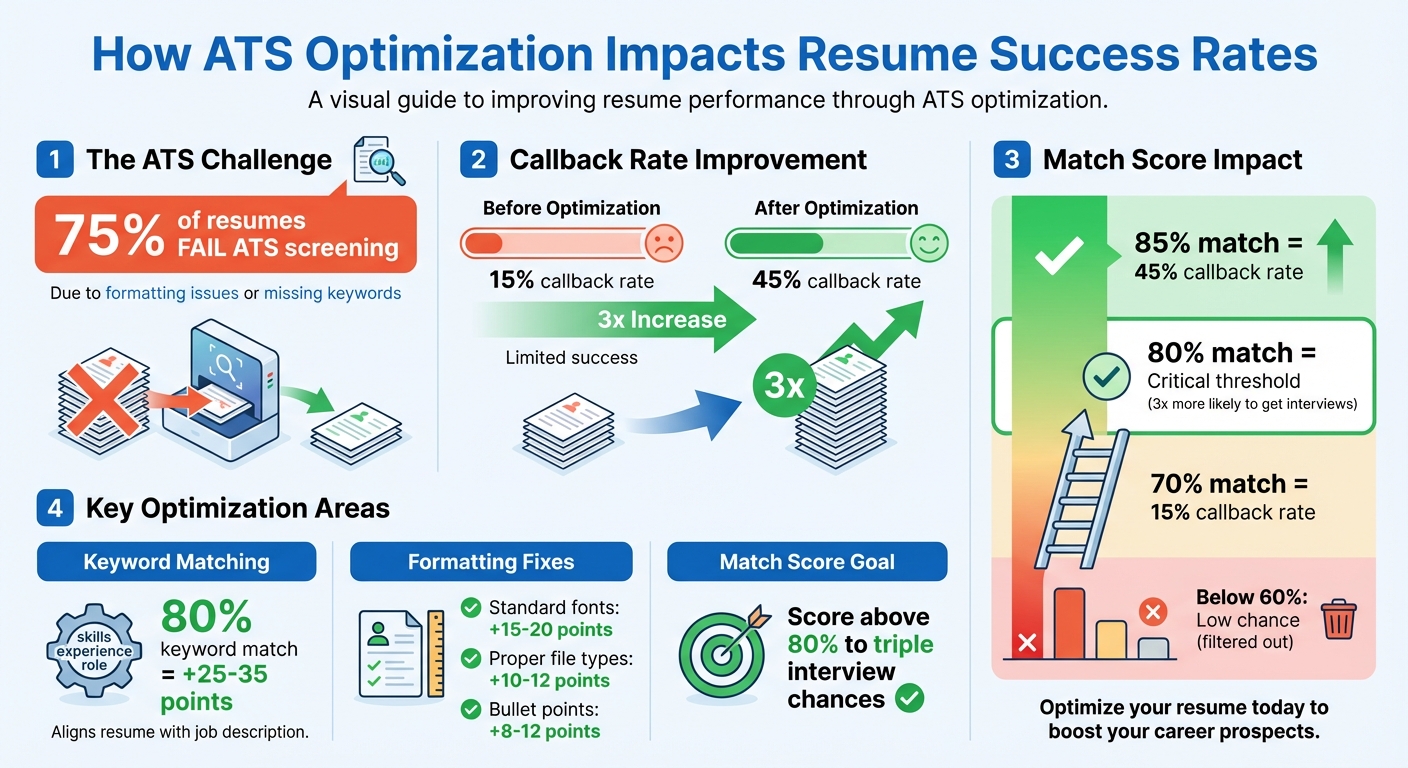
How ATS Optimization Impacts Resume Callback Rates and Match Scores
How ATS Checkers Improve Resume Shortlisting Rates
Keyword Matching and Job Description Alignment
ATS checkers are designed to scan your resume for keywords that align with the job description. By uploading the job posting into the tool, it identifies key skills and terms that are either present or missing in your resume. For instance, if a software engineering position lists "Python", "AWS", and "CI/CD pipelines" as required skills, but your resume only mentions "Python", the checker will flag the missing terms and suggest where to include them.
Matching at least 80% of the job description's keywords can increase your ATS score by 25 to 35 points. These tools also recommend integrating keywords into your experience and skills sections naturally. If you've used similar terms in the past - like "continuous integration" instead of "CI/CD" - the checker will prompt you to include both phrases to improve compatibility with the ATS.
In addition to keyword optimization, proper formatting plays a major role in ensuring your resume is ATS-friendly.
Fixing Formatting Problems That Block ATS Parsing
"ATS software doesn't 'read' a resume like a human would. Instead, it parses (extracts and organizes) the text." - Kickresume
One of the most common reasons resumes fail ATS scans is poor formatting. ATS checkers help identify these issues, such as the use of non-standard fonts or unconventional headings, which can prevent the system from parsing your resume correctly. Switching to fonts like Arial, Calibri, or Times New Roman can instantly add 15 to 20 points to your score.
Additionally, ATS checkers advise using standard section headers like "Experience", "Education", and "Skills" instead of creative alternatives. They also ensure your file type is compatible - Word documents and simple PDFs tend to perform 10 to 12 points better than image-heavy or overly designed formats. Replacing dense paragraphs with bullet points can add another 8 to 12 points, making your resume easier to scan for both ATS algorithms and recruiters who typically spend just a few seconds reviewing each one.
By addressing these formatting issues, you can significantly improve your resume's chances of passing ATS filters.
Understanding Match Rate Scores
After optimizing keywords and formatting, ATS checkers assign a match rate score to indicate how well your resume aligns with a specific job posting. This score, expressed as a percentage, directly impacts your likelihood of getting a callback. For example, a 70% match rate correlates with a 15% callback rate, while an 85% match rate increases callbacks to 45%. Candidates scoring above 80% are three times more likely to land interviews compared to those scoring below 60%.
The match rate score also helps you prioritize improvements. A score of 65% places you in the "high competition risk" category, where most resumes are filtered out. However, small adjustments - like adding quantified achievements, fixing formatting, or incorporating missing keywords - can elevate your score past the critical 80% threshold, making it more likely your resume will reach a human recruiter. For those who want to streamline the process, using a job application service can handle optimization and submission, saving time and effort while boosting your chances of success.
Jobscan vs scale.jobs: Why scale.jobs Outperforms Jobscan & Rezi.ai
Jobscan: Fast Keyword Scanning with Limited Customization
Jobscan helps job seekers by analyzing their resumes against job descriptions, offering a match rate score based on keyword alignment, formatting issues, and qualifications. By uploading your resume and a job posting, you quickly receive feedback on missing keywords and formatting tweaks. The tool recommends standard resume formats like chronological or hybrid, common fonts, and .docx files while advising against using tables, graphics, or headers that might confuse ATS systems.
While Jobscan excels at speed and automation, it primarily focuses on analysis. The tool lacks human oversight, leaving users to manually customize their resumes for each job. Additionally, it doesn’t provide assistance with application submissions or strategies to avoid ATS bot-detection flags, which can sometimes filter out bulk or automated applications.
Rezi.ai: ATS-Friendly Templates with Template Constraints
Rezi.ai offers pre-designed templates that ensure ATS compliance, guiding users through resume creation with built-in formatting rules. These templates simplify the process of creating a clean, professional-looking resume.
However, the reliance on templates comes with limited flexibility. Users may struggle to adapt resumes to specific ATS requirements or incorporate personal branding. If you need a resume tailored to unique job postings or want to go beyond the template's structure, Rezi can feel restrictive. Like Jobscan, Rezi also requires users to manually handle application submissions, which can be time-consuming and prone to errors. This is where scale.jobs steps in to fill the gaps with a more comprehensive, human-driven approach.
Why scale.jobs Wins: Human Assistants + ATS Optimization + Application Execution
What sets scale.jobs apart is its blend of automation and human expertise. While leveraging ATS optimization strategies, scale.jobs also provides personalized assistance. Human assistants customize resumes for each job, ensuring your experience and skills align perfectly with the job description. Beyond resume tailoring, they handle the entire application process manually, reducing the risk of bot-detection flags that can reject AI-generated applications.
Another standout feature is the proof-of-work system. Scale.jobs provides real-time updates via WhatsApp and time-stamped screenshots of every submitted application. With a one-time flat fee, scale.jobs takes care of everything from resume optimization to application execution, saving job seekers over 20 hours a week. For those applying to 100+ jobs or dealing with tight deadlines, this job application service streamlines the process and boosts shortlisting chances.
| Feature | Jobscan | Rezi.ai | scale.jobs |
|---|---|---|---|
| Human Involvement | None (automated) | None (AI templates) | Human assistants |
| Resume Customization | AI-driven suggestions | Fixed AI templates | Human-written per job |
| ATS Handling | Keyword analysis only | Template compliance | Optimization + manual submission |
| Application Execution | Self-service (manual) | Self-service (manual) | Managed by human assistants |
| Transparency | Basic tracking | Analytics/Rezi Score | WhatsApp screenshots + dashboard |
| Pricing Model | Monthly subscription | Tiered subscription | One-time flat fee |
Who should use Jobscan or Rezi.ai: These tools are ideal for job seekers who prefer a hands-on approach and only need help identifying keyword gaps or creating ATS-friendly templates. If you're applying to a small number of jobs (10–20) and have time to customize and submit each application manually, they offer affordable solutions.
Who should choose scale.jobs: If you're aiming to apply for 100+ jobs, facing tight deadlines like visa expirations, or simply want to delegate the entire process, scale.jobs is the better choice. It offers end-to-end application management, including personalized resume updates, manual submissions, and proof-of-work for every application.
Switch to scale.jobs if:
- You’re applying to 100+ jobs and don’t have the time to handle manual submissions.
- You need proof-of-work, such as screenshots and timestamps, for every application.
- You want to avoid ATS bot-detection flags by having humans manually fill out applications.
- You prefer a one-time flat fee instead of recurring subscription costs.
- You’re under tight deadlines and need guaranteed turnaround within 24 hours.
How to Use ATS Checkers to Get Shortlisted
Extract and Add Relevant Keywords from Job Postings
To improve your chances of passing an Applicant Tracking System (ATS), fine-tune your resume with keywords directly from the job description. Start by copying the job posting into an ATS checker, such as Jobscan or Scale.jobs, to generate a match rate report. This report will highlight the keywords missing from your resume and indicate the phrases the ATS expects to find. Ideally, aim for a match rate of 80% or higher, as this significantly boosts callback rates - 35% compared to just 15% for lower scores.
When incorporating these keywords, do so naturally. For example, if the job description emphasizes "project management", "Agile methodology", or "stakeholder communication", weave these terms into your experience and skills sections where they genuinely apply. Avoid overloading your resume with keywords, as this can make it unreadable and hurt your chances with both ATS systems and recruiters. Strive for a balance: include relevant terms while keeping the language professional and easy to read.
Once you’ve optimized your keywords, ensure your resume’s formatting is ATS-friendly to avoid technical parsing issues.
Remove Formatting That ATS Systems Cannot Read
ATS systems often struggle with certain design elements, so keeping your resume clean and simple is essential. Avoid using images, text boxes, headers, footers, or multi-column layouts. For example, move your contact details from the header into the main body of the document. Instead of tables, use simple spacing or tabs, and remove any decorative elements like photos, icons, or charts.
Stick to standard fonts like Arial, Calibri, or Times New Roman, as decorative fonts can confuse ATS software. Always submit your resume in a .docx file or a plain-text PDF format. Avoid sending files in .png, .jpg, or PDFs with embedded graphics, as these can disrupt parsing. Use straightforward section headers such as "Experience", "Education", and "Skills", and replace dense paragraphs with easy-to-read bullet points. These adjustments can add an extra 8-12 points to your ATS score.
Once you’ve ensured technical compliance, take an additional step to refine the resume’s overall quality through human review.
Pair Automated Checks with Human Review
While ATS checkers are excellent for spotting technical issues, they often miss the finer details that only human reviewers can catch. For instance, an ATS tool might flag missing keywords but fail to recognize that your "team leadership" experience demonstrates key "project management" skills. Combining automated insights with human expertise ensures your resume is both technically optimized and compelling to hiring managers.
If you’re juggling multiple applications or working under tight deadlines, consider using professional resume services that combine ATS optimization with human touch. For example, Scale.jobs offers customized resume assistance where human experts tailor your resume to specific roles while ensuring it meets ATS standards. This dual approach not only improves your chances of passing automated filters but also ensures your resume resonates with hiring teams. By blending automation with human insight, you can maximize your chances of standing out without triggering bot-detection systems.
How to Create an ATS-Friendly Resume (and get through the scanners)
Conclusion
ATS checkers play a crucial role in identifying formatting issues and missing keywords that often lead to resumes being filtered out before they even reach recruiters. These tools highlight problems like the use of tables or graphics and provide match rate scores to help you refine your resume for better results.
However, while these tools are effective at spotting technical issues, they fall short when it comes to evaluating whether your experience truly aligns with what hiring managers are looking for. For instance, an ATS might recognize "team leadership" as a keyword but won't determine if it effectively showcases the "project management" expertise a specific role demands. This is where human insight becomes essential, especially for competitive roles or situations that require a deeper understanding, such as navigating visa-specific requirements.
Scale.jobs bridges this gap by combining ATS optimization with personalized human support. Their trained assistants customize your resume for each job, manually handle applications to bypass automated filters, and keep you updated with real-time WhatsApp notifications, complete with time-stamped screenshots. This combination ensures both technical accuracy and a compelling narrative that automated tools alone can't achieve.
For those tackling high-volume or complex applications, pairing automated tools with human expertise is a smart strategy. Services like Scale.jobs offer this balanced approach, helping you meet ATS requirements while creating resumes that resonate with recruiters, ultimately improving your chances of landing the job.
FAQs
How do ATS checkers help your resume get noticed?
ATS checkers enhance your chances of standing out by ensuring your resume is designed to pass automated screening systems. These tools evaluate your resume for key terms, proper layout, and a clear, organized structure that aligns with ATS standards. By fine-tuning these aspects, they help your application get through automated filters and land in front of hiring managers.
This approach ensures your qualifications are presented in a way that mirrors the job description, improving your likelihood of making it to the shortlist.
What common formatting mistakes can prevent an ATS from reading your resume?
Formatting mistakes on resumes can often confuse ATS (Applicant Tracking Systems), leading to your application being overlooked. Frequent issues include inconsistent date formats, using tables or columns, non-standard fonts, and incorporating graphics or images. Placing critical details in headers or footers, using unsupported file types, unusual bullet points, or overusing colors can also disrupt how the system reads your resume.
To ensure your resume is ATS-friendly, opt for a straightforward layout with standard fonts and avoid intricate design elements. Save your resume in commonly accepted formats like .docx or .pdf to maximize compatibility.
How does scale.jobs stand out from other ATS tools?
Scale.jobs differentiates itself by blending human expertise with cutting-edge technology to craft resumes that excel in ATS (Applicant Tracking System) screenings and streamline the application process. While many platforms rely solely on automated systems or keyword algorithms, Scale.jobs takes a more tailored approach. It ensures resumes are formatted correctly, include relevant keywords without overloading, and are optimized for ATS compatibility - giving job seekers a stronger shot at getting noticed.
What sets Scale.jobs apart even further are its standout features, such as real-time updates via WhatsApp, proof-of-work transparency, and a one-time payment model. These features provide users with clear insights into their application progress, minimize errors, and enhance the likelihood of passing ATS filters. By combining technology with a human touch, Scale.jobs delivers customized solutions that align closely with specific job requirements, making it an excellent choice for those aiming to stand out in competitive job markets.
For those exploring tools to simplify their job search, Scale.jobs offers a unique blend of support and efficiency. Whether you're applying for full time jobs or seeking help from a job application service, this platform ensures your applications are tailored and effective.