
Career Readiness Checklist For Job Seekers

Sarah Mitchell
January 20, 2026
Finding a new job can take time - on average, 8 months - but being prepared can significantly shorten this process. Employers now emphasize skill-based hiring, so showcasing your strengths in areas like communication, leadership, and technology is essential. This guide outlines practical steps to help you refine your skills, organize your job search, and create standout application materials.
Key Takeaways:
- Self-Assessment: Identify your skills (technical, soft, transferable) and align them with specific career goals.
- Market Research: Explore industry trends, target companies, and salary ranges using platforms like LinkedIn or Teal.
- Professional Materials: Build an ATS-compliant resume, use an AI resume builder for customization, and consider creating an online portfolio.
- Job Search Management: Use tools like Scale.jobs to track applications, tailor resumes, and stay organized.
- Interview Prep: Practice STAR-based answers, research employers, and follow up professionally.
By following these steps, you can streamline your job search and improve your chances of landing a role that aligns with your goals.
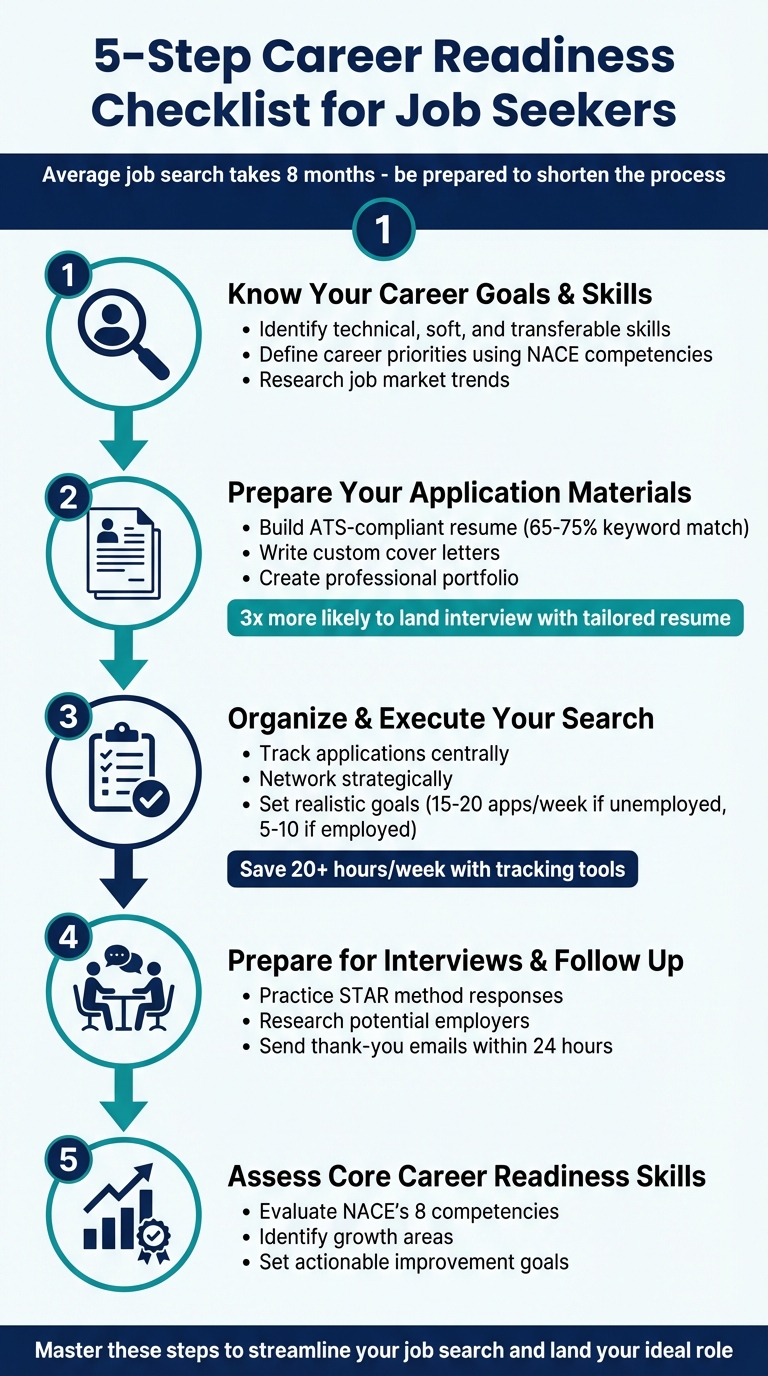
5-Step Career Readiness Checklist for Job Seekers
Organizing Your Job Search (Career Readiness Series Part 2)
Self-Assessment: Know Your Career Goals and Skills
Before diving into job applications, it’s crucial to understand both what you bring to the table and where you want to go. This clarity helps you focus on roles that truly align with your strengths and aspirations.
Identify Your Core Strengths and Skills
Create a detailed list of your skills, breaking them down into three categories: technical skills, soft skills, and transferable skills. Tools like O*NET can help you identify the key skills required for the roles you’re targeting.
"Your resume should be a summary of your accomplishments, not your responsibilities. It should not read like a job description." - Resume Worded
For instance, instead of writing "managed social media accounts", showcase measurable outcomes such as "increased audience engagement by 35% through targeted campaigns." This shift reflects the growing emphasis on skill-based hiring, where employers prioritize results over job titles.
Define Your Career Goals and Priorities
Align your skills with specific career objectives. Think about what success looks like for you - whether it’s a particular job title, a collaborative work environment, opportunities for growth, or a certain salary range. To guide this process, consider using the NACE competencies framework, which evaluates eight key areas: Career & Self-Development, Communication, Critical Thinking, Equity & Inclusion, Leadership, Professionalism, Teamwork, and Technology.
"Proactively develop oneself and one's career through continual personal and professional learning, awareness of one's strengths and weaknesses, navigation of career opportunities, and networking." - National Association of Colleges and Employers (NACE)
Also, take a close look at your LinkedIn profile to ensure it mirrors your resume and reflects the professional level you’re aiming for. Recruiters often cross-check these platforms, and inconsistencies can raise concerns. Once you’ve clarified your goals, research the job market to align your skills with current industry demands.
Research Job Market Trends
With a clear understanding of your abilities and career path, dive into market research to validate your next steps. Explore industry-specific job boards by searching for phrases like "[industry] jobs" to find platforms with targeted roles and less competition. Additionally, review company "About Us" pages, recent funding announcements, and news articles to understand their direction and priorities.
Platforms like Teal (rated 4.9/5 stars by over 140,000 users on the Chrome Web Store) can streamline your job search by tracking applications and helping you tailor your resume with keyword-rich language from job descriptions to boost your job search success - potentially helping you land jobs 58% faster.
Don’t overlook salary trends, relevant certifications, and emerging skills in your field. If visa sponsorship is a concern, tools like Scale.jobs can filter opportunities by employers that sponsor visas, saving you valuable time during the application process.
Prepare Your Professional Materials
Your application materials play a crucial role in showcasing your qualifications as you move from preparation to actively applying for jobs. These documents often serve as your first - and sometimes only - chance to make it past automated screening systems. Many companies rely on Applicant Tracking Systems (ATS) to filter resumes before they reach human eyes, making formatting and keyword alignment far more important than flashy designs.
Build an ATS-Compliant Resume
To ensure your resume gets through ATS filters, stick to standard headers like Work Experience, Education, and Skills. Use clean, web-safe fonts such as Arial, Calibri, or Times New Roman, and avoid graphics, tables, or other elements that ATS software may struggle to read.
Save your resume as a .docx file unless the job posting specifies another format, as older ATS systems often have trouble processing complex PDFs. Focus on matching keywords directly from the job description. For example, if the job posting mentions "project management experience", use that exact phrase instead of rewording it as "led team initiatives." Aim for a keyword match rate of 65%–75% to improve your chances.
Customizing your resume for each role significantly boosts your odds - candidates who tailor their applications are three times more likely to land an interview. Tools like the Scale.jobs ATS Resume Checker can help you assess your compatibility score before submitting. Scale.jobs offers a free ATS-compliant resume builder (up to two base resumes), and their AI Assistant Pro tier ($9/month launch price, regularly $19/month) allows unlimited tailored resumes with just one click. Alternatives like Jobscan provide keyword-focused feedback, but Scale.jobs is a more budget-friendly option compared to platforms like Teal or Rezi.ai.
Once your resume is optimized, shift your attention to crafting a compelling cover letter.
Write Custom Cover Letters
A generic cover letter won’t cut it. Tailor each one to the specific role by referencing the company’s recent projects, values, or challenges mentioned in the job posting. Use this document to highlight specific accomplishments from internships, past roles, or even simulations that align with the skills and qualifications the employer values.
Start with a concise elevator pitch in the opening paragraph to immediately communicate your value. For example, explain how your background directly addresses the company’s needs or goals. To save time while maintaining a personal touch, consider using tools like the AI-powered Cover Letter Generator from Scale.jobs. It can draft a customized cover letter in seconds (one free per day, unlimited with AI Assistant Pro), helping you strike the right balance between efficiency and personalization.
Once your resume and cover letter are polished, consider creating a portfolio to further demonstrate your abilities.
Create a Professional Portfolio
An online portfolio provides tangible proof of your skills that goes beyond what a resume can convey. Include case studies, project samples, certifications, and measurable results from your work. For tech roles, link to GitHub repositories or live project demos. If you work in creative fields, showcase design work, writing samples, or campaign outcomes.
Ensure your portfolio aligns with your LinkedIn profile to present a cohesive professional image. If you’re not sure where to start, the Scale.jobs Portfolio Website Generator offers a free, no-code solution to create a polished online presence that highlights your expertise.
Organize and Execute Your Job Search
Once your resume and cover letter are polished, the next step is staying on top of the application process. Keeping everything organized ensures you don’t miss out on opportunities and helps maintain a steady pace. Think of your job search like managing a project - track your progress, set clear goals, and actively build connections. Scale.jobs offers free tools and a flat-fee service to make this process smoother and more efficient.
Track Your Applications
Having a centralized system to manage your applications is key. This should include resumes, interview notes, contact details, and the status of each application. Without a reliable way to track these, it’s easy to lose track of follow-ups, forget interview dates, or misplace important job descriptions.
Always save the full job posting when you apply, as listings are often taken down before interviews are scheduled. The Scale.jobs Job Applications Tracker is available for free and includes a browser extension that lets you save job listings from platforms like LinkedIn or Indeed with just one click. Their flat-fee model ensures no recurring charges, and with the optional Human Assistant service, you’ll receive real-time WhatsApp updates along with time-stamped proof-of-work screenshots, so you’ll always know exactly when and where your applications were submitted.
Here’s why Scale.jobs stands out:
- Cost-Effective: Unlike Teal’s weekly fees or Huntr’s monthly subscriptions, Scale.jobs offers a free tracker and a flat-fee model.
- Simplified Tracking: The browser extension eliminates the hassle of manual tracking by saving job listings instantly.
- Transparent Submissions: Human-verified applications, real-time updates, and proof-of-work screenshots provide unmatched clarity.
"What gets measured gets managed - and that means fewer missed opportunities and more interviews." - TealHQ
Once your applications are organized, you can shift your energy toward expanding your professional connections.
Use Networking Opportunities
Many job opportunities never make it to public job boards, which makes networking an essential part of your search. Start by reaching out to former colleagues, classmates, professors, and industry contacts. LinkedIn is a great resource for identifying connections at companies you’re targeting. A warm introduction often has a greater impact than a cold application. Additionally, setting up informational interviews can provide insights into company culture and uncover hidden roles.
Scale.jobs’ Networking Tools can help you organize your contacts and track outreach efforts for free. If you opt for their Human Assistant service, you could save over 20 hours a week, giving you more time to focus on meaningful conversations and building relationships.
Set Realistic Job Search Goals
Clear goals are essential to staying motivated and avoiding burnout. Without them, the job search process can feel overwhelming. Tailor your weekly application targets to your situation - if you’re unemployed, aim for 15–20 high-quality applications per week. If you’re balancing a job while searching, 5–10 applications might be more practical. Don’t forget to track other activities like networking, learning new skills, and preparing for interviews.
Balancing your efforts is just as important as setting goals. Dedicate specific hours to job hunting and make time for self-care. Using Scale.jobs’ structured dashboard, along with their Human Assistant service, allows you to offload repetitive tasks so you can focus on interview prep and expanding your network effectively.
Prepare for Interviews and Follow Up
Securing an interview means your application has made it past the initial screening - a significant milestone in your job search. But just like tailoring your resume and cover letter, preparing thoroughly for interviews and follow-ups is essential for your success. Employers often evaluate a candidate's online presence alongside their interview performance, so being ready for every step is key.
Practice Common Interview Questions
Once your professional materials are polished, the next step is preparing for the interview itself. Expect behavioral questions like, "Tell me about a time when..." - these are staples in most interviews. To answer effectively, use the STAR method (Situation, Task, Action, Result). This structure helps you share clear, concise examples of how you've handled specific responsibilities or challenges. Practice a few STAR-based examples for key skills relevant to the role, and rehearse until your responses feel natural and confident.
For an extra edge, Scale.jobs offers a free AI Interview Questions Predictor, which analyzes job descriptions to anticipate likely questions. Their AI Assistant Pro, available at $9/month during launch, combines AI tools and human coaching to help you prepare with precision.
Additionally, have 3–5 thoughtful questions ready to ask at the end of the interview. This demonstrates genuine interest in the role and helps you assess whether the company aligns with your goals. If your interview is virtual, test your video and audio setup at least 30 minutes beforehand to avoid any technical hiccups.
Research Potential Employers
Failing to research a company can undermine an otherwise strong interview. Start with the basics: visit the company's "About Us" page to understand its mission and values. Then, explore recent news on Google to uncover updates like product launches, challenges, or leadership changes. For startups, Crunchbase is a great resource for insights on funding and financial health. If the company is publicly traded, review its latest quarterly earnings report for a snapshot of its performance.
"Employers can spot a mile off if you haven't put the time and effort into finding out more about the organisation." – Hays Experts
Use LinkedIn to research your interviewer. Look for shared connections, professional achievements, or common interests that could serve as conversation starters. Platforms like Glassdoor provide employee reviews and salary insights, while GitHub can be helpful for technical roles, offering a glimpse into the tools and frameworks the team uses. Rather than merely reciting facts during the interview, weave your research into your responses. For example, mention a recent project you admire or ask how the team approaches specific industry challenges.
Follow Up Professionally
After the interview, focus on timely, professional communication. Send a personalized thank-you email within 24 hours. Reference specific points from your conversation, reaffirm your interest in the role, and briefly highlight the unique skills or experiences you bring to the table. If you haven't heard back within a week, follow up with a polite inquiry.
Scale.jobs' AI Assistant Pro can streamline this process by generating tailored follow-up messages that strike the right professional tone. While waiting for a response, stay engaged with the company by interacting with its LinkedIn posts. This keeps you visible without coming across as overly persistent.
Before interviews even begin, ensure your voicemail greeting is professional and your email signature is up-to-date. These small details can make a big impression during the follow-up phase, and overlooking them could hurt your chances.
Assess Your Core Career Readiness Skills
Take a moment to evaluate where you stand on the skills that employers value most. The National Association of Colleges and Employers (NACE) has outlined eight key competencies that are essential for workplace success: Career + Self-Development, Communication, Critical Thinking, Equity + Inclusion, Leadership, Professionalism, Teamwork, and Technology. These are the abilities hiring managers look for during interviews and on the job.
"Career readiness is the foundation upon which a successful career is launched. Career readiness is, quite simply, the new career currency." – NACE
By understanding these competencies, you can create a roadmap for self-improvement and better articulate your strengths when applying for jobs. Align your preparation with these industry-recognized standards, and use them to identify areas where you can grow to boost your career readiness.
Evaluate Key Competencies
Start by comparing your own experiences with NACE's examples of behaviors for each competency. For Communication, ask yourself if you actively listen and tailor your messages effectively for different audiences. When it comes to Critical Thinking, think about whether you gather information from diverse sources before making decisions or if you can juggle tasks in fast-paced environments. Leadership isn’t just about managing people - it also includes inspiring others with a shared vision and successfully overseeing projects.
Professionalism shows up in your attention to detail, dependability, and maintaining a positive image both online and offline. For Technology, assess how well you adapt to new tools and use them to make informed decisions. With Career + Self-Development, consider whether you seek learning opportunities, understand your strengths and weaknesses, and build meaningful professional connections.
When discussing your experiences, use the STAR method (Situation, Task, Action, Result) to structure your examples. For instance, if you've contributed to creating inclusive practices in a previous role, that’s a clear demonstration of the Equity + Inclusion competency. You can also use tools like the NACE Competency Assessment to get feedback on your proficiency levels. Keep in mind that as of early 2026, the Equity + Inclusion competency is under review due to evolving legal and regulatory considerations. Mastering these competencies not only strengthens your interview responses but also adds weight to your resume.
Identify Areas for Growth
Once you’ve assessed your competencies, focus on bridging any gaps. If communication is an area for improvement, consider joining a public speaking group or taking a writing course. For technology-related skills, certifications can be a game-changer - whether it’s learning Excel for finance roles or mastering GitHub for software development. Seek advice from mentors or colleagues who excel in areas where you feel less confident.
Tools like Scale.jobs’ free Resume ATS Checker can help you see which competencies your resume highlights and where you might be falling short. Their AI Assistant Pro (available for $9/month during launch) can guide you in integrating these skills into your application materials, ensuring you present yourself as career-ready at every stage. With its combination of AI tools and human verification, Scale.jobs helps translate your skills into tangible opportunities.
To track your progress, set actionable goals, such as completing one online course per quarter or attending two networking events each month. These small but consistent steps can turn skill gaps into strengths, making you more competitive in today’s job market. By addressing these areas, you’ll build a solid foundation for long-term career success.
Conclusion: Your Career Readiness Action Plan
Take a moment to review your checklist and pinpoint areas that need immediate attention. If your resume could use a refresh, consider running it through an ATS checker to see how it stacks up. Feeling uneasy about networking? Set a simple goal - reach out to two professionals in your industry this week. Even small, consistent steps can lead to meaningful progress. Put your updated checklist into action right away to give your job search the momentum it needs.
Job hunting can feel overwhelming with so many moving parts, but having the right tools can make all the difference. For instance, Scale.jobs offers a free job application tracker and an ATS-friendly resume builder to help you stay organized. If you’re looking for even more support, their AI Assistant Pro ($9/month at launch) creates customized resumes and cover letters in seconds.
For those who prefer a hands-off approach, the virtual assistant service ($199 for up to 250 applications) might be just what you need. With this service, virtual assistants handle your job submissions with care - avoiding bot detection and ensuring a personalized touch. Plus, you’ll receive real-time updates via WhatsApp, proof-of-work screenshots, and a simple flat-fee structure with no recurring charges. Many users have found these tools to be game-changers in their job search. As Kim St John, a satisfied Scale.jobs user, shared:
"Job seekers dream come true! No more spreadsheet tracking; the extension makes job tracking seamless."
Start implementing this action plan today to take charge of your career readiness and stand out in your job search.
FAQs
How can I make sure my resume is ATS-friendly?
To make sure your resume gets through Applicant Tracking Systems (ATS) and catches the attention of hiring managers, follow these key tips:
- Keep it simple: Use a straightforward, single-column format with standard headings such as "Experience", "Education", and "Skills." Avoid using tables, charts, icons, or graphics, as they can confuse ATS software.
- Align keywords with the job description: Incorporate specific skills and terms from the job posting into your resume. This increases the likelihood of being identified as a strong candidate.
- Highlight measurable results: Use action verbs and include quantifiable achievements in your bullet points. For example, "Boosted customer satisfaction scores by 15% within three months."
-
Choose the correct file format: Save your resume as a PDF with a clear file name like
FirstName_LastName_Resume.pdfto ensure it’s ATS-friendly.
For a streamlined approach, tools such as Scale.jobs can help you craft ATS-compatible resumes tailored to each job, making the application process more efficient and improving your odds of success.
What skills and qualities do employers value most in job seekers?
Employers place a high value on a mix of soft skills and professional traits that indicate you're ready to tackle the demands of a career. Here are some key areas to focus on:
- Self-awareness: Recognizing your strengths, identifying areas where you can grow, and aligning your career goals accordingly.
- Proactive planning: Defining clear objectives for your career and actively taking steps to reach them.
- Networking and relationship-building: Developing strong, meaningful connections within your industry or field.
- Adaptability and curiosity: Staying open to new experiences, embracing lifelong learning, and seeking opportunities to grow.
- Professional self-advocacy: Clearly and confidently communicating your skills, achievements, and the value you bring to the table.
When you emphasize these qualities, you position yourself as someone who is not only ready for new opportunities but also prepared to excel in them.
What’s the best way to track my job applications effectively?
Staying organized is a crucial part of a successful job search. One effective way to keep track of your progress is by using a dedicated tool, such as Scale.jobs’ free Job Applications Tracker or similar apps. These tools allow you to log important details, including the company name, position, application date, and current status (e.g., applied, interview, offer).
Make it a routine to update your tracker immediately after submitting an application. Be sure to include specifics like the version of your resume or cover letter you used, especially if they were tailored for that role. Set reminders to follow up within 7–10 days and take time to review your progress regularly. A weekly check-in with your tracker can help you spot patterns, fine-tune your approach, and ensure you’re not missing out on opportunities. Additionally, tools like Scale.jobs provide AI-powered features to optimize your resume, giving you a better shot at securing interviews.