
Empathy vs Assertiveness: Which Matters More in Negotiations?

Sarah Mitchell
December 14, 2025
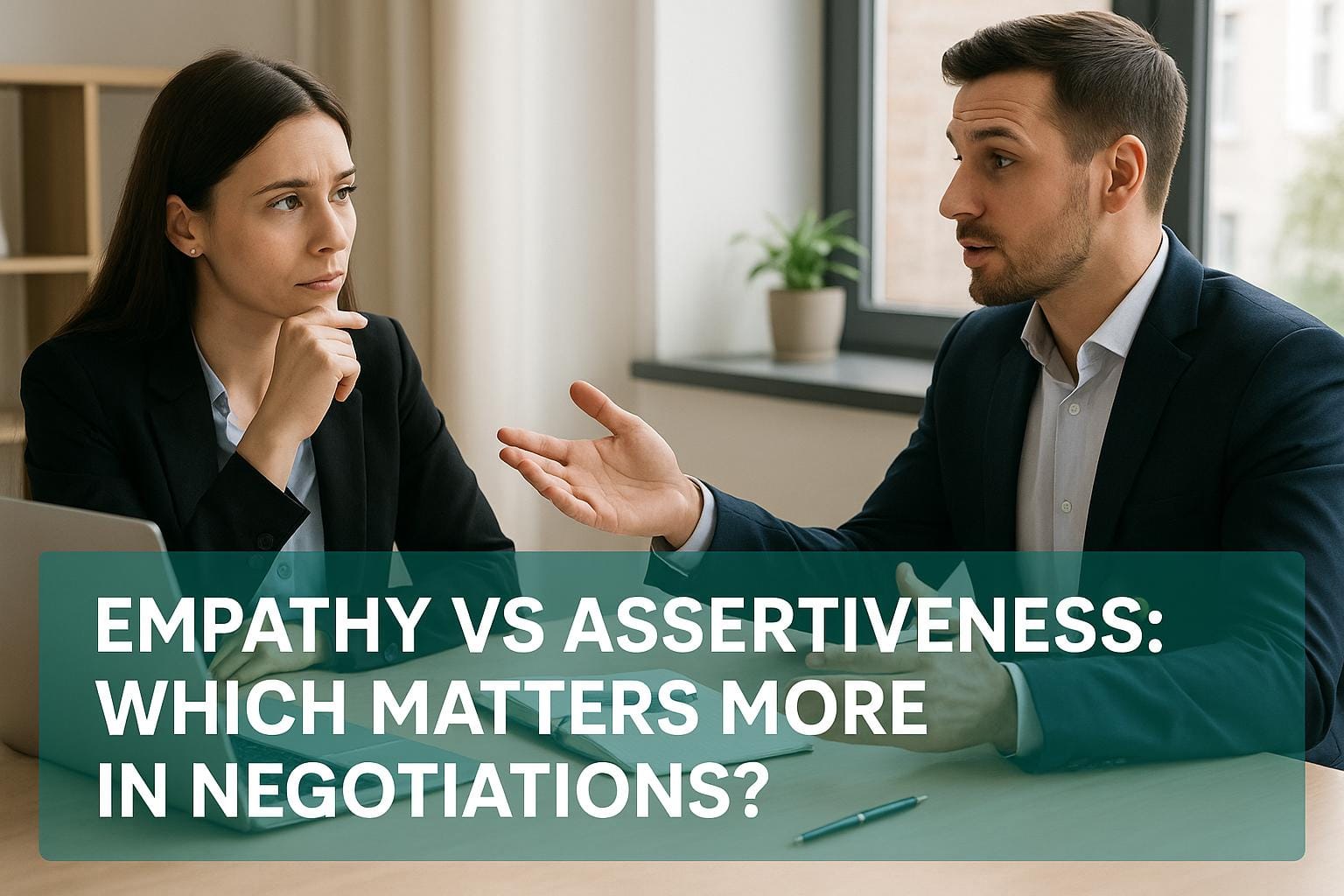
When it comes to negotiations, the key to success lies in balancing empathy and assertiveness. Empathy helps you understand the other person’s perspective and build trust, while assertiveness ensures you confidently express your needs and advocate for your worth. Leaning too far in either direction can hurt your results - excessive empathy might make you seem too flexible, while too much assertiveness can come across as aggressive.
Here’s what you need to know:
- Empathy: Focuses on understanding the other person’s priorities and challenges. It fosters collaboration and preserves relationships, but too much can lead to undervaluing yourself.
- Assertiveness: Centers on clearly expressing your goals and setting boundaries. It ensures your voice is heard, but being overly assertive can harm relationships or make you seem inflexible.
- Cultural Context: High-context cultures (e.g., Japan, India) value empathy and indirect communication, while low-context cultures (e.g., U.S., Germany) prefer directness and assertiveness.
- Blending Both: Active listening, clear communication, and addressing concerns respectfully can help you strike the right balance.
Quick Tip: Start by understanding the other party’s perspective, then confidently present your value and negotiate for what you deserve. Combining empathy and assertiveness is the best way to achieve better outcomes in any negotiation.
Episode 39: Being Assertive and Empathetic in Negotiation- Debbie Goldstein
What Empathy Means in Negotiations
Empathy in negotiations is about genuinely understanding the other person's concerns, priorities, and limitations while still pursuing your own objectives. It requires active listening and recognizing their needs before presenting your case. This approach can transform the tone of a negotiation, fostering collaboration rather than conflict.
When you demonstrate empathy, you show that you're interested in finding a solution that works for both sides, not just securing a win at the other party's expense. This can be especially useful in job negotiations, where building a strong connection with a hiring manager or recruiter might uncover opportunities that a purely assertive approach could miss. By understanding their perspective, you create room for practical advantages, as outlined below.
For example, if a recruiter subtly mentions budget constraints, acknowledging this limitation before pushing further can open the door to exploring creative alternatives that benefit both sides.
Benefits of Using Empathy
Empathy lays the foundation for stronger professional relationships from the outset. Taking time to understand a hiring manager's concerns - whether about team dynamics or project deadlines - can establish trust and set the stage for a collaborative working relationship. When people feel heard, they are often more willing to share valuable insights, which can help you position yourself more effectively.
Over time, negotiations built on empathy tend to preserve relationships. Even if you don't secure every term you hoped for, leaving the conversation on good terms can keep future opportunities within reach.
Downsides of Too Much Empathy
However, leaning too heavily on empathy can sometimes backfire. Focusing too much on the employer's constraints might lead you to concede too quickly or accept an initial offer without fully advocating for your own needs. In such cases, it can become harder to set boundaries, and your flexibility might be mistaken for a lack of assertiveness, potentially affecting the final outcome of the negotiation. Striking a balance is key.
What Assertiveness Means in Negotiations
Empathy helps to build strong connections, but assertiveness ensures your voice is heard. Being assertive means expressing your needs, expectations, and boundaries clearly and confidently - without crossing into aggression. It's about standing up for yourself while still respecting the other person's perspective. Unlike aggression, which aims to overpower, assertiveness focuses on honest, balanced communication.
When you're assertive, you prioritize your goals and ensure your needs are understood. This kind of clarity helps both sides figure out if an agreement can work, making the negotiation process simpler and more transparent. Assertiveness pairs well with empathy, as it underscores self-advocacy while still fostering mutual respect.
Benefits of Being Assertive
Assertiveness gives you control by clearly defining your boundaries and expectations, rather than passively reacting. This clarity sets the tone for the conversation and ensures your priorities are front and center. Unlike the empathy-driven approach, which leans on understanding, assertiveness takes a proactive role in shaping the discussion. By establishing boundaries early, you encourage a more open and transparent dialogue, which can lead to outcomes that align more closely with your goals.
Downsides of Too Much Assertiveness
While clear communication is essential, being overly assertive can backfire. Taking too rigid a stance might come across as inflexible or dismissive of the other party's limitations. In collaborative environments where teamwork is key, this can damage professional relationships and make future cooperation more challenging. Balancing assertiveness with understanding is crucial to maintaining both your goals and positive connections.
Empathy vs. Assertiveness: Side-by-Side Comparison

Empathy vs Assertiveness in Negotiations: Key Differences and Benefits
Empathy focuses on building mutual understanding by putting yourself in the other person's shoes, while assertiveness is all about clearly expressing your priorities and setting firm boundaries. Both play essential roles in negotiations, each bringing its own strengths depending on the situation and goals.
The balance between these two approaches depends heavily on the context and what you're aiming to achieve. Below, we’ll explore their differences in detail through a comparison table, providing a clear picture of how these strategies work in practice.
How Culture Affects Empathy and Assertiveness
Cultural context plays a crucial role in shaping negotiation strategies. Your background often influences how you approach discussions, and what works seamlessly in one part of the world might completely backfire in another. For instance, a negotiation style that thrives in New York could fall flat in Tokyo. This largely depends on whether you're dealing with high-context or low-context cultures. Understanding these differences is key to navigating salary negotiations, visa discussions, or even interview conversations effectively.
In essence, high-context cultures lean on subtle communication and relationships, while low-context cultures favor directness and clarity. Knowing when to lean on empathy or assertiveness can be the difference between success and failure.
When Empathy Works Better: High-Context Cultures
In places like China, Japan, South Korea, India, and the Middle East, negotiations are more nuanced. The focus isn't just on what's being said but also on what's left unsaid. Relationships, history, and even silence carry weight. Jumping straight to demands without establishing rapport is often seen as disrespectful and can shut down opportunities before they even begin.
Empathy plays a pivotal role here because maintaining harmony within the group often takes precedence over individual gains. For example, when negotiating a job offer with a company in Shanghai or Bangalore, showing understanding of the team’s challenges or the company’s constraints can help build trust. On the other hand, pushing aggressively for a higher salary right away might label you as difficult or unaware of the cultural norms.
In these settings, indirect communication is common. A phrase like "we'll think about it" might actually mean "no", and picking up on these subtleties requires active, empathetic listening. For professionals from high-context cultures working in the U.S., or Americans negotiating internationally, recognizing these cues can help avoid misinterpreting politeness as agreement.
Mastering these cultural nuances allows you to tailor your approach for better results.
When Assertiveness Works Better: Low-Context Cultures
Countries like the United States, Germany, Canada, Australia, and Scandinavian nations operate on a different wavelength. Here, directness is the norm, and ambiguity is often frowned upon. Hiring managers expect you to clearly state your salary expectations, list your non-negotiables, and advocate for yourself. There’s little room for guessing games.
Assertiveness is the winning strategy in these environments because individual accomplishments and transparency are highly valued. For example, if you’re negotiating with a U.S. tech company, saying something like, "I need a $120,000 base salary and visa sponsorship" is not just acceptable - it’s expected. Waiting for them to offer more without asking might signal you’re unsure of your value.
If you come from a high-context culture, this level of directness might feel uncomfortable at first. However, failing to adapt could mean leaving money or opportunities on the table. Conversely, Americans working with international teams should tone down their directness to avoid being perceived as overly aggressive or insensitive.
Adapting your approach based on cultural expectations ensures smoother negotiations and better outcomes.
How to Use Both Empathy and Assertiveness Together
Top negotiators masterfully combine empathy with assertiveness, knowing exactly when to use each skill and how to transition between them. This balance is especially important in job search negotiations, where you’re aiming to secure a strong salary while also building a professional relationship.
Techniques for Blending Both Approaches
Here’s how you can effectively weave empathy and assertiveness into your negotiation strategy:
Start every conversation with active listening. Before diving into your salary expectations or countering an offer, take the time to understand the hiring manager’s limitations. A question like, "What is the salary range, and are there budget constraints?" demonstrates empathy while equipping you with the insights needed to negotiate assertively later.
Once you’ve listened, state your value clearly and confidently. For instance, instead of saying, "I was wondering if we could maybe discuss a higher salary?", opt for something like, "Based on my experience and the market rate for this role, I’m seeking a base salary of $120,000." This phrasing is assertive yet respectful, showing confidence without being overbearing.
Another effective technique is to acknowledge concerns before addressing them. If a recruiter mentions budget limitations, you could respond with, "I understand budget constraints. I bring five years of experience in this field, which allows me to contribute immediately. Is there flexibility in the total compensation package, such as equity or a signing bonus?" This approach validates their concerns while keeping the door open for further negotiation.
These strategies not only improve your negotiation outcomes but also strengthen your overall approach to job searching.
Applying These Skills to Job Search Negotiations
The balance between empathy and assertiveness is crucial at every stage of your job search, from networking to final salary discussions. Each phase requires a slightly different approach.
During networking, focus on personalization. Research the individual and their company before reaching out. Reference a recent project they’ve worked on or a challenge their team is facing. Then, assertively highlight your value: "I saw your team is expanding into AI-driven analytics. I’ve led three similar projects at my current company and would love to connect."
In interviews, the balance shifts again. Active listening helps you understand what the interviewer values, while assertively showcasing your accomplishments ensures you stand out. Practice this dynamic beforehand using tools like AI-driven interview simulators or coaching platforms. For example, TealHQ offers unlimited practice sessions to help you refine your skills.
When it comes to salary discussions, data becomes your best ally. Use tools like salary predictors to understand your market value and back up your requests. Show empathy by acknowledging the company’s perspective, but don’t shy away from advocating for yourself. Services like Find My Profession offer tailored advice for salary negotiations. They’ve helped clients like Emerson Quinn, a Director of Customer Success, land better roles with improved compensation after layoffs, thanks to their personalized support.
Lastly, delegate time-consuming tasks like job applications to focus on high-impact activities like networking and interviews. Platforms like scale.jobs can handle the heavy lifting - submitting hundreds of customized applications on your behalf. This frees up over 20 hours a week, allowing you to concentrate on what truly matters. As Shubham Dhakle, Outcome Manager at scale.jobs, says:
"You should focus on what matters the most - Interview Prep and let us handle the rest."
Scale.jobs boasts a 4.8/5 rating from over 1,500 customers, with 9 out of 10 users landing a job within 90 days. Many even secure multiple offers, often leading to a $30,000 salary increase. By channeling your energy into negotiation moments where empathy and assertiveness shine, you can maximize your opportunities and outcomes.
Conclusion
Navigating job negotiations successfully requires more than just one skill. The most effective job seekers understand that empathy and assertiveness work hand in hand, each playing a vital role depending on the situation. Empathy helps you build trust and foster connections, while assertiveness ensures your voice is heard and your value is recognized.
In practice, this means using empathy to understand the hiring manager’s goals and limitations, creating a foundation of mutual respect. At the same time, assertiveness allows you to confidently advocate for your worth, ensuring fair compensation and terms. Mastering these two skills isn’t just helpful - it’s what sets apart candidates who settle from those who negotiate their way to better opportunities.
Start honing these abilities today by actively listening, expressing your value with confidence, and using solid salary data to support your requests. These habits will make balancing empathy and assertiveness feel more natural over time.
FAQs
How do I balance empathy and assertiveness during negotiations?
Balancing empathy and assertiveness in negotiations takes careful effort. Start by truly listening to the other party. When you take the time to understand their perspective, you not only build trust but also set the stage for collaboration. Empathy can make the other side more receptive to your ideas.
At the same time, it’s important to be assertive. Clearly and respectfully express your own needs and goals. There’s a fine line here - being overly aggressive can damage relationships, while being too passive might mean your interests are overlooked. Confidence, paired with respect, strikes the right balance. In cross-cultural settings, it’s especially important to adjust your approach to ensure your message is clear while remaining considerate of different norms and expectations.
When you combine empathy to connect with others and assertiveness to stand up for your interests, you create the foundation for a productive conversation that can lead to mutually beneficial outcomes.
How does cultural context influence the balance between empathy and assertiveness in negotiations?
Cultural background significantly influences whether empathy or assertiveness proves more effective in negotiations. In high-context cultures - common in many Asian and Middle Eastern countries - there’s often a strong emphasis on building relationships and appreciating others' viewpoints. In these settings, empathy becomes an essential tool for fostering trust and understanding.
Conversely, in low-context cultures like the United States, straightforward communication and assertiveness tend to take center stage. These cultures generally value a direct approach, making assertiveness a more natural fit for negotiations.
Recognizing the cultural norms of those involved allows negotiators to adjust their approach, fostering trust and improving outcomes. Balancing empathy with assertiveness ensures communication remains respectful while driving results.
How do empathy and assertiveness work together in job search negotiations?
Empathy and assertiveness play a crucial role in navigating job search negotiations effectively. Empathy helps you tune into the employer’s priorities, concerns, and needs. By actively listening and showing genuine interest, you can build trust and create a meaningful connection with the person on the other side of the table.
On the other hand, assertiveness empowers you to confidently communicate your value when discussing salary, benefits, or job responsibilities. It ensures you advocate for yourself without undervaluing your skills or coming across as overly pushy.
When you combine empathy with assertiveness, you strike a balance - understanding the employer’s perspective while clearly expressing your own needs and qualifications. This thoughtful approach not only sharpens your negotiation skills but also leaves a lasting positive impression, increasing the likelihood of achieving the role and terms you’re aiming for.