
H-1B Grace Period After a Layoff: How It Works, Can You Travel, and the 2026 Proposal

Sarah Mitchell
October 26, 2026
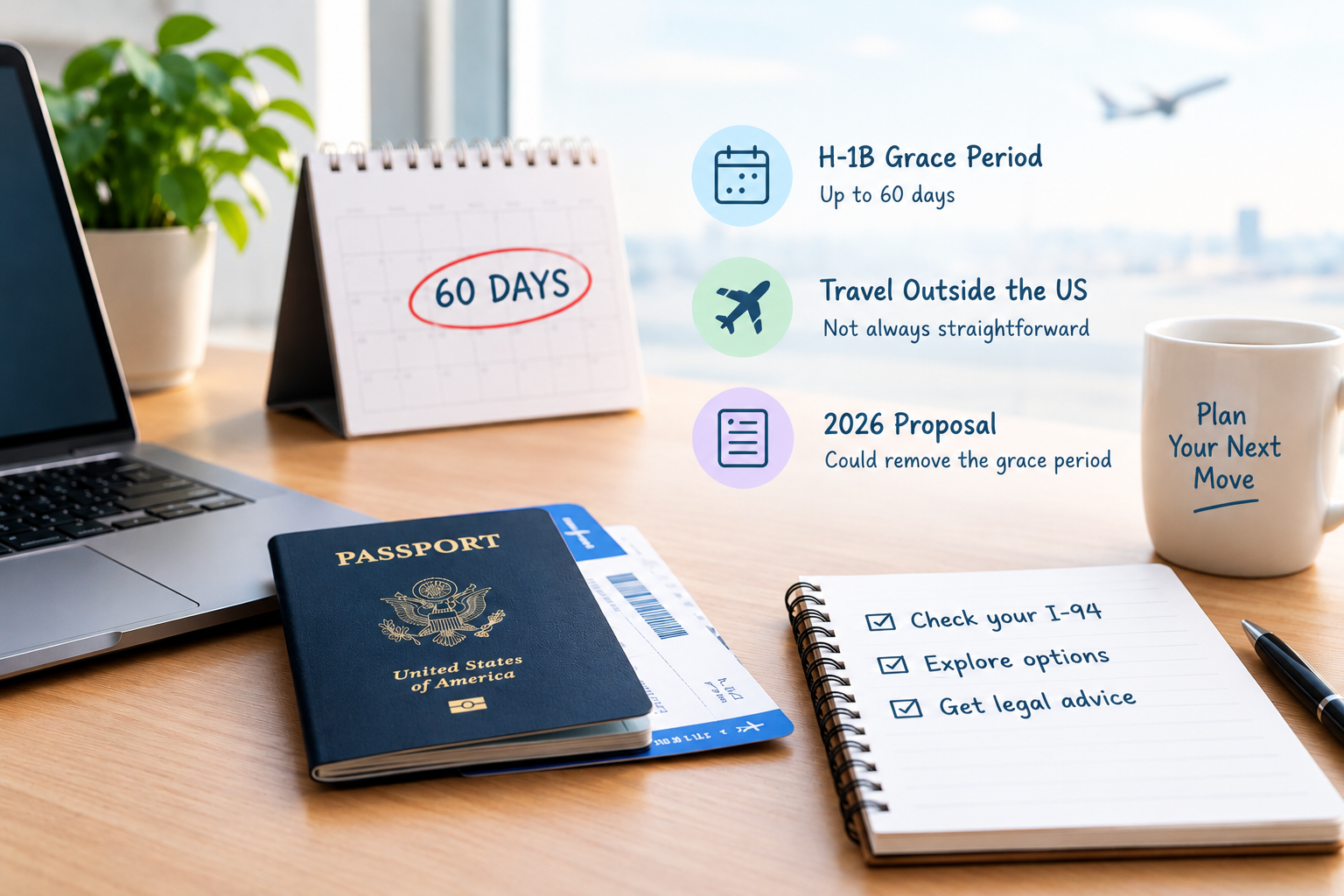
Getting laid off is already a lot to deal with. But if you're on an H-1B visa, there's another thing to figure out: how much time do you have to sort out your next move?
The H-1B grace period can give eligible workers up to 60 days after a layoff to explore their options. That could mean looking for a new employer or figuring out another immigration status. But here's the catch: you don't automatically get the full 60 days, and the grace period doesn't give you permission to keep working.
Planning to travel outside the US? That's a separate question, too.
There's also a new development to watch. In September 2026, the Department of Homeland Security proposed removing the existing grace-period rule.
So, if you've been laid off on H-1B, let's break down how the current rule works, what to know before travelling, and what the 2026 proposal could mean for you and your family.
How the H-1B 60-Day Grace Period Works After a Layoff
Let's start with the rule itself.
Under the current regulation, eligible H-1B workers may get a discretionary grace period of up to 60 consecutive days after their employment ends. The clock doesn't give you extra time beyond the end of your authorized validity period, whichever comes first. DHS can also shorten or eliminate the grace period at its discretion.
You can check the official wording in 8 CFR § 214.1(l)(2).
Is the H-1B grace period always 60 days?
No. This is one of the biggest things to get right. The rule says up to 60 days, not a guaranteed 60-day extension for everyone.
Think of the grace period as time to explore your next move, not a free pass to stay and work as usual. Depending on your situation, you might look for a new employer, explore a change of status, or consider another option you're eligible for.
But none of those outcomes is automatic. A new petition isn't guaranteed approval, and the grace period itself doesn't authorize you to work.
When does the grace-period clock start?
Your actual employment end date matters. Don't assume your last paycheck, severance payment, or the date your former employer withdraws its petition automatically decides when the clock starts.
Keep your termination letter, employment records, and final payroll documents. If the dates don't line up or you're not sure which date matters, ask your former employer for written clarification and speak with an immigration attorney.
What if your I-94 expires before the 60 days are over?
Your I-94 is an important part of the picture. The grace period cannot go beyond the end of the authorized validity period covered by the regulation.
For example, imagine your employment ends on October 22, but your authorized validity period ends on November 10. You shouldn't assume you can stay until December 21 just because 60 days haven't passed since your layoff.
Check your actual documents instead of relying on a generic online calculator.
One more thing: your visa stamp and your I-94 aren't the same. A visa stamp is generally used to seek entry into the US. Your I-94 records your admission and authorized stay. The expiration date on your visa stamp alone doesn't tell you how long you're allowed to remain in the country.
Can You Travel Outside the US After an H-1B Layoff?
This is where things can get complicated fast, which is why “can H-1B travel after layoff” is such a common question.
Having time left under the H-1B grace period doesn't automatically answer whether you can leave the US and return. And having a valid visa stamp doesn't guarantee you'll be admitted back into the country.
Before booking a flight, look at your current immigration situation, the documents you hold, any pending applications or petitions, and what you'll need to return.
What if you're still in the US and planning a trip?
Don't make the call based only on the expiration date printed on your visa.
Check your I-94, H-1B approval notice, passport, and visa validity. If a new employer is preparing an H-1B petition, or you've already filed an application to change status, find out how leaving the country could affect your specific case.
This isn't a great situation for guessing based on what worked for a friend or someone in an online forum. Get advice from an immigration attorney before you leave, especially if you have a pending application or your employment has recently ended.
What if you've already left the country?
Your next question is probably, "Okay, so what do I need to get back in?"
That depends on your documents and the immigration basis you're relying on to seek entry. The US Department of State explains that a visa lets you seek entry, but it doesn't guarantee admission. US Customs and Border Protection makes the admission decision when you arrive.
Read the State Department's guidance on visa expiration and its information about temporary worker visas.
Does a new H-1B petition solve the travel question?
Not by itself.
Your ability to work, your authorized stay, the status of a new petition, and your ability to reenter the US are separate questions. Under H-1B portability rules, some eligible workers may be able to start working after a qualifying petition is properly filed and the required conditions are met. That doesn't mean every pending or approved petition automatically sorts out travel and reentry.
Before you travel, get advice based on your own case. A general online answer can't tell you for sure whether you'll be able to return.
The 2026 H-1B Grace-Period Proposal: What Could Change?
On September 11, 2026, the Department of Homeland Security published a proposed rule called Eliminating the Discretionary 60-Day Grace Period.
In simple terms, DHS is proposing to remove the existing provision in 8 CFR § 214.1(l)(2) that allows certain employment-based nonimmigrant workers, including H-1B workers, and their dependents to receive a discretionary grace period of up to 60 days after qualifying employment ends.
You can read the official Federal Register proposal here.
Has the H-1B grace period been eliminated?
A proposal isn't the same as a final rule.
Publishing a proposed rule doesn't automatically change the current regulation. The existing grace-period provision remains the basis for the current framework unless and until a change takes effect.
Because immigration rules can change, check the official Federal Register notice and government docket for the latest status before making decisions.
What would change if the proposal became final as written?
If DHS finalizes the proposal as written, the specific grace-period protection would be removed. That could leave affected workers with less time to figure out their next immigration step after qualifying employment ends.
It could also affect dependents covered by the current provision, including eligible family members in dependent status.
That doesn't automatically mean every other immigration option would disappear. Whether someone can qualify for a new petition, a change of status, or another route would still depend on the relevant rules and their individual circumstances.
The main thing to remember: the current rule and the proposed rule are not the same thing. Don't assume the grace period has already been removed, and don't make decisions based on a proposal alone.
What to Check After an H-1B Layoff
If you've just lost your job, you probably have a lot on your mind. Start by getting the important details in one place.
- Confirm your employment end date. Keep your termination letter and ask your former employer to clarify the date if needed.
- Check your immigration documents. Find your latest I-94, H-1B approval notice, passport, and visa stamp.
- Ask about your petition. Find out whether your former employer plans to notify USCIS or withdraw the petition. Ask an attorney how that could affect your situation.
- Understand your options. A new employer petition, a change of status, or another route may be possible if you meet the requirements.
- Get advice before travelling. Leaving the US can raise separate questions about your ability to return.
- Save your records. Keep employment documents, immigration notices, and relevant emails somewhere you can easily access them.
There's one more detail worth knowing. Under certain conditions, an employer that dismisses an H-1B worker before the end of the authorized admission period may be responsible for reasonable return transportation costs abroad.
This doesn't mean every laid-off worker automatically gets a flight paid for. The rules can differ depending on the circumstances, including whether the worker was dismissed or resigned voluntarily. Ask an immigration attorney whether this applies to your situation.
How an H-1B Layoff Can Affect Your H-4 Spouse and Dependents
If your spouse or children are in the US as your dependents, your layoff could raise questions for them, too. It's worth checking their situation instead of focusing only on your own documents.
The current grace-period regulation also covers qualifying dependents. But what happens to your spouse's or child's status depends on the circumstances, their documents, and any applications or petitions that follow.
What if your spouse has an H-4 EAD?
If your spouse has an H-4 Employment Authorization Document (EAD), don't assume their ability to work is automatically unaffected by a change in your situation. At the same time, don't assume their work authorization automatically ends just because you've been laid off.
Check their I-94, H-4 documents, and EAD. Ask an immigration attorney how your employment ending, a new H-1B petition, or a change in your status could affect their situation.
The 2026 DHS proposal also addresses dependents. If finalized as written, it could affect the current grace-period protection for qualifying family members. But the proposal shouldn't be treated as a change that's already in effect.
What Are Your Options During the H-1B Grace Period?
There's no one-size-fits-all answer here. Your options depend on your eligibility, documents, and timing.
Broadly, you may be able to:
- Find a new employer willing to file a qualifying H-1B petition.
- Explore a change of status if you meet the requirements for another immigration category.
- Apply for an extension of stay if you're eligible.
- Consider leaving the US and get advice about what you'd need for any future return.
Each option has its own requirements. Filing a petition or application doesn't automatically mean it will be approved, that you can remain in the US indefinitely, or that you're allowed to work.
If you're looking for a new H-1B employer, our H-1B transfer while job searching guide covers the transfer process.
And if you're trying to get your job search moving while keeping track of the bigger picture, check out our H-1B transfer in 30 days playbook.
H-1B Grace Period After Layoff: FAQs
Is the H-1B grace period always 60 days?
No. The current rule allows eligible workers a discretionary period of up to 60 consecutive days, or until the end of their authorized validity period, whichever comes first. DHS can shorten or eliminate the period.
Can I work during the H-1B grace period?
The grace period itself doesn't give you permission to work. Some eligible workers may have a separate basis for employment, such as qualifying H-1B portability after a new employer files a qualifying petition and the required conditions are met.
Can I change to another immigration status during the grace period?
You may be able to apply for a change of status or extension of stay if you're eligible. Whether you qualify and what happens after filing depend on your circumstances and the rules that apply to your case.
Can I return to the US after travelling during the grace period?
Don't assume you can return just because your visa stamp is valid or a new petition is pending. Reentry depends on your documents and the applicable admission requirements. Get case-specific legal advice before travelling.
Has the 2026 H-1B grace-period proposal become law?
A proposed rule isn't the same as a final, effective rule. Check the official Federal Register notice for the latest status before making decisions.
What to Remember After a Layoff
A layoff on H-1B comes with enough uncertainty already. Don't assume you automatically have the full 60 days, and don't assume a valid visa stamp means you can safely travel and return.
Check your employment end date and immigration documents. Understand the difference between authorized stay and permission to work. And before making any big decisions, check the latest status of the 2026 proposal.
This article is for general information only, not legal advice. Immigration rules and outcomes depend on individual circumstances, so speak with a qualified immigration attorney before making decisions about your work, status, or international travel.