
Internal vs External Hiring: How It Affects Career Growth

Sarah Mitchell
January 9, 2026

Which is better for your career: staying within your company or moving to a new one? Here's the breakdown:
- Internal Hiring: Offers faster integration, longer job tenure (53% increase), and stronger relationships within the company. However, salary growth is slower, promotions may lack transparency, and skill development can stagnate if the company isn't evolving.
- External Hiring: Provides higher starting salaries (18-20% more), access to new skills, and broader industry exposure. Yet, it comes with longer adjustment periods (up to 2 years), higher termination risks (61% more likely), and potential cultural misalignment.
Key Stats:
- Internal promotions: 10-20% salary increase.
- External hires: Faster promotions after 2 years but higher exit rates.
- Lateral moves internally: Critical for retention but underused (8% mobility rate).
Quick Tip: Combine both strategies. Build expertise internally, then leverage it for higher pay externally. Repeat to balance stability and growth.
Keep reading to decide which path fits your goals and how tools like scale.jobs can simplify external job searches.
Internal Hiring vs External Hiring - What’s Better? Ft. Fit Small Business
How Internal Hiring Affects Career Growth
Internal hiring leverages the familiarity you already have with your company’s culture, systems, and relationships. This head start means you can become productive more quickly compared to someone hired externally. In fact, while external hires often take up to two years to fully adjust, internal hires can hit their stride much faster.
Another advantage is longevity. Employees promoted from within tend to stay longer than those brought in from outside. Research shows that companies focusing on internal career growth report a 53% increase in employee tenure. Even a simple conversation with a manager about career development can improve retention rates by 41%, emphasizing how impactful internal career pathways can be.
That said, internal promotions often come with slower salary growth. While you’ll likely see a pay bump with each promotion, external hires usually start with higher salaries because they negotiate from a stronger position. Staying within the same company may also limit your exposure to new skills and experiences, especially if your employer isn’t growing or evolving. It’s worth noting that one in three employees are dissatisfied with promotion opportunities, and 61% start job hunting if they don’t see internal mobility options.
Benefits of Internal Hiring
Being part of a company already gives you a leg up when pursuing internal opportunities. Using an AI resume builder can help you highlight these internal achievements effectively. You’ve built trust with leadership, understand the unspoken rules, and know how to navigate the internal dynamics. This knowledge can make it easier to transition into new roles. Lateral moves - shifting to another department at the same level - are particularly valuable for learning new skills without the added pressure of a promotion.
Some companies have formalized internal hiring processes to encourage career growth. For example, Seagate Technology requires all job openings to be posted internally first, using an 80% skills match threshold for transfers. Employees then receive training to close the remaining skills gap. Similarly, Unilever launched its "Flex Experiences" program in 2018, powered by an AI platform called Gloat, to connect employees with internal opportunities and project-based work. These initiatives demonstrate how structured internal hiring can create meaningful career development.
Your institutional knowledge is another major asset. You already know who the key stakeholders are, how decisions are made, and where potential challenges lie. This familiarity makes you 3.5 times more likely to feel engaged with your work compared to employees who don’t see internal growth opportunities. From the company’s perspective, internal hiring is also cost-effective - there are no recruiter fees, relocation costs, or lengthy onboarding processes - making you an attractive candidate in budget-conscious times.
Drawbacks of Internal Hiring
Despite its advantages, internal hiring has its limitations. One major concern is the potential for stagnant thinking. When teams are made up entirely of people who share the same background and experiences, it can hinder innovation. As Workhuman points out, internal hires may be “too entrenched in company culture” to bring fresh perspectives. If your company isn’t evolving, your career growth could stall as well.
Another drawback is slower pay progression. While promotions within the company do come with raises, these increases are often smaller and tied to internal pay scales. External hires, on the other hand, can negotiate higher salaries based on market demand. Although some companies are working to address this by using real-time job market data to adjust internal pay, it remains a challenge.
Internal promotions can also create friction among employees, especially if the process lacks transparency. Amdocs addressed this issue by introducing an "employee-led" mobility model, where managers are not allowed to block team members from pursuing new opportunities. As Asaf Jackoby, Vice President of Global HR at Amdocs, explains:
"While it's only human nature to want to hang on to your talent, managers simply don't have the opportunity to limit mobility for their teams."
This approach prevents "talent hoarding", where managers hold onto top performers at the expense of their career development. Unfortunately, not all companies have such policies in place, and internal mobility can sometimes be restricted by managerial gatekeeping.
When Internal Hiring Is the Right Choice
Internal hiring is most effective when your company has clear promotion paths and actively supports internal mobility. Large organizations, like Fortune 500 companies or established tech firms, often offer structured career progression, making them ideal for employees looking to grow without leaving.
It’s also a smart move if your role requires specialized knowledge unique to the company. For instance, if you work in a highly regulated industry, deal with proprietary systems, or manage complex internal relationships, your expertise gives you a competitive edge for internal promotions. External hires would need significant time to catch up.
Lastly, internal hiring is a good fit if you prioritize stability and job security over rapid pay increases. The 53% longer tenure associated with internal hires suggests that staying with one company can lead to a long-term, stable career. If your employer is growing, investing in employee development, and promoting from within, internal moves can be a smart choice. However, if you find yourself stuck - whether in terms of pay, skills, or opportunities - it might be time to explore options outside your current organization.
How External Hiring Affects Career Growth
Switching companies can offer unique career advantages that internal promotions often can't match. One immediate perk? Higher starting salaries. External candidates can negotiate better pay by leveraging market demand and competing offers. In contrast, internal raises tend to stick within existing pay structures, which can limit your earning potential. Beyond the paycheck, moving to a new company often provides access to specialized skills and cutting-edge technologies that your current employer might not offer. For example, if you're eager to break into AI, data science, or digital marketing, joining a company already excelling in those fields can fast-track your career. With over 40% of companies citing skill gaps as a major challenge, professionals with niche expertise are in high demand.
External hiring also exposes you to new perspectives and diverse work environments. Moving between organizations allows you to expand your toolkit and learn what "best practices" look like in various industries. Eightfold AI highlights this well:
External candidates bring diverse experiences, industry best practices, and innovative approaches that can catalyze organizational change.
This variety not only enhances your adaptability but also makes you more appealing to future employers.
Another advantage is career flexibility. External moves let you redefine your role or even pivot into a new industry. Companies undergoing rapid growth or strategic changes are often eager to bring in fresh talent with bold ideas. Plus, expanding your professional network through new colleagues, partners, and industry leaders can accelerate your career trajectory.
That said, external hiring does come with challenges. The biggest hurdle? Longer ramp-up times. Unlike internal hires, who already know the company's culture and processes, external hires often take up to two years to match the productivity levels of their peers. Adjusting to a new environment and building relationships from scratch requires time and effort. There's also a higher risk of culture fit issues. Even if a company seems like a perfect match on paper, differences in communication styles, leadership approaches, or team dynamics could lead to dissatisfaction. Research shows that high-performing external hires are more likely to leave sooner than their internal counterparts. Additionally, external recruitment is more costly for employers, which can increase pressure on new hires to perform quickly.
Benefits of External Hiring
One of the biggest advantages of external hiring is the potential for a significant salary boost. Internal promotions often come with modest raises tied to fixed pay scales, but external candidates can negotiate from a stronger position. If you're being underpaid compared to market rates, switching companies is often the quickest way to close that gap.
Another major benefit is the diverse experiences you'll gain. Exposure to different organizational cultures and processes makes you a more well-rounded professional. You'll pick up new communication styles, project management techniques, and industry-specific insights. This variety makes you more valuable to future employers. With nearly 39% of core job skills expected to evolve by 2030, the ability to adapt and acquire new competencies is becoming increasingly important. As Salary.com Staff explains:
External recruiting boosts company visibility and reputation while new hires bring networks that open opportunities for clients, partners, and talent.
External moves also provide the freedom to reshape your career path. If you're feeling stuck in a role with limited growth potential, an external move allows you to take control and pursue opportunities that align with your goals. Companies expanding into new markets or undergoing digital transformation are particularly receptive to external candidates who can bring fresh ideas and challenge the status quo. These factors underscore why external hiring remains a powerful tool for advancing your career, despite its challenges.
Drawbacks of External Hiring
While external hiring offers plenty of benefits, it does come with downsides. The most notable is the time it takes to reach full productivity. Internal hires already understand the company's culture, key players, and decision-making processes, giving them a head start. External hires, however, often need up to two years to catch up. This adjustment period can make you feel less effective initially compared to your previous role.
There's also the risk of culture fit issues. Even if a company looks like a great match during the interview process, the reality of working there might not live up to your expectations. Differences in leadership styles, team dynamics, or communication norms can make the transition challenging. Research shows that high-performing external hires are more likely to leave sooner than their internal peers, suggesting that external moves don't always lead to long-term satisfaction.
Another potential drawback is the perception of frequent job changes. While job-hopping has become more common, some employers still see it as a red flag. External hires tend to have shorter tenures, with job tenure reaching its lowest point since 2002 in 2024. A resume filled with short-term roles might raise concerns about your commitment or adaptability.
Finally, external hiring is costly for employers, which can create added pressure to deliver results quickly. If you don't meet expectations early on, you might face scrutiny that internal hires are less likely to encounter.
When External Hiring Is the Right Choice
External hiring is often the best option when your current company can't meet your career needs. If promotions are rare, salary increases are minimal, or your employer isn't investing in new technologies or skills, it's time to look elsewhere. With internal recruitment dropping to around 24% of all hires in 2023 - down from 40% during the pandemic - many professionals are finding that external moves are the only viable path to advancement.
External moves are especially valuable when targeting companies undergoing rapid growth or transformation. These organizations often prioritize external talent to drive innovation and build new capabilities quickly. As Eightfold AI points out:
External hires can challenge existing assumptions, introduce new methodologies, and help organizations adapt to market changes more effectively.
If you can position yourself as someone who brings fresh ideas and industry expertise, you'll stand out as an attractive candidate.
Finally, external hiring is a smart choice if you're looking to maximize your earning potential. Internal promotions offer stability but rarely come with the same financial rewards as external moves. If you're confident in your ability to adapt and willing to invest the time to build new relationships, the professional and financial benefits of external hiring can be well worth the effort. For those looking to accelerate their career growth, an external move can be a game-changer.
Internal vs. External Hiring: Side-by-Side Comparison
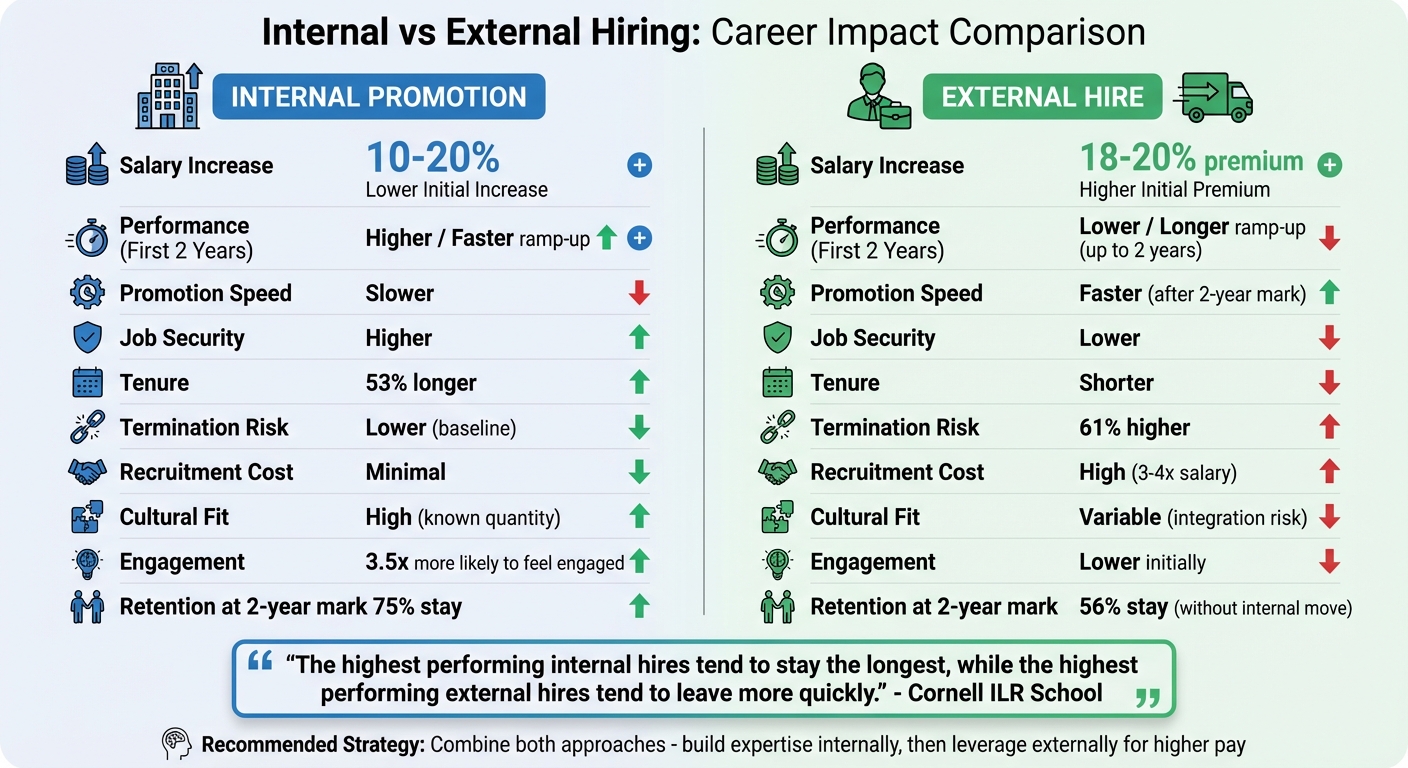
Internal vs External Hiring: Career Impact Comparison
Career Tradeoffs Between Internal and External Hiring
Weighing the differences between internal promotions and external job changes can help you make smarter career decisions. Let's start with salary: internal promotions typically come with a 10% to 20% raise, while external hires often see an 18% to 20% salary premium. Wharton's Matthew Bidwell explains this gap, noting that hiring managers "typically pay 10% or 20% more to pull people out of positions where they already have some security and where people know them and know they are doing a good job." However, this higher pay for external hires comes with its own set of challenges, particularly around performance and integration.
When it comes to performance, external hires might earn more initially, but they often struggle to deliver right away. Bidwell's research highlights that external hires "get significantly lower performance evaluations for their first two years on the job... They also have higher exit rates." On the other hand, internal hires tend to hit the ground running because they already understand the company’s culture, processes, and key relationships. Supporting this, a Cornell University study that tracked over 109,000 retail employees from 2009 to 2016 found that internal hires consistently outperformed external hires in monthly sales and profits. A key reason? High-performing internal employees tend to stick around longer, while high-performing external hires often leave for other opportunities.
Job security also varies significantly. External hires face a 61% higher risk of being fired compared to internal hires. Companies that focus on internal hiring also report 53% longer employee tenures. But here’s the twist: external hires, if they make it through the initial two-year adjustment period, often get promoted faster than their internally promoted peers. This creates a clear tradeoff - higher pay and faster advancement versus better job security and quicker productivity.
| Factor | Internal Promotion | External Hire |
|---|---|---|
| Initial Salary | Lower (10-20% increase) | Higher (18-20% premium over internal) |
| Performance (First 2 Years) | Higher / Faster ramp-up | Lower / Longer ramp-up |
| Promotion Speed | Slower | Faster (after 2-year mark) |
| Job Security | Higher | Lower (higher exit/termination risk) |
| Recruitment Cost | Minimal | High (3-4x salary) |
| Cultural Fit | High (known quantity) | Variable (integration risk) |
Combining Internal and External Moves
Understanding these tradeoffs lays the groundwork for a balanced career strategy. Alternating between internal and external moves can help you maximize your career potential. Internal moves allow you to gain deep expertise and build credibility within your organization, while external moves open doors to new industries, expand your network, and often result in significant salary increases. Employees who make an internal career move at the two-year mark are 75% more likely to stay with their company, compared to just 56% for those who don’t.
Here’s a practical approach: spend two to three years developing your skills and relationships internally, then use that experience to negotiate a higher-paying role at a new company with job search assistance. After gaining fresh insights and exposure externally, you can decide whether to continue climbing the ladder elsewhere or return to internal growth if the right opportunity arises. Companies like Sephora exemplify this strategy - they fill over 50% of leadership roles internally, which has contributed to their strong retention rates. This balanced approach helps you avoid "skill stagnation" from staying too long in one place while using free job application tools to keep your options open while steering clear of the "job-hopper" label that can come from moving too often.
How to Choose Between Internal and External Hiring
Evaluating Internal Promotion Opportunities
Before looking outside your current organization, take a moment to explore the potential for growth where you are. Start by having an open conversation with your manager about your career aspirations. Did you know that discussing career goals and growth opportunities can increase retention by 41%? Ask direct questions like: What skills do I need to develop for the next step? Are there clear criteria for promotion? How transparent is the salary structure for the role I’m aiming for?
Additionally, see if your company offers an internal talent marketplace or career portal. These tools are becoming increasingly common - 35% of organizations reported using them in 2025, compared to 25% the year before. They can highlight opportunities you might not have otherwise considered. Think about whether you’re aiming for a vertical move (more responsibility) or a horizontal one (building new skills at the same level). The traditional career ladder is evolving into more of a "career lattice", where growth can come from various directions.
"It's vital to create an atmosphere of coaching, mentorship and sponsorship within the workplace for mobility and advancement." - Shaylae Duprís, Founder, Blu Prospects Consulting
Be cautious, though, of trends like quiet hiring, where extra responsibilities are added without formal promotions or pay raises. If your manager can’t provide clear timelines or criteria for advancement, it might be a signal to start exploring external options.
Preparing for External Job Applications
When internal options feel limited, turning to external opportunities can open new doors. While moving externally often requires more effort, it can lead to higher salary increases and fresh perspectives. Start by ensuring your resume can pass Applicant Tracking Systems (ATS), which many companies use to filter applications. Focus on aligning your resume with the specific skills and requirements in the job description rather than emphasizing years of experience.
Tailoring your application is critical - 83% of job seekers research company reviews before applying, and hiring managers can easily spot generic resumes. This is where platforms like scale.jobs can be a game-changer. Unlike tools like Jobscan or Rezi.ai, scale.jobs offers a free ATS-optimized resume builder, AI-powered customization for $9/month, and a Human Assistant service. For $199, trained virtual assistants manually submit up to 250 applications, providing real-time WhatsApp updates and proof-of-work screenshots.
Keep in mind, external recruitment is costly for companies - three to four times a position’s salary when sourcing and onboarding are factored in. That’s why employers expect polished, targeted applications. Generic, auto-generated resumes are likely to be filtered out.
How scale.jobs Supports External Career Moves
When planning an external move, you need more than just a resume scanner. Scale.jobs combines software, AI, and human expertise into a single platform. Its free tier includes access to a job board with over 2 million postings monthly, an application tracker, and an ATS-compliant resume builder. For $9/month, the AI Assistant Pro generates unlimited tailored resumes, cover letters, and interview responses with just one click.
What sets scale.jobs apart from competitors like LazyApply, Simplify, or LoopCV is its Human Assistant service. Instead of relying solely on automation - which can sometimes trigger spam filters - scale.jobs employs trained reverse recruiters to manually complete applications. This service offers a 24-hour turnaround for custom resumes and cover letters, compatibility with any job portal, and transparent workflow tracking. Packages range from $199 for 250 applications to $1,099 for 1,000, with added perks like a personal recruiter, resume reviews, and LinkedIn makeovers.
Why does this matter? With 75% of organizations struggling to fill full-time roles, competition is fierce. Scale.jobs’ flat-fee model eliminates surprise renewals and saves you over 20 hours each week on repetitive application tasks. For job seekers navigating visa requirements or recovering from layoffs, having human experts manage the tedious parts of the process allows you to focus on networking and interview prep. This all-in-one support system simplifies the external job hunt and helps you stay focused on advancing your career.
Conclusion
Internal and external hiring paths impact your career in distinct ways. Moving internally often means faster integration and stronger engagement - employees who make internal transitions are 3.5 times more likely to feel engaged compared to those who remain in static roles. However, staying with one company for too long can sometimes limit your growth, leading to skill stagnation or a lack of exposure to fresh perspectives.
On the other hand, external moves can open doors to new skills, larger salary increases, and opportunities to switch industries or roles. But these benefits come with challenges: longer adjustment periods, a higher risk of turnover within the first 18 months, and recruitment costs that can reach three to four times the position's salary. The choice ultimately depends on your goals - are you looking for stability and leadership opportunities within a familiar environment, or do you crave new challenges and expertise that your current employer can't offer?
"The highest performing internal hires tend to stay the longest, while the highest performing external hires tend to leave more quickly." - Ben A. Rissing, Assistant Professor, Cornell ILR School
If you're considering an external move, the process can feel daunting. That’s where scale.jobs steps in, blending technology with human expertise to simplify your job search. They offer a free ATS-compliant resume builder, AI-driven resume customization for just $9/month, and Human Assistant services starting at $199 for up to 250 applications. What sets them apart? Real-time WhatsApp updates, proof-of-work screenshots, and manual submissions across platforms - a hybrid approach that saves you over 20 hours a week while ensuring a personalized touch.
FAQs
Should I pursue an internal promotion or look for an external job to grow my career?
Deciding whether to pursue an internal promotion or an external job opportunity largely hinges on your career goals and priorities. Each path has its own set of advantages, and understanding these can help you make the right choice.
Internal promotions often provide a sense of stability, quicker onboarding, and the benefit of leveraging existing relationships and company knowledge. Staying within a familiar environment can make it easier to excel in your role and build long-term growth. Plus, you'll already have a strong grasp of the company culture and expectations, which can make the transition smoother.
On the flip side, external roles can offer a chance to explore higher starting salaries, gain exposure to new industries or functions, and expand your skill set and professional network. These opportunities might bring fresh challenges and perspectives that can push you out of your comfort zone and accelerate your growth.
When weighing your options, think about key factors like skill development, compensation, and career trajectory. If you're looking to deepen your roots in a company you already know and trust, an internal move could be the way to go. But if you're eager for a new challenge, better pay, or a broader perspective, stepping into an external role might be the better fit. The right choice ultimately depends on what aligns with your long-term goals and current priorities.
What challenges can arise from cultural misalignment when changing jobs?
Switching to a new company often means getting used to a whole new workplace vibe - those unwritten rules, shared values, and typical ways of working. If these elements clash with what you’re used to or what you expect, it can leave you feeling out of place, frustrated, or even unmotivated. This disconnect can make it harder to feel aligned with the company’s mission, which can take a toll on both your enthusiasm and your productivity.
And let’s be honest - the stakes are high. Mixed messages, like leaders encouraging teamwork but rewarding individual competition, can lead to confusion and frustration. For new employees, this can slow down their ability to hit the ground running. For executives, it might mean a longer adjustment period and even the risk of leaving the role prematurely. When international or cross-cultural transitions are involved, differences in communication styles and workplace norms can make things even trickier. All of this can impact your career trajectory and job satisfaction, so it’s worth taking the time to understand a company’s culture before you decide to join.
How does internal hiring influence long-term job satisfaction and engagement?
Internal hiring, often referred to as internal mobility, plays a key role in boosting long-term job satisfaction and employee engagement. When team members see clear paths for growth within their company, they’re more likely to feel valued and motivated. It allows them to build on their existing skills and knowledge without the uncertainty of starting over in a new workplace. This sense of recognition and stability strengthens their commitment and lowers the chances of them seeking opportunities elsewhere.
For businesses, internal hiring aligns employees' roles with their career goals, fostering a deeper sense of engagement. Research shows that structured internal mobility programs give employees the confidence to explore new opportunities within the organization. This not only enhances job satisfaction but also creates a more motivated workforce. The result? Employees grow in meaningful ways, while companies enjoy higher retention rates and a boost in morale. It’s a win for everyone involved.