
How To Land A Web3 Growth Marketer Job


scale.jobs
January 5, 2026

Want to break into Web3 as a growth marketer? Here’s the deal:
Web3 companies are hiring marketers who can grow decentralized communities, analyze on-chain data, and design token-based incentives. Salaries range from $135,000 to $260,000, but traditional marketing experience isn’t required. What matters? Proving your Web3 knowledge through on-chain activity, DAO participation, and public contributions.
Key Takeaways:
- Focus on community building: Use platforms like Discord, Telegram, and Farcaster to engage users.
- Learn the tools: Master Dune Analytics, Nansen, and tokenomics to measure success (think active wallets, not click-through rates).
- Show proof of work: Highlight DAO governance, token swaps, and on-chain contributions in your portfolio.
- Tailor your resume: Use blockchain-specific keywords and measurable results to stand out.
- Network smartly: Join Web3 communities, attend events like ETHDenver, and connect directly with hiring managers.
Ready to land your dream job in Web3? Start by building your on-chain resume and engaging with the ecosystem today.
Web3 Growth Marketing: A Practical Guide To Build And Scale Communities
What Web3 Growth Marketers Do
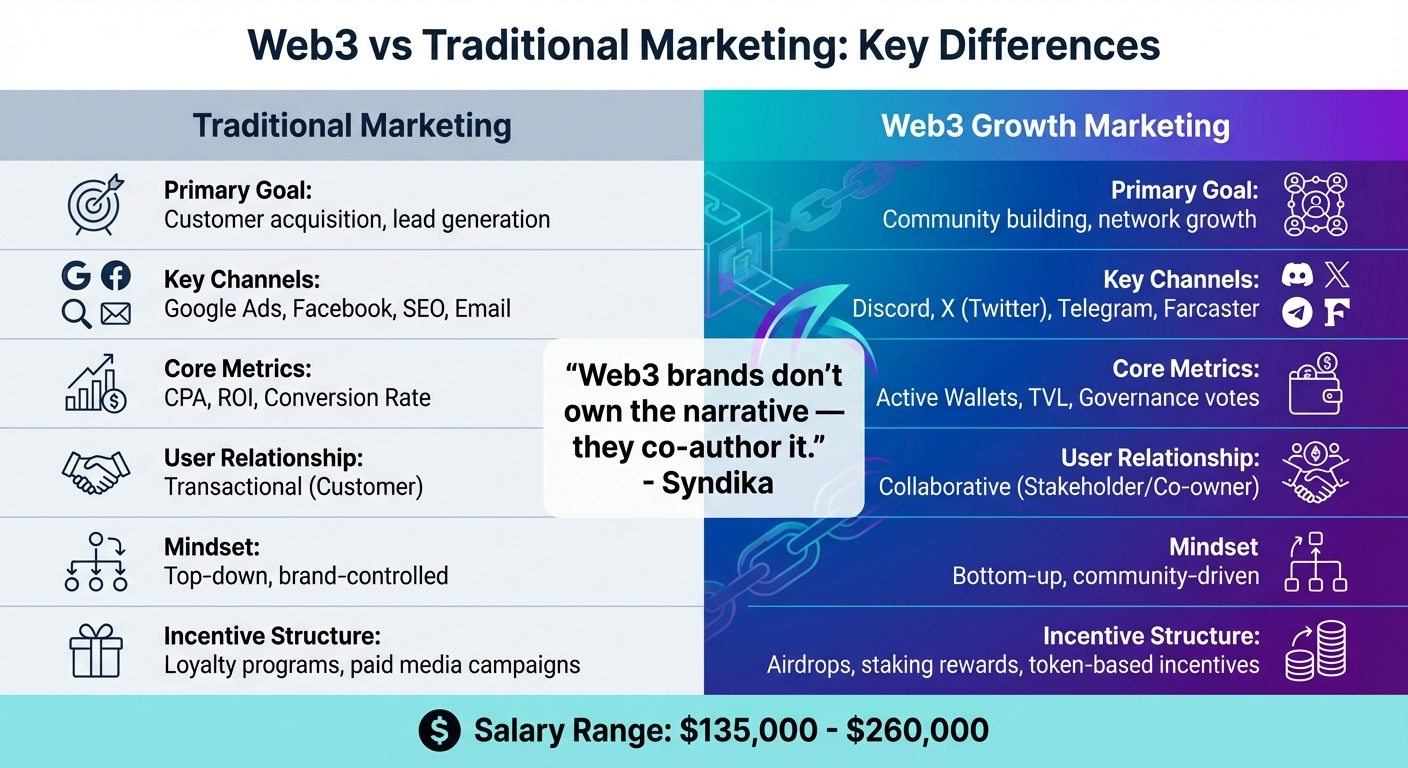
Web3 vs Traditional Marketing: Key Differences for Growth Marketers
Main Job Responsibilities
Web3 growth marketers focus on building communities rather than just customer bases. Instead of running traditional ad campaigns on platforms like Google or Facebook, they cultivate decentralized communities on Discord, Telegram, and Farcaster. These spaces transform users into advocates who actively participate in governance and promote projects organically. By leveraging tools like Dune Analytics, they analyze on-chain data to track active wallets and transaction volumes. Collaborating with Key Opinion Leaders (KOLs) is another critical aspect, helping to establish trust in niche markets.
A key part of the job is incentive design. This includes creating campaigns like airdrops, staking rewards, and referral loops that encourage user participation. For instance, the "Swap with Love" campaign by Changelly and Tangem reached 1.18 million people and facilitated 6,590 zero-fee swaps, showcasing how well-designed incentives can drive engagement. Web3 marketers also tackle challenges like simplifying KYC requirements and easing fiat-to-crypto transitions, which are unique friction points compared to traditional marketing.
They also create educational content and viral memes to simplify blockchain concepts and build a brand identity. In Web3 culture, the ability to craft and spread memes is often seen as a "superpower", as viral narratives can drive growth more effectively than paid ads. Experimentation is constant, with marketers testing scalable, low-cost tactics to boost visibility on discovery platforms while segmenting users - distinguishing genuine community members from airdrop hunters.
To excel in these tasks, mastering specific skills and tools is essential.
Required Skills and Tools
Understanding blockchain basics is non-negotiable. While coding in Solidity or Rust isn’t necessary, marketers must grasp concepts like the difference between Layer 1 and Layer 2 solutions, how smart contracts work, and the impact of gas fees on user experience. Familiarity with non-custodial wallets like MetaMask or Phantom is also important, as it helps in understanding the user journey and addressing security concerns.
Proficiency in on-chain analytics is what sets Web3 marketers apart. Tools like Dune Analytics and Nansen allow them to track meaningful metrics like active wallets, Total Value Locked (TVL), token holder distribution, and governance participation. Unlike traditional metrics such as click-through rates, these metrics measure true engagement and the health of a network. Knowledge of tokenomics - covering supply and demand mechanics, staking rewards, and airdrop structures - is also crucial for creating growth loops that don’t rely on constant paid advertising.
The toolkit extends beyond analytics. Platforms like Discord and Telegram are central for community management, while tools like Zealy, Galxe, and Layer3 enable gamified missions that reward users for on-chain actions. Decentralized blogging platforms like Mirror, as well as social platforms like Twitter (X) and Farcaster, are vital for building personal brands and engaging with founders and investors. Web3 marketers must also prioritize privacy and security, as users are particularly sensitive to data protection. Understanding decentralized identity solutions is key in this regard.
Beyond tools and skills, appreciating the shift from traditional to Web3 marketing is fundamental.
Web3 Marketing vs. Traditional Marketing
At its core, the shift boils down to relationships. Traditional marketing treats users as customers in a transactional model: you pay for ads, they buy your product, and the interaction ends. Web3 flips this approach, turning users into stakeholders and co-owners with governance rights and financial incentives tied to the project’s success. As Syndika puts it:
"Web3 brands don't own the narrative - they co-author it."
In this model, wallet addresses replace email lists as the primary user identifier, and blockchain technology offers real-time, immutable tracking, eliminating issues like bot-inflated metrics. Marketing channels shift from centralized platforms like Google and Meta to decentralized ones like Discord and Telegram. Transparency becomes a cornerstone, with open roadmaps, verifiable metrics, and community-driven decisions through DAOs shaping the narrative.
| Aspect | Traditional Marketing | Web3 Growth Marketing |
|---|---|---|
| Primary Goal | Customer acquisition, lead generation | Community building, network growth |
| Key Channels | Google Ads, Facebook, SEO, Email | Discord, X (Twitter), Telegram, Farcaster |
| Core Metrics | CPA, ROI, Conversion Rate | Active Wallets, TVL, Governance votes |
| User Relationship | Transactional (Customer) | Collaborative (Stakeholder/Co-owner) |
| Mindset | Top-down, brand-controlled | Bottom-up, community-driven |
The incentive structures also diverge significantly. Traditional marketing relies on loyalty programs and paid media campaigns managed from the top down. In Web3, tokenized incentives take center stage. Airdrops, staking, and quest-based rewards give users a sense of ownership. A powerful example is Axie Infinity, which generated $1.3 billion in revenue in 2021 and reached 2.7 million peak daily active users through its play-to-earn model. However, the project also highlighted a key challenge: when token values dropped, retention fell by 45%, underscoring the importance of building authentic community engagement beyond financial incentives.
Creating Your Web3 Resume and Portfolio
Writing an ATS-Friendly Web3 Resume
Before your resume lands in front of a hiring manager, it often has to pass through automated filters. In fact, around 75% of qualified candidates are filtered out by resume-scanning algorithms. To avoid being part of that statistic, start with a clean and professional format: stick to 1-inch margins, modern sans-serif fonts like Lato or Montserrat, and use a reverse-chronological layout.
Make sure to include technical keywords relevant to Web3, such as Solidity, Ethereum, Smart Contracts, dApps, and Tokenomics. For example, instead of saying "managed social media campaigns", try something like "drove community-led growth on Discord and Telegram, leading to 2,000 new wallet sign-ups."
Use the STAR method - Situation, Task, Action, Result - to turn vague descriptions into measurable achievements. Instead of writing "increased engagement", say "Grew Twitter community from 5,000 to 25,000 followers in Q2 2025, resulting in a 150% increase in Discord joins and 1,200 active governance participants." Metrics like Total Value Locked (TVL), active wallets, and governance participation rates are far more compelling to Web3 hiring managers than general click-through rates.
For additional help, tools like scale.jobs specialize in creating ATS-compliant resumes tailored for tech roles. They offer AI-based optimization to ensure blockchain-specific keywords are included. Their free platform analyzes your resume against actual Web3 job descriptions and flags missing keywords or formatting issues. For those applying to multiple roles, their AI Assistant Pro ($9/month launch offer) can generate unlimited job-specific resumes with just one click, adjusting metrics and keywords for each position.
Once your resume clears ATS filters, the next step is to frame your experience in a way that resonates with Web3 hiring managers.
Showing Relevant Experience and Skills
Even without prior Web3 experience, you can position yourself for roles like growth marketer by reframing your existing skills in a Web3 context. Employers often look for transferable skills, especially from Web2 backgrounds, in areas like analytics and AI strategy.
Highlight data-driven decision-making and community management. For instance, if you managed a Facebook group, describe it as "moderated a 10,000-member community, implemented engagement protocols, and resolved conflicts - skills directly applicable to Discord server management." If you worked on email campaigns, emphasize achievements like "designed automated nurture sequences that boosted retention by 40%", which demonstrates an understanding of user lifecycle management in token-based ecosystems.
Experience with incentive design or gamification is another strong point. Traditional loyalty programs share similarities with Web3 concepts like airdrops and staking rewards. If you've built referral programs, be specific: "Created a three-tier referral system that brought in 3,500 new users in 90 days with a 22% conversion rate." These kinds of metrics show you understand growth mechanics, which are vital for Web3 protocols.
Don't overlook open-source contributions and DAO participation, even if unpaid. These demonstrate your involvement in the Web3 space. As Shivam Chhuneja from CryptoJobsList explains:
"In Web3 your open source contributions can be a huge part of your resume. You'd be surprised at how many job offers are made just based on open source contributions alone."
Participating in bounties, contributing to marketing working groups, or creating educational content for protocols shows commitment. Include these under a "Web3 Contributions" section, complete with links to your work.
Building a Portfolio That Shows Web3 Knowledge
Your portfolio is your chance to showcase real-world contributions to Web3 projects. Organize it into sections like Projects, Case Studies, Skills, and Testimonials. Each project entry should answer a simple question: How did my work contribute to measurable growth?
If you lack direct Web3 experience, create a mock growth strategy. Select an existing DeFi or NFT project, identify gaps in their marketing, and craft a 90-day plan with clear KPIs. For example, you could analyze a protocol's community engagement, pinpoint weaknesses in their onboarding flow, and offer actionable recommendations. This kind of "spec work" shows you can think strategically about Web3 challenges.
Use tools like Dune Analytics to create dashboards that highlight metrics such as active wallets or TVL. For instance, analyze competitor data on airdrop retention rates or wallet activity patterns. Include links to any Discord moderation history, blog posts simplifying concepts like liquid staking, or educational X threads explaining perpetual DEXs. These public contributions build your "on-chain resume."
Establish your on-chain identity by including an ENS (Ethereum Name Service) name or wallet address in your portfolio. This isn't about flaunting wealth but about proving you're an active participant in the ecosystem. As The Crypto Recruiters explain:
"In Web3, your on-chain activity and public contributions are your resume. A real track record of getting involved and creating value speaks way louder than any past job title."
Finally, consider adding video walkthroughs of your portfolio. Some Web3 companies prefer video introductions or screen recordings to build trust in a space where anonymity is common. A three-minute video explaining your approach to a case study can highlight your communication skills in a way that written portfolios can't.
Networking in Web3
Once you've crafted a standout resume and portfolio, the next step is to build meaningful connections within the Web3 community.
Joining Web3 Communities and Events
In Web3, hiring often hinges on relationships rather than traditional resume submissions. Platforms like Discord and Telegram are at the heart of this ecosystem, serving as hubs where protocols form communities and share opportunities before they hit public job boards. Discord is ideal for structured, large-scale communities like NFT projects and DAOs, while Telegram caters to fast-paced DeFi updates and privacy-focused groups.
Start by joining Discord servers for protocols that interest you. Take time to observe how onboarding works, how members engage, and how governance discussions unfold. Participate actively - answer questions, provide feedback on proposals, or join marketing working groups. This "contribute-first" approach helps you build a reputation within the community even before you apply for a role. As Shivam Chhuneja from CryptoJobsList puts it:
"Web3 is a highly relationship dependent industry and if people remember your insightful replies and interactions then you have a higher chance of landing opportunities."
Beyond Discord, check out decentralized social networks like Farcaster (via Warpcast) and Lens Protocol (via Orb). Farcaster has grown significantly, from 5,000 daily active users in January 2024 to over 50,000 by September 2024, becoming a go-to platform for crypto professionals. Networking apps like Link3 and Entre are also gaining traction, offering ways to connect with Web3 professionals through verifiable credentials.
Another way to build connections is by completing bounties on platforms like Layer3 or Galxe. These platforms allow you to showcase your skills while contributing to projects, often serving as a stepping stone to full-time roles. Attending Web3 conferences and hackathons, such as ETHDenver or Consensus, is another excellent way to network face-to-face, which can be invaluable in an industry dominated by remote work.
Using Social Media to Build Your Brand
Once you're active in Web3 communities, use social media to amplify your professional presence. X (formerly Twitter) remains the primary platform for Web3 news and networking. Founders use it to announce launches, share updates, and scout for talent. Create a dedicated account focused on Web3 topics. Share educational threads, insights, or Dune Analytics dashboards to showcase your expertise.
An effective strategy is to provide thoughtful, high-value replies to posts from industry leaders. This approach can increase your visibility and build rapport, even before a job is posted. LinkedIn is also useful, particularly for connecting with Web3 companies that follow more traditional hiring practices, though it tends to take a backseat to X in this space.
On platforms like Farcaster, you can engage with "Frames" (mini-dApps within the feed) to interact directly without leaving the app. Establishing your on-chain identity is also important - include an ENS name in your bio and link your wallet address. This isn't about flaunting wealth; it's about showing you're an active participant in the ecosystem.
A great example of social media's impact is the "Swap with Love" campaign by Changelly and Tangem in February 2024. Over 21 days, they used blog reviews, a zero-fee swap week, and an AMA on X Spaces to reach 1.18 million people, generate 6,590 zero-fee swaps, and earn 350,000 impressions through influencer collaborations. This campaign highlights how strategic social media use can drive growth in Web3.
Reaching Out to Hiring Managers
Instead of relying solely on application systems, consider directly messaging or emailing hiring managers. Before reaching out, spend time reviewing the project's Discord or other community spaces. Identify areas for improvement - perhaps their onboarding process needs streamlining, or their engagement strategy could use a boost. Including these insights in your message demonstrates initiative and problem-solving skills.
For instance, a marketer named Ivy landed a "Head of Marketing" role at an on-chain gaming company without submitting a traditional resume. She found the role on LinkedIn but bypassed the time zone delay by emailing the company directly. Her email included a link to her read.cv portfolio and a Google Document showcasing her work with other Web3 projects. Within 48 hours, after a single interview with the CEO and team, she was hired.
When reaching out, tailor your message to the project. If they've recently launched a governance token, suggest how you could educate the community on voting mechanics. If their Discord engagement is lagging, propose a 90-day growth plan. Pieter DePree, Head of People at Hiro, emphasizes:
"DMing the hiring manager directly, or any team member you can get a hold of, can be a powerful way to stand out from the pack and show that you are interested in the opportunity and will take the initiative to pursue it."
In addition to direct outreach, explore niche job boards like Web3 Jobs, CryptoJobs, and Web3.career. But don't stop at clicking "Apply." Take the extra step to find the hiring manager on X or Farcaster and send a personalized message highlighting shared interests or specific contributions you've made to similar projects. For those juggling multiple applications, scale.jobs offers tools to track your networking efforts and ensure consistent follow-ups.
These strategies will not only expand your network but also set the stage for successful interviews and career growth in Web3.
Preparing for Web3 Growth Marketer Interviews
Once you've built your network and secured interview opportunities, the next step is preparation. This is where you can set yourself apart. Web3 interviews aren’t like those for traditional marketing roles - they dive deep into your strategic thinking and your active involvement in the ecosystem.
Researching the Company and Project
Dedicate a week to thoroughly researching the project. Start by joining their Discord server to observe how they onboard users and engage with their community. Take note of the tone, activity levels, and how they handle questions or issues. Test their dApp using tools like MetaMask or Phantom to get a feel for the user experience. Dive into block explorers like Etherscan to review their smart contract activity, token distribution, and overall transaction volume.
For deeper insights, analyze on-chain data such as Total Value Locked (TVL), active wallets, and token distribution using platforms like Dune Analytics or Nansen. For example, if the company’s Discord has 10,000 members but only 500 active wallets, you’ve spotted a retention issue worth addressing. Create a simple dashboard or document highlighting your findings, and prepare specific recommendations to share during the interview. This approach not only shows initiative but also demonstrates how you can add value from day one.
Understanding the project’s tokenomics is equally important. Study how their token design influences user behavior - whether through staking rewards, governance rights, or utility within the protocol. If the company recently launched a governance token, review past proposals and participation rates. This knowledge will help you discuss how token mechanics impact user acquisition and retention, a critical area for any Web3 growth role.
Common Web3 Interview Questions
Web3 interviews often combine strategic thinking, technical know-how, and community engagement. Be ready for questions like: "How would you launch a new DeFi protocol to a skeptical community?" or "How would you use on-chain data to identify high-value users for an airdrop?" These test your ability to think strategically while leveraging data.
You may also face community-focused scenarios, such as: "Our Discord engagement has stagnated. What’s your 30-day plan to revive it?" Here, the focus is on understanding the shift from traditional, top-down marketing to bottom-up, community-driven growth. Another common question might be: "What’s your understanding of our token utility and how it affects user behavior?" This checks if you’ve done your homework on their tokenomics.
Don’t be surprised if interviewers ask about your personal involvement in Web3. Questions like "Do you use dApps, vote in DAOs, or collect NFTs? Which ones?" are becoming more common. Be prepared to share your ENS name or wallet details as proof. As The Crypto Recruiters emphasize:
"Proving you're an active participant in the ecosystem is far more powerful than just saying you're passionate. Show, don't just tell."
Finally, craft a concise story about what drew you to Web3. Authenticity matters here, and your personal journey can help you stand out.
Demonstrating Your Problem-Solving Ability
To make your case stronger, back up your answers with concrete examples. Use the STAR method (Situation, Task, Action, Result) to structure your responses. For instance, instead of saying "I improved community engagement", you could say:
"Our Discord had 5,000 members but only 200 daily active users (Situation). My task was to increase engagement by 50% in 60 days (Task). I launched a weekly AMA series with the founders, created role-based channels for governance discussions, and introduced a bounty program for content creators (Action). Within 60 days, daily active users increased to 450, and governance participation rose from 8% to 23% (Result)."
Translate your Web2 achievements into Web3 terms. For example, instead of saying "boosted social media engagement by 40%", you might say "drove 2,000 new wallet sign-ups through Twitter threads and Discord campaigns." This shift in focus shows you understand that Web3 success is measured by on-chain activity - like active wallets or TVL - rather than traditional metrics like clicks or impressions.
To further stand out, prepare tangible deliverables. Create a 90-day growth plan for a similar project, outlining target audiences, channel strategies, and expected KPIs. Or share a public Dune Analytics dashboard analyzing a competitor’s airdrop retention rates. These proactive steps showcase your problem-solving ability before you even walk into the interview.
If you’re juggling multiple interview processes, tools like scale.jobs can help. Their AI-powered interview prep resources can generate customized answers to common Web3 questions, helping you practice the STAR method with scenarios tailored to your role.
As The Crypto Recruiters put it:
"The best Web3 growth marketers think like economists and community builders first, and marketers second."
Your preparation should reflect this mindset. Show that you don’t just know how to run campaigns - you understand the decentralized, community-driven nature of Web3 growth. That’s the key to standing out in this competitive space.
Next Steps in Your Web3 Career
Now that the interviews are behind you, it’s time to turn all that preparation into action. You’ve got the roadmap to land a Web3 growth marketer role - now let’s bring it to life.
Start by leveraging your polished resume and strong network. Create profiles on Web3-focused job boards like Crypto Jobs List, Web3 Jobs, and Wellfound. These platforms can help you spot hiring trends and identify the skills that are in demand. If you’re juggling multiple applications, tools like scale.jobs can be a game-changer. Their human-powered application service saves you over 20 hours a week. Unlike automated systems that might raise red flags with ATS software, their virtual assistants handle each submission manually, tailoring your materials for each role. You’ll even get WhatsApp updates and proof-of-work screenshots to stay on top of your progress.
But landing a role in Web3 isn’t just about applying - it’s about staying deeply engaged in the space. Shivam Chhuneja, Content Lead at CryptoJobsList, emphasizes:
"Web3 changes every single second of every single day which means everyone working in the industry needs to spend time and effort to keep themselves updated."
Immerse yourself in the industry. Join Discord servers, participate in DAO marketing groups, and contribute through governance proposals. These on-chain efforts showcase your value and keep your skills sharp. Tools like Dune Analytics and Nansen are essential for tracking protocol health and understanding user behavior - mastering these will help you stand out as the industry evolves.
Don’t forget the power of in-person networking. Major events in 2026, like Consensus Miami (May 5–7), TOKEN2049 Dubai (April 29–30), and ETHDenver (February 17–21), are prime opportunities to connect with founders, investors, and hiring managers. Ian Rogers, Chief Experience Officer at Ledger, describes Consensus as:
"a real b2b conference where you can get three months worth of meetings done in three days."
These gatherings are perfect for uncovering unlisted opportunities, showcasing your expertise, and building relationships that could lead to your next role.
In the Web3 world, visible and active contributions matter. Your success depends on how you engage with the community. The time to start is now.
FAQs
What skills do you need to succeed as a Web3 growth marketer?
To excel as a Web3 growth marketer, you'll need a solid blend of technical know-how and marketing savvy, specifically tuned to the decentralized world. Start by diving into the basics: blockchain technology, cryptocurrency, and tokenomics. These are the building blocks for creating campaigns around token launches, NFTs, or DAOs.
Equally important are your digital marketing skills. Think SEO, paid media, and community engagement - especially on platforms like Discord, Telegram, and X (formerly Twitter), which are at the heart of the Web3 community.
Another key skill is on-chain data analysis. This involves tracking wallet activity, token performance, and protocol usage to gauge ROI and refine your strategies. And don’t underestimate the power of creativity and storytelling. Being able to craft engaging content and simplify technical jargon into relatable ideas is vital for building strong communities and driving organic growth in this ever-changing space.
How can I showcase my Web3 skills to stand out to employers?
To stand out as a Web3 candidate, it’s essential to showcase a mix of technical skills and interpersonal abilities. Start by building a portfolio that highlights your work on smart contracts, dApps, on-chain analyses, or community-growth campaigns. Don’t overlook the value of freelance or open-source contributions - those count too! Share your projects on GitHub, ensuring they include clear documentation and measurable outcomes, such as growth in token holders or increased participation in DAOs. These tangible results can help demonstrate the real-world impact of your efforts.
Pair your technical portfolio with examples of your soft skills, such as community building, communication, and creativity. Think about experiences where you’ve led discussions, created educational materials, or collaborated with cross-functional teams. To further establish yourself as a thought leader, consider writing blog posts, creating short videos, or engaging with the Web3 community on platforms like Twitter/X. These activities not only showcase your expertise but also help you connect with like-minded professionals.
When your portfolio is ready, tools like scale.jobs can help you take the next step. Use their free resources, such as the Job Applications Tracker and Resume ATS Checker, to ensure your resume or portfolio website meets hiring standards. If you’d prefer to focus on networking and interviews, their Human Assistant service can handle your applications and provide real-time updates, saving you time and energy. Combining a well-documented portfolio with a professional job search strategy will help you leave a lasting impression on potential employers.
How is Web3 marketing different from traditional marketing?
Web3 marketing takes a different approach compared to conventional strategies by utilizing decentralized, blockchain-powered platforms instead of centralized ones. At its core, it emphasizes community-driven data ownership, incorporates token-based rewards to engage users, and thrives on interactive, two-way communication through platforms like Discord and Telegram.
While traditional marketing leans on steady KPIs and one-directional advertising funnels, Web3 marketing shifts the focus to on-chain metrics, quick adaptability, and managing the unpredictable, fast-evolving world of blockchain ecosystems. The goal isn't just to deliver messages but to build stronger, decentralized connections within communities.
Related Blog Posts



Land Jobs Faster and Easier withHuman Assistants
Who apply to jobs for you with Custom Resumes and Cover Letters in under < 24 hours, so you can focus on what matters: Networking and Interviews.