
LMIA-Exempt Jobs: Canadian Employers Who Skip the Queue

Sarah Mitchell
March 24, 2026

LMIA-exempt jobs in Canada offer a faster, simpler pathway for employers to hire foreign workers without proving a lack of Canadian candidates. These roles fall under the International Mobility Program (IMP), which focuses on advancing Canada's broader economic, social, and cultural priorities. Employers can bypass the costly and time-consuming LMIA process by using specific exemption categories like trade agreements (CUSMA, CETA), intra-company transfers, and public policy exemptions (e.g., Post-Graduation Work Permit).
Key Takeaways:
- No Labor Market Test: Unlike LMIA-based hiring, employers don’t need to advertise jobs or justify hiring foreign workers.
- Lower Cost: The compliance fee is $230 CAD compared to $1,000 CAD for LMIA applications.
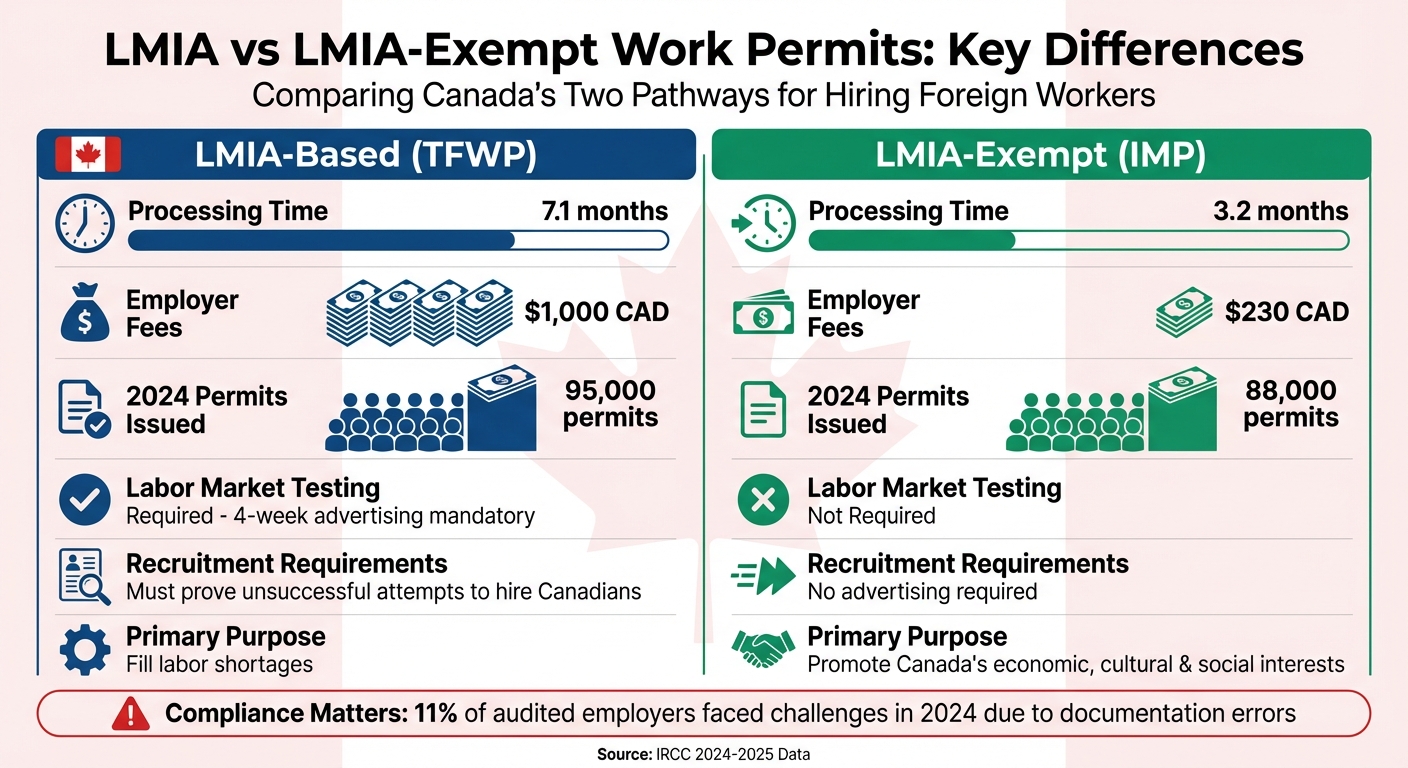
- Faster Processing: LMIA-exempt permits average 3.2 months vs. 7.1 months for LMIA-based permits.
- Eligibility: Common exemptions include trade agreements, intra-company transfers, and roles with economic or social value.
Employers must submit job offers through the IRCC Employer Portal and ensure roles align with Canada’s National Occupational Classification (NOC) system. For job seekers, targeting LMIA-exempt positions can lead to quicker work permit approvals.
For those navigating this process, tools like a Virtual Assistant for Job Applications or an AI resume builder can help streamline applications and maximize success.
LMIA vs LMIA-Exempt Work Permits: Processing Time, Cost & Requirements Comparison
LMIA-Exempt Work Permits 2026: 12 Fastest IMP Paths to Canada (No LMIA Needed!) + PR Strategy
What Is an LMIA-Exempt Job?
An LMIA-exempt job allows foreign nationals to obtain a Canadian work permit without the need to prove that no Canadian worker is available for the role. This exemption bypasses the extensive labor market test typically required in standard hiring processes.
These positions fall under the International Mobility Program (IMP), which prioritizes Canada's broader economic, social, and cultural goals rather than just addressing labor shortages. While the LMIA requirement is waived, workers still need a valid permit to work in Canada.
Eligibility for LMIA exemptions depends on specific criteria. Common pathways include international trade agreements like CUSMA (formerly NAFTA), intra-company transfers for executives or employees with specialized expertise, and roles that deliver significant social or cultural benefits to Canada. For example, demonstrating "significant benefit" might involve showing over a decade of experience or earning prestigious industry awards.
Employers hiring under LMIA-exempt streams must submit a formal job offer and pay a compliance fee of $230 CAD through the IRCC Employer Portal. Unlike LMIA-based hiring, employers are not required to advertise the job or justify their need for a foreign worker. The International Mobility Program simplifies the process, making it faster and more efficient.
How the International Mobility Program (IMP) Works
The IMP is the government framework overseeing most LMIA exemptions. Unlike the Temporary Foreign Worker Program (TFWP), which mandates proof that no Canadians are available for the role, the IMP allows exemptions to support Canada's strategic interests.
The program offers several exemption categories, including:
- International agreements: These cover trade treaties like CUSMA, CETA, and CPTPP.
- Significant benefit exemptions: These apply to entrepreneurs, intra-company transferees, and film/TV production crews.
- Reciprocal employment: This applies when Canadians receive similar opportunities abroad, such as academic exchanges or professional sports.
- Public policy exemptions: Examples include the Post-Graduation Work Permit (PGWP) for international students and the Mobilité Francophone program for French-speaking workers outside Quebec.
Employers using the IMP must submit a job offer through the IRCC Employer Portal before the worker applies for their permit. Certain categories, like charitable or religious workers, are exempt from the compliance fee.
"The biggest misconception is that LMIA-exempt means 'easy' or 'automatic.' In reality, IRCC applies strict eligibility criteria depending on the exemption code."
– CanadianVisas.com
Employers should carefully identify the appropriate LMIA exemption code for their hiring scenario before submitting a job offer. For claims under "significant benefit", supporting evidence such as academic credentials, industry awards, or membership in reputable organizations is essential to meet eligibility requirements while benefiting from the streamlined process.
Why Employers Choose LMIA Exemptions
Employers often prefer LMIA exemptions due to their efficiency and reduced costs, all while operating within the IMP framework.
LMIA exemptions significantly cut down hiring timelines by eliminating the labor market test. Employers are not required to advertise roles, document recruitment efforts, or justify the need for a foreign worker over a Canadian candidate.
The administrative workload is also lighter. Instead of completing detailed LMIA applications, employers only need to submit a job offer and pay the $230 CAD compliance fee. This streamlined process often results in faster approvals compared to LMIA-based permits.
Cost savings are another major advantage. Employers avoid LMIA processing fees, which can reach $1,000 CAD, and sidestep expenses tied to mandatory recruitment advertising. For businesses transferring employees or hiring through trade agreements, this creates a more direct and cost-effective route to bringing in talent.
Flexibility is another key benefit. The "significant benefit" category allows employers to hire individuals who bring notable economic, social, or cultural advantages to Canada - such as innovators, specialized healthcare professionals, or cultural performers - without needing to prove labor market shortages.
For foreign workers aiming to navigate Canada's job market, understanding LMIA exemptions can lead to faster work permit approvals. Similarly, using tools like an AI resume builder can help candidates tailor their applications to stand out for these specialized roles.
Main LMIA-Exempt Categories and Real Employer Examples
Canada offers several LMIA exemption categories tailored to specific employment scenarios. Let’s break down these categories with practical examples to help clarify how they work.
Trade Agreement Exemptions (CUSMA, CETA, Pacific Alliance, UK-TCA, CKFTA)
Trade agreements simplify the work permit process for professionals from partner countries. For instance, CUSMA (formerly NAFTA) allows U.S. and Mexican nationals in over 60 professional fields - like engineers, IT analysts, graphic designers, and management consultants - to skip the LMIA process. Real-life examples include:
- Emily, who obtained her Management Consultant permit under CUSMA in just 1.8 months.
- Thomas, who secured his Financial Analyst permit through CETA in 3 months.
- Ana, who used the Pacific Alliance to get her Civil Engineer permit in 2.5 months before transitioning to permanent residency via the Canadian Experience Class.
Other agreements like CETA benefit EU nationals, while the Pacific Alliance facilitates opportunities for citizens from Chile, Colombia, Peru, and Mexico. The UK-TCA covers British professionals in fields such as accounting and architecture, and CKFTA supports South Korean experts. Employers must ensure job titles align with the agreements’ professional annexes, and candidates must meet credential requirements.
| Trade Agreement | Eligible Countries | Example LMIA-Exempt Occupations |
|---|---|---|
| CUSMA | USA, Mexico | Engineers, IT Analysts, Graphic Designers, Investors |
| CETA | EU Member States | Lawyers, Scientists, Project Managers, Biologists |
| UK-TCA | United Kingdom | Accountants, Architects, HR Specialists, Mathematicians |
| CKFTA | South Korea | Marketing Managers, Auditors, Technical Writers |
| Pacific Alliance | Chile, Colombia, Peru, Mexico | Civil Engineers, Technicians, Researchers |
Now, let’s look at how companies move their internal talent across borders.
Intra-Company Transfers
Multinational companies often rely on intra-company transfers to bring executives, senior managers, and specialized experts to their Canadian branches. To qualify, employers must show a valid corporate relationship and confirm that the employee has worked abroad for at least one year in the past three years. The Canadian role must involve high-level or specialized responsibilities, not routine tasks.
Once internal talent is transferred, some roles also benefit from reciprocal employment arrangements.
Reciprocal Employment (C20 Category)
Reciprocal employment allows workers to take advantage of opportunities that mirror those available to Canadians in other countries. This exemption is common in areas like academic exchanges, sports, and seasonal jobs. Since 2026, evidence requirements have become stricter - employers must now prove that Canadian workers enjoy similar opportunities abroad. Examples of roles in this category include coaches, athletes, and summer camp counselors.
Next, let’s explore exemptions designed to attract workers who bring critical value to Canada.
Benefit to Canada and Public Policy Exemptions
The "Significant Benefit" category (C10/C11) targets workers who provide notable economic, social, or cultural benefits to Canada. This includes:
- Entrepreneurs launching new ventures.
- Film and TV production crews.
- Emergency repair technicians.
- Specialized physicians addressing urgent healthcare needs.
Employers must present evidence of the worker’s exceptional qualifications, such as recognized awards, patents, scholarly publications, or elite professional memberships.
Other exemptions include the Post-Graduation Work Permit (PGWP), which allows international graduates to work without an LMIA. The Mobilité Francophone program supports French-speaking workers outside Quebec, and as of March 13, 2026, Quebec will allow certain workers extending employer-specific permits to be LMIA-exempt if they’ve applied for permanent selection.
Additionally, the Global Hypergrowth Project (GHP) assists cutting-edge companies in hiring critical talent. Companies like Ada Support Inc. (Toronto), AlayaCare (Montreal/Toronto), CellCarta (Montreal), Clarius Mobile Health (Vancouver), Clio (Burnaby/Toronto/Calgary), and Lightspeed Commerce (Montreal/Toronto/Ottawa) benefit from employer-specific LMIA exemptions under this program, streamlining their hiring processes.
How Employers Can Use LMIA Exemptions
To navigate LMIA exemptions effectively, employers must correctly identify the exemption category and gather the necessary documentation. Mistakes, such as using the wrong code or submitting incomplete paperwork, can lead to significant delays.
How to Verify Your LMIA Exemption Code
The IRCC website is the go-to resource for confirming your LMIA exemption code. Each code is tied to a specific exemption category. For example:
- C10: Significant Benefit
- C12: Intra-Company Transfers
- C20: Reciprocal Employment
Ensure the exemption code matches your hiring scenario and include it in the formal job offer submitted through the IRCC Employer Portal. Employers are required to submit the offer through this portal and pay a $230 employer compliance fee before the worker applies for their permit.
Some organizations, such as international missions, foreign governments, and specific programs like Fulbright, may qualify for a fee exemption. If this applies, include a detailed explanation in the portal’s fee exemption field, specifying the reason. Simply stating that your organization is a charity or non-profit won’t suffice.
Once the correct exemption code is secured, confirm that the job description aligns with the National Occupational Classification (NOC) requirements.
Matching Job Descriptions to NOC Requirements
Many LMIA-exempt streams require the position to meet specific Training, Education, Experience, and Responsibilities (TEER) levels as defined by the NOC system. For instance, exemptions like Francophone Mobility and Significant Benefit typically apply to TEER 0, 1, 2, or 3 roles. These include high-skill positions such as executives, engineers, IT professionals, and specialized technicians.
The job duties outlined in the offer must closely match the lead statement and main duties listed in the corresponding NOC profile. For example, if hiring a specialized track maintenance worker under a Significant Benefit exemption, the role should align with NOC 72106. Discrepancies between the job description and NOC requirements can result in application refusals.
For Express Entry candidates on LMIA-exempt permits, the job must meet specific conditions to earn job offer points. These include being non-seasonal, full-time, lasting at least one year, and falling under TEER 0, 1, 2, or 3.
Once the exemption code and job description are finalized, the next step is to compile the necessary supporting documents.
Preparing Required Documents and Evidence
The type of documentation required depends on the exemption category. Below are some examples of what might be needed:
- Intra-Company Transfers: Provide proof of the relationship between the foreign and Canadian companies (e.g., parent-subsidiary, branch, or affiliate). Also, confirm the worker has been employed abroad for at least one year in the past three years. Documentation must show the Canadian role involves executive, senior management, or specialized knowledge responsibilities.
- Significant Benefit Exemptions: Submit evidence of the worker’s economic, social, or cultural contributions. This could include academic records, proof of 10+ years of experience, awards, patents, scholarly publications, or membership in professional organizations. Letters of support from recognized experts in the field can strengthen the application.
- Charitable or Religious Fee Exemptions: Include proof of CRA registration and evidence that the worker is unpaid or receives a stipend below the prevailing minimum wage. A detailed letter explaining the worker’s compensation is required - vague or incomplete explanations won’t meet IRCC standards.
If you’re uncertain about documentation requirements or need assistance drafting a compliant job offer, consider using a job application service to ensure all employer-specific documents meet IRCC guidelines.
Employers should also maintain ongoing proof of compliance with employment conditions. This includes keeping organizational charts, transfer letters, and evidence of the worker’s qualifications on file. Such records are essential if IRCC requests additional information or for extending permits in the future.
LMIA-Exempt vs. LMIA-Based Hiring: Side-by-Side Comparison
Employers in Canada have two main options for hiring foreign workers: LMIA-based hiring under the Temporary Foreign Worker Program (TFWP) and LMIA-exempt hiring through the International Mobility Program (IMP). While the TFWP focuses on addressing labor shortages where no Canadian workers are available, the IMP supports broader goals like advancing Canada’s economic and social priorities.
The differences between these pathways are striking. In 2024–2025, LMIA-based work permits took an average of 7.1 months to process, compared to just 3.2 months for LMIA-exempt permits. Employers also face a significant cost difference, with LMIA processing fees set at $1,000 CAD per position, while LMIA-exempt applications require only a $230 CAD compliance fee. In terms of volume, Canada issued 95,000 LMIA-based permits and 88,000 LMIA-exempt permits in 2024.
Administrative requirements also vary. LMIA-based hiring involves mandatory four-week advertising on specific platforms and documenting unsuccessful efforts to hire Canadians. LMIA-exempt hiring, on the other hand, skips labor market testing but requires strict adherence to exemption codes and National Occupational Classification (NOC) criteria.
"The biggest misconception is that LMIA-exempt means 'easy' or 'automatic.' In reality, IRCC applies strict eligibility criteria depending on the exemption code."
– CanadianVisas.com
Compliance remains a critical issue. In 2024, 11% of audited employers faced challenges due to errors in documentation or misuse of exemptions. Regardless of the pathway chosen, employers must maintain accurate records and ensure job descriptions align with NOC profiles. For those unsure about meeting documentation standards, consulting a professional service can help ensure compliance with IRCC requirements.
Comparison Table: LMIA vs. LMIA-Exempt Process
Here’s a quick breakdown of the two pathways:
| Factor | LMIA-Based (TFWP) | LMIA-Exempt (IMP) |
|---|---|---|
| Primary Purpose | Fill labor shortages when no Canadians are available | Promote Canada's economic, cultural, and social interests |
| Average Processing Time | 7.1 months | 3.2 months |
| Employer Fee | ~$1,000 CAD per position | $230 CAD compliance fee |
| Recruitment Requirements | Required four-week job advertising | No advertising required |
| Labor Market Testing | Must prove unsuccessful attempts to hire Canadians | Not required |
| Key Authority | Employment and Social Development Canada (ESDC) + IRCC | IRCC only |
| Application Method | LMIA approval from ESDC, then work permit application | Job offer submission via the IRCC Employer Portal, then work permit |
| Annual Volume (2024) | 95,000 permits issued | 88,000 permits issued |
| Audit Risk | Monitored for compliance regarding wages and conditions | 11% of audited employers found non-compliant in 2024 |
| Express Entry Points | Can provide additional CRS points with dual-intent LMIA | Eligible if the job is full-time, non-seasonal, TEER 0-3, and lasts 1+ year |
This table highlights the key differences, making it easier for employers to determine which process aligns with their hiring needs. Whether choosing the LMIA-based route or the LMIA-exempt option, understanding these distinctions helps streamline the hiring process and ensures compliance with Canadian immigration standards.
Conclusion
LMIA-exempt jobs simplify the hiring process for Canadian employers and foreign workers by bypassing the traditional labor market assessment. In 2024, the International Mobility Program processed 88,000 work permits with an average processing time of 3.2 months, significantly faster than the 7.1 months typically required for LMIA-based applications. Employers benefit from reduced bureaucracy, paying a $230 CAD compliance fee while avoiding the extra steps involved in LMIA hiring.
To succeed, employers must carefully align job descriptions with NOC requirements and use the correct exemption codes. They also need to submit offers through the IRCC Employer Portal and maintain accurate records, as 11% of audited employers in 2024 faced compliance challenges due to poor documentation. For job seekers, ensuring the role is full-time, non-seasonal, and classified under TEER 0-3 in the NOC system is key to earning Express Entry points.
Navigating LMIA exemptions can transform a lengthy process into a manageable one. This is especially relevant when evaluating tools for job applications, such as comparing platforms like scale.jobs with alternatives like FindMyProfession and LazyApply.
Scale.jobs vs FindMyProfession: Choosing the Right Application Service
For job seekers targeting LMIA-exempt roles, the right application service can make a significant difference. While FindMyProfession focuses on career coaching and resume writing, scale.jobs is designed for those ready to apply to multiple positions efficiently and effectively.
Why scale.jobs stands out:
- Human-driven applications: Every application is customized and submitted by real people, ensuring attention to detail that automated tools can't provide.
- ATS-optimized documents: Resumes and cover letters are formatted to meet the specific requirements of applicant tracking systems used by Canadian employers.
- One-time payment model: Offers a defined number of applications without requiring ongoing monthly fees.
- Direct support: Provides real-time updates and guidance through dedicated WhatsApp communication.
- Proof of work: Screenshots and confirmations for each submitted application ensure transparency.
FindMyProfession, on the other hand, specializes in career strategy and executive-level coaching, ideal for professionals seeking long-term career planning. Their services include personalized consultations and career roadmaps, making them a great fit for senior executives. However, for job seekers focused on LMIA-exempt positions and needing immediate application support, scale.jobs provides faster, more targeted results.
Who benefits from FindMyProfession:
- Senior executives looking for strategic career advice and repositioning.
- Professionals who want long-term career coaching and development.
- Candidates comfortable handling their own applications after receiving guidance.
- Those with budgets for ongoing coaching services.
Who should choose scale.jobs:
- Job seekers actively applying to multiple LMIA-exempt positions.
- Candidates requiring 50-200+ applications completed quickly and accurately.
- Professionals seeking human-level quality without the risks of automation.
- Applicants needing ATS-optimized documents tailored for Canadian employers.
- Those who value transparency and proof of submitted applications.
| Criteria | FindMyProfession | scale.jobs |
|---|---|---|
| Human Involvement | Coaching with candidate-led applications | Assistants handle all applications |
| Resume Customization | Templates with coaching guidance | Tailored and ATS-optimized per job |
| ATS Optimization | General advice | Specific formatting for Canadian ATS |
| Application Process | Candidate applies after coaching | Assistant submits applications directly |
| Proof of Work | Progress updates during coaching | Screenshot confirmation of submissions |
| Pricing | Monthly retainer ($3,000-$5,000+) | One-time payment for application packages |
Key Takeaways
Opt for FindMyProfession if you need in-depth career planning, executive coaching, or a long-term strategy for career growth. Their expertise lies in helping professionals redefine their careers over time.
Choose scale.jobs if you're actively applying to LMIA-exempt positions and need a service that delivers high-volume, high-quality application support with ATS optimization and proof of submission.
Why scale.jobs Could Be the Right Fit
- You're targeting 50+ LMIA-exempt positions and need applications submitted efficiently.
- You want personalized, human-quality applications without paying for lengthy coaching services.
- You require confirmation that applications are submitted, not just queued.
- You're focused on reducing ATS rejection rates with tailored documents.
- You prefer a clear, one-time payment for defined services.
Whether you're an employer or a job seeker, ensuring applications meet IRCC standards and align with LMIA exemption requirements is crucial. For help crafting compliant applications, consider consulting a Virtual Assistant for Job Applications to streamline the process. With the right approach, LMIA exemptions can open doors to opportunities in Canada without unnecessary delays or complications.
FAQs
How can I find the right LMIA-exemption code for my job offer?
To identify the correct LMIA-exemption code, start by determining the category your job aligns with under Canada's International Mobility Program (IMP) or related agreements. Typical exemptions include positions under international agreements like CUSMA (Canada-United States-Mexico Agreement) or CETA (Comprehensive Economic and Trade Agreement), intra-company transfers, or roles that align with public policy objectives. Each exemption has specific eligibility requirements, so it's essential to carefully review official resources or consult with legal professionals to ensure your role qualifies.
What evidence is strongest for a “significant benefit” LMIA exemption?
The clearest advantage of the “significant benefit” LMIA exemption lies in how it streamlines the hiring process by eliminating the need for an LMIA. This exemption is relevant in cases such as international agreements, humanitarian considerations, individuals awaiting permanent residency, vulnerable workers, or those without alternative means of support. It allows employers to bring in foreign workers more quickly and with fewer administrative hurdles.
Can an LMIA-exempt job still count for Express Entry job-offer points?
Yes, jobs that are LMIA-exempt can still count for Express Entry job-offer points, provided they fall under the International Mobility Program and meet the specific criteria set by IRCC. However, it's important to be aware that recent updates have influenced the CRS points allocated for LMIA-based job offers.
Related Blog Posts
- Surviving Trump’s $100K H-1B Fee: Insider Strategies and Loopholes for 2025
- Is the H-1B $100,000 Fee the End of Tech’s Global Talent Flow? Myths, Fears, and Facts
- Cracking the New H-1B Code: Legal Workarounds for Tech Firms Facing the $100K Fee
- Navigating the New $100,000 H-1B Fee: Tips, Challenges, and Legal Insights for 2025