
One-Page vs Two-Page Resume: What ATS Prefers in 2026

Sarah Mitchell
March 25, 2026

Applicant Tracking Systems (ATS) in 2026 no longer favor one-page resumes over two-page ones. Instead, they prioritize signal density - the relevance of keywords and achievements compared to overall content. Whether you choose a one-page or two-page format depends on your experience level and the role you're targeting. Here's a quick breakdown:
- One-page resumes are ideal for early-career professionals (0–5 years of experience), career changers, or those applying for high-volume roles. They perform well in mobile-first ATS systems, ensuring consistent formatting across devices.
- Two-page resumes work best for mid-level (5–10 years) and senior professionals (10+ years) who need space to showcase leadership roles, technical expertise, and measurable accomplishments.
Regardless of length, clarity and relevance are critical. Focus on tailoring your resume to the job description, using measurable achievements and avoiding filler content with real-life examples. Test your resume on mobile devices to ensure it displays correctly, as many recruiters now review applications on smartphones.
If you're unsure about the right format or need help optimizing your resume, Scale.jobs offers human-assisted ATS-friendly services, ensuring your resume performs well with both algorithms and recruiters.
1. One-Page Resume
ATS Parsing Effectiveness
One-page resumes excel on mobile-friendly ATS platforms, where multi-page documents can sometimes lose their formatting or display incorrectly. With the rise of companies reviewing applications on tablets and smartphones in 2026, the consistent formatting of a single-page resume offers a clear advantage. The key lies in signal density - ensuring that every line communicates relevant, measurable accomplishments.
"One-page resumes also perform better in mobile-first ATS environments, where two-page documents sometimes render poorly or lose formatting on the second page." - ApplyGlide
Modern ATS platforms focus on clarity and keyword relevance rather than how many pages your resume has. A concise, one-page resume tailored to the job description will outperform a cluttered two-page version filled with outdated or irrelevant details. This is why Scale.jobs' human-assisted, ATS-optimized resumes are often more effective than tools like Rezi.ai or Jobscan.
Given the importance of formatting consistency, the one-page resume is particularly advantageous in certain career scenarios.
Ideal Use Cases
A one-page resume is most effective when your experience is well-targeted and every detail directly supports the job you're pursuing. This format works particularly well for:
- Early-career professionals with 0–5 years of experience
- Career changers transitioning to a new field
- Applicants for high-volume roles like retail, customer service, or entry-level tech positions
Condensing your resume to one page forces you to focus on what truly matters. As ApplyGlide explains:
"The discipline of fitting your story onto one page forces the valuable editing exercise of prioritizing what matters most."
If your second page would only include outdated projects, redundant skills, or filler content, it's better to eliminate it. Recruiters often make their decision within seconds, so if the first page doesn’t immediately demonstrate role alignment, the second page won’t save you.
Recruiter Preferences
Beyond technical considerations, think about recruiter behavior. Recruiters don’t care about the number of pages - they care about signal strength. A one-page resume that clearly highlights your fit for the role will always outperform a two-page version that buries key achievements under unnecessary details. The top half of your first page should answer: Can this person do the job? If it doesn’t, the rest of the resume becomes irrelevant.
"Recruiters don't prefer one page. They prefer clarity." - Maywise
That said, avoid cramming too much information onto one page. Fonts smaller than 10pt or removing white space to fit everything can make your resume hard to read. A clean, well-organized two-page resume is always better than a cluttered one-page version.
Optimization Strategies
To ensure your one-page resume delivers, start with the 3-second rule: your alignment with the role, key skills, and measurable results should be immediately apparent within the first three seconds of scanning the top half of the page. Additionally, follow the half-page rule: if your second page is less than half full, consolidate everything into one page to maintain a polished, professional appearance.
Test your resume on a smartphone to confirm it’s mobile-friendly. Avoid using complex tables, text boxes, or multi-column layouts that might break on smaller screens. Stick to simple, professional fonts like Arial, Calibri, or Times New Roman in 10.5–12pt size, with margins between 0.5 and 0.75 inches.
If you're unsure about how well your one-page resume performs, consider using professional resume services. These services can fine-tune your formatting for ATS compatibility and recruiter readability, ensuring your resume works seamlessly across all devices.
2. Two-Page Resume
ATS Parsing Effectiveness
A two-page resume can be effective when used strategically. While one-page resumes deliver concise information, a two-page format offers the space to highlight more substantial experience and achievements. Applicant Tracking Systems (ATS) in 2026 focus more on structural clarity and keyword relevance than the number of pages. However, mobile-first screening can sometimes create formatting issues, especially on the second page, when viewed on tablets or smartphones.
The key is ensuring that the second page adds real value. Use it to showcase measurable accomplishments, significant leadership roles, or technical expertise. Avoid cluttering it with outdated internships, irrelevant certifications, or generic skills, as doing so can dilute the impact of your application.
Ideal Use Cases
Two-page resumes are typically expected for professionals with over a decade of experience. At this stage, recruiters look for detailed insights into leadership roles, cross-functional projects, and quantifiable achievements. Compressing such depth into a single page can strip away the context that demonstrates your contributions.
| Career Stage | Recommended Length |
|---|---|
| Freshers / New Graduates | 1 page only |
| Early Professionals (0–5 yrs) | 1 page (1.5 pages max) |
| Mid-level (5–10 yrs) | 1–2 pages (if justified) |
| Senior / Executive (10+ yrs) | 2 pages (expected) |
Certain industries also favor two-page resumes. Fields like academia, healthcare, government, and executive roles often require detailed documentation, including project histories, certifications, and technical skills.
Recruiter Preferences
Recruiters value clarity and structure above all. A well-organized two-page resume can outperform a cluttered one-page version. As Maywise aptly points out:
"A clean two-page resume is better than a cramped one-page resume. Always."
However, the first page is critical. Recruiters often decide whether to continue reading within the first 10–15 seconds. Your professional summary, key skills, and recent accomplishments should be prominently displayed on page one. Think of the second page as supporting material that reinforces the story told on the first.
Optimization Strategies
When opting for a two-page resume, follow the half-page rule: only add a second page if you can fill at least half of it with relevant content. A sparsely filled second page can appear unprofessional and suggest filler content. If your information doesn’t justify two full pages, condense it into one.
Here are some tips for maintaining a polished two-page format:
- Include your name and page number in the header for continuity.
- Avoid splitting a single job description across pages; move the entire section to page two if necessary.
- Ensure both pages display correctly on mobile devices, with headers and formatting intact.
- Use a clean, single-column layout with professional fonts like Arial, Calibri, or Times New Roman in sizes between 10.5 and 12pt.
If you're unsure about your resume's ATS compatibility or overall readability, consider using a professional resume writing service. These services can help fine-tune your formatting to ensure it meets both ATS and recruiter expectations.
The 'ATS Friendly' CV Myth: Stop Wasting Time (2026)
Pros and Cons Comparison
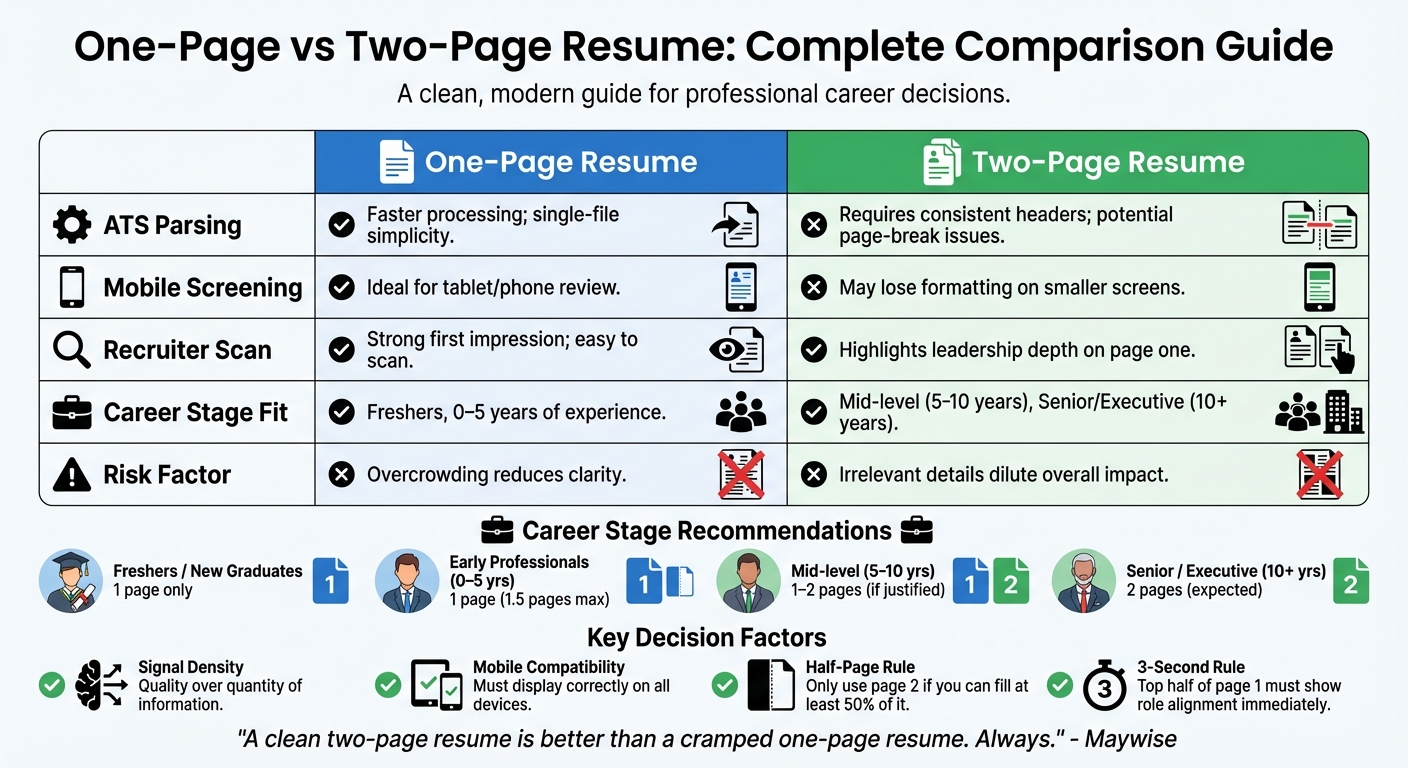
One-Page vs Two-Page Resume Comparison Guide for ATS 2026
When deciding between one-page and two-page resumes, it's essential to match the format with your level of experience and the value each layout brings. While both formats are compatible with 2026 ATS systems, they come with distinct advantages and challenges in areas like parsing, recruiter review, and mobile rendering.
If you're exploring tools like Rezi.ai or Jobscan to refine your resume, Scale.jobs offers a more tailored approach by combining ATS technology with human expertise. Automated platforms can identify keywords and flag formatting issues, but they lack the strategic insight to determine whether your experience warrants a second page or how to optimize content for maximum impact. Here's what sets Scale.jobs apart:
- Human-assisted resume optimization ensures informed decisions on format, length, and content prioritization.
- ATS-optimized documents guarantee consistent formatting across devices, including mobile and desktop.
- Transparent one-time payment model with clear proof-of-work for every application.
- Dedicated WhatsApp support for real-time guidance on resume-related decisions.
- Bulk application services, where human assistants apply to multiple roles using your optimized resume.
Comparing One-Page and Two-Page Resumes
One-page resumes are ideal for fresh graduates and early-career professionals with up to five years of experience. They emphasize "signal density", prioritizing impactful achievements while avoiding unnecessary filler. This format also performs well in mobile ATS systems, where maintaining formatting consistency is crucial.
On the other hand, two-page resumes are better suited for mid-level and senior professionals. They provide the space needed to showcase complex projects, leadership roles, and measurable results without sacrificing clarity. As Maywise aptly states:
"A clean two-page resume is better than a cramped one-page resume. Always."
However, formatting across both pages can be tricky, particularly on mobile devices where page-break errors might occur.
| Aspect | One-Page Resume | Two-Page Resume |
|---|---|---|
| ATS Parsing | Faster processing; single-file simplicity | Requires consistent headers; potential page-break issues |
| Mobile Screening | Ideal for tablet/phone review | May lose formatting on smaller screens |
| Recruiter Scan | Strong first impression; easy to scan | Highlights leadership depth on page one |
| Career Stage Fit | Freshers, 0–5 years of experience | Mid-level (5–10 years), Senior/Executive (10+ years) |
| Risk Factor | Overcrowding reduces clarity | Irrelevant details dilute overall impact |
This comparison underscores how Scale.jobs' human-driven, ATS-focused strategy enhances your resume's effectiveness compared to automated tools like Rezi.ai or Jobscan. The key is ensuring that a second page genuinely adds value rather than serving as filler.
Scale.jobs vs Rezi.ai: Resume Optimization Comparison
| Feature | Rezi.ai | Scale.jobs |
|---|---|---|
| Human Involvement | Automated AI suggestions only | Human experts review and optimize |
| Resume Customization Depth | Template-based with keyword insertion | Strategic content restructuring for each role |
| ATS Handling | Automated keyword matching | Human-verified ATS compatibility with keyword optimization |
| Application Execution Method | Self-service; manual applications | Human assistants handle bulk applications |
| Transparency and Proof of Work | Limited tracking of changes | Full documentation for every application |
| Pricing Model | Monthly subscription ($29–$129/month) | One-time payment per service |
Who Should Use Rezi.ai
Rezi.ai is a good fit for:
- Job seekers comfortable with a DIY approach who want quick keyword suggestions.
- Applicants on a budget who don't mind managing their own applications.
- Those who prefer template-based formatting with minimal customization.
- Individuals applying to a limited number of roles where manual applications are manageable.
Who Should Choose Scale.jobs
Scale.jobs is better suited for:
- Professionals who need expert judgment on resume format, length, and content strategy.
- Mid-level to senior candidates with complex experience requiring thoughtful presentation.
- Job seekers applying to 50+ positions who want bulk application support.
- Applicants who value transparent proof of application submissions and dedicated support.
- Those frustrated with automated tools that fail to provide strategic career advice.
If you're unsure about the right format for your experience level, professional resume writing services can assess your background and craft a resume designed for both ATS compatibility and recruiter appeal.
Switch to Scale.jobs If…
You should consider switching from Rezi.ai or other automated tools to Scale.jobs if:
- You've tried AI resume builders but still aren't landing interviews despite strong qualifications.
- You need expert advice on whether your experience justifies a two-page format.
- You're applying to 50+ roles and want human assistants to manage the application process.
- You require mobile-friendly formatting that remains consistent across all devices.
- You want clear proof that applications were submitted with your optimized resume.
Conclusion
When deciding on your resume length in 2026, focus on signal density - the quality and relevance of the information - rather than sticking to outdated rules. For fresh graduates and professionals with 0–5 years of experience, a single page works best, emphasizing recent accomplishments and key skills. Mid-level candidates with 5–10 years of experience might benefit from a two-page resume, but only if the second page highlights measurable achievements, such as leadership roles, complex projects, or diverse technical expertise. For senior professionals with over 10 years of experience, two pages are often necessary to effectively showcase career growth while keeping the content clear and concise.
A helpful guideline is the half-page rule: add a second page only if you can fill at least half of it with relevant, impactful content. Avoid overloading your resume with unnecessary details that could dilute its effectiveness. As ApplyGlide aptly puts it:
"The length of your resume should be determined by the depth of your experience and the requirements of the role - not by a rigid rule you read somewhere ten years ago."
With mobile ATS (Applicant Tracking Systems) screening becoming more common, ensure your resume is consistently formatted for devices like tablets and smartphones. Poor formatting on mobile can hurt your chances, especially in industries like tech, startups, or remote-first companies where digital applications dominate. A final review for mobile compatibility is essential to ensure your resume performs well at every stage of the hiring process.
To ensure your resume meets these standards, try Scale.jobs' free ATS checker to verify mobile formatting and keyword accuracy. If you're unsure whether your experience warrants a second page or need help prioritizing content, professional resume writing services can provide expert guidance. Keep in mind that recruiters prioritize clarity over strict page limits. With Scale.jobs' tailored ATS-friendly formatting and expert optimization, you can create a resume that appeals to both algorithms and hiring managers alike.
FAQs
How do I measure “signal density” on my resume?
"Signal density" refers to how well your resume emphasizes the most relevant and impactful details while cutting out unnecessary information. To achieve this, focus on showcasing key accomplishments, essential skills, and experiences that directly align with the job you’re targeting. By maintaining clarity and minimizing distractions, you make your resume more effective and easier for both recruiters and Applicant Tracking Systems (ATS) to assess.
What are the most common ATS formatting issues on page two?
When it comes to applicant tracking systems (ATS), certain formatting choices can cause issues, especially on the second page of your resume. Including outdated or irrelevant information - like internships from years ago or overly generic job responsibilities - can clutter your resume and dilute its impact. Additionally, using complex layouts such as tables, text boxes, headers, footers, or graphics often confuses ATS software, potentially leading to processing errors.
To improve your resume's chances of passing through an ATS, stick to straightforward formatting and prioritize content that is both clear and relevant. This approach ensures your resume is not only compatible with ATS but also easy for recruiters to review.
How can I test if my resume is mobile-friendly before applying?
To make sure your resume is easy to view on mobile devices, consider using free ATS resume scanners. These tools can identify formatting issues, check for keyword optimization, and confirm compatibility with applicant tracking systems. Additionally, take a moment to manually preview your resume on your phone or tablet. Look for clear headings, readable fonts, and consistent formatting. These simple steps will help ensure your resume looks professional on mobile devices and works seamlessly with ATS software.