
OPT vs STEM OPT vs H1B: What Employers Actually Care About

Sarah Mitchell
March 4, 2026

When employers evaluate candidates on OPT, STEM OPT, or H-1B visas, they focus on three main factors: work authorization duration, sponsorship costs, and compliance requirements. Here's a quick breakdown:
- OPT: Offers 12 months of work authorization, no sponsorship fees, and minimal compliance. Ideal for short-term hiring but lacks long-term guarantees.
- STEM OPT: Extends work authorization to 36 months, allowing up to three H-1B lottery attempts. Requires E-Verify enrollment and a detailed training plan (Form I-983).
- H-1B: Provides 3–6 years of work authorization with long-term stability, but comes with the industry's most stringent compliance requirements. A $100,000 supplemental fee on new petitions for beneficiaries outside the U.S. was introduced in late 2025, though a federal judge struck it down as unlawful on June 8, 2026, and the ruling is now under appeal. Employers filing Change of Status petitions for candidates already in the U.S. were never subject to this fee in the first place, which is one more reason employers increasingly prefer hiring OPT/STEM OPT candidates already stateside.
Employers often use the OPT period to evaluate candidates for potential H-1B sponsorship. For STEM OPT candidates, the extended timeline and multiple H-1B lottery attempts make them more appealing. H-1B remains the preferred option for long-term roles despite higher costs.
Platforms like scale.jobs help visa holders stand out by offering manual application submissions, custom ATS-optimized resumes, and real-time updates, ensuring compliance and boosting job search success. Whether you're navigating OPT, STEM OPT, or H-1B, tailoring your approach to employer priorities is key to securing opportunities. Implementing a daily job search system can help you manage these priorities effectively.
F1 to OPT to H1B Explained Simply What Students Miss
sbb-itb-564272e
OPT: What Employers Think and Worry About
Employers view OPT candidates as low-risk hires for addressing short-term staffing needs. With a talent pool of 418,781 nonimmigrants authorized to work through OPT in 2024 - making up 26% of all F-1 and M-1 students - the numbers speak for themselves. The attraction lies in the simplicity: no sponsorship fees, no E-Verify requirements, and minimal administrative work beyond standard onboarding procedures.
However, the 12-month limit attached to OPT eligibility brings its own set of challenges that employers must confront early on.
12-Month Timeline Encourages Short-Term Planning
The 12-month OPT period is often seen by hiring managers as a trial phase. Companies like Amazon, for example, use this window to evaluate whether an employee is worth the investment of H-1B sponsorship from top companies. For non-STEM candidates, who make up a significant share of OPT participants, this timeline is even more restrictive, as extensions are not an option.
Employers now assess sponsorship potential within the first 90 days of employment. This means candidates are expected to deliver measurable results - such as cost savings or operational improvements - early in their tenure to justify further investment. Tools like scale.jobs help candidates tailor their resumes in ATS-friendly formats, ensuring their contributions are clearly visible to hiring managers.
This accelerated evaluation process ties directly to concerns about job security beyond the initial OPT period.
No Sponsorship Costs, But No Long-Term Guarantees
While the lack of sponsorship fees makes hiring OPT candidates attractive for short-term roles, it does little to address long-term workforce needs. Employers save on costs, such as the $215 H-1B registration fee (a significant jump from $10 in FY-2026) and the potential $100,000 filing fee proposed in late 2025. However, when it comes to retaining talent beyond the 12-month period, challenges arise.
For non-STEM graduates, the so-called "cliff effect" becomes a pressing issue. Once the 12-month OPT period ends, these candidates have just 60 days to secure alternative status or leave the country. This creates a ticking clock for both employers and employees, leaving little room for long-term planning.
The Uncertainty After OPT
The lack of a clear post-OPT pathway adds another layer of complexity for employers. Many worry about the unpredictability of the H-1B lottery system and the complications of transitioning to STEM OPT extensions. While 34% of first-time H-1B workers do transition from F-1 status, there are no guarantees. Employers supporting a STEM OPT extension must ensure they are enrolled in E-Verify and complete a formal I-983 training plan. Without these steps, companies risk losing valuable talent abruptly.
"It is very difficult to convince the recruiter to hire you without a Permanent Residence/citizenship, since they wouldn't want to take the pain of going through all the hurdles to file an H1B1 visa for an entry level candidate." – Sumeet Jain, Co-founder, Yocket
For candidates competing against 120,000 peers for just 20,000 advanced degree H-1B slots, the 12-month OPT period is more than a trial - it’s a high-pressure audition. Employers demand clear evidence of value before committing to sponsorship, making it critical for candidates to showcase their impact from day one. Tools like job search platforms and resume builders can play a vital role in helping candidates stand out in this competitive environment.
STEM OPT: Benefits and Risks Employers Weigh
The 24-month STEM OPT extension has reshaped how employers evaluate international talent. By extending work authorization to a total of 36 months, it directly addresses retention challenges that hiring managers face when considering candidates with limited work authorization.
24 Extra Months to Evaluate and Transition Candidates
The extended 36-month timeframe offers employers three opportunities to enter a candidate into the H-1B lottery, compared to just one or two for non-STEM candidates. This additional time allows companies to assess the candidate's measurable contributions to the business before committing to the higher costs associated with H-1B sponsorship.
The financial advantage is noteworthy. STEM OPT candidates transitioning to H-1B via a Change of Status are typically exempt from the $100,000 supplemental fee for international hires, making these candidates a more economical choice for long-term employment.
"Candidates who are already in the U.S. on a student visa or OPT... are a cheaper hire, which gives you a real advantage." – Mihailo Bozic, Founder & CEO, Migrate Mate
The extended period also allows employers to manage salary adjustments strategically under the wage-weighted lottery system. For instance, candidates at Level IV (67th percentile) receive four lottery entries compared to just one at Level I. This gives companies the flexibility to adjust compensation to improve lottery outcomes.
E-Verify Enrollment and I-983 Training Plan Requirements
Before a candidate's first day, employers must tackle specific administrative requirements. One key obligation is enrollment in E-Verify, a mandatory step for hiring STEM OPT candidates. This system requires ongoing compliance monitoring to ensure adherence.
Additionally, employers must complete the Form I-983 training plan, a document that outlines the candidate's learning objectives, supervision methods, and job responsibilities. Any significant changes to the role or compensation must be updated in this plan. USCIS and school officials use the I-983 form to validate STEM OPT eligibility.
Employers should be prepared for potential site visits from USCIS to confirm that the training program is being implemented as outlined. Keeping all versions of the I-983 and E-Verify confirmations organized is essential to avoid issues during audits. Platforms like scale.jobs simplify documentation management, making compliance more straightforward and enhancing a candidate's appeal despite the administrative demands. It’s also worth noting that candidates can face an unemployment limit of 150 days total during the 36-month period (90 days during the initial OPT and 60 additional days during the STEM extension). Exceeding this limit results in immediate termination of work authorization.
Cap-Gap Protection and H-1B Transition Planning
Cap-gap protection ensures no interruption in employment when a candidate’s OPT expires after an H-1B petition is filed but before the October 1 start date. This automatic extension bridges the gap, allowing candidates to continue working during the transition.
However, the cap-gap period can introduce legal uncertainties. Some employers’ legal teams remain cautious about the automatic extension and require detailed documentation to mitigate risks. This administrative complexity often prompts hiring managers to closely examine a candidate’s remaining work authorization before committing to sponsorship.
STEM OPT candidates benefit from three H-1B lottery attempts over 36 months, compared to one or two for non-STEM candidates. This significantly increases their chances of securing H-1B status, reducing the risk of losing trained employees due to visa lottery failures. For employers, this ensures better stability for long-term projects and team dynamics.
"The $100,000 supplemental fee on H-1B visas has made the STEM OPT extension dramatically more important." – Shrey R., H1B Visa Jobs
With H-1B selection rates hovering around 35% under the beneficiary-centric system, the additional time provided by STEM OPT offers a distinct advantage for both employers and candidates in a competitive sponsorship environment. These factors highlight the critical role STEM OPT plays in shaping hiring strategies and retaining international talent.
H1B: Why Employers Prefer It Despite Higher Costs
The H-1B visa remains a top choice for employers, even with its higher financial and administrative demands. Why? It provides long-term workforce stability - something that alternatives like OPT or STEM OPT cannot fully offer. Platforms like scale.jobs also help highlight the stability and value of H-1B candidates, making them even more appealing to employers.
3-Year (or 6-Year) Commitment Means Better Retention
One of the biggest advantages of the H-1B visa is its initial 3-year work authorization, which can be extended to 6 years and even beyond if a Green Card application is in progress. This extended timeline allows employers to confidently invest in training, assign critical projects, and retain institutional knowledge without worrying about visa expiration deadlines.
Another key feature is the "dual intent" policy, which lets H-1B holders pursue a Green Card while maintaining their temporary visa status. For employers, this means they don’t risk losing skilled employees due to visa expiration. This is especially critical for roles that require months of training or onboarding, such as software architects, data scientists, or regulatory compliance specialists.
Additionally, the H-1B visa creates a natural retention mechanism. While employees can technically switch employers, doing so involves filing a new H-1B petition, which can be time-consuming and legally complex. This friction often encourages employees to stay with their sponsoring company longer than they might under OPT, where mobility is simpler. For employers, this retention justifies the upfront investment in sponsorship.
Sponsorship Fees and Legal Compliance Costs
Sponsoring an H-1B visa is not cheap. Standard sponsorship fees and supplemental charges for international hires have driven up costs significantly. Employers often opt for premium processing, which guarantees a decision in just 15 business days, but this adds an extra $2,965 to the total cost (raised from $2,805 effective March 1, 2026).
Given these expenses, many employers use the OPT period as an extended evaluation phase. During this time, they assess whether a candidate can deliver measurable results, such as boosting efficiency, cutting costs, or driving revenue. For candidates, documenting these achievements during their OPT phase can significantly improve their chances of securing sponsorship. Services like scale.jobs help candidates effectively showcase their contributions, making it easier for employers to justify the sponsorship investment.
Lottery System Creates Risk for Employers
As if the high costs weren’t enough, the H-1B lottery system adds another layer of uncertainty for employers. With only 85,000 visas issued annually (65,000 for the regular pool and 20,000 for U.S. advanced degree holders), selection rates are typically around 35%. This unpredictability makes workforce planning a challenge.
As of the FY2027 cap season, the H-1B lottery is no longer random. DHS's wage-weighted selection rule took effect February 27, 2026, and applied for the first time to registrations submitted during the March 4–19, 2026 window. Instead of one equal-chance entry per candidate, USCIS now weights entries by DOL wage level:
- Level IV (67th percentile+): 4 entries
- Level III: 3 entries
- Level II: 2 entries
- Level I (17th percentile, entry-level): 1 entry
The real-world results confirmed what critics predicted: early-career and entry-level candidates saw selection odds drop to roughly 15%, while Level III/IV candidates saw better odds than under the old random system. Overall selection landed around 34–42%, similar to prior years on paper, but the distribution of who gets picked shifted hard toward higher-paid roles. For OPT and STEM OPT candidates targeting H-1B sponsorship, this makes salary negotiation part of your immigration strategy, not just your compensation strategy. A higher offered wage now directly improves your lottery odds.
The uncertainty of the lottery system also makes STEM OPT candidates more attractive, as they have three lottery attempts over 36 months compared to non-STEM candidates, who may only have one or two chances. This extended timeline reduces the risk of losing a trained employee due to visa limitations.
For candidates seeking predictability, cap-exempt employers - such as universities, nonprofit research organizations, and affiliated medical institutions - offer a more secure path. These organizations can sponsor H-1B visas year-round, bypassing the lottery entirely, which makes them an appealing option for long-term stability.
OPT vs STEM OPT vs H1B: Side-by-Side Comparison for Employers
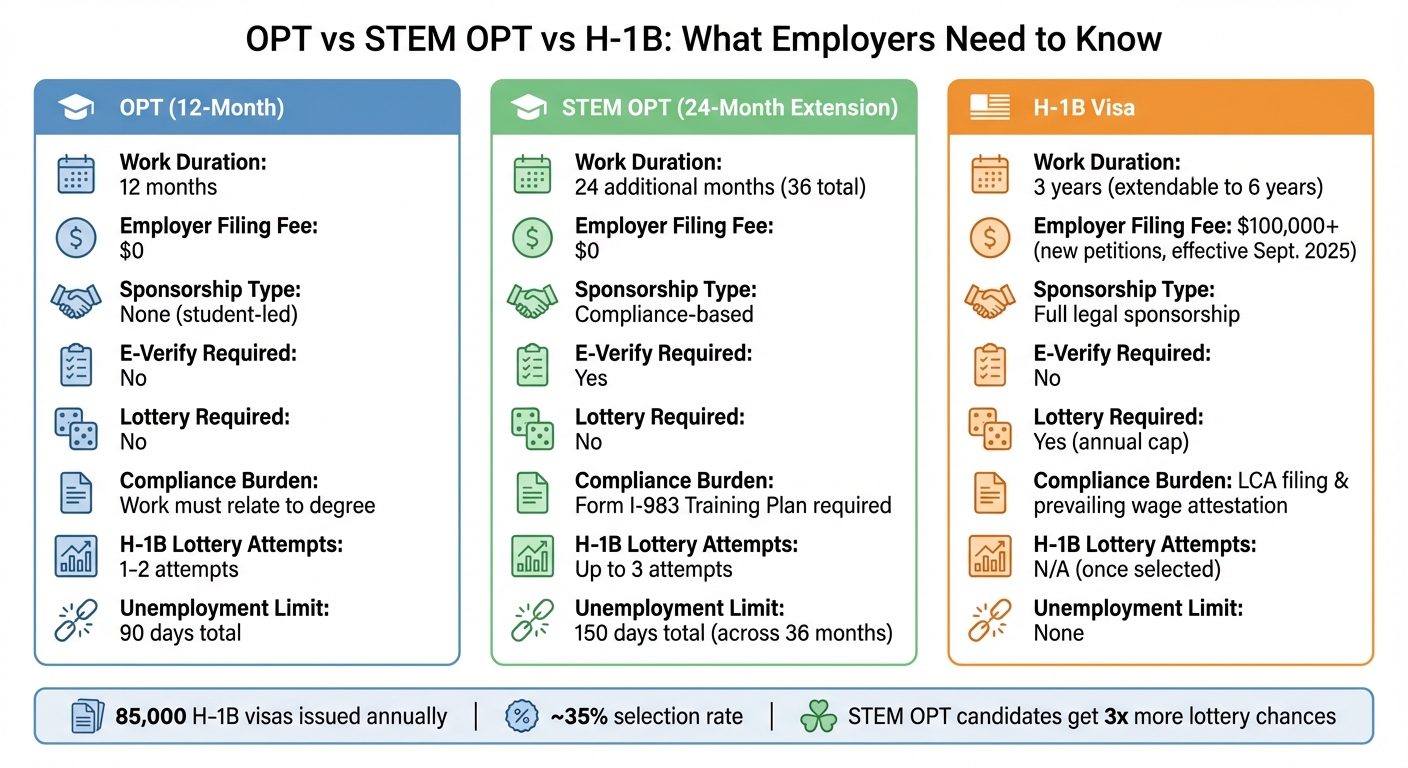
OPT vs STEM OPT vs H-1B Visa Comparison for Employers
When hiring international candidates, employers often weigh their options between OPT, STEM OPT, and H‑1B visas. These choices come with varying durations, costs, and compliance requirements, making it essential to understand the practical differences. The table below highlights the most critical factors: work duration, employer costs, and compliance responsibilities.
| Feature | OPT (12-Month) | STEM OPT (24-Month Extension) | H-1B Visa |
|---|---|---|---|
| Work Duration | 12 months | 24 additional months (36 total) | 3 years (extendable to 6 years) |
| Employer Filing Fee | $0 | $0 | $100,000+ (new petitions, effective Sept. 2025) |
| Sponsorship Type | None (student-led) | Compliance-based | Full legal sponsorship |
| E-Verify Required | No | Yes | No |
| Lottery Required | No | No | Yes (annual cap) |
| Compliance Burden | Work must relate to degree | Form I-983 Training Plan required | LCA filing & prevailing wage attestation |
| H-1B Lottery Attempts | 1–2 attempts | Up to 3 attempts | N/A (once selected) |
| Unemployment Limit | 90 days total | 150 days total (across 36 months) | None |
OPT and STEM OPT present cost-effective options for employers, as there are no filing fees involved, unlike the H-1B visa, which will exceed $100,000 for new petitions starting September 2025. This steep cost has led many companies to focus on hiring candidates already in the U.S. under F-1 status, avoiding the additional expenses associated with a Change of Status process.
From a compliance perspective, the requirements increase significantly across these visa types. OPT demands minimal oversight, with employers only needing to ensure the job aligns with the candidate's degree field. STEM OPT, however, requires employers to participate in E-Verify and collaborate on a detailed Form I-983 Training Plan, which outlines learning goals and supervision. H‑1B sponsorship involves the most stringent compliance, including Labor Condition Application (LCA) filings, prevailing wage attestations, and detailed justifications for the role as a specialty occupation. These steps often invite additional scrutiny, such as Requests for Evidence, if documentation is incomplete or unclear.
Another key difference lies in the lottery system. STEM OPT allows candidates up to three H-1B lottery attempts during its 36-month period, improving their odds compared to the one or two attempts available to non-STEM candidates. With an overall H-1B selection rate hovering around 35%, this extended window can make a significant difference. For candidates aiming to stand out during this process, using a professional resume service can help highlight their qualifications and reduce perceived hiring risks.
Ultimately, employers often lean toward candidates with longer-term work authorization to ensure a smoother hiring process and better workforce planning. This comparison underscores the strategic considerations involved in choosing the right visa category for both cost efficiency and compliance management.
How scale.jobs Helps Visa Holders Get Hired Faster
For international candidates on OPT, STEM OPT, or those awaiting H-1B approval, time is of the essence. Employers often hesitate due to sponsorship costs, and even small application errors can disrupt visa compliance. scale.jobs addresses these challenges with a blend of human expertise, ATS-friendly tools, and a system focused on accuracy and transparency. Unlike FindMyProfession's fully automated system, scale.jobs combines manual precision with technology to ensure every application meets employer and compliance standards. This approach minimizes the risk of missed opportunities caused by technical errors or generic submissions.
Why scale.jobs Outperforms Competitors
- Manual application submissions that avoid ATS "bot flags" common with automated tools
- Custom resumes optimized for ATS and tailored to specific job postings, not generic templates
- Proof of submission through time-stamped screenshots and real-time WhatsApp updates
- One-time payment plans with a free trial - no subscription fees or hidden costs
- Fast turnaround times, including 24-hour resume customizations for quick applications
This human-first approach ensures a more reliable and responsive job application process, particularly for visa holders navigating complex hiring environments.
Human Assistants Submit Every Application by Hand
Automated tools can trigger "bot flags" in Applicant Tracking Systems (ATS), leading to instant rejections. scale.jobs eliminates this risk by employing trained virtual assistants to manually complete every application. For visa holders, this level of care is crucial. USCIS has tightened scrutiny on visa compliance, particularly for students maintaining lawful status, making accuracy in applications more important than ever. By submitting applications manually across various platforms, scale.jobs ensures that candidates avoid the technical errors and glitches that could otherwise jeopardize their chances.
This hands-on method not only improves submission accuracy but also builds trust with employers, who value error-free applications.
ATS-Optimized Resumes for Every Job
Employers today are increasingly rejecting H-1B petitions for roles with vague titles like "analyst" or "coordinator." scale.jobs addresses this issue by crafting custom resumes and cover letters for each application. These documents use targeted keywords to align a candidate’s academic background and skills with the job’s specific requirements. This approach is especially important given USCIS's stricter validation processes for "specialty occupations", which demand clear evidence that a role requires a specific degree.
With a 24-hour turnaround, scale.jobs ensures candidates can apply within the critical 24–48 hour window when they're most likely to secure interview callbacks. As career coach Arjun Sharma notes, acting quickly within this timeframe can boost callback rates by up to 70%, according to Flashfire data.
Time-Stamped Screenshots and Real-Time Updates
For visa holders, maintaining an accurate record of job applications is essential. Unemployment limits - 90 days for OPT and 150 days for STEM OPT - are strictly enforced, and proof of timely applications can be critical. scale.jobs provides time-stamped screenshots for every submitted application, along with real-time WhatsApp updates. This creates a transparent audit trail, giving candidates peace of mind and helping them meet USCIS requirements.
The live chat feature and application dashboard further simplify the process, allowing candidates to focus on networking and interview preparation instead of manually tracking their applications.
Flat-Fee Pricing with a Free Trial
Unlike subscription services that charge recurring monthly fees, scale.jobs uses a flat-fee pricing model starting at $199 for 250 applications. This includes a free trial where candidates can test the service with five applications at no cost. For international students managing tight budgets - on top of expenses like the $215 H-1B registration fee and potential premium processing costs - this pricing structure removes financial stress.
Additional services, such as professional resume writing, are available without hidden charges or surprise renewals, offering candidates flexibility and control over their job search.
This straightforward model ensures visa holders can access reliable support without worrying about unexpected costs, making it easier to focus on securing the right opportunity.
Which Visa Status and Job Search Tool Fits Your Situation
Your visa status plays a critical role in determining the best job search tool for your needs. The timeline tied to your visa influences your strategy significantly. For example, if you're on a 12-month OPT, time is of the essence. You must demonstrate your value quickly to secure sponsorship before your work authorization expires. Data from Flashfire shows that applying within 24–48 hours of a job posting can increase your callback rate by 70%. In such a fast-paced scenario, scale.jobs offers quick turnaround times and human oversight, helping you avoid ATS-related issues that might otherwise cost you valuable interview opportunities.
In contrast, those on STEM OPT have up to 36 months to showcase their value and participate in the H-1B lottery up to three times. However, this comes with its own set of challenges, such as strict compliance with E-Verify enrollment and Form I-983 training plans. Employers evaluating sponsorship during the initial OPT phase often look for measurable outcomes alongside your credentials. If you’re managing multiple applications while adhering to SEVIS deadlines, scale.jobs can simplify the process with time-stamped proof of submission and real-time WhatsApp updates, ensuring your compliance file stays organized without the need for manual tracking.
For individuals already on an H-1B or aiming for cap-exempt roles at universities or nonprofit research institutions, the focus shifts to long-term goals like retention and Green Card pathways. With the wage-weighted lottery system introduced in 2026, your salary and location now play a significant role in your selection odds. For instance, a $95,000 salary might qualify as Level I (1 entry) in San Francisco but Level III (3 entries) in Dallas. In these situations, scale.jobs' professional resume service and human-first approach can help ensure your documents align with specialty occupation requirements, reducing the risk of Requests for Evidence (RFEs).
Regardless of your visa status, consistent and error-free application submissions are crucial to overcoming employer scrutiny. The right tool depends on your specific priorities:
- If you need high-volume applications with compliance tracking, Flashfire’s automated dashboard can handle 40–50 applications weekly.
- If your focus is on targeting verified H-1B sponsors with wage-level optimization, Migrate Mate’s database of over 500,000 jobs offers strategic targeting.
- For error-free, custom applications with proof of submission, scale.jobs provides a human-first approach that eliminates the technical errors often associated with automated tools.
"Degrees open doors. Execution opens offers." - Arjun Sharma, Career Coach
Your choice should reflect your timeline, compliance requirements, and comfort level with automation. For F-1 graduates who are exempt from the $100,000 supplemental H-1B fee, demonstrating your value during OPT is your best leverage. This starts with submitting accurate, well-crafted applications that reach hiring managers. By understanding these distinctions, you can decide whether automated tools suffice or if scale.jobs' personalized approach is the better fit for your career goals.
FAQs
When should I bring up H-1B sponsorship with an employer?
When discussing long-term employment plans, it’s important to address H-1B sponsorship, especially if you’re on a temporary visa and considering a role tied to a specific employer. Employers often view H-1B sponsorship as a step toward extended employment or even green card opportunities. Timing this conversation strategically - aligning it with discussions about your future goals - can make the process smoother and more productive.
How can I quickly prove ROI during OPT or STEM OPT?
To demonstrate your ROI effectively during OPT or STEM OPT, focus on tangible results that align with your employer's objectives. Showcase contributions such as improving processes, reducing expenses, or increasing revenue. Keep track of accomplishments like completed projects, earned certifications, or enhanced skills. Use specific metrics - like hours saved or revenue generated - and incorporate feedback from performance evaluations to make your case stronger. Summarize these achievements clearly and in an ATS-friendly format to highlight your value to the organization.
What do employers need from me for STEM OPT compliance?
Employers must confirm that you have valid work authorization, that the job offer aligns with your STEM field of study, and that all USCIS reporting and documentation requirements are met. It's crucial to maintain accuracy in your paperwork and submit everything within the required deadlines to stay compliant with STEM OPT regulations.