
Real-Time Job Search Analytics Every Job Seeker Should Use

Sarah Mitchell
January 20, 2026
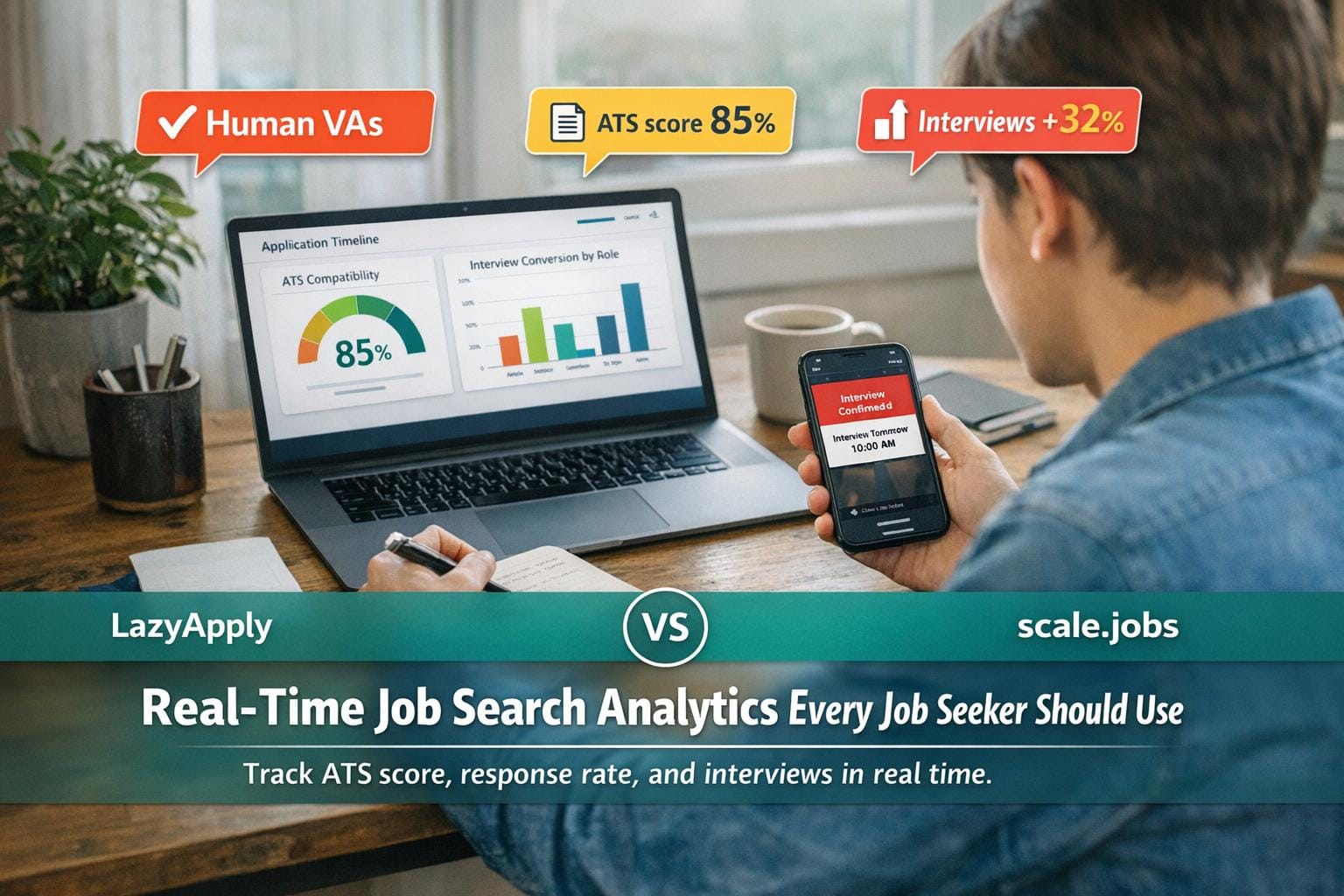
In today’s competitive job market, relying on guesswork won’t cut it. Real-time job search analytics can transform how you apply for jobs by offering instant insights into your application performance. These tools track essential metrics like response rates, ATS compatibility, and interview conversions, helping you focus on strategies that work. Platforms like scale.jobs combine automation with human support to simplify your job search, offering features like WhatsApp updates, proof-of-work screenshots, and AI-driven resume optimization. Whether you’re applying for full-time jobs, part-time jobs near you, or navigating visa requirements, these tools save time and improve results.
Key Takeaways:
- Metrics Matter: Track applications, response rates, and interview conversions to refine your approach.
- Optimize Applications: Use tools like AI resume builders and ATS checkers to ensure your resume aligns with job descriptions.
- Target High-Response Jobs: Focus on roles and job boards that yield better results.
- Save Time: Platforms like scale.jobs handle submissions, freeing up hours for networking and interview prep.
Real-time analytics streamline the job search process, helping you make data-driven decisions and prioritize opportunities with the highest potential. Below, we explore how these tools work, the best platforms available, and actionable steps to improve your job search outcomes.
How to Effectively Job Search in the Digital Era | Step by Step
What Real-Time Job Search Analytics Are and How They Work
Real-time job search analytics are automated tools designed to track and analyze your job application process in real time, offering immediate insights into your progress. Instead of manually logging applications in a spreadsheet and waiting weeks to review results, these tools collect application data, monitor status updates, and generate actionable insights instantly. This allows you to fine-tune your approach at every stage of the application process.
Here's how it works: some platforms automatically capture job details, but scale.jobs takes it a step further by combining AI-powered tracking with human support from a virtual assistant. Through features like WhatsApp updates and time-stamped screenshots, the platform records key details - job title, company, application date, and job description - into a centralized dashboard as soon as you apply. Unlike traditional tools that only log information, scale.jobs offers a blend of automation and personalized assistance, ensuring you always know the status of your applications.
The main difference between traditional tracking methods and real-time analytics is the speed and automation. Real-time systems provide live updates on your application pipeline, interview schedules, and status changes, enabling you to spend more time preparing for interviews and less time on administrative tasks.
Key Metrics to Track During Your Job Search
With automation in place, it’s important to focus on the right metrics to measure your job search progress. These include:
- Application submission status: Tracks how many jobs you’ve applied to and their current stages.
- Employer response rates: Measures the percentage of applications that receive replies.
- Interview conversion rates: Shows how many applications lead to interviews.
- Time-to-hire statistics: Calculates the average time from application to receiving an offer.
Additional metrics, like resume match rates, follow-up success, and interview-to-offer ratios, can reveal patterns in your job search. For instance, if your response rate is low, it might indicate that your resume needs adjustments to better align with specific roles or industries. Tools like Jobscan can help by comparing your resume to job descriptions and highlighting missing keywords before you hit submit.
| Metric | Purpose | Benchmark |
|---|---|---|
| Response Rate | Tracks how often employers reply | Varies by industry (5-15%) |
| Interview-to-Offer | Evaluates interview performance | Personal improvement benchmark |
| ATS Score | Checks resume compatibility with ATS | 80% or higher |
| Source Yield | Identifies the most effective job platforms | Depends on platform |
Platforms like scale.jobs go beyond basic tracking by offering competitive benchmarking and conversion analytics. This allows you to see how your metrics stack up against others in your field, helping you understand whether your response rate or interview success is on par with industry standards or if adjustments are needed.
How Real-Time Analytics Improve Your Job Search
The power of real-time analytics lies in its ability to help you make immediate, informed decisions. These tools can uncover patterns that would otherwise take weeks to identify. For example, by analyzing your application data, you can determine which types of roles are more likely to result in interviews, enabling you to focus on similar opportunities. You can also track employer response times - if certain companies typically reply within a few days, you’ll know when to follow up.
One of the most impactful benefits is data-driven resume optimization. By tracking keywords and ATS compatibility in real time, you can quickly adjust your resume to align with job requirements. If you’re landing interviews but not receiving offers, it may signal a need to improve your interview preparation. Conversely, if interviews are scarce, it’s a sign that your applications need refinement.
Real-time platforms also help you distinguish between high-response opportunities and low-probability applications. AI-powered matching algorithms evaluate how well your qualifications align with job requirements, allowing you to prioritize roles with the highest chance of success. Advanced platforms even analyze hiring trends, showing which companies are actively recruiting and more likely to respond quickly. This ensures your efforts are focused on realistic opportunities, saving you time and energy while improving your chances of landing a job.
Best Tools for Real-Time Job Search Analytics

Job Search Analytics Tools Comparison: scale.jobs vs LazyApply vs Jobscan vs Simplify.jobs
Finding the right analytics platform can save you weeks of manual tracking and guesswork. While there are plenty of tools out there, most fall into three main categories: resume scanners (like Jobscan), automation bots (like LazyApply), or self-service dashboards (like Simplify.jobs). Each has its limitations - scanners focus solely on resume analysis, automation bots can trigger red flags for employers, and dashboards often require tedious manual input.
scale.jobs stands out by combining automation with a human touch. It offers three distinct tiers: free tracking software, an AI-powered Pro plan for $9/month (introductory price, normally $19/month), and human-assisted submissions. This hybrid approach blends the efficiency of job search automation with the judgment needed to tailor applications and avoid ATS (Applicant Tracking System) rejections. Whether you’re looking for a free option or a comprehensive service with real-time updates, scale.jobs delivers flexibility and transparency. Let’s see how it compares to other popular tools.
scale.jobs vs LazyApply, Jobscan, and Simplify.jobs
Here’s how these platforms stack up when it comes to simplifying your job search:
| Feature | scale.jobs | LazyApply | Jobscan | Simplify.jobs |
|---|---|---|---|---|
| Application Method | Human-assisted manual submissions | Automated bot | Self-service (user-driven) | Self-service autofill |
| Real-Time Updates | WhatsApp + time-stamped screenshots (improves response rates) | Limited dashboard | Email/web notifications | Limited dashboard |
| ATS Optimization | AI + human review for each application | Template matching only | AI keyword analysis (no submissions) | Basic compatibility check |
| Pricing Model | Flat-fee with credit refunds | Monthly subscription | Monthly subscription | Monthly subscription |
| Transparency | Proof-of-work images & refunds for unused credits | Limited tracking | Analysis reports only | Basic tracking only |
Why scale.jobs stands out: Unlike its competitors, scale.jobs combines human oversight with automation. Human assistants manually handle submissions, avoiding the risks of bot detection while freeing up over 20 hours per week for users. The flat-fee pricing model ensures cost predictability, and unused credits are refunded - something subscription-based services don’t offer. Real-time WhatsApp updates with screenshots give you instant proof that applications are being sent out. For immigrant job seekers navigating H-1B or visa requirements, scale.jobs also provides compliance-focused filters and knowledgeable virtual assistants - offering support that automated tools simply can’t match.
With these comparisons in mind, let’s break down the key features you should prioritize in any job search analytics tool.
What to Look for in Job Search Analytics Tools
A great platform should simplify your job search by offering centralized application tracking. This means automatically logging job titles, companies, application dates, and statuses without requiring you to input everything manually. ATS compatibility checks are also essential - they scan your resume against job descriptions before submission. For instance, scale.jobs includes this feature for free, while Jobscan charges a monthly subscription.
Another crucial feature is tailored document generation. Instead of relying on generic templates, look for tools that use AI to customize resumes and cover letters for each role. With scale.jobs’ AI Pro plan, you can create role-specific documents in seconds, saving hours of manual editing.
Transparency is equally important. You need real-time insights into your job applications - not just a list of submissions, but proof that each one was customized and sent on time. Platforms like scale.jobs provide WhatsApp updates with screenshots, ensuring accountability and giving you peace of mind.
Finally, consider integrated tools that go beyond basic tracking. Features like salary predictors, interview question generators, and networking tools can streamline your entire job search process. By consolidating everything from ATS checks to portfolio creation, platforms like scale.jobs help you focus on high-response opportunities instead of juggling multiple tools and subscriptions.
How to Use Real-Time Analytics to Speed Up Your Job Search
Using Data to Improve Your Applications
When applying for jobs, running your resume through an ATS checker after each submission can make a big difference. If your match score is below 80%, revise it immediately based on the feedback provided. Tools like Jobscan can help identify missing keywords - say you're applying for tech roles, and analytics show gaps like "Python" or "AWS." Adding these skills can significantly boost your chances of passing the ATS screening. Research from MokaHR shows that tailoring your resume using data can improve screening success rates by up to 87%.
scale.jobs takes this process a step further. Their free ATS Checker highlights keyword gaps instantly, while the AI Pro plan (currently $9/month as a launch offer) generates resumes tailored to specific job postings. This combination of AI and human review ensures your applications are optimized to pass automated filters. For those dealing with frequent rejections - like laid-off workers or recent graduates - this feedback loop provides a quick way to refine and strengthen your applications.
With optimized resumes in hand, you'll be better equipped to focus on roles where you're more likely to succeed.
Focusing on High-Response Opportunities
Real-time metrics can help you identify job postings with the highest likelihood of success. By tracking response rates and application-to-interview ratios, you can zero in on opportunities that generate callbacks. Tools like the Job Applications Tracker in scale.jobs or similar platforms allow you to monitor your progress across multiple job boards. Prioritize roles where your profile shows a response rate above 10%. For example, if applications for "Software Engineer" positions requiring "React" yield a 25% response rate, it makes sense to focus your energy there instead of casting a wide net.
This shift from quantity to quality can save significant time. According to MokaHR benchmarks, targeting high-return opportunities can reduce your job search time by as much as 63%. For job seekers aiming for specific salary ranges, scale.jobs offers tools like the Salary Predictor and Interview Questions Predictor, which help filter roles where the predicted salary exceeds $100,000 and response likelihood is above 20%. This ensures you're dedicating your efforts to positions that are worth pursuing.
Monitoring Progress and Adjusting Your Approach
Once you've refined your applications and targeted the right opportunities, tracking your progress becomes essential. Set aside time each week to review key metrics: submission volume (aim for at least 50 applications), response rate (target above 15%), and time-to-response (keep it under 14 days). If, for instance, LinkedIn applications yield no callbacks but direct applications to company websites show a 40% response rate, adjust your strategy accordingly. Real-time updates from platforms like scale.jobs make it easy to see which channels are performing best.
Analytics can also help you identify and address bottlenecks. If you're consistently receiving low ATS scores or facing rejections for a specific type of role, it may be time to pivot. For example, if "Data Analyst" applications aren't generating any responses but "Data Engineer" roles show a 20% response rate, refocus your efforts on the latter. These quick adjustments, driven by real-time data, can dramatically improve your outcomes. Many laid-off tech workers using scale.jobs' Human Assistant service report saving over 20 hours a week by outsourcing manual submissions. With its flat-fee model and refund for unused credits, every dollar spent translates into measurable results, giving you more time to focus on networking and other high-impact activities.
Why scale.jobs Works Best for Job Search Analytics
Human-Powered Application Submissions
scale.jobs takes a hands-on approach by using trained virtual assistants to manually handle each job application. Unlike automated tools such as LazyApply or LoopCV, this method avoids triggering anti-bot flags that can derail your efforts. With a human filling out every form, your applications are submitted smoothly and securely.
To add an extra layer of reassurance, every submission comes with real-time WhatsApp updates and time-stamped screenshots. This creates a clear audit trail, visible in your analytics dashboard, so you’ll know exactly when and where your applications are submitted. This is especially helpful for job seekers navigating specific visa requirements like H1B or F1 OPT, where precision is crucial.
This personalized approach is seamlessly integrated into scale.jobs’ all-in-one dashboard, making it a standout option for job seekers who value both efficiency and accuracy.
All Job Search Tools in One Platform
scale.jobs brings everything you need into one unified platform. From a Job Applications Tracker and access to over 2 million job postings to an ATS-compliant Resume Builder, networking tools, and AI-powered resume and cover letter assistance (via AI Assistant Pro for just $9/month), the platform covers every aspect of your job search.
This complete integration ensures that all your job search data flows into one system, eliminating the hassle of manual syncing or dealing with missing information. The result? Real-time analytics that provide consistent and accurate insights into your progress.
On top of that, scale.jobs prioritizes cost efficiency and transparency, giving you a clear view of your efforts and results.
Flat-Fee Pricing with Full Transparency
scale.jobs offers straightforward, one-time payment plans designed to simplify your budgeting. Choose between the Basic plan at $199 for 250 applications, the Standard plan at $299 for 500 applications, or the Premium plan at $399 for 1,000 applications. Plus, unused credits are refundable, offering a flexibility that subscription models often lack.
With features like real-time WhatsApp updates and proof-of-work screenshots, scale.jobs ensures you’re always in the loop. This transparency allows you to calculate metrics like cost-per-interview, making it easier to measure your return on investment. Users report saving over 20 hours per week by outsourcing application submissions, giving them more time to focus on networking and preparing for interviews. By providing clear, measurable results, scale.jobs empowers you to adjust your strategy and get the most out of your job search without the burden of recurring fees.
Conclusion
The landscape of job searching has been revolutionized by real-time analytics, offering job seekers a smarter, more efficient way to approach their hunt. Instead of blindly sending out applications, you can now pinpoint what’s working, see which resume versions are getting responses, and focus on opportunities that lead to interviews. Studies reveal that these insights can save over 20 hours a week by cutting out the guesswork. With this data-driven approach, you can adapt your strategy on the fly and improve your chances of success.
In this space, scale.jobs stands out with its straightforward pricing and robust features. While some platforms like LazyApply rely on automated bot submissions and others like Jobscan charge $49.95/month for limited tools, scale.jobs offers a flat rate of $199 for 250 applications, complete with credit refunds for unused submissions. Features like real-time WhatsApp updates and proof-of-work screenshots keep you informed at every step - whether you’re a recent graduate, navigating H1B visa requirements, or recovering from a layoff.
You can start with scale.jobs' free tools, such as the Resume ATS Checker and Job Applications Tracker, to gain immediate insights. For more advanced support, upgrade to AI Assistant Pro for $9/month to quickly create tailored resumes and cover letters. Or, opt for Human Assistant services, where trained virtual assistants manage your applications for you. With integrated real-time analytics, scale.jobs gives you the visibility and control needed to land your next role faster and with confidence.
FAQs
How can using real-time job search analytics help me get more interviews?
Real-time job search analytics offer a powerful way to track and improve your job-hunting efforts. By monitoring metrics like your application-to-interview ratio, response times, and the success of your follow-ups, you can pinpoint exactly where adjustments are needed. For example, you might find that tweaking your resume, customizing your cover letters, or even changing the timing of your applications could make a big difference.
Using these insights to guide your strategy allows you to make smarter, more targeted changes that can boost your chances of getting interviews and callbacks. Tools such as job application trackers and analytics platforms simplify this process, helping you stay on top of your progress and fine-tune your approach for better results.
What job search metrics should I track to improve my results?
Tracking the right metrics can make a big difference in your job search journey. Start by keeping tabs on essential data points such as the total number of applications you've submitted, your application-to-interview conversion rate, and your interview-to-offer rate. These figures give you a clear picture of how well your efforts are translating into opportunities.
It's also crucial to stay organized. Record details like the status of each application, the company name, job title, submission date, recruiter contact information, and any follow-up deadlines. This helps ensure no opportunity slips through the cracks.
Another valuable area to monitor is your response rates and the average time it takes employers to reply. Additionally, take note of which job boards or application sources are delivering the best outcomes. By analyzing this data, you can spot trends and focus your energy on strategies that yield the best results.
What makes scale.jobs the best choice for job search analytics?
Scale.jobs brings together real-time analytics and personalized human support to offer job seekers a powerful toolkit for managing and improving their job applications. Its free job tracker provides a straightforward way to monitor every stage of your job search, from when you submit an application to the outcome of your interviews. You’ll also receive instant updates and proof-of-work details, so you always know where and when your resume has been sent.
What sets Scale.jobs apart is its ability to boost success rates by combining AI-crafted, ATS-friendly resumes and cover letters with human-reviewed submissions. This blend of technology and personal attention leads to higher callback rates compared to fully automated platforms. Additional features like visa-specific filters, smart reminders, and affordable pricing options - such as the $9/month AI Pro plan - make the job search process easier and more effective. Scale.jobs offers a smarter way to take control of your career and achieve meaningful results.