
Top #5 Resume Action Verbs That Beat ATS Filters in 2026

Sarah Mitchell
December 27, 2025
Your resume is probably being rejected before a human ever reads it, and weak verbs are a major reason why.
Applicant Tracking Systems scan for specific keywords, and action verbs are one of the highest-weighted signals. Phrases like "responsible for" or "helped with" score near zero. Words like "spearheaded," "engineered," or "orchestrated" rank significantly higher, and 87% of hiring managers find resumes with targeted verbs more compelling than generic ones.
This guide gives you 100+ ATS-tested action verbs organized by industry and role type, plus exactly how to rewrite your bullet points to pass ATS filters and impress recruiters in 2026.
Key Takeaways:
- ATS ranks resumes based on keyword matching; action verbs are critical.
- Replace weak phrases like "responsible for" with stronger verbs like "orchestrated."
- Tailor verbs to job descriptions and use measurable results to boost impact.
- Use ATS tools like Scale.jobs to check your ATS score and refine your resume.
Pro Tip: Avoid passive language and focus on verbs that highlight your achievements. For example, replace "managed a team" with "directed a 10-person team, increasing revenue by 25%." This approach ensures your resume passes ATS filters and grabs a recruiter's attention.
The Problem: Weak Verbs Lead to ATS Rejection
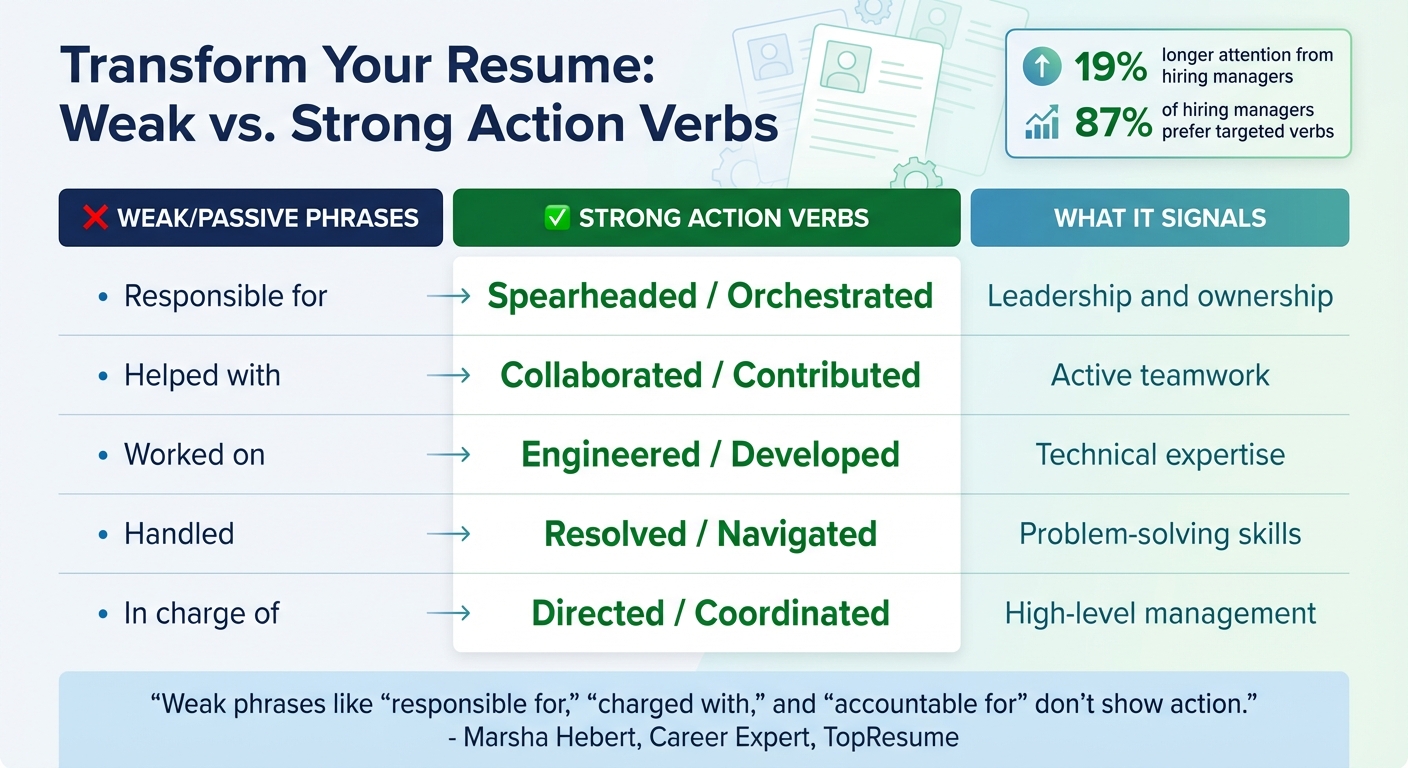
Weak vs Strong Resume Action Verbs Comparison Guide
sbb-itb-564272e
What are the best action verbs for a resume in 2025?
The best resume action verbs are role-specific, results-oriented, and match the exact language in the job description.
For leadership: spearheaded, orchestrated, championed. For tech: engineered, deployed, automated.
For analytics: forecasted, quantified, modeled. Always pair verbs with a measurable outcome, "increased revenue by 30%" outperforms "managed sales team" in both ATS ranking and recruiter attention.
Why Vague Language Lowers Your ATS Score
Writing phrases like "responsible for managing projects" or "duties included customer service" might seem fine, but they list tasks, not accomplishments. This kind of passive language doesn't highlight what you achieved. Instead, it tells Applicant Tracking Systems (ATS) and recruiters what your job description was, which can push your resume to the bottom of the pile. Stronger, more specific language is key to standing out.
Here's the thing: resumes that use strong action verbs hold hiring managers' attention 19% longer than those filled with passive phrases. And when recruiters are skimming through hundreds of resumes, those extra seconds can mean the difference between getting an interview or being overlooked. In fact, a study found that 87% of hiring managers preferred resumes with targeted, impactful verbs over those using generic ones like "managed" or "helped."
"Weak phrases like 'responsible for,' 'charged with,' and 'accountable for' are all technically verb phrases, but they don't show action." - Marsha Hebert, Career Expert, TopResume
This isn't just about style; it's about results. ATS algorithms rank resumes higher when action verbs are paired with measurable achievements. You can verify your current impact using a resume keyword optimizer. For example, "responsible for sales" gives no quantifiable details, while "increased revenue by 20%" clearly demonstrates your impact.
Up next, you'll see how swapping weak verbs for dynamic ones can transform your resume.
Common Weak Verbs That Hurt Your Resume
Certain phrases can immediately signal a lack of impact to both ATS software and recruiters. Words like "responsible for", "charged with", and "accountable for" focus on tasks rather than results. Similarly, outdated terms like "utilized" or "interfaced" can make your resume feel stale and disconnected from modern industry language.
| Weak/Passive Phrase | Strong Action Verb Alternative | What It Signals |
|---|---|---|
| Responsible for | Spearheaded / Orchestrated | Leadership and ownership |
| Helped with | Collaborated / Contributed | Active teamwork |
| Worked on | Engineered / Developed | Technical expertise |
| Handled | Resolved / Navigated | Problem-solving skills |
| In charge of | Directed / Coordinated | High-level management |
"If you say managed five or ten times, I'm going to assume AI wrote your resume." - Keanna Carter, Former Google Recruiter
The Solution: Using Action Verbs to Pass ATS Scans
How to Match Resume Keywords to Job Descriptions
The job description is your guide to understanding what employers are looking for. Pay close attention to the qualifications and opening paragraph to spot key terms. Look for action verbs that are repeated or emphasized with bold or capital letters.
Be precise with your language. For example, if the job listing mentions "customer relationship management", avoid shortening it to "CRM" on your resume. Many ATS systems look for exact matches, so abbreviations could cause your resume to be overlooked. Similarly, if the description highlights verbs like "spearheaded" or "orchestrated", those words reflect the values and priorities of the employer.
Once you’ve identified essential keywords, use Scale.jobs' free ATS Checker to evaluate how well your resume aligns with the job posting. This tool pinpoints missing keywords and provides a compatibility score, giving you clear steps to improve your resume before submitting it. It’s a straightforward way to ensure your resume speaks the same language as both ATS systems and recruiters.
Also read: How to Match Resume Keywords to Job Descriptions
Organizing Action Verbs by Category
After identifying the right keywords, group your action verbs to align with specific areas of achievement. For example:
- Leadership verbs: Use words like "spearheaded", "orchestrated", and "mobilized" to highlight team leadership or project management.
- Achievement verbs: Words such as "accelerated", "surpassed", and "outperformed" are ideal for showcasing measurable success.
- Technical verbs: Roles in tech benefit from terms like "engineered", "debugged", "automated", and "deployed."
- Communication verbs: For roles focused on interaction, use verbs like "negotiated", "articulated", "persuaded", or "facilitated."
- Analysis verbs: Words like "forecasted", "quantified", and "diagnosed" emphasize problem-solving and analytical skills.
According to LinkedIn studies, resumes that use strong action verbs tend to attract more views and increase contact rates from recruiters. These verbs not only help ATS systems recognize your qualifications but also make your contributions clear to human readers.
Rewriting Resume Bullets with Action Verbs
Once your verbs are categorized, refine each bullet point by starting with a powerful action verb and adding measurable results. Use the STAR method (Situation, Task, Action, Result) to structure your points clearly. For instance, instead of saying, "Responsible for managing a sales team", try something like:
"Directed a 12-person sales team, implementing a new CRM system that increased quarterly revenue by 30%."
This version begins with "Directed", includes specific metrics, and demonstrates impact. Strong, dynamic verbs not only improve your ATS ranking but also grab the attention of recruiters, who typically spend about six seconds reviewing a resume. Leading with compelling verbs ensures your achievements stand out immediately.
To keep your resume fresh and engaging, vary your word choices. If you’ve used "led" multiple times, switch it up with alternatives like "spearheaded", "orchestrated", or "championed." Additionally, make sure your verbs match the timeline of your roles: use present tense for your current position and past tense for previous ones. This consistency ensures your resume reads smoothly and professionally.
Testing Your Resume for ATS Compatibility
Using ATS Scanners to Check Your Resume
To see how your resume stacks up against a job posting, try running it through an ATS checker. Tools like Jobscan and scale.jobs' free ATS Resume Checker analyze your resume and compare it to the job description, giving you a compatibility score. These tools can pinpoint missing keywords, highlight formatting issues, and suggest where to include industry-relevant terms or certifications.
While Jobscan limits free scans, scale.jobs offers unlimited feedback. It not only evaluates keyword usage but also checks your resume's structure to ensure it can be read properly by ATS systems. The tool even provides actionable tips, like where to insert strong action verbs and how to refine bullet points for better impact.
Pay special attention to keyword gaps. Use exact phrases from the job posting - for instance, if it says "Customer Relationship Management", avoid abbreviating it to "CRM." Many ATS systems prioritize exact matches, and even slight differences can hurt your score. After tweaking your resume, run it through the scanner again to measure your progress and confirm that your changes are effective.
Once you've optimized keywords, make sure your resume format is ATS-friendly.
Formatting Rules to Avoid ATS Rejection
Formatting matters just as much as keywords. With 99.7% of recruiters using ATS filters to screen candidates and 76.4% filtering specifically by skills, your resume must be easy for the system to read. Avoid using intricate layouts with columns, tables, or sidebars, as these can confuse ATS software.
Stick to standard section headers like "Work Experience", "Education", and "Skills" so the system can correctly categorize your details. Skip images, charts, and graphics altogether. Save your resume as a .docx file or a standard PDF to ensure compatibility. Lastly, include the exact job title from the posting in your resume - this simple adjustment boosts your visibility in ATS searches and helps recruiters locate your application more easily.
Action Verbs by Industry
Different industries value distinct skill sets, and the verbs you use on your resume should reflect that. Choosing the right action words for your field not only aligns with what hiring managers are looking for but also helps applicant tracking systems (ATS) recognize your qualifications, a key part of tailored job application assistance. By mirroring the language found in job descriptions, you demonstrate that you understand the priorities of your profession. Let’s dive into some industry-specific action verbs that can help showcase your expertise.
Tech Industry Action Verbs
In tech roles, precision and technical expertise are key. Instead of generic phrases like "worked on a database", use specific terms such as engineered or architected to highlight your skills. Verbs like deployed, debugged, integrated, migrated, optimized, refactored, and scaled emphasize your development abilities. For data-oriented positions, words like analyzed, configured, interpreted, modeled, monitored, and visualized are more impactful. Security professionals can use terms like patched, secured, and troubleshot to underline their expertise. These targeted verbs not only make your resume ATS-friendly but also appeal to recruiters who are familiar with the demands of tech roles.
Management and Leadership Action Verbs
Leadership roles require verbs that convey strategy, decision-making, and team development. Avoid vague phrases like "responsible for a team" and opt for dynamic words such as mentored, cultivated, coached, or guided to highlight your ability to grow and lead others. Strategic verbs like spearheaded, orchestrated, championed, mobilized, pioneered, and directed showcase your vision and leadership. For roles involving change management, use terms like transformed, revitalized, restructured, or overhauled to emphasize your impact. Operations-focused candidates can benefit from verbs like executed, delegated, oversaw, coordinated, and consolidated. In a survey of 50 hiring managers, 87% found resumes with specific, action-oriented verbs more compelling than those using generic terms like "managed" or "helped."
Creative Industry Action Verbs
Creative professionals need language that reflects originality and artistic vision. Verbs such as conceptualized, crafted, designed, devised, envisioned, illustrated, invented, and revamped highlight your creative process. Instead of saying "helped with social media", use terms like revitalized or ignited to show a transformative impact. Replace "made graphics" with words like visualized or distilled to demonstrate sophistication. Pairing these verbs with measurable results makes your accomplishments even more compelling. For example, "Crafted 35+ SEO-optimized articles that increased organic traffic by 78%" not only highlights your creativity but also quantifies your success. Using an AI resume builder alongside these action verbs ensures your creative talents stand out to both ATS systems and hiring managers.
How many action verbs should be on a resume?
Every bullet point in your work experience should start with an action verb, that typically means 15–25 action verbs across a one-page resume. Avoid repeating the same verb more than twice. If you've used "led" three times, replace two instances with "directed," "mobilized," or "championed" to show range and keep the ATS from flagging repetition.
Do ATS systems actually care about action verbs?
Yes, but not in isolation. ATS systems score resumes on keyword matching between your content and the job description. Action verbs matter most when they (1) mirror the exact language of the job posting and (2) are paired with quantified results. "Managed a team" scores lower than "directed a 12-person team, increasing quarterly output by 40%" because the second version includes role-specific context and a metric.
What's the difference between a strong and weak resume verb?
Weak verbs describe duties ("responsible for," "assisted with," "worked on"). Strong verbs describe actions and outcomes ("reduced," "launched," "secured"). The test: can the verb be followed by a number or result? "Managed" is hard to quantify. "Reduced onboarding time by 3 weeks" is impossible to ignore. Always push toward verbs that force you to include a result.
Should I use different action verbs for different jobs?
Absolutely, and this is one of the most overlooked ATS tactics. Each job posting uses its own language. If the listing says "collaborated cross-functionally," use that exact phrase. If it says "scaled operations," mirror it. Copy-pasting the same resume for every application is the fastest way to get low ATS scores. Tailoring even 4–5 verbs per application can significantly improve your match rate.
Conclusion: Action Verbs Help You Beat ATS and Impress Recruiters
Strong action verbs do more than just make your resume sound better - they help you pass ATS filters and grab a recruiter’s attention in those crucial first 7 seconds. In fact, job seekers who use targeted action verbs in their profiles see 13.5% more views and are 72% more likely to be contacted by recruiters. That’s often the difference between getting shortlisted or being filtered out before anyone even reads your qualifications.
Switching from passive phrases to active verbs is not just about style - it’s about showcasing results. Pair these verbs with measurable achievements (e.g., "Increased revenue by 20%" or "Reduced costs by 15%") to give both ATS systems and recruiters the proof they need to recognize your value.
"Action verbs aren't just fancy words - they're strategic tools that create immediate visual impact during those crucial first 7 seconds." - Adam, Resume.ai
To take it a step further, advanced tools can amplify the effect of these action verbs. For example, Scale.jobs offers a free ATS Resume Checker to identify missing keywords. Their AI Assistant Pro (available for $9/month during the launch) automatically refines your verb usage. For those who prefer a hands-off approach, the Human Assistant service ($199 for 250 applications) provides ATS-optimized resumes crafted manually, complete with real-time updates via WhatsApp.
Customizing your resume for each job is key - customizing action verbs to match the job description can make all the difference. Whether you choose to optimize it manually or leverage AI and human expertise, the right verbs transform your resume from just a list of duties into a compelling showcase of your accomplishments. With these strategies, you can turn ATS rejections into interview opportunities.
FAQs
What are the best action verbs to use on my resume and how can I choose them?
When selecting action verbs for your resume, aim for words that emphasize your accomplishments and align closely with the job description. Choose strong, role-specific verbs that mirror the skills and duties outlined in the posting. For instance, use terms like developed, led, optimized, or streamlined to clearly convey the value you brought to previous roles.
Customize your word choices to match the language used in the job listing. This not only enhances your resume's compatibility with Applicant Tracking Systems (ATS) but also helps it grab attention. Steer clear of vague phrases like responsible for or worked on. Instead, go for action-oriented verbs that highlight measurable outcomes or showcase leadership.
How can I check if my resume is ATS-friendly?
To make sure your resume works well with applicant tracking systems (ATS), take advantage of free tools like Scale.jobs’ ATS Checker, Resumeworded, or SkillSyncer. These tools can help identify formatting problems and pinpoint missing keywords, giving you the chance to fine-tune your resume for ATS compatibility.
An ATS-friendly resume boosts your odds of getting through automated filters, making it simpler for recruiters to locate your profile in their databases.
How do action verbs improve my resume’s chances with recruiters and ATS systems?
Using action verbs brings your accomplishments to life, making them more dynamic, precise, and measurable. This not only catches the eye of recruiters during their quick scans but also improves the clarity of your skills and achievements. Plus, action verbs help Applicant Tracking Systems (ATS) pinpoint key qualifications, boosting your resume's ranking. By choosing strong, impactful verbs, you can highlight your contributions and make a lasting impression in a competitive job market.