
Why Your Resume Looks Good to You but Bad to Recruiters

Sarah Mitchell
February 3, 2026

Your resume might look polished to you, but recruiters often see it differently. Here's why: flashy designs, irrelevant details, and missing job-specific keywords can cause your application to fail both ATS (Applicant Tracking Systems) and human review. Recruiters spend an average of 7.4 seconds scanning resumes, and 75% of resumes never make it past ATS filters.
To stand out, focus on:
- ATS-friendly formatting: Use simple layouts with standard fonts and avoid graphics or tables.
- Targeted content: Highlight measurable achievements and align your resume with job descriptions.
- Keywords: Integrate job-specific terms naturally to improve ATS compatibility.
If you’re struggling to optimize your resume, professional services like Scale.jobs combine AI tools and human expertise to create resumes that pass ATS filters and impress recruiters.
Your Resume Is Getting REJECTED by ATS (Here’s How to FIX IT) + FREE TEMPLATE INSIDE!
What Job Seekers See vs. What Recruiters Look For
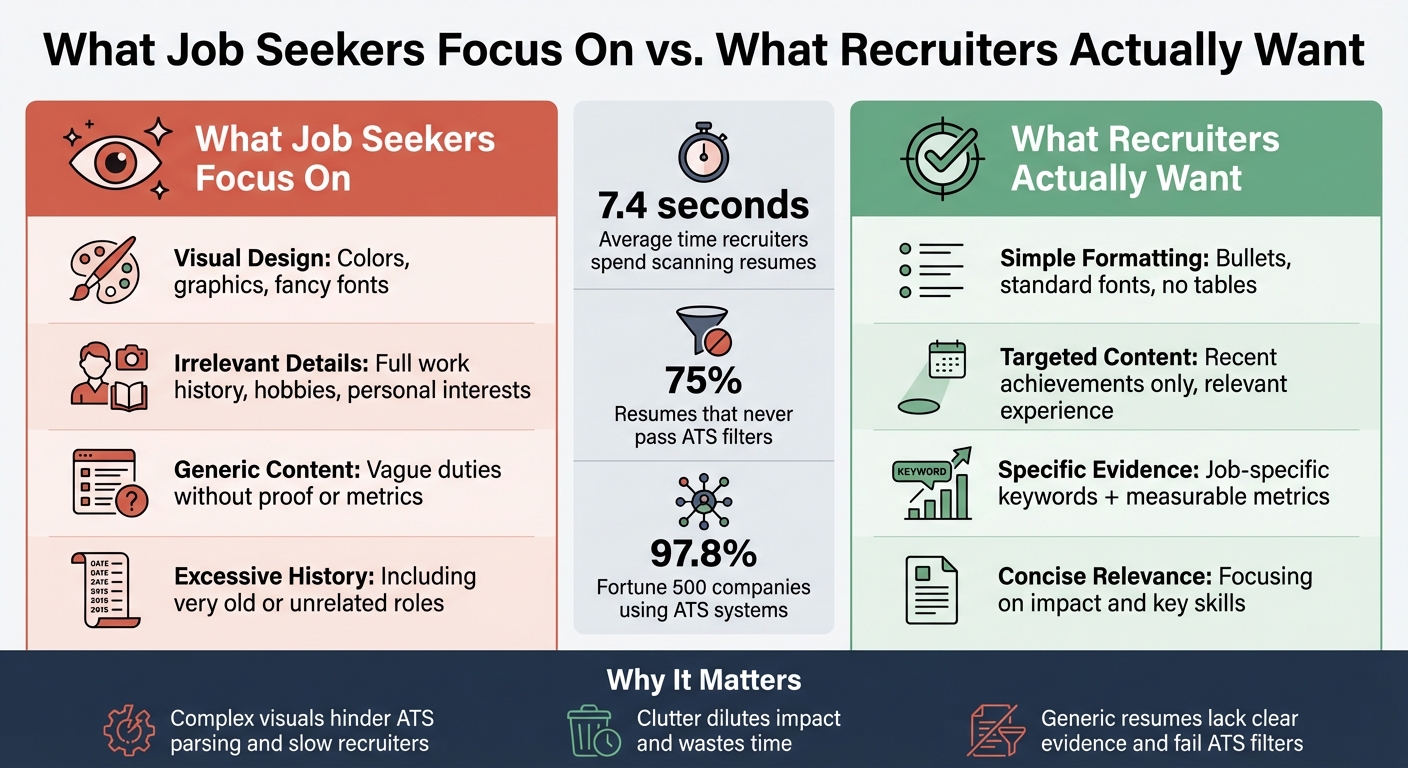
Resume Mistakes: What Job Seekers Do vs What Recruiters Want
The gap between what job seekers emphasize and what recruiters prioritize often boils down to differing goals. While candidates might focus on making their resumes visually appealing, recruiters look for straightforward evidence that aligns with the role's requirements. This mismatch explains why resumes that seem impressive to job seekers can fail to make an impact during hiring. Let’s explore how design choices, irrelevant details, and missing keywords can hold your resume back.
Too Much Focus on Visual Design
Many job seekers invest time in perfecting the aesthetics of their resumes - adding custom colors, creative layouts, or graphics like infographics and skill charts. While these elements may look sleek, they often do more harm than good. Applicant Tracking Systems (ATS) frequently struggle to interpret complex designs, and recruiters don’t have time to decode them.
For example, placing your contact details in a header or using text boxes can lead to ATS errors, meaning critical information like your email or phone number might not even get processed. Similarly, graphics indicating skill levels - such as "85% proficient in Excel" - are often ignored because ATS systems read plain text only.
Recruiters typically favor resumes with a clean, simple format: bulleted lists, left-aligned text, and standard fonts like Arial or Calibri. Fancy multi-column layouts may look polished but can disrupt readability, slowing down the review process. Instead, focus on a skills-first approach that highlights your abilities with clear examples of your work.
If you’re unsure about your resume’s formatting or its compatibility with ATS systems, services like scale.jobs can help create layouts that are easy to read and optimized for both software and human eyes.
Including Irrelevant Details
Another common misstep is adding unnecessary personal details or outdated information. Hobbies like "avid reader" or "weekend hiker", irrelevant volunteer work, or jobs from decades ago can clutter your resume and dilute its focus. These details may feel like they add personality, but they often distract from your qualifications.
Recruiters are interested in content that directly ties to the role. For instance, if you’re applying for a marketing manager position, listing an old retail job is only helpful if you can clearly show transferable skills. Similarly, personal interests should only appear if they’re relevant to the job - like mentioning marathon running for a fitness-related role.
Every part of your resume should answer this question: "Does this show I’m the right fit for this role?" Extra details force recruiters to sift through unnecessary information, increasing the chances they’ll move on to someone with a more focused resume.
Missing Job-Specific Keywords
One of the biggest mistakes candidates make is submitting a generic resume that doesn’t include keywords from the job description. ATS filters often screen out resumes that lack these specific terms, even if the candidate has the right skills.
For example, if a job posting mentions "stakeholder management", but your resume only says "client relations", the ATS might not recognize your qualifications. These systems rely on exact matches or close variations, so missing the right keywords can prevent your resume from ever reaching a recruiter.
Some candidates skip tailoring their resumes because it feels time-consuming or they don’t realize how critical ATS matching is. However, simply stuffing keywords into your resume without context can also backfire. Aim for natural integration of job-specific terms, maintaining a keyword density of about 2-3% across your summary, skills, and work experience sections.
To ensure your resume aligns with both ATS algorithms and recruiter expectations, consider using professional services like scale.jobs, which specialize in optimizing resumes for better results.
| Job Seeker Focus | Recruiter/ATS Preference | Why It Matters |
|---|---|---|
| Visual design (colors, graphics, fancy fonts) | Simple, scannable layout (bullets, standard fonts, no tables) | Complex visuals can hinder ATS parsing and slow recruiters down |
| Irrelevant personal details or full history | Targeted, recent achievements only | Clutter dilutes impact and wastes recruiters' time |
| Generic duties without proof | Job-specific keywords + metrics | Lacks clear evidence of capabilities and fails ATS filters |
Common Resume Mistakes That Turn Off Recruiters
Building on the earlier discussion of resume design mismatches, let's explore specific errors that often frustrate recruiters. Even if job seekers understand ATS compatibility and the importance of keywords, certain formatting and content missteps can still derail their chances. Recruiters, who sift through hundreds of resumes weekly, often reject candidates - not due to a lack of qualifications, but because their resumes make it unnecessarily hard to identify those qualifications quickly.
Bad Formatting and Hard-to-Read Layouts
Poor formatting can make a resume look sloppy. Resumes with inconsistent fonts, random bolding, or mismatched date formats (e.g., "Jan 2024" in one section and "01/2024" in another) can signal a lack of attention to detail. Additionally, using tables for skills, text boxes for contact details, or multi-column layouts often causes problems when ATS software parses the document.
Stick to clean, professional formatting: use 1-inch margins, left-aligned text, bulleted lists, and standard fonts like Arial or Calibri. Hyperlink your LinkedIn profile to text rather than pasting the full URL, and save your resume as a PDF named with your full name. Maintain consistent formatting for job titles, companies, and dates throughout the document.
While formatting helps recruiters navigate your resume, the content itself needs to clearly convey your achievements with real-life examples.
Vague Objectives and Missing Numbers
Outdated career statements like "Seeking a challenging role where I can grow professionally" don’t tell recruiters anything meaningful about your skills or experience. These generic objectives waste valuable space at the top of your resume - space that should instead highlight your specific value. Similarly, listing job duties without quantifiable results makes it difficult for recruiters to assess your contributions.
For example, replace "Managed social media accounts" with "Increased Instagram engagement by 47% within six months." Recruiters are drawn to resumes that include measurable achievements, such as percentages, dollar amounts, timelines, or team sizes. Resumes lacking these specifics often underperform, with callback rates hovering around 2%. In contrast, resumes showcasing concrete results can boost interview chances significantly.
Tailoring your content is just as important as getting the format right - generic resumes fail to stand out.
Using the Same Resume for Every Job
Sending the same resume to multiple employers might seem efficient, but it significantly lowers your chances of standing out. ATS systems are designed to scan for specific keywords from job descriptions, and recruiters often interpret generic resumes as a lack of effort or understanding of the role. Using an AI resume builder can help you efficiently tailor your document for each application.
To customize your resume, align it with the job description by mirroring the language in the summary and skills sections. Use the exact job title when possible, and remove irrelevant details that don’t align with the role. Tailoring ensures your resume highlights the qualifications most relevant to the job. Services like scale.jobs's professional resume services can help create targeted, ATS-friendly resumes that showcase your top achievements.
| Mistake | Why It Turns Off Recruiters | Fix |
|---|---|---|
| Inconsistent fonts, spacing, or date formats | Signals lack of attention to detail; breaks ATS parsing | Use one font, consistent spacing, and a uniform date format (e.g., "Jan 2024") |
| Generic objectives without specifics | Wastes valuable space; lacks a clear value proposition | Replace with a targeted summary that highlights relevant skills |
| No measurable results in job descriptions | Makes it hard to assess your impact | Include numbers: percentages, dollar amounts, timelines |
| Same resume for all applications | Fails ATS keyword matching; appears generic | Customize for each role using keywords from the job description |
How to Fix Your Resume for Recruiters
Make your resume stand out by addressing common formatting and content issues that often hinder its effectiveness.
Use ATS-Friendly Formatting
Applicant Tracking Systems (ATS) process resumes differently than human readers. Flashy designs with graphics, text boxes, or multiple columns can confuse these systems, leading to missing or scrambled information. To avoid this, stick to a single-column layout and use standard fonts like Arial, Calibri, or Times New Roman in sizes between 10 and 12 points. Maintain 1-inch margins and align all text to the left for consistency.
Use familiar headings such as "Work Experience", "Skills", and "Summary" to help ATS software correctly categorize your qualifications. Save your resume in a .docx or PDF format, depending on the job posting's requirements, and name the file in a professional manner, like "JohnSmith_Resume.pdf."
Avoid using tables for critical information like skills or contact details, as these can disrupt ATS parsing. Instead, list your skills in a straightforward bulleted format under a clearly labeled "Skills" section.
Add Keywords from Job Descriptions
With 97.8% of Fortune 500 companies relying on ATS systems, incorporating the right keywords is crucial for getting your resume noticed. These systems scan resumes for terms that align with the job description, so tailoring your resume to the specific role is essential.
Start by carefully reviewing the job posting. Pay attention to repeated terms in sections like "duties and responsibilities" or "preferred qualifications." Highlight relevant hard skills (e.g., software tools, technical expertise), soft skills (e.g., leadership, teamwork), certifications, and the exact job title mentioned in the listing. For instance, if the role specifies "project management", use that exact term instead of a variation like "project coordination."
Include both full terms and their acronyms to ensure your resume matches various search criteria. For example, write "Customer Relationship Management (CRM)" when first mentioning the term. Tools like Jobscan or SkillSyncer can help you compare your resume to a job description and identify missing keywords.
"Tailor your CV to mirror the job description, enhancing visibility."
– Amelia Dowty, Recruitment Lead for Europe, WTW
Integrate these keywords naturally throughout your resume - in the summary, skills section, and work experience. Avoid "keyword dumping", where terms are listed without context, as this can deter human recruiters who review your resume after it passes the ATS stage.
Show Results, Not Just Job Duties
Recruiters are more interested in your achievements than a list of responsibilities. Statements like "Managed social media accounts" don’t convey your impact. Instead, focus on measurable results by including numbers, percentages, dollar figures, or timeframes.
Use proven formulas to frame your accomplishments. The XYZ formula is particularly effective: "Accomplished [X] as measured by [Y], by doing [Z]." For example: "Increased Instagram engagement by 47% within six months by implementing a content calendar and testing post formats." Another approach is the "What? / So What?" formula, where you describe your action and its measurable outcome.
Start each bullet point with strong action verbs like "Generated", "Implemented", "Resolved", or "Led" rather than passive phrases like "Responsible for" or "Duties included." If specific metrics are unavailable, refer to past performance reviews or feedback to quantify your contributions.
Here’s a quick comparison of vague duties versus impactful results:
| Task | Result |
|---|---|
| Handled customer complaints | Resolved 300+ complaints weekly, maintaining a 97% satisfaction rating (12% above goal) |
| Improved office organization | Implemented a digital filing system that reduced document retrieval time by 30% |
| Managed a team of developers | Led a team of 12 to complete a software project 3 weeks ahead of schedule, saving $100,000 |
| Responsible for increasing sales | Boosted sales revenue by 25% ($2.5M) in Q3 2022 by targeting new market segments |
If you're struggling to create an ATS-optimized resume with the right keywords and quantifiable achievements, consider working with professional resume services. They can craft a polished, tailored document in just 24 hours, saving you time and effort while improving your chances of landing interviews.
Tools and Services for Better Resumes
Crafting a resume that aligns with recruiter expectations can be a game-changer in your job search. The right tools and services can help ensure your resume doesn’t get lost in an ATS (Applicant Tracking System) but instead lands you interviews. While platforms like Jobscan, Rezi, and TealHQ are popular choices, Scale.jobs offers a unique hybrid approach that combines AI efficiency with personalized, human-reviewed expertise.
ATS Checkers and Resume Builders
Many job seekers start with ATS checkers and AI resume builders to optimize formatting and keyword usage. Here’s a closer look at some popular options:
- Jobscan: At $49.95 per month, this tool focuses on ATS scanning, highlighting missing keywords and formatting issues. However, it doesn’t rewrite your resume for you.
- Rezi: With plans ranging from free to $40 per month, Rezi provides ATS-friendly templates but often produces generic content that lacks personalization.
- Wobo: Rated as a "Top Pick" for 2026, Wobo offers a free tier with a 24-metric ATS analysis, making it a strong choice for budget-conscious job seekers.
- TealHQ: Known for its Chrome extension and 4.9-star rating, TealHQ combines job tracking with resume optimization. It ensures high keyword density and formatting but, like others, lacks the personal touch.
While these tools excel at formatting and hitting keyword benchmarks, they often fall short in crafting a compelling narrative or addressing unique career situations. Platforms like Zety have also faced criticism for billing issues and limited AI features. For a more refined approach, human-reviewed resume services can bridge the gap.
Human-Reviewed Resume Services
Resumes crafted with human insight tend to achieve higher callback rates - 15–22% compared to 12–18% for AI-generated resumes. Human reviewers excel at showcasing leadership potential, addressing employment gaps, and crafting narratives that resonate with hiring managers. They also help achieve a 90–98% ATS pass rate without sacrificing natural language.
Scale.jobs stands out by combining AI-generated structures with human expertise. Here’s what sets it apart:
- Transparent Workflow: With real-time WhatsApp updates and proof-of-work screenshots, you’ll have full visibility into the customization process.
- Cost-Effective Pricing: For a one-time flat fee starting at $199, you get tailored resumes for up to 250 applications - eliminating the need for recurring subscriptions.
- Hybrid Approach: AI handles the initial structuring, while human experts refine the content, ensuring both ATS compatibility and an engaging narrative.
- Quick Turnaround: Resumes are often delivered within 24 hours, making it a reliable choice for urgent applications.
- Dedicated Support: The service ensures your resume is both technically optimized and compelling for hiring managers.
Professional resume writing services typically range from $150–$250 for entry-level roles, with executive packages going beyond $1,000. Scale.jobs offers a competitive edge by blending technology with human insight.
Resume Templates and Examples
Whether you choose an automated or human-reviewed service, the right template can further enhance your resume’s effectiveness. Avoid overly designed layouts with graphics or multi-column formats that could confuse ATS systems. Instead, opt for single-column templates that prioritize clarity and content hierarchy. This approach ensures your most relevant qualifications are immediately visible to both ATS systems and hiring managers.
Conclusion: Making Your Resume Work for Recruiters
Your resume has one main job: to pass ATS filters and grab a recruiter's attention within seconds. To do this, stick to a straightforward, single-column format, replace vague responsibilities with measurable achievements, and tailor each application to align with the specific job description. The key difference between what appeals to you and what works for recruiters lies in understanding their process. Recruiters are scanning for relevant keywords, clear evidence of your impact with real-life examples, and a layout that doesn’t slow them down.
Personalization is a must. Using the exact job title from the posting (when it reflects your experience) and highlighting the employer's top requirement in your very first bullet point can instantly prove your relevance. Even small adjustments - like sticking to standard section headers such as "Work Experience" - can make the difference between landing an interview or being overlooked. These tweaks reinforce the importance of aligning your resume with what recruiters expect to see.
When it comes to tools, results can vary. Automated tools like Jobscan and Rezi can help with formatting and keyword optimization but often lack the personal touch. On the other hand, human-reviewed resume services can significantly improve your chances. While DIY resumes might lead to fewer than 3 interviews per 100 applications, professionally tailored resumes can boost that number to about 6 interviews per 100 applications.
If you're sending out countless applications and need both ATS optimization and a personalized touch, professional services like scale.jobs can be a game-changer. Scale.jobs offers a blend of AI-driven efficiency and human expertise, including:
- Tailored resume revisions crafted by experts
- ATS-friendly single-column formatting with strategic keywords
- Real-time updates via WhatsApp, complete with proof-of-work screenshots
- One-time payment with no hidden fees
To take action, start by running your current resume through an ATS checker to identify potential issues in formatting or keyword usage. Next, refine your bullet points to emphasize specific numbers, outcomes, and skills that match the job description. If you’re not getting responses, the problem might not be your qualifications but how they’re presented. Switching from generic ATS tools to scale.jobs' transparent and human-driven service could be the solution you need to stand out.
FAQs
How can I make my resume compatible with ATS while still looking professional?
To craft an ATS-friendly resume that still appears professional, stick to a straightforward design that works well for both software and recruiters. Opt for a single-column layout and use standard fonts such as Arial or Calibri. Avoid elements like graphics, text boxes, or multi-column formats, as these can confuse ATS systems.
Make sure to include keywords from the job description in sections like "Work Experience" and "Skills" to match the employer's criteria. Save your resume as a .docx file or a text-based PDF, as these formats are generally ATS-compatible. Use standard section headings like "Education" and "Experience", and steer clear of overly elaborate formatting. This method ensures your resume gets through ATS screening while still looking polished for human reviewers.
What keywords should I include in my resume to stand out?
The most effective keywords for your resume are those that closely match the job description and reflect terminology specific to the industry. Pull terms directly from the job posting - like "project management", "data analysis", or "software development" - to align with what recruiters and applicant tracking systems (ATS) prioritize.
Highlight measurable accomplishments to give your experience more weight. For example, phrases like "increased sales by 23%" or "managed a team of 10" demonstrate tangible results. However, avoid cramming your resume with too many or unrelated keywords, as this can feel forced and work against you. Instead, tailor your resume for each job application by emphasizing the skills, tools, and qualifications that the employer is seeking. Using targeted, well-chosen keywords ensures your resume grabs the attention of both hiring managers and ATS systems.
How can I use numbers to highlight my achievements on my resume?
Using numbers on your resume is a powerful way to highlight your achievements and clearly show the impact you've had in previous roles. Instead of using general statements, include measurable results to illustrate the value you brought to your team or organization. For instance, rather than saying you "improved efficiency", you might write, "streamlined processes, cutting project turnaround time by 25%."
To make this work, focus on metrics that matter, such as revenue growth, cost savings, time reductions, or percentage improvements. If precise numbers aren't available, provide reasonable estimates to give a sense of scale. For example, you could say, "boosted team productivity by approximately 20% within six months." These specifics make your accomplishments more concrete and help your resume stand out during a recruiter’s quick review.
Including quantifiable achievements not only captures attention but also enhances the credibility of your experience, increasing the likelihood of landing an interview.