
Resume Objective Section: What ATS Systems Actually Read

Sarah Mitchell
December 10, 2025
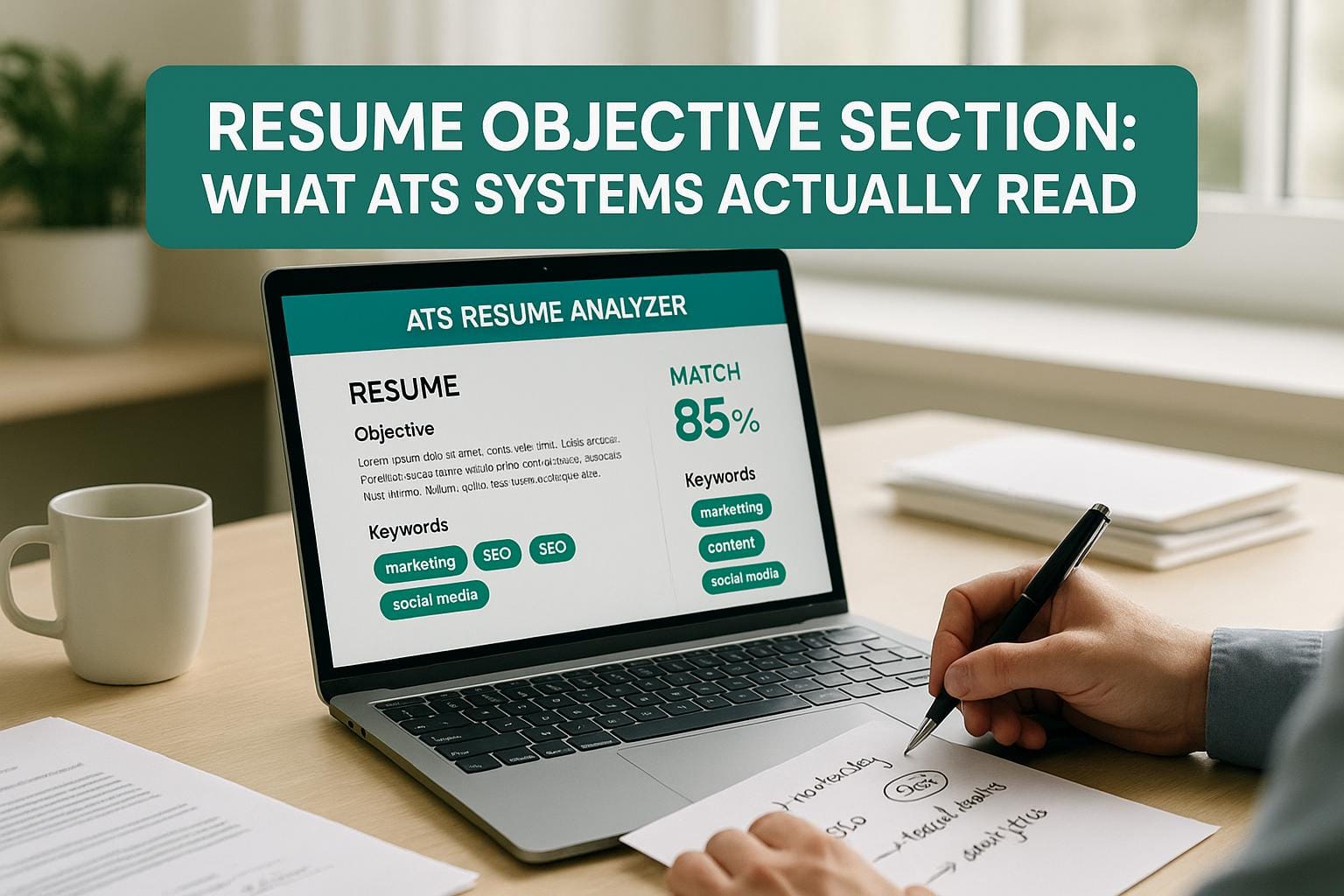
When applying for jobs online, your resume often goes through an Applicant Tracking System (ATS) before reaching a recruiter. ATS software scans resumes for keywords, skills, and qualifications to determine if you're a match for the job. The objective section, located at the top of your resume, is one of the first areas ATS evaluates. Here's what you need to know:
- ATS prioritizes keywords: Include relevant terms from the job description, like specific skills, certifications, and job titles.
- Avoid vague language: Generic phrases like "seeking a challenging role" won’t help your match score.
- Formatting matters: Use a simple layout with standard fonts and avoid tables or images to ensure ATS can read your resume.
- File format impacts success: Save your resume as a .docx file for better compatibility.
For a tailored approach, platforms like scale.jobs offer human-powered resume optimization, creating ATS-friendly resumes and objective sections for each job you apply to. This can save time and improve your chances of passing the ATS filter.
Key takeaway: Craft your objective section with precise, job-specific keywords and simple formatting to increase your chances of passing ATS and securing an interview.
Can an ATS System Read My Resume Objective?
How ATS Systems Read the Objective Section
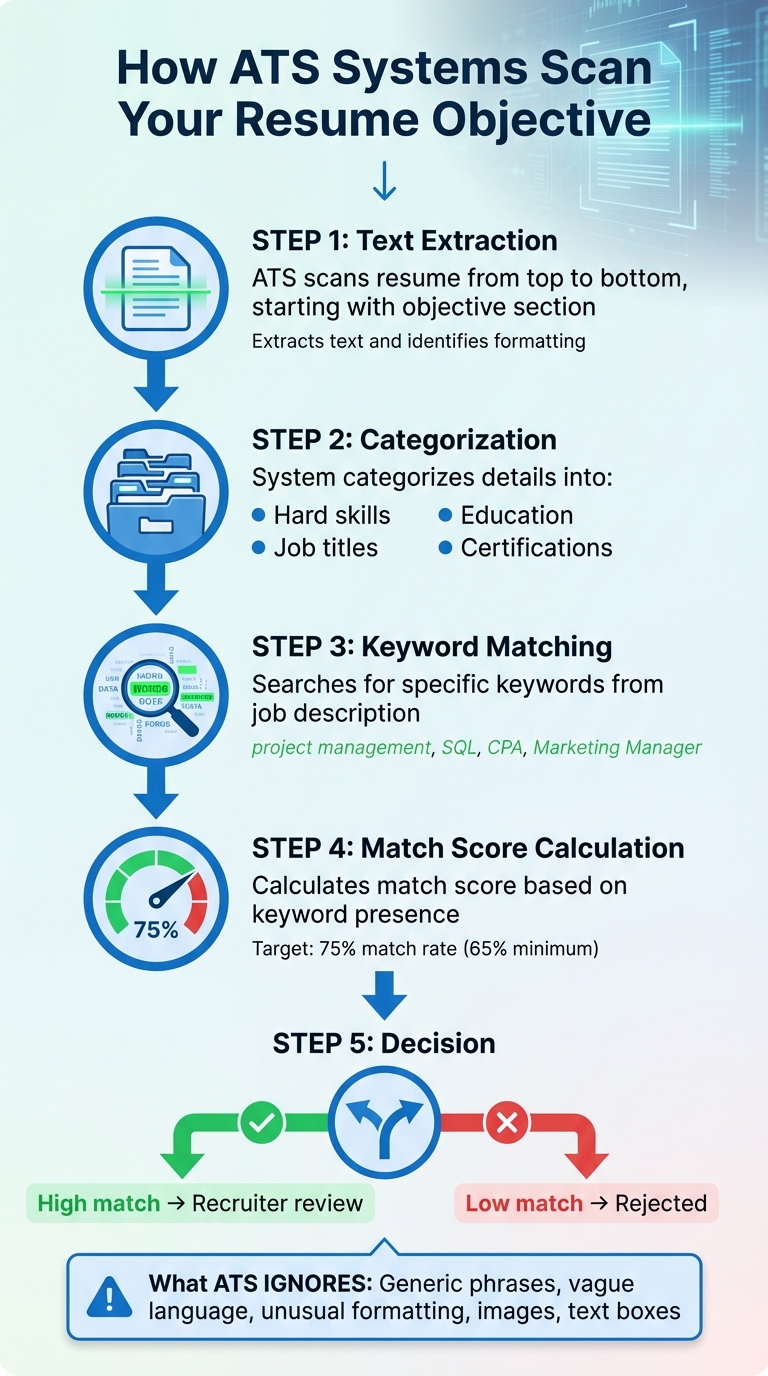
How ATS Systems Scan and Score Resume Objective Sections
The ATS Scanning Process Explained
To understand why your objective section matters, it helps to know how ATS (Applicant Tracking Systems) process resumes. These systems analyze resumes from top to bottom, starting with the objective section. They extract text, identify formatting, and categorize details like skills, job titles, and education. Afterward, they calculate a match score based on the presence of specific keywords.
As Jobscan explains, "An ATS will scan your resume and search for certain keywords, skills, job titles, and education that the recruiter is looking for." This match score determines whether your application advances or gets filtered out. Knowing this process makes it clear why tailoring your objective section is so important.
What ATS Systems Look For
Once the ATS parses your resume, it zooms in on specific details like hard skills and job titles. Hard skills are the top priority. For example, if the job description mentions "project management", "SQL", or "financial analysis", the ATS will search for those exact terms in your objective.
Job titles are another key factor. If you're applying for a "Marketing Manager" position, including that title in your objective signals direct relevance to the role.
Education requirements also play a role, especially if the job specifies an advanced degree. Including industry-specific terms, certifications, and both the long-form and acronym versions of terms - like "Search Engine Optimization (SEO)" - can boost your score. This ensures the ATS identifies your qualifications, no matter how the employer phrases their requirements. Focus on hard skills, job titles, education, and certifications to make your objective section stand out.
What ATS Systems Skip or Ignore
While ATS systems are great at spotting relevant keywords, they ignore generic or vague phrases that don't align with the job description. Statements like "seeking a challenging position" or "looking to grow my career" don’t improve your match score. Similarly, subjective claims like "team player", "hard worker", or "results-oriented" are skipped unless they’re backed by context or examples.
Formatting issues can also cause problems. Using unusual fonts, text boxes, or images might prevent the ATS from reading your resume correctly. Additionally, non-specific phrases or jargon that doesn’t match the job description will be ignored, lowering your match score. Keep your objective clear, specific, and formatted for easy parsing.
How to Write an ATS-Friendly Objective Section
Formatting Rules for ATS
To make sure your resume gets through an Applicant Tracking System (ATS) without a hitch, formatting is key. Stick to a single-column layout and opt for a chronological or hybrid format. ATS systems often struggle with tables, columns, or text boxes, so keeping things straightforward ensures your information is read correctly.
Choose standard fonts like Arial, Calibri, or Times New Roman, and use clear headings such as Objective, Experience, and Education to help the system categorize your details. Avoid using headers and footers altogether - ATS software may not read content placed there, which could mean losing important information.
How to Add Keywords Naturally
Keywords are essential for ATS compatibility, but they need to be used thoughtfully. Pull these directly from the job description, focusing on hard skills, certifications, or job titles that are mentioned multiple times. For example, if the job posting highlights "financial analysis", "budget forecasting", or "CPA certification", include those exact terms in your objective.
Rather than cramming keywords into a list, weave them into sentences that showcase your qualifications. For instance: "Certified Public Accountant with 5+ years of financial analysis experience seeking a Senior Accountant role to apply budget forecasting and compliance expertise." This method not only incorporates keywords but also highlights your value to the employer.
Once you've refined your content with the right keywords, double-check that your formatting supports smooth ATS parsing.
Best File Formats for ATS
The file format you choose can make or break your resume's ATS compatibility. Unless otherwise specified in the job posting, save your resume as a .docx file. Research shows that ATS software processes .docx files more reliably than other formats. While PDFs can work, they sometimes cause parsing errors depending on how they were created.
Steer clear of embedding images, graphics, or intricate design elements in your resume. These might look great to human readers, but ATS systems can't interpret them - or worse, they might distort your content during the scan. Keep it simple: plain, text-based content in a .docx file gives you the best shot at making it through the system intact.
Keyword Strategies for ATS Success
How to Pull Keywords from Job Postings
Carefully read through the job description to identify what the employer values most. Focus on hard skills like "Python", "financial analysis", or "CPA certification", as well as soft skills such as "cross-functional team leadership" or "problem-solving." Pay attention to industry-specific terms that are repeated throughout the posting - these are often key priorities.
To maximize your chances with ATS (Applicant Tracking Systems), include both the full and abbreviated versions of terms. For example, if the job mentions "Project Management Professional", make sure to use both "Project Management Professional" and "PMP" in your resume. This approach also applies to certifications, software, and technical qualifications. The next step is integrating these keywords naturally into your skills and experience.
Mixing Technical and Soft Skills
Using your keyword list, aim for a balance between technical and soft skills in your resume. Start by emphasizing hard skills, as these are usually the priority, but don’t neglect soft skills - especially if the job description highlights them.
For instance, if the posting mentions "budget forecasting" and "stakeholder communication", you can craft a statement like: "CPA with 7+ years of experience in budget forecasting and effective stakeholder communication seeking a Senior Accountant role." This way, you address both the technical expertise and interpersonal abilities the employer is looking for, all while keeping the tone natural and professional.
Testing Your Objective with ATS Tools
After fine-tuning your keywords, it’s smart to test your resume using ATS tools to gauge its effectiveness. Tools like Jobscan allow you to scan your resume for free and recommend aiming for a 75% match rate with the job description. While a lower match rate (around 65%) can still work, overloading your resume with keywords can backfire when a human recruiter reviews it.
Other tools, like Rezi, offer a free version that highlights missing keywords, making it easier to refine your resume without guesswork. Simplify is another platform that helps job seekers improve their chances of hearing back by optimizing their applications. These tools provide a clear view of how your resume aligns with the job requirements and what tweaks can boost your chances.
scale.jobs vs. Automated ATS Tools: Which Works Better?
Understanding how ATS systems work is just the beginning; picking the right tool or service can make all the difference in your job search.
scale.jobs vs. Jobscan, Teal, and Rezi
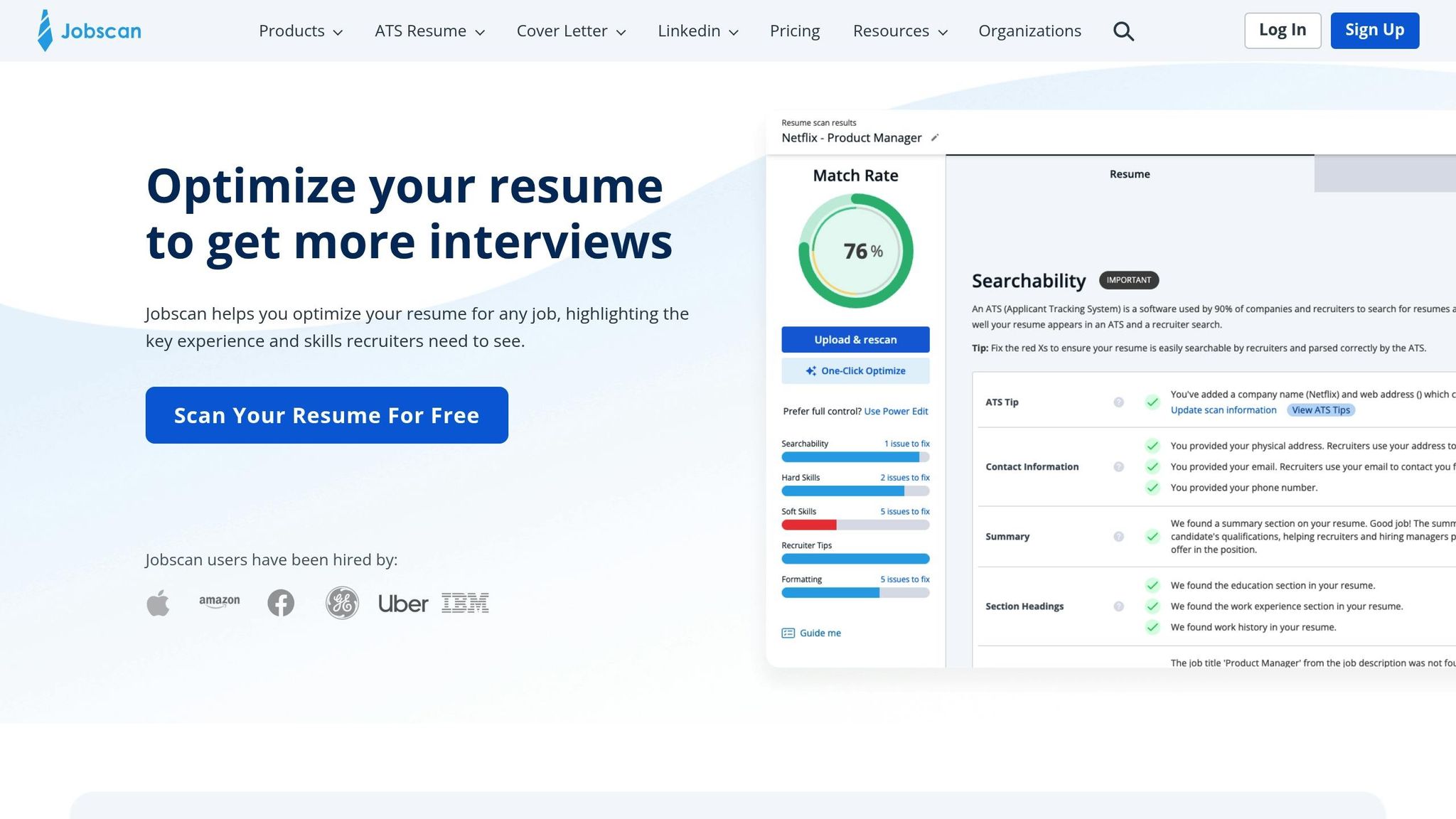
Automated ATS tools like Jobscan, Teal, and Rezi rely on algorithms to analyze your resume and recommend keyword optimizations to improve your ATS match rate. However, these platforms leave the actual updating, tailoring, and submission of your applications entirely in your hands.
On the other hand, scale.jobs takes a hands-on, human-powered approach. Instead of giving you a checklist, the platform assigns dedicated assistants who create custom, ATS-compliant resumes and cover letters for each job you apply to. They even craft personalized objective sections tailored to the role. With scale.jobs, you also get real-time updates via WhatsApp, proof-of-work screenshots with timestamps, and a user-friendly application dashboard. Their pricing is straightforward: $199 for 250 applications, $299 for 500, or $399 for 1,000 applications - with no hidden fees or recurring subscriptions.
According to scale.jobs, 93% of customers secure jobs within three months, with 47% of those roles coming directly from applications submitted by their assistants. Additionally, 70% of customers receive refunds because they land jobs before using all their credits. In comparison, automated tools like Jobscan claim to boost interview chances by 50%, and Rezi reports a 62.18% interview rate - but their success depends entirely on your ability to implement their suggestions and manage the entire application process.
This comparison underscores how human-assisted services can address the gaps left by automated tools.
Why scale.jobs Outperforms Automated Tools
Here’s why scale.jobs stands out: its human-first approach. Unlike automated tools that rely solely on algorithms, scale.jobs employs human assistants who understand the nuances and context that can make your application shine. During onboarding, they take the time to understand your career goals and tailor objective sections to reflect your unique experience.
Scale.jobs also excels with features like dedicated WhatsApp support, proof-of-work transparency, compatibility with any job portal, and a 24-hour turnaround for custom resumes. These elements not only streamline the process but also cut the average job search time from five months to just one to three months - delivering a 200x return on investment. One customer shared:
"Great team of people and the person that was assigned to work with me was wonderful too. Majority of the heavy lifting is done by them and they are in constant communication with you."
While automated tools can help with resume scanning and keyword optimization, scale.jobs takes care of these tasks for you, saving 20+ hours a week so you can focus on networking and preparing for interviews.
These benefits clearly set scale.jobs apart, offering a more effective and time-saving solution for job seekers.
Key Takeaways
To improve your resume's performance with ATS (Applicant Tracking Systems), focus on these essential strategies: format your resume with precision, integrate keywords naturally, and tailor your content to the job description. Use keywords found directly in job postings, including both full terms and their acronyms. Steer clear of formatting choices that might confuse ATS software.
Automated tools like Jobscan, Rezi, and Teal can analyze your resume and offer suggestions, but the actual editing is still up to you. For a more hands-on approach, scale.jobs provides a human-powered service. Their dedicated assistants create custom, ATS-optimized resumes and objective sections for each application, saving you over 20 hours of effort per week.
Here’s what the numbers show:
- 93% of scale.jobs customers secure jobs within three months.
- 47% of those roles come from applications submitted by their assistants.
- 70% request refunds because they land jobs before using all their credits.
Scale.jobs demonstrates how human expertise can outperform automated tools. With personalized WhatsApp support, proof-of-work transparency, and a 24-hour turnaround for custom documents, they handle the heavy lifting of ATS optimization. This leaves you free to focus on networking and preparing for interviews.
FAQs
How do I make my resume's objective section ATS-friendly?
To make the objective section of your resume more ATS-friendly, focus on integrating keywords directly from the job description. These keywords should reflect the skills and qualifications the employer is looking for. Craft a brief and clear statement that not only highlights your career goals but also shows how they align with the specific role.
Avoid using graphics, images, or intricate formatting, as these can confuse ATS software. Stick with a simple, traditional font, and ensure your text is easy to read. For better compatibility, include both full terms and their acronyms (like "Search Engine Optimization" and "SEO"). Always customize your objective section for each job application. By keeping it straightforward and tailored, you’ll increase your chances of getting through ATS scans.
What keywords should I include in my resume to pass ATS scans?
To make your resume more ATS-friendly, start by using keywords straight from the job description. This includes job titles, required skills, certifications, and relevant industry jargon. Be sure to include both the full terms and their abbreviations - for example, write out "Search Engine Optimization" alongside "SEO."
Balance your keyword usage by incorporating a combination of hard skills (like technical expertise or software knowledge) and soft skills (such as communication or leadership abilities). Customize your resume for each job by matching your terminology to the language in the posting, ensuring the ATS can easily identify and rank your application.
What makes scale.jobs better than automated ATS tools?
Scale.jobs takes a unique approach by blending human expertise with advanced technology to craft resumes and cover letters that work seamlessly with ATS systems. Unlike fully automated tools, Scale.jobs provides personalized support through dedicated human assistants. This ensures your application not only meets job requirements but also highlights what makes you stand out.
What’s more, Scale.jobs operates on a one-time payment model, saving you from ongoing fees. They also offer proof-of-work transparency, so you can clearly see the improvements made to your application. To top it off, their dedicated WhatsApp support provides real-time help, making the entire process smooth and hassle-free. This human-first approach consistently outshines fully automated ATS tools.