
Scale.jobs vs Ladders vs Ivy Exec: best for senior-level job hunters

Sarah Mitchell
August 13, 2026

If you’re a senior candidate, the best pick depends on where you get stuck: finding roles, or finishing applications.
Here’s the short answer:
- Ladders is best if you want a cleaner list of $100k+ U.S. roles
- Ivy Exec is best if you want a more private executive search
- Scale.jobs is best if you already have roles to target and want help to Apply for jobs without doing each portal yourself
The biggest difference is simple: Ladders and Ivy Exec help you find jobs. Scale.jobs helps submit them.
For many director, VP, and executive candidates, that matters more than job volume. A senior application can take 15 to 40+ minutes once you hit custom portals, screeners, and customizing your resume. So if your issue is time, the better question is not “Which site has more listings?” It’s “Which one cuts the work I still have to do?” For those who need to move even faster, an executive job search team can manage the entire process for you.
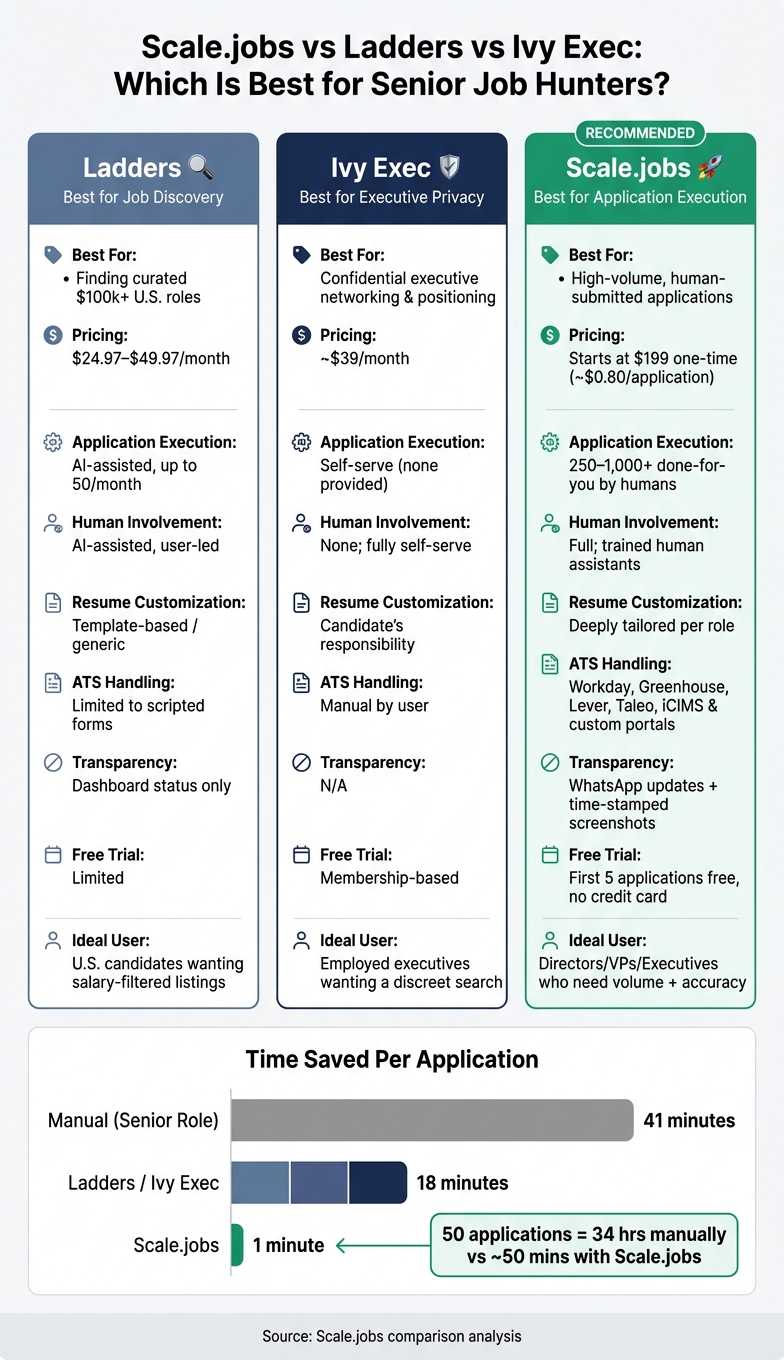
Scale.jobs vs Ladders vs Ivy Exec: Senior Job Search Tools Compared
Quick comparison
| Tool | Best for | Pricing | What you still do |
|---|---|---|---|
| Ladders | $100k+ job discovery in the U.S. | $24.97–$49.97/month | Most applications, plus role follow-up |
| Ivy Exec | Private executive listings and career support | About $39/month | All applications yourself |
| Scale.jobs | Done-for-you applications | Starts at $199 one time | Share target roles and review progress |
If you want a better job search platform, Ladders or Ivy Exec may fit. If you want a job application service that handles the admin side, Scale.jobs fits that use case better.
Below, I’ll break down who each one is for, when each is worth paying for, and when it makes sense to switch.
sbb-itb-564272e
What Ladders and Ivy Exec Actually Are

Ladders sells higher-salary discovery. Ivy Exec sells private executive access. Those are two different problems, and that difference changes which tool makes sense for your search.
If your main issue is too much noise, Ladders is built to narrow the field. If your main issue is privacy and senior-level positioning, Ivy Exec leans more in that direction. Neither one is built to fully handle the apply step for you, which is where many job seekers still get stuck when they try to apply for jobs.
What Ladders Actually Is
Ladders is a U.S.-focused job board built around $100k+ roles, with a minimum $80k base salary threshold. That filter cuts out a lot of lower-fit listings fast, which is the main draw.
It also gives members access to 25,000+ recruiters, and Apply4Me can submit up to 50 applications per month. Pricing usually falls between $24.97 and $49.97/month, depending on the plan.
For senior candidates aiming at $100k to $150k roles, that’s the core pitch: less clutter, more salary alignment, and some help with outbound applications. If you're comparing it to other best job boards, that salary filter is the piece that stands out most.
What Ivy Exec Actually Is
Ivy Exec works more like a curated executive membership than a standard job board. It focuses on private executive listings, which matters if you’re employed right now and don’t want your search to be visible.
Membership usually includes tailored matches, mentorship, and executive career advice. Pricing is typically around $39/month.
That setup can help with positioning, especially for leadership candidates who want a more selective search experience. But it still isn’t built to take over the hands-on application work. If you want help with outreach, targeting, and follow-through, that usually calls for a job search coach or a job application service.
Where each one is actually strong
Ladders is strongest at salary-based discovery and recruiter reach. Ivy Exec is strongest at confidentiality, curated matches, and executive-level branding.
Here’s the simple split:
- Ladders: better for finding higher-paying roles fast
- Ivy Exec: better for private access and executive-focused guidance
- Both: still leave the apply step mostly on you
That gap matters once you move from browsing to submitting. Finding a role is one thing. Getting tailored applications out the door, at scale, is another. That’s why some people pair these tools with a job search virtual assistant or a Virtual Assistant for Job Applications.
The Reframe: These Are Not the Same Category
Ladders and Ivy Exec help with discovery. Scale.jobs handles submission. That split matters the moment you stop browsing and start trying to Apply for jobs.
Here’s the plain version: finding a role is only one part of the process. Once you click apply, the same work is still sitting there waiting for you. You still have ATS forms. You still have screener questions. You still need custom docs. That’s where a lot of senior candidates get stuck.
This is why grouping these tools together can be misleading. A job search platform helps you spot openings. A job application service helps you get those applications out the door.
The 5-Minute Trap for Senior Applications
At the Director and VP level, the so-called quick apply flow often falls apart.
Custom career portals, login walls, and captchas at companies like Apple, Spotify, or Amazon can turn a “fast” application into 20+ minutes of manual work. And that’s before you deal with role-specific questions or upload the right version of your resume.
Generic submissions also tend to lose steam at this level. Senior applications usually need fit, accuracy, and tailoring. Shortcuts sound good at first, but they don’t save much when each company has its own process.
If you’ve ever tried to apply to a batch of senior roles in one sitting, you know how it goes. The first application feels fine. By the fifth, you’re buried in tabs, passwords, dropdowns, and repeated work.
quick apply breaks down fast on senior roles.
That’s the heart of the problem.
Time Math: Manual vs Ladders or Ivy Exec vs Scale.jobs
The time gap gets hard to ignore once you look at it step by step.
| Task | Manual (Senior Role) | Ladders / Ivy Exec | Scale.jobs |
|---|---|---|---|
| Find job | 10 mins | 5 mins | 1 min (select from list) |
| Log in / navigate | 5 mins | 2 mins | 0 mins |
| Fill ATS form | 10 mins | 5 mins (Apply4Me, where available) | 0 mins |
| Tailor resume / cover letter | 10 mins | 0 mins (generic template) | 0 mins (assistant handles) |
| Screener questions | 5 mins | 5 mins (still on you) | 0 mins |
| Submit & confirm | 1 min | 1 min | 0 mins |
| Time per application | ~41 mins | ~18 mins | ~1 min |
| Time for 50 applications | ~34 hours | ~15 hours | ~50 mins |
That spread explains a lot. Discovery tools can help you find openings faster, including full time jobs and Part time jobs near me. But they don’t remove most of the work that comes after the click.
Scale.jobs is closer to a Virtual Assistant for Job Applications than a listing site. If the slowest part of your process is submission, that distinction matters more than people think.
It also helps explain why some job seekers pair different tools together. They may use one of the best job boards to spot openings, then use a service built for execution to handle the admin-heavy apply step.
That gap is why the next section focuses on the part that actually eats up time: the submit step.
Where Scale.jobs Is Different
This is where the gap gets obvious: discovery tools still leave the submit step on you. Scale.jobs handles the part that gets applications out the door - software plus human assistants working inside the ATS and company portals you send over.
If you're trying to Apply for jobs at scale, that changes the day-to-day in a pretty big way.
Why Scale.jobs Wins in the Application Phase
The main difference is human execution. When a Scale.jobs assistant submits your application to companies like Meta, Netflix, or Apple, they log in, move through the portal, fill in each field, answer screener questions, and upload a resume shaped for that role, not copied from one master version. That includes Workday, Greenhouse, Lever, Taleo, iCIMS, and custom portals.
That matters because many senior candidates don't get stuck on job discovery. They get stuck on the grind of portal-by-portal submission. A tool can show you openings. A human team can get them filed.
Here’s what that looks like in practice:
- No bot-style automation layer. Every submission is human-led vs. automated, so you’re not stuck with scripted form fills. That’s often where the “can’t-login” issue hits senior candidates the hardest.
- Timestamps and screenshots for each submission. You get WhatsApp updates with time-stamped screenshots for each application, not just a dashboard total.
- Tailored docs per role. Resumes and cover letters are adjusted for each posting, not recycled from a single file. If you're using an ai resume builder or an ai cover letter builder, this step adds the human pass many job seekers still need.
- Strategy reviews every 15 days. The team checks what’s landing and shifts targeting as needed. A board subscription doesn’t do that.
- Usually under 24 hours from shortlist to submission.
On pricing, the math is simple. Three months of Ladders costs $75–$147 with no application execution included. Scale.jobs’ basic plan is a one-time $199 for 250 applications, fully submitted by humans - about $0.80 per application - with a pro-rata refund on unused credits if you land a job early.
That’s a very different setup from paying each month just to browse listings on best job boards.
Full Feature Comparison: Ladders vs Ivy Exec vs Scale.jobs
| Feature | Ladders | Ivy Exec | Scale.jobs |
|---|---|---|---|
| Human involvement | AI-assisted, user-led | none; self-serve | full; trained human assistants |
| Resume customization depth | template-based / generic | candidate's responsibility | deeply tailored per role |
| ATS handling | limited to scripted forms | manual by user | covers Workday, Greenhouse, Lever, Taleo, iCIMS, and custom portals |
| Login walls & captchas | usually skipped by bots | candidate handles | handled by humans |
| Application execution | AI-automated, capped at 50/month | none | done-for-you, 250–1,000 applications depending on plan |
| Transparency & proof of work | dashboard status only | n/a | WhatsApp + time-stamped screenshots |
| Pricing model | monthly subscription ($25–$49/mo) | membership subscription | one-time bundle ($199+) |
| Bot-detection risk | higher with automation | n/a | no bot-style automation pattern |
| Geographic focus | primarily US | global / US | global / US |
| Role seniority focus | $100k+ listings | $100k+ / executive | director / executive focus |
| Coaching & strategy support | career articles | mentorship / advisors | strategy calls every 15 days |
| Job discovery quality | curated $100k+ board | discreet / exclusive board | AI job board + browser extension |
| Done-for-you applications | up to 50/month via Apply4Me | none | 250–1,000 depending on plan |
| Refund policy | limited | varies | pro-rata on unused credits |
| Support channel | email / phone | membership support | dedicated WhatsApp + video calls |
| Turnaround | varies | n/a | typically under 24 hours |
| Free trial | limited | membership-based | first 5 applications, no card |
| Ideal use case | passive $100k+ job browsing | discreet executive networking | senior leaders who need volume + accuracy |
You can read this another way: Ladders and Ivy Exec are mainly discovery products. Scale.jobs is closer to a job application service with hands-on follow-through.
For someone chasing full time jobs at the director or executive level, that gap can be the whole ballgame. The same is true if your search includes location-based roles like Part time jobs near me, where speed and volume still matter.
Scale.jobs Free Trial: First 5 Applications Are Free
Before you pay anything, Scale.jobs submits your first five applications at no cost - no credit card, no time limit.
Ladders and Ivy Exec don’t offer a similar hands-on trial for the application execution step, because neither one handles that step for you.
If you’re comparing a job search platform with a done-for-you layer, this is the cleanest way to test the difference for yourself. A virtual assistant for job seekers sounds abstract until you see five applications actually submitted on your behalf.
That’s the test; next comes the actual choice of which tool fits your search.
Who Should Use Each Option and When to Switch
At this stage, the choice has less to do with brand and more to do with where your job search is getting stuck.
Who Should Use Ladders, Who Should Use Ivy Exec, Who Should Choose Scale.jobs
Use Ladders if your main problem is finding the right openings, not sending applications. It works best for U.S.-based candidates chasing $100k+ roles who want better filtering and signal, not hands-on help to Apply for jobs.
Use Ivy Exec if you care more about privacy and senior-level positioning than sheer application output. It makes sense for a quieter executive search where visibility needs to be handled with care.
That’s the split: discovery and positioning on one side, execution on the other.
Choose Scale.jobs when the issue is no longer finding openings on a job search platform. The issue is getting applications out the door. Scale.jobs fits searches where volume, accuracy, and portal handling matter more than browsing tools. A lot of candidates use Ladders or Ivy Exec to find roles, then pass those job links to Scale.jobs through its job application service for submission.
Switch to Scale.jobs If
The switch usually happens when your search stops being about finding jobs and starts being about finishing applications.
- You already have a shortlist of roles but don’t have time to apply
- You need more than 50 applications per month - Ladders’ Apply4Me stops there, while Scale.jobs handles 250–1,000+ based on plan
- Login walls, captchas, and custom employer portals keep slowing you down
- You want WhatsApp updates for each submission, not just a dashboard total
- You need a Virtual Assistant for Job Applications instead of another place to browse listings
Decision Summary
| Tool | Best For | Pricing Model | Application Execution |
|---|---|---|---|
| Ladders | Finding curated $100k+ U.S. roles | Monthly subscription | AI-assisted, up to 50/month |
| Ivy Exec | Confidential executive networking | Membership-based | Self-serve |
| Scale.jobs | High-volume human-submitted applications | One-time campaign fee | 250–1,000+ done for you |
If discovery is enough, stick with Ladders or Ivy Exec. If application work is the choke point, switch to Scale.jobs. You can also pair discovery tools with a job search virtual assistant when the main goal is to move faster without doing every portal by hand.
The first 5 applications are free - no credit card, no time limit.
FAQs
Should I use one tool to find jobs and another to apply?
Yes - if the tool mainly helps you find job leads and not finish the application itself.
Ladders and Ivy Exec can help with senior-level openings. They work best as a job search platform for discovery. But once you find a role, you still need to deal with the ATS, fill out the forms, upload files, and submit everything on your own.
That’s where Scale.jobs is different. It’s not a job board. It’s a job application service built for people who want help with the actual submission work. You get human-powered applications, tailored documents, and a one-time fee instead of a monthly subscription.
If your main problem is finding openings, tools like the best job boards may help. If your main problem is time, follow-through, or application volume, a Virtual Assistant for Job Applications or job search virtual assistant setup makes more sense.
How much time can a done-for-you application service save?
A done-for-you service saves the most time when it covers the entire workflow, not just quick apply.
Ladders helps speed up parts of the process. Ivy Exec leans more toward networking and coaching. But with both, you still handle a lot yourself.
Scale.jobs works differently. For $199 for 250 apps, human assistants build ATS-optimized resumes and cover letters, then manually submit applications for you. You also get WhatsApp proof of work, so you’re not stuck in the 5-minute quick-apply loop that often leads nowhere.
If your main goal is to Apply for jobs at scale without doing the admin yourself, this setup makes a big difference. It blends a done-for-you job application service with hands-on support from a Virtual Assistant for Job Applications, instead of leaving you to bounce between tools, tabs, and half-finished forms.
When does it make sense to switch from job discovery to application help?
It makes sense to switch gears once finding roles stops being the hard part and getting applications out the door becomes the slowdown.
Tools like Ladders or Ivy Exec can work well if your main need is curated listings and easier browsing. They’re built to help you spot roles.
But if the drag comes from repeat tasks, application support is the better fit. That’s where a job application service can save time. The key difference is simple: those tools help you find jobs to apply to, while Scale.jobs handles the submission work for you.
In other words, they’re closer to a job search platform. We’re closer to a Virtual Assistant for Job Applications built for people who already know they should be applying more, but don’t have the time or energy to keep doing the same forms over and over.
If your goal is to Apply for jobs at a higher volume without spending hours on each one, that shift matters. It can also pair well with support from a job search virtual assistant when you want less admin work and more momentum.