
Tsenta Pricing: Plans, ATS Coverage & Is It Worth It?

Sarah Mitchell
July 21, 2026

If you want the short answer: Tsenta is a low-cost bot for a fixed set of 19 ATS platforms, while Scale.jobs is a done-for-you service run by people across almost any job portal. That means the choice is less about monthly price and more about how much of your job hunt still stays on your plate.
Here’s the simple breakdown:
- Tsenta fits people who want lower-cost automation on supported ATS systems.
- Scale.jobs fits people who want help with the full workflow, not just form filling.
- Tsenta costs $39/month
- Scale.jobs starts at $199 for 250 applications
- Scale.jobs also offers the first 5 applications free
- Tsenta supports 19 ATSes
- Scale.jobs is built around human handling across mixed portals
If you’re trying to Apply for jobs across company sites, old portals, and ATS pages, this gap matters fast. A bot can cut typing time. A person can finish the application when the portal gets messy.
Quick Comparison
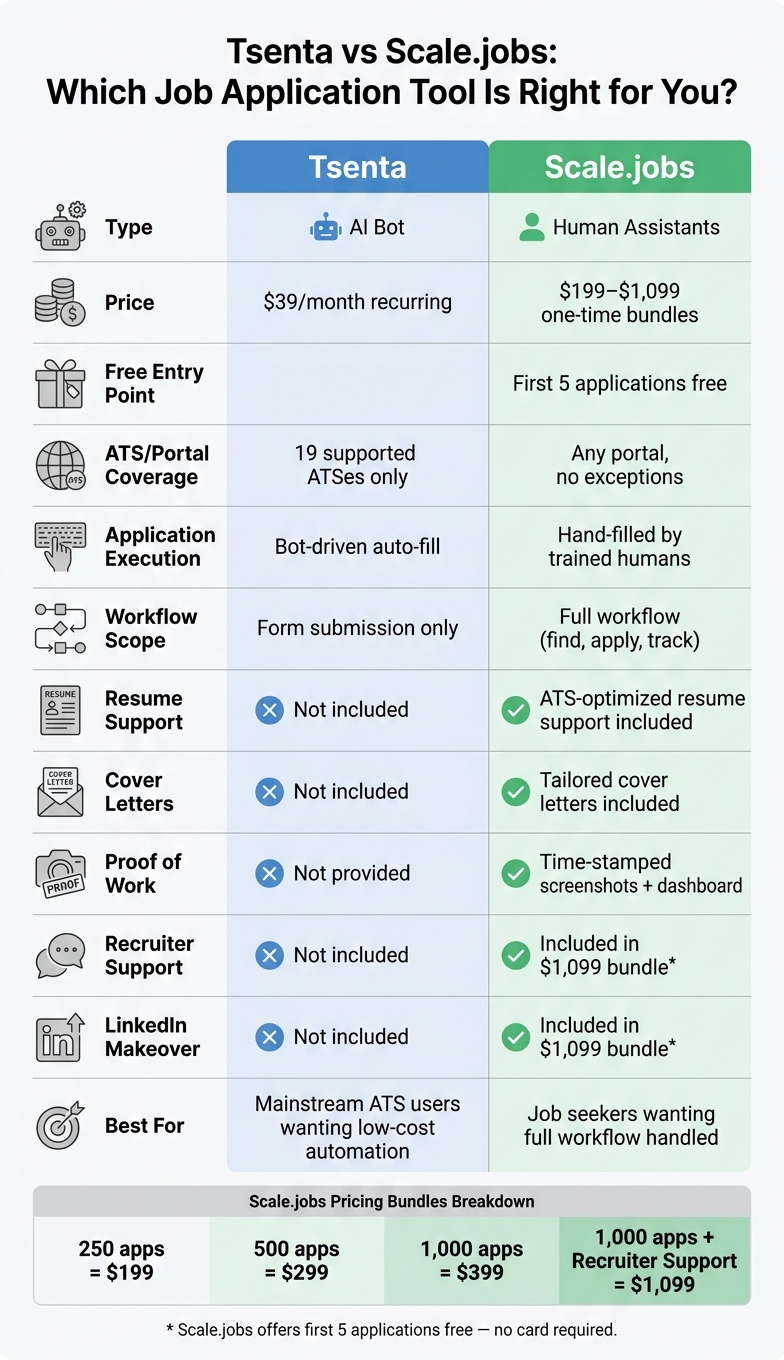
Tsenta vs Scale.jobs: Full Feature & Pricing Comparison
| Criteria | Tsenta | Scale.jobs |
|---|---|---|
| Main use | Bot-driven ATS auto-apply | Human-run application help |
| Price | $39/month | $199 to $1,099 one-time bundles |
| ATS coverage | 19 supported ATSes | Nearly any portal |
| Search help | Limited | Included in workflow |
| Proof of work | Not listed in the article | Screenshots + dashboard |
| Free trial | Not listed | First 5 applications free |
| Best fit | People who want lower-cost ATS automation | People who want less hands-on work |
Tsenta vs Scale.jobs: What I’d Focus On First
When I compare these two, I’d start with three questions:
- How many of my target roles sit outside those 19 ATSes?
- Do I want a tool, or do I want the work done for me?
- Do I want a monthly bill or a one-time bundle?
That gets you to the answer much faster than feature lists do.
Is Tsenta Worth It?
Yes, if most of your target jobs sit inside its supported ATS list and you’re fine handling the rest yourself.
No, if your search runs across mixed portals and you want less manual work.
That’s the cleanest way I can put it.
My take
I’d view Tsenta as a narrow automation option and Scale.jobs as a hands-on job application service. If you also need help with materials before applying, a setup that includes an ai resume builder or an ai cover letter builder can save extra steps too.
A simple decision playbook
Use Tsenta if:
- You apply mostly on mainstream ATS platforms
- You want the lowest monthly cost
- You don’t mind doing job search, review, and edge cases yourself
Use Scale.jobs if:
- You apply across mixed portals
- You want one place to track submissions
- You want human help for forms, screeners, and portal issues
- You’re looking for a job search virtual assistant or a virtual assistant for job seekers, not just a browser bot
A common use case
Say you’re applying to 50 roles in a week:
- If 70% to 80% of them are on supported ATSes, Tsenta may cover a solid chunk.
- If many are on employer sites, old systems, or mixed portals, you’ll still spend hours finishing the rest.
That’s where a human-run service starts to make more sense, especially for people targeting full time jobs and applying at volume.
sbb-itb-564272e
Bottom line
Tsenta helps with speed inside a fixed lane. Scale.jobs helps with completion across the full lane.
If your search is simple, Tsenta may be enough. If your search is messy, broad, or time-heavy, Scale.jobs is easier to justify.
If I were choosing, I’d base it on coverage first, then price second.
What Tsenta Actually Is
Tsenta Is an AI Application Agent Built for High-Volume Applications on Supported ATSes
Tsenta is an AI application agent built for high-volume applications on supported ATSes. In plain English, it helps people find matching roles, tailor their documents, and auto-submit applications when the company uses one of the systems Tsenta supports.
There’s also an approval step before anything gets sent. That matters. You can look over the AI-made edits, check the details, and decide if you want to move ahead. So yes, it can move fast, but it only works inside a pretty fixed lane.
If your goal is to Apply for jobs at scale, that setup can save time. But the catch is simple: Tsenta works best only where its ATS coverage exists.
Where Tsenta Is Genuinely Strong
Tsenta’s biggest edge is speed on supported systems. If the jobs you want sit inside its covered ATS platforms, it can line up and submit applications much faster than doing each one by hand. That’s the main appeal.
The approval workflow also stands out. Plenty of auto-apply tools push applications through with little or no review. Tsenta gives you a checkpoint first, which is a big deal when the role is one you care about and not just another name on a list.
That said, its main limit is coverage: about 19 supported ATSes. When your target roles live inside those systems, Tsenta can work well. When they don’t, the process stops there. That’s where a broader job application service or a more hands-on job search platform starts to look like a better fit.
For job seekers who want help beyond a fixed ATS list, this is also where Tsenta vs Scale.jobs becomes a useful comparison. Tsenta is built for speed inside supported systems. Scale.jobs fills the gap when your search includes more of the market, including roles outside those ATS lanes, whether you're targeting full time jobs or a mix of openings from the best job boards.
The Core Difference: Tsenta and scale.jobs Are Not the Same Category
Once you move past speed and look at coverage, the gap is hard to miss. Tsenta cuts form-filling time inside the ATS platforms it supports. scale.jobs handles the entire application process. That’s not a small product gap. It’s a different category.
If you’re comparing tools to help you Apply for jobs, this is the part that matters most: one tool helps with pieces of the process, while the other takes over the whole workflow.
The Coverage Ceiling: Bots Stop Where Support Ends
Tsenta supports 19 ATSes. That can help, but it still leaves a big chunk of the market untouched. Older portals, government sites, and direct company forms often sit outside that range.
The problem shows up fast. If the role you want lives outside those 19 systems, the bot can’t finish the application. You’re back to handling it on your own.
scale.jobs uses human assistants who can work across any portal. There’s no fixed support list to worry about. That’s where the line becomes clear: a bot can be a shortcut, but it can also turn into a partial tool the second you hit a portal it doesn’t support.
For job seekers using a job search platform or comparing help options, that difference changes the day-to-day experience in a big way.
The 5-Minute Trap: Faster Clicks Do Not Remove the Full Job Search Workload
The time savings stop at the form. Tsenta can save typing time, but you still own the search, review, edge cases, follow-up, and tracking.
That’s the bigger issue. It’s not only about coverage. It’s about the pile of work that still sits on your plate after the bot does its part.
scale.jobs handles the full sequence. A human assistant finds jobs, tailors the resume, fills out the form, and sends time-stamped proof-of-work screenshots when it’s done. You get timestamps and screenshots instead of another to-do list.
That’s a very different setup from a basic job application service. It’s closer to having a Virtual Assistant for Job Applications who sees the process through from start to finish.
Why Manual Execution Is a Feature, Not a Flaw
Manual execution matters because plenty of applications need judgment. Bots often miss the messy parts: login resets, odd employer instructions, and form fields that don’t fit a rigid workflow. Those are usually the moments when an application breaks.
automation saves time until the system pushes back; human execution avoids that failure mode.
That’s why “manual” isn’t a weakness here. It’s the reason the application gets finished when things stop being neat and predictable.
A bot may help with speed. A human assistant helps with completion. If you’re weighing Tsenta against a virtual assistant for job seekers or a job search virtual assistant, that distinction is the one to pay attention to.
The real question isn’t which one clicks faster. It’s which one gets the application submitted when the process gets messy.
That’s why the timing math matters more than click speed.
Timing, Pricing, and Feature Differences
Timing Breakdown: Manual vs Tsenta vs scale.jobs
Time claims only matter if they remove actual work.
That’s the sticking point here. If a role lives on a company career page or an older portal, Tsenta can hit a wall. A person usually doesn’t. So the gap is pretty simple: Tsenta cuts time inside a narrow lane, while scale.jobs takes the lane away and handles the work for you.
That’s where “faster” turns into hours back in your week.
| step | manual | tsenta | scale.jobs |
|---|---|---|---|
| find job | you do it | you do it | can be handled for you |
| log in to portal | you do it | automated in its 19 supported ATSes | human handles it |
| navigate ATS/portal | you do it | automated in its 19 supported ATSes | human handles it |
| fill fields | you do it | automated in its 19 supported ATSes | human handles it |
| upload files | you do it | automated in its 19 supported ATSes | human handles it |
| screener | you answer it | automated only in supported ATSes | human handles it |
| submit | you do it | automated in its 19 supported ATSes | human handles it |
| time/app | all of it is on you | less time inside supported ATSes | your time is mostly review and approval |
| time/50 apps | all of it still sits on you | less than manual, but capped by 19 ATSes | much less of your time because the execution is handled |
Tsenta does save time inside its lane. But that lane is still just 19 ATSes.
If you’re trying to Apply for jobs at scale, that limit can become a bottleneck fast. And if you’re juggling full time jobs and contract roles at the same time, those extra portal issues add up.
Where scale.jobs Is Different
Tsenta reduces clicks inside 19 ATSes. scale.jobs removes the whole application workflow, which is why the pricing starts to mean more than it seems at first glance.
- Human assistants handle login resets, odd fields, and multi-step forms. That’s the stuff bots often choke on, and it also cuts the risk of bot flags.
- Flat-fee bundles, not monthly rent. $199 for 250 apps, $299 for 500, $399 for 1,000, and $1,099 for 1,000 plus recruiter support.
- Proof of work you can check. Time-stamped screenshots and a live application dashboard show what was submitted and when.
- First 5 applications are free. That gives you a simple way to test the process before spending money.
This setup will make more sense to people who want a job application service instead of another browser tool. It also lines up better if you want a virtual assistant for job seekers to handle the messy parts you’d rather not touch.
Full Feature Comparison: Tsenta vs scale.jobs
| feature | tsenta | scale.jobs |
|---|---|---|
| human involvement | AI-powered bot | trained human assistants |
| ATS coverage | 19 supported ATSes | any portal, no exceptions |
| application execution method | bot-driven | manual, hand-filled by a human |
| workflow scope | applies inside supported ATS workflows | broader job-search workflow handled by humans |
| resume support | not included | ATS-optimized resume support and AI custom resumes |
| cover letters | not included | tailored cover letters in human assistant plans |
| transparency and proof of work | not included | time-stamped screenshots + application dashboard |
| support channel | not specified | WhatsApp updates |
| pricing model | $39/month recurring | flat-fee bundles, one-time payment |
| pricing examples | $39/mo | $199 / 250, $299 / 500, $399 / 1,000, $1,099 / 1,000 |
| portal compatibility | limited to supported ATSes | any portal, no exceptions |
| free entry point | not included | first 5 applications free |
| recruiter support | not included | included in the $1,099 bundle |
| LinkedIn makeover | not included | included in the $1,099 bundle |
| turnaround | varies by posting | varies by posting |
A few differences stand out right away.
Tsenta is closer to a narrow automation tool. scale.jobs is closer to a done-for-you job search platform with human execution behind it. That changes the day-to-day experience a lot, especially if you’re applying across mixed systems, older portals, and company sites that don’t play nicely with bots.
The resume and cover letter gap matters too. If you also need an ai resume builder or help with custom application materials, scale.jobs covers more of the process in one place.
That’s the split that matters for the buyer decision below.
Who Should Use Tsenta, Who Should Choose scale.jobs, and the Decision Summary
Tsenta vs scale.jobs: Two Different Buyer Profiles
Tsenta fits people who mainly want faster submits inside supported ATS platforms. scale.jobs fits people who want the entire application process handled from start to finish.
These two tools solve different parts of the job hunt. The simplest way to sort them is this: do you just need faster form filling, or do you want the full application done for you?
- Tsenta: Best for people applying mostly through mainstream ATS platforms who want a fast, lower-cost bot for form submission. At $39/month, it can work well if your search stays inside those 19 systems.
- scale.jobs: Better for laid-off mid-career applicants moving across company sites, older portals, and ATS forms. It also fits people juggling a search at night or on weekends who need the whole workflow handled, not just the typing. If you want more hands-on help, this works more like a job application service than a simple submit bot.
Switch to scale.jobs If…
If the limits above already feel familiar, here’s the practical line.
Switch if any of these are true:
- Your target roles show up on portals outside Tsenta’s 19 supported ATSes.
- Screener questions involve visa status or anything else that calls for human judgment.
- You want one-time pricing instead of a monthly recurring charge.
- You need time-stamped submission proof for tracking and review.
- Your resume needs work before applications go out. scale.jobs’ resume writing and career services handles that in the same workflow, and tools like an ai resume builder can help if you want to tighten your materials first.
- You want help across the full search, not just form submits. In that case, a Virtual Assistant for Job Applications or a job search virtual assistant setup makes more sense.
Decision Summary
The table above gives the full detail. Here’s the short version.
Tsenta is a bot that speeds up form submission inside a fixed set of 19 ATSes. scale.jobs is a human-led service that handles the full application across any portal. That matters because submissions stay ATS-safe when a person handles them instead of an automation script.
If you want to try it before spending money, scale.jobs offers the first 5 applications free, with no card and no time limit. That can be a better fit for people applying across mixed portals, trying to Apply for jobs, or targeting both full time jobs and roles spread across different company systems.
FAQs
How much of my search would still be manual?
Some of your search will still be manual.
Tsenta mainly helps by flagging roles, but it only works across 19 ATS. A person can apply across far more systems, so the rest of the job application service process still needs hands-on work.
If you're trying to Apply for jobs at scale, that's the gap. Tsenta can point you to openings, but it doesn't handle the full process across the whole market. That means you may still need to track listings, fill out forms, and manage follow-ups yourself.
For job seekers who want broader support, a job search virtual assistant or Virtual Assistant for Job Applications can help cover the parts Tsenta leaves on your plate.
What happens when a job is outside supported ATSes?
If a job sits outside the ATS systems the bot supports, it may not be able to submit that application.
That’s the plain limit here: supported ATS coverage decides which jobs the bot can process.
Is one-time pricing better than a monthly plan for me?
It comes down to how often you'll use the service.
If you need help during one focused job hunt, a one-time price usually makes more sense. You pay once and use it for that stretch.
If you expect to need help for a longer period, a monthly plan may be a better fit. That setup works well when your search takes more time or you want steady support over several months.