
Studying in Canada in 2026? Here's How the Job Search Actually Works

Sarah Mitchell
March 27, 2026

In 2026, securing a job in Canada as an international student involves navigating advanced hiring technologies, visa requirements, and a competitive job market. Employers now rely heavily on Applicant Tracking Systems (ATS) and AI tools to screen resumes, making precise, tailored applications essential. Additionally, many positions are filled through the hidden job market, emphasizing the importance of networking and referrals over mass applications.
Key Takeaways:
- ATS Optimization: Use keywords and proper formatting to ensure your resume passes automated filters.
- Visa Clarity: Clearly state your Post-Graduation Work Permit (PGWP) eligibility in your application.
- Networking: Build connections through LinkedIn, professional associations, and informational interviews.
- Targeted Job Boards: Use platforms like Job Bank, Indeed.ca, and industry-specific sites to find visa-compliant roles.
- Application Tools: Services like Scale.jobs offer human-assisted resume customization and manual submissions, avoiding pitfalls of automated tools like Lazyapply or Simplify.jobs.
For international students, combining these strategies with tools like professional resume writing services can significantly improve job search outcomes in Canada.
Work Permits and Visa-Compliant Job Opportunities
Post-Graduation Work Permit (PGWP) Requirements
The Post-Graduation Work Permit (PGWP) is a key option for international students aiming to work in Canada after completing their studies. This open permit allows you to work for any employer without restrictions. To qualify, you must complete a program lasting at least eight months at a Designated Learning Institution (DLI). The permit's duration matches the length of your study program, up to a maximum of three years for programs lasting two years or more.
Starting in March 2026, new measures in Quebec will extend timelines for permanent residency applications. To stay competitive, apply for jobs quickly - ideally within 48 hours of posting - to navigate applicant tracking systems (ATS) effectively. A helpful tip: include the phrase "Post-Graduation Work Permit Eligible" prominently in your resume header or summary. This simple addition eliminates recruiter doubts and ensures your visa status is clear, increasing your chances in ATS screenings.
If you're unsure how to format your resume for ATS systems, consider using professional resume writing services. These services can help ensure your application meets compliance standards while highlighting your eligibility for work permits. With your documentation in order, focus on roles that align with immigration and visa requirements.
Finding Visa-Compliant Roles
Not all jobs align seamlessly with visa or immigration criteria. Positions that qualify under the Ontario Immigrant Nominee Program (OINP) Employer Job Offer stream are especially beneficial for international students pursuing permanent residency. These roles are typically offered by well-established companies that meet specific revenue and staffing criteria, making them familiar with immigration processes.
In 2026, high-demand sectors include:
- Technology: AI and cybersecurity roles are expanding rapidly.
- Healthcare: Opportunities in nursing and clinical research remain strong.
- Construction: Project management and skilled trades are in demand.
- Engineering: Civil, software, and mechanical engineering roles are growing.
Public sector jobs at federal, provincial, or municipal levels also provide stable, visa-compliant opportunities. These positions often require specific credentials, especially for regulated professions. The Job Bank (jobbank.gc.ca) is a valuable tool for finding employers actively seeking international graduates. This government resource offers unbiased labor market insights and allows you to filter for companies with a history of sponsoring newcomers.
In Ontario, many employers have moved away from requiring "Canadian experience" as a hiring prerequisite. Instead, they focus on how effectively candidates adapt to workplace norms in Canada. This shift levels the playing field for international students, provided you present your achievements in ways that resonate with Canadian recruiters. For example, engineering roles may be more abundant in Alberta, while Vancouver sees faster growth in tech jobs compared to Montreal. By researching regional trends and targeting areas with high growth, you can find visa-compliant roles that align with both your career and immigration goals.
Building Resumes and Applications for Canadian ATS Systems
ATS-Compliant Resume and Cover Letter Formatting
In Canada, Applicant Tracking Systems (ATS) such as Hirex, Breezy HR, Folks ATS, Lever, and Recruiteze are widely used by employers to screen resumes before they reach a human recruiter. In fact, nearly 99% of Fortune 500 companies rely on these systems. To ensure your resume passes through these filters, you need to format it correctly. Begin by placing your name, phone number, email, and location (e.g., "Toronto, ON") directly in the document body, as ATS platforms often fail to read information placed in headers or footers - a common mistake among international students.
For work authorization, include a clear statement like "Work authorization: Canada (PGWP)" or "Eligible for PGWP (graduating Aug 2026)". This helps eliminate any uncertainty for recruiters. Avoid adding personal details such as your date of birth, marital status, photographs, or full home address, as these can cause parsing issues and may inadvertently introduce bias. Stick to standard fonts like Arial, Calibri, or Times New Roman, and avoid using tables, columns, graphics, or decorative elements that can confuse ATS software.
When crafting a cover letter, Canadian hiring managers prefer a straightforward tone with specific examples. The "T-Style" method is particularly effective: create two columns - one listing the job requirements and the other showcasing your matching achievements. Use exact terms from the job description, such as "project management", rather than synonyms like "led initiatives." Personalize your letter by addressing it to a specific hiring manager, which you can often find through LinkedIn or the company’s website. These strategies address the common challenges international applicants face in Canada’s ATS-focused hiring environment.
Tools for Checking and Improving Applications
Once your resume and cover letter are formatted for ATS, the next step is to ensure they align with the specific job requirements. A tool like Jobscan can help you analyze how well your resume matches a job description by evaluating keywords, hard skills, and job titles. Aim for a match rate of 75% or higher, though a 65% match is generally acceptable without overloading your resume with keywords. Jobscan offers a free resume score and basic scanning features to help you fine-tune your application.
Another helpful resource is CVailor, an AI-powered resume builder designed for modern market standards, including Canadian-specific requirements like PGWP eligibility. It produces ATS-compatible drafts and offers pricing from $0.35 per CV in bundles to $0.79 for single resumes. For more personalized guidance, professional resume writing services can ensure your documents meet Canadian employer expectations, especially in regulated fields or competitive industries like technology and healthcare.
To boost your ATS score, aim to naturally incorporate 80% or more of the job description's keywords throughout your resume. This can increase your score by 25 to 35 points. Use standard section headers like "Experience", "Education", and "Skills" instead of creative alternatives. Replace lengthy paragraphs with concise bullet points, and quantify your achievements with metrics - for instance, use "Reduced processing time by 22%" instead of "Improved efficiency." Additionally, include both long-form and acronym versions of technical terms, such as "Continuous Integration (CI)", to ensure the system captures your skills regardless of how they’re listed.
Networking and Job Boards for the Canadian Market
Building Your Professional Network
In Canada, many jobs are filled through referrals and internal connections, making networking a key part of your job search strategy. Start by refining your LinkedIn profile with a professional headshot and a headline tailored to your career goals (e.g., "International Graduate Seeking Marketing Analyst Role in Toronto"). Be sure to highlight your cross-border experience and work eligibility, such as stating "Eligible for PGWP, graduating August 2026."
Take the initiative to schedule brief informational interviews, often called "coffee chats", to learn directly from industry professionals. Aim to conduct two coffee chats and attend three to four networking events each semester to expand your connections.
"In today's hiring environment, precision outperforms persistence alone." – Waheed Jalalzada, Immigration Consultant, Waheed Immigration Services
After meeting someone, follow up with a personalized LinkedIn message or email within 48 hours to solidify the connection.
Consider joining professional associations specific to your field as a student member. These groups often provide access to exclusive job boards and networking opportunities. For instance, CIPS (Canadian Information Processing Society) is ideal for IT professionals, while the Opticians Association of Canada supports those in healthcare. Volunteering or interning can also help you build relationships with supervisors who may serve as future references. To stand out, maintain an active GitHub or digital portfolio showcasing your technical skills. These efforts complement ATS-friendly applications, which are essential for modern job searches. If you’re unsure how to tailor your experience for networking conversations, services like professional resume writing services can help align your profile with Canadian employer expectations.
Once you’ve optimized your network, expand your efforts by tapping into targeted Canadian job boards.
Canadian Job Boards and Search Strategies
When it comes to job boards, Indeed.ca, LinkedIn, and Glassdoor Canada are excellent starting points for high-volume searches and market research. For reliable insights into the Canadian labor market and work permit-friendly roles, explore Job Bank (jobbank.gc.ca), run by the Government of Canada. Platforms like GoHires connect job seekers with employers across various sectors, while aggregators such as Careerjet.ca and Eluta.ca help uncover hidden opportunities.
For more specialized searches, turn to industry-specific platforms. For example, technology professionals can benefit from Canada IT Club (canadaitclub.ca) and CIPS.ca, while educators should explore Educationcanada.com and Applytoeducation.com. Healthcare roles can be found on Jobscience.com and CSEB.ca. To maximize your job search efficiency, set up three to five targeted job alerts on LinkedIn and Indeed. Applying within the first two to three days after a job is posted can significantly boost your chances of being noticed by recruiters.
Use search filters to find roles that match your visa status by looking for terms like "PGWP eligible" or "open to international candidates." Be upfront about your work permit status in your cover letters to address any potential concerns about sponsorship. With Canada’s growing demand for international talent in fields like technology, healthcare, and construction, employers are increasingly open to hiring candidates from abroad.
Here’s a quick reference for platforms to complement your networking efforts:
| Platform Type | Recommended Sites for Canada |
|---|---|
| General Job Boards | Indeed.ca, LinkedIn, Glassdoor Canada, Job Bank (jobbank.gc.ca), GoHires, Eluta.ca, Careerjet.ca |
| Technology | Canada IT Club (canadaitclub.ca), CIPS.ca, ITAC.ca |
| Healthcare | Jobscience.com, CSEB.ca, Opticians Association of Canada (opticians.ca) |
| Education | Applytoeducation.com, Educationcanada.com, Jobsineducation.com |
| Public Sector | Job Bank (jobbank.gc.ca), Government of Canada Careers (jobs-emplois.gc.ca) |
These platforms, combined with a strong professional network, can help you navigate the Canadian job market with confidence.
Why You Still Can’t Find a Job in Canada (a MUST For International Students in 2026)
Lazyapply vs Scale.jobs: Which Tool Fits Canadian Job Searches
When it comes to navigating the job application process in Canada, Lazyapply and Scale.jobs offer two very different approaches. Lazyapply relies on browser extensions to automate job applications, enabling users to submit hundreds of applications on platforms like LinkedIn and Indeed with minimal effort. This high-volume method is often favored in U.S. markets, where speed can sometimes outweigh precision. However, for international students and professionals aiming to secure Canadian roles, this approach can create obstacles, particularly with ATS (Applicant Tracking Systems) and visa-specific requirements.
On the other hand, Scale.jobs delivers a personalized, human-powered alternative that aligns with the unique demands of Canadian employers. Unlike Lazyapply, Scale.jobs focuses on tailoring applications to meet ATS standards, ensuring compatibility with Canadian hiring practices. This distinction is crucial for those navigating structured application processes and work authorization questions, where automation tools often fall short.
Why Lazyapply Struggles with Canadian Job Applications
Lazyapply’s automation-first approach can be problematic for Canadian job seekers. Automated tools often trigger bot-detection systems in ATS platforms, which are widely used by Canadian employers. In fact, over 90% of companies in Canada rely on ATS to filter applications based on specific keywords and formats. Lazyapply’s generic templates and inability to address visa-related questions accurately can lead to high rejection rates. For international students, this is especially concerning, as incorrect or incomplete answers about work permits can immediately disqualify an application.
How Scale.jobs Stands Out in the Canadian Market
Scale.jobs takes a more hands-on approach by assigning human assistants to handle each application. These specialists customize resumes to meet Canadian ATS standards, ensuring they include relevant keywords, metrics, and formatting. They also address visa questions on a case-by-case basis, tailoring responses to reflect the applicant’s specific situation, such as PGWP (Post-Graduation Work Permit) eligibility. This level of detail helps avoid the pitfalls of automation and increases the likelihood of success in a competitive job market.
Another key feature of Scale.jobs is its transparency. Applicants receive real-time updates via WhatsApp, including time-stamped proof of submissions and analytics that track employer engagement. This level of feedback allows job seekers to refine their strategy and focus on what works.
Why Scale.jobs Works Better for Canadian Applications
For those targeting Canadian employers, Scale.jobs offers several advantages over Lazyapply’s automated system:
- Manual Submission Avoids Bot-Detection Flags: Canadian ATS platforms, such as those used on Job Bank and Indeed Canada, actively filter out automated applications. Scale.jobs ensures your application reaches real recruiters by using human assistants to manually submit each entry.
- Tailored Resumes for ATS Standards: Scale.jobs optimizes resumes with local keywords, quantified achievements, and ATS-friendly layouts, increasing compatibility with Canadian hiring systems.
- Accurate Visa Question Handling: Work permit questions can make or break an application. Scale.jobs assistants provide precise, case-specific answers, reducing the risk of rejection caused by automation errors.
- Cost-Effective Pricing: Lazyapply’s monthly subscription fees range from $99 to $249, which can add up over time. Scale.jobs offers a one-time payment model starting at $199, with unused credits refunded, making it a more budget-friendly option for extended job searches.
- Proof of Submission: Scale.jobs provides time-stamped screenshots and real-time updates through WhatsApp, offering transparency that Lazyapply’s automation lacks.
If you’re looking to refine your resume before launching your job search, consider using professional resume writing services to align your experience with Canadian hiring expectations.
| Feature | Lazyapply | Scale.jobs |
|---|---|---|
| Application Method | Automated bots/browser extensions | Manual entry by human assistants |
| Resume Customization Depth | Generic templates | Detailed, locally optimized |
| ATS Compatibility | High rejection risk | Tailored for Canadian systems |
| Visa Question Handling | Automated, error-prone | Case-specific manual responses |
| Bot-Detection Risk | High | Low |
| Proof of Work | Application count only | Time-stamped updates + analytics |
| Pricing Model | $99–$249/month | $199–$499 one-time fee |
Who Should Use Lazyapply vs Scale.jobs
Your choice between Lazyapply and Scale.jobs depends on your specific job search needs:
- Lazyapply: Ideal for high-volume U.S. job searches where speed is a priority, such as retail or customer support roles on platforms like ZipRecruiter. If you’re applying to over 100 roles weekly and don’t need tailored applications, Lazyapply might be sufficient.
- Scale.jobs: Best for international students and professionals targeting Canadian employers. This tool is particularly useful for those navigating ATS-heavy sectors like technology, healthcare, or STEM fields, where precision and compliance with visa requirements are crucial.
Consider switching to Scale.jobs if:
- You’ve applied to 50+ jobs using automation tools without receiving interviews, indicating ATS issues.
- You’re targeting Canadian employers with strict visa documentation requirements.
- You need access to specialized job boards, such as campus co-op portals or provincial job banks.
- You have a 3–6 month job search timeline and want proof that each application was submitted correctly.
- You prefer a one-time payment structure over recurring monthly fees.
Simplify.jobs vs Scale.jobs: Automation vs Human Support
When it comes to job application tools, Simplify.jobs and Scale.jobs offer two very different approaches. Simplify.jobs relies on AI-powered automation for quick submissions, while Scale.jobs emphasizes manual, human-assisted applications. Let’s break down how these two platforms compare, especially for those navigating the complexities of the Canadian job market.
Simplify.jobs: Speed with Automation
Simplify.jobs offers a one-click AI auto-fill feature that submits applications across platforms like LinkedIn, Indeed Canada, and Job Bank in seconds. This approach is great for those working under tight deadlines or aiming to submit a large volume of applications quickly. However, in Canada’s evolving job market, where applicant tracking systems (ATS) and visa-specific questions demand precision, this speed-focused method can sometimes fall short. Automated systems may miss critical details or fail to address the nuances required for roles with specific eligibility criteria, such as Post-Graduation Work Permit (PGWP) compliance.
Scale.jobs: Human Expertise for Precision
Scale.jobs takes a completely different route by assigning trained human assistants to handle job applications manually. These professionals customize resumes to meet Canadian formatting standards, address visa-related questions accurately, and tailor applications to specific job postings. For students aiming for competitive roles - like engineering co-ops or positions under the Express Entry system - this personalized approach ensures that every detail aligns with the job’s requirements, something automation often overlooks.
How Scale.jobs Stands Out
Automation might work for entry-level or high-volume job searches, but manual precision becomes essential for competitive fields. Here’s why Scale.jobs tends to outperform Simplify.jobs:
- ATS Compatibility: Many Canadian ATS platforms flag automated submissions as bot activity, which could hinder your application from reaching recruiters. Scale.jobs avoids this by using manual entry, ensuring your application complies with ATS rules and reaches its intended audience.
- Resume Tailoring: While Simplify.jobs relies on generic templates, Scale.jobs customizes resumes using strategies like the STAR method (Situation, Task, Action, Result) and incorporates data from Job Bank for roles in demand, such as data analysts. This targeted approach can significantly improve callback rates.
- Visa and Work Permit Accuracy: Simplify.jobs’ automated responses might not fully address visa questions or PGWP eligibility, leading to potential errors. Scale.jobs, on the other hand, provides accurate, case-specific answers, reducing the risk of rejections due to incomplete or incorrect information.
- Transparency: Simplify.jobs offers basic submission logs, but Scale.jobs provides real-time updates via WhatsApp, including time-stamped screenshots, application tracking, and metrics like employer open rates. This level of visibility allows users to adjust their strategies mid-campaign, such as shifting focus from one city to another.
- Cost Structure: Simplify.jobs charges $29.99 per month, which can add up over time. Scale.jobs uses a flat-fee model starting at $199 for 250 applications, offering predictable costs and refunds for unused credits in some cases.
For those considering a job search in Canada, it may also be worth exploring professional resume writing services to create an ATS-friendly resume before ramping up application efforts.
| Feature | Simplify.jobs | Scale.jobs |
|---|---|---|
| Application Method | AI auto-fill & instant submissions | Manual entry by human assistants |
| Resume Customization | Generic templates | Tailored per job posting |
| ATS Compatibility | Standardized formats, limited optimization | Custom optimization for Canadian systems |
| Visa Question Handling | Automated (risk of errors) | Accurate, case-specific manual responses |
| Bot-Detection Risk | High | Low (manual bypass) |
| Proof of Work | Minimal submission logs | Time-stamped screenshots via WhatsApp |
| Pricing Model | $29.99/month subscription | $199–$399 flat fee |
Choosing Between Simplify.jobs and Scale.jobs
The decision between these two platforms depends on your specific needs:
- Simplify.jobs is ideal for students with strong, generic profiles who need to apply quickly to a high volume of less competitive roles, such as part-time campus jobs or entry-level positions in smaller markets like Winnipeg.
- Scale.jobs is better suited for international students targeting competitive fields or roles requiring detailed visa documentation. For example, engineering co-ops, healthcare positions, or Express Entry opportunities often demand the customized approach that Scale.jobs provides. Many users have reported up to double the interview rate for co-op roles compared to automated submissions.
When to Switch to Scale.jobs
Consider Scale.jobs if:
- You’ve applied to numerous jobs using automated tools but haven’t secured interviews, indicating possible ATS compatibility issues.
- You’re targeting sectors like STEM, healthcare, or trades in Canada, where local experience and visa compliance are critical.
- Your applications involve complex visa questions, such as PGWP eligibility or Express Entry requirements.
- You’re working within a 4–8 week timeline and value real-time updates to refine your job search strategy.
- You prefer a one-time payment model over recurring monthly fees for an extended search.
Decision Summary: Picking the Right Job Search Tool
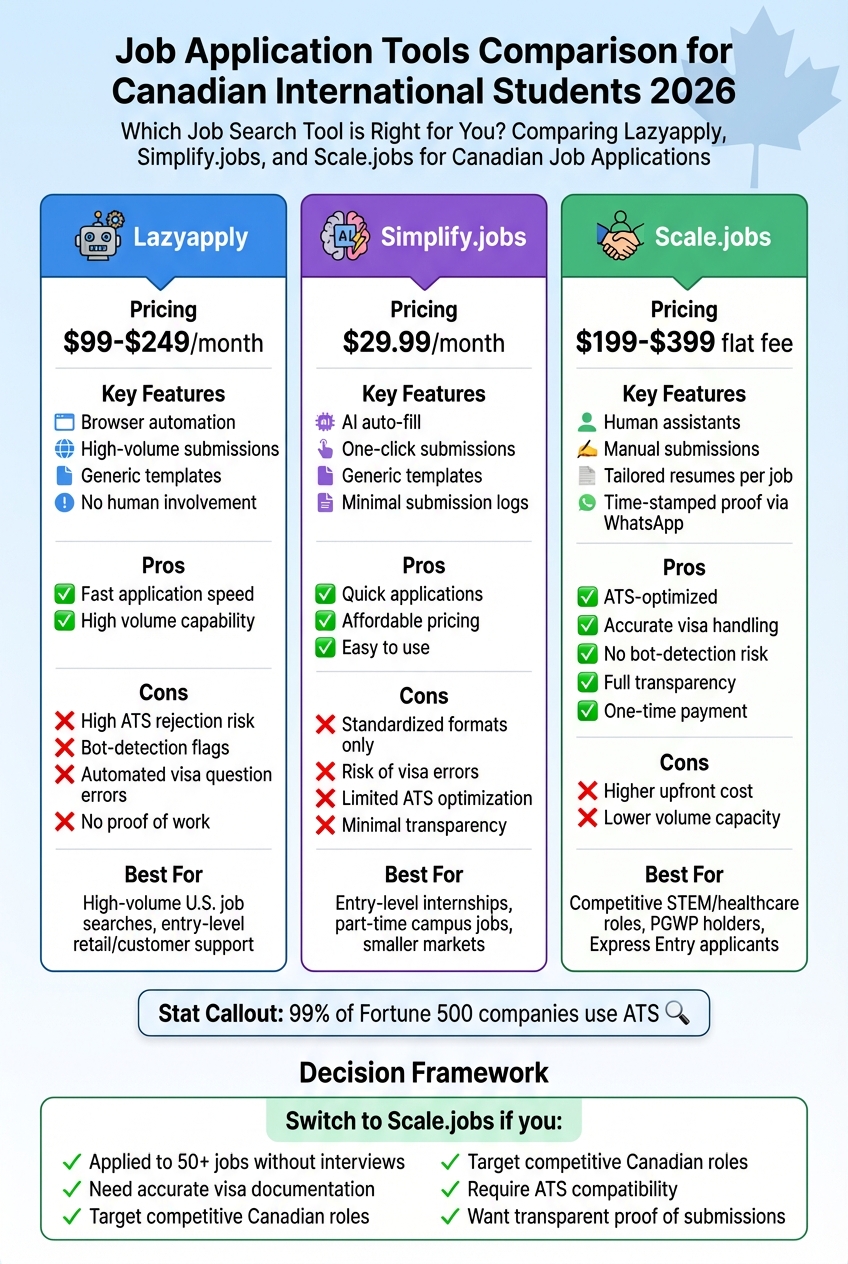
Job Application Tools Comparison for Canadian International Students 2026
Based on the comparisons outlined earlier, here's a quick guide to help you decide on the most suitable job search tool for your needs. When choosing between automated platforms like Simplify.jobs and Lazyapply or the human-driven approach of scale.jobs, focus on three key factors: the volume of applications, visa-related complexities, and your comfort with automation errors.
Simplify.jobs is a great pick if you're aiming to send out a high number of applications quickly. It works well for entry-level internships or part-time roles where speed takes priority. However, if you're on a Post-Graduation Work Permit (PGWP) and need to provide accurate answers to visa sponsorship questions, its AI auto-fill feature might lead to mistakes.
Lazyapply is suitable for exploring opportunities across different employers, especially if you have the time to oversee submissions and fix any errors manually. That said, for competitive roles like engineering co-ops, healthcare jobs, or positions eligible for Express Entry, automated submissions may face issues with advanced Applicant Tracking Systems (ATS).
scale.jobs stands out when precision is critical, particularly for visa-compliant roles. Starting at a flat fee of $199 for 250 applications, it eliminates recurring subscriptions. With trained human assistants handling manual submissions, this approach reduces errors in work authorization details and ATS compatibility. It also provides time-stamped proof of submissions, which is especially helpful for immigration purposes. Additionally, scale.jobs offers professional resume writing services to strengthen your application strategy.
When to Use Lazyapply or Simplify.jobs
Choose Lazyapply or Simplify.jobs if you're conducting high-volume, exploratory searches for entry-level or part-time jobs where speed is more important than customization. These tools are ideal for students with straightforward profiles applying for less competitive roles in smaller markets or for those willing to manually check and correct automated submissions.
When to Opt for scale.jobs
Go with scale.jobs if you're pursuing competitive, visa-sensitive roles in fields like STEM, healthcare, or skilled trades. This tool is particularly useful for international students managing Express Entry requirements, engineering co-ops, or jobs that demand detailed immigration documentation on tight schedules.
Consider switching to scale.jobs if:
- You need accurate responses to visa-related questions without the risk of automation errors.
- You're applying for competitive roles where advanced ATS systems or bot-detection measures are in place.
- You require transparent, time-stamped proof of applications for compliance or immigration purposes.
- You prefer personalized, human-reviewed resumes and applications over generic, automated submissions.
| Feature | Lazyapply | Simplify.jobs | scale.jobs |
|---|---|---|---|
| Human Involvement | None (browser automation) | None (AI auto-fill) | Trained human assistants |
| Resume Customization Depth | Generic templates | Generic templates | Tailored per job posting |
| ATS Handling | High rejection risk | Standardized formats | Custom optimization for Canadian systems |
| Application Execution Method | Automated bots | AI auto-fill | Manual entry |
| Transparency (Proof-of-Work) | Application count only | Minimal submission logs | Time-stamped screenshots via WhatsApp |
| Pricing Model | $99–$249/month | $29.99/month | $199–$399 flat fee |
Use the table and the points above to decide which tool best fits your career and visa-related goals. Each option has its strengths, so pick the one that aligns with your priorities and requirements.
FAQs
How do I prove PGWP eligibility on applications?
To demonstrate your eligibility for a PGWP (Post-Graduation Work Permit), you’ll need to gather several important documents. These include a letter of completion from your educational institution, your academic transcript, and evidence that you maintained full-time student status throughout your studies. Additionally, ensure you have a valid passport, a digital photo, and documentation showing your language proficiency.
If your studies took place outside Canada, you’ll also need to provide proof of your physical location during that time, such as immigration documents. Double-check that all your documents are up-to-date and free of errors to avoid any delays in processing.
What ATS resume mistakes get rejected most in Canada?
When it comes to navigating applicant tracking systems (ATS) in Canada, several common errors can hinder your chances of landing an interview. One of the biggest missteps is failing to optimize your resume with the right keywords - these systems rely heavily on matching specific terms to the job description. Additionally, using vague or unclear job titles and skills can confuse the system, leading to inaccurate parsing. Another frequent issue is not tailoring your resume to align with Canadian standards, such as including proper formatting or emphasizing relevant local experience. These mistakes can disrupt ATS parsing and ranking, ultimately lowering your chances of standing out in the hiring process.
How can I access Canada’s hidden job market fast?
To tap into Canada’s less visible job opportunities, prioritize networking. Engage with alumni from your school, participate in industry-specific events, and join professional groups on platforms like LinkedIn or WhatsApp. Seek out visa-friendly employers, particularly those known for sponsoring work permits, and explore specialized job boards that highlight such roles. Make sure your resume is tailored for Applicant Tracking Systems (ATS) commonly used by Canadian employers, and keep track of application deadlines to stay on top of your job search.