
Top Industries Actively Hiring OPT & H1B Candidates This Month

Sarah Mitchell
February 28, 2026

February 2026 brings evolving opportunities for OPT and H-1B candidates, despite a 23.1% drop in applications compared to FY2025. Certification rates remain above 90%, with industries like tech, healthcare, finance, education, and manufacturing actively hiring. Key highlights:
- Tech leads with 34% of H-1B roles (e.g., Software Developers, AI Engineers) and high salaries ($125K–$185K).
- Healthcare expands sponsorship for Occupational Therapists, IT specialists, and researchers, leveraging cap-exempt visas.
- Finance and consulting firms (e.g., Deloitte, JPMorgan) prioritize quantitative and IT skills, offering salaries up to $207K.
- Manufacturing focuses on specialized engineers (e.g., robotics, semiconductors) with salaries ranging from $108K–$142K.
- Education and research institutions provide stable, cap-exempt pathways for academic roles.
For OPT candidates, targeting states like California, Texas, and Washington increases chances of sponsorship. Tools like scale.jobs offer tailored support for resumes, applications, and navigating the H-1B process. Targeting mid-to-senior roles with higher wages enhances lottery odds under the wage-weighted system, especially for STEM graduates eligible for the 36-month OPT extension.
H1B Lottery 2026 New Rules Explained | Wage Levels, Chances & USCIS Changes
1. Technology
For candidates on OPT or H-1B visas, the technology industry offers a wealth of opportunities, particularly in specialized, high-paying roles. In FY 2024, the tech sector accounted for 64% of all approved H-1B petitions, with computer-related occupations dominating the field. Leading the charge in H-1B approvals are US tech giants like Amazon, Meta, Microsoft, and Google, which have surpassed Indian IT consulting firms in sponsorship numbers. These companies often offer competitive median salaries, with positions at Amazon and Google typically ranging between $155,000 and $185,000. Most of these roles fall within the Level III or Level IV wage bands, which are advantageous under the wage-weighted lottery system.
The role of Software Developer remains the most sponsored, making up 34% of certified H-1B positions (55,517 roles) in Q1 FY 2026. However, employers are increasingly seeking candidates for highly specialized roles. Broad titles like "Full-stack Engineer" are giving way to niche positions such as "AI Infrastructure Engineer", "Cloud Security Architect", and "MLOps Platform Engineer." For instance, Intel filed 8,652 Labor Condition Applications (LCAs) in FY 2025, focusing mainly on hardware engineers and chip designers. NVIDIA, while filing fewer LCAs (1,123), offers an impressive average salary of $180,712 for AI and GPU software engineering roles. This trend toward specialization reflects a market shift that favors candidates who can bypass the $100,000 visa fee.
Introduced in September 2025, the $100,000 supplemental visa fee applies only to candidates hired from overseas, giving OPT and STEM OPT holders a significant edge as they are exempt from this cost. To maximize your chances, target companies with strong sponsorship records, which you can verify through the USCIS H-1B Employer Data Hub, before engaging in lengthy interview processes.
Key skills in demand include expertise in AI (LLM fine-tuning, Generative AI, MLOps), Cloud Infrastructure (Kubernetes, AWS, Azure, Terraform), and Cybersecurity (zero-trust design). Proficiency in Python and SQL remains critical across these domains. As of FY 2024, the median salary for H-1B workers in computer-related roles was $125,000, with 63% holding a master’s degree or higher. Mid-to-senior positions that qualify for Level II–IV prevailing wages offer better odds in the wage-weighted lottery compared to entry-level Level I roles, which have a lower selection rate of 15–20%. These technical requirements drive concentrated hiring in major tech hubs.
Cities like San Francisco, Seattle, Austin, and New York City are home to the highest concentration of E-Verify employers and offer higher prevailing wages. For candidates seeking professional resume optimization tailored to Applicant Tracking Systems (ATS) used by major H-1B sponsors, platforms like scale.jobs provide specialized services. With access to over 2 million monthly job postings, these tools are particularly useful for international applicants navigating the complexities of the H-1B lottery process.
2. Healthcare
Healthcare organizations are increasingly stepping into the realm of international talent sponsorship, moving beyond the tech-heavy H-1B landscape. In FY 2025, staffing agencies like Avant Healthcare Professionals (1,955 LCAs, ~$66K), Management Health Systems (614 LCAs, ~$71K), and Conexus MedStaff (511 LCAs, ~$62K) played a major role in placing international candidates. Unlike automated tools such as LazyApply, which rely on mass applications without customization, scale.jobs provides tailored solutions. This includes human-assisted resume optimization specifically designed for healthcare ATS systems, one-time payment models, and dedicated WhatsApp support - key features for professionals targeting specialized healthcare employers.
Academic medical institutions offer a unique advantage with cap-exempt H-1B visas, allowing them to sponsor international hires without being tied to the annual lottery. For example, Baylor College of Medicine (357 LCAs, average salary $67,103) and The University of Texas M.D. Anderson Cancer Center (297 LCAs) frequently sponsor researchers, physicians, and healthcare IT specialists. Similarly, large hospital networks like CommonSpirit Health (324 LCAs, ~$73K) are actively recruiting. In Seattle, the University of Washington sponsored 362 visas, making it a top choice for candidates in biotech and clinical research. These academic institutions and hospital networks are also driving a shift toward digital and remote healthcare roles, reflecting the evolving nature of the industry.
The rise of digital transformation in healthcare has created demand for professionals who blend clinical expertise with technical skills. Positions such as healthcare IT specialists, data scientists working with AI-driven diagnostic tools, and experts in electronic health records (EHR) systems are in high demand. Employers are also expanding remote opportunities, such as clinical coordination roles for virtual appointments and client communication. Additionally, companies like PharmaBridge International, an online pharmacy provider, are hiring sales and marketing executives familiar with healthcare solutions, highlighting the growth of digital pharmaceutical services.
Geography plays a critical role in healthcare hiring trends. Boston, with its concentration of biotech firms and pharmaceutical research companies, is a hotspot for opportunities. Meanwhile, Seattle's university-affiliated medical centers offer consistent sponsorship prospects. Candidates aiming for international roles should focus on cap-exempt employers and staffing agencies with established pipelines for overseas hiring. To stand out, job seekers can use professional resume services that craft ATS-optimized resumes emphasizing the increasingly valuable overlap between technical and clinical expertise.
Salaries for healthcare sponsorships vary based on the role and employer type. Clinical positions through staffing agencies typically range between $58,000 and $76,000, while academic research and hospital-based roles often start at $72,000 or higher. Unlike the tech sector, which is often wary of visa-related costs, healthcare employers benefit from cap-exempt visas, making them an excellent choice for international candidates. Tools like scale.jobs further enhance the process by offering customized application assistance. This shift toward healthcare IT and biotech research roles aligns with the growing number of international graduate students in computer and information sciences - approximately 80% - creating a steady pipeline for OPT candidates transitioning into H-1B roles.
Stop using LazyApply until you read this: Scale.jobs provides personalized, human-powered application assistance tailored for healthcare placements, addressing the specific ATS requirements of medical institutions and staffing agencies. LazyApply’s automated mass submissions, on the other hand, often fail to meet these specialized needs, making scale.jobs a more effective option for healthcare professionals.
3. Finance and Consulting
Finance and consulting firms are now standing shoulder to shoulder with tech companies in sponsoring international talent. In FY2025, Deloitte Consulting emerged as the #3 H-1B sponsor, submitting 3,209 labor condition applications (LCAs) with an average salary of $117,683. Ernst & Young U.S. followed with 1,764 LCAs at $141,263, while JPMorgan Chase filed 1,507 LCAs, offering an average salary of $135,712. These numbers highlight the growing demand for specialized international talent in this sector.
The "Big Four" accounting firms - Deloitte, EY, KPMG, and PwC - along with major investment banks, consistently rank among the top 30 H-1B sponsors. For instance, KPMG filed 755 LCAs at $126,087, Citibank submitted 600 LCAs at $132,387, and Goldman Sachs filed 424 LCAs at an average of $106,974. Premium salaries are evident in top-tier consulting firms, with Boston Consulting Group offering an average of $207,165 across 487 sponsored roles and McKinsey & Company averaging $124,374 for 308 positions. These firms are actively hiring for roles in financial analysis, IT infrastructure, compliance, and more. Key areas of focus include quantitative analysis, risk assessment, and investment operations.
This trend reflects a deliberate approach to workforce planning. Unlike tech companies like Amazon, which have narrowed their focus to specific technical roles, finance and consulting firms are sponsoring a broader range of positions. For example, financial analysts saw 817 H-1B approvals in FY2025 with a 97.01% approval rate. Morgan Stanley Services filed 248 LCAs at $140,218, while Accenture submitted 280 LCAs at $148,035. Additionally, banks and telecom companies are increasingly outsourcing IT and support functions, sustaining the demand for H-1B workers with specialized technical expertise.
Candidates holding STEM-designated degrees have a distinct edge, benefiting from up to 36 months of Optional Practical Training (OPT), which provides three chances at the H-1B lottery. In FY2025, eligible registrations dropped by about 38%, from 759,000 to 470,000, resulting in a 25.6% selection rate. The updated beneficiary-centric lottery system aims to reduce duplicate entries and favor genuine applicants. For better chances, candidates should focus on high-volume sponsors with robust LCA processing systems and emphasize their specialized skills in high-demand areas.
Simplify vs. scale.jobs: Why You Should Switch to Human-Powered Apply
The high-stakes nature of finance and consulting roles demands a well-thought-out application strategy. While Simplify provides automated, one-click application broadcasts suitable for high-volume job searches, it falls short when it comes to the depth required for competitive positions in these fields. On the other hand, scale.jobs offers a human-powered approach that addresses the specific needs of these roles. Here's why scale.jobs stands out:
- Human-powered customization: Tailored resumes that meet the strict ATS standards used by Big Four firms and investment banks.
- ATS-optimized documents: Applications that emphasize quantitative modeling, cybersecurity, and IT skills critical for finance roles.
- Dedicated WhatsApp support: Real-time guidance throughout the application process.
- Transparent proof-of-work: A one-time payment model with clear accountability.
Simplify's advantage: It offers quick and straightforward applications for candidates targeting a large number of roles without the need for deep customization.
Where scale.jobs excels: Finance and consulting positions demand tailored applications that showcase specialized expertise. Unlike Simplify’s generic approach, scale.jobs ensures applications meet the nuanced requirements of these sectors through human oversight.
Who Should Use Simplify
- Candidates who need a fast, automated application process.
- Applicants targeting roles where a generic, one-click approach suffices.
Who Should Choose scale.jobs
- International candidates aiming for competitive finance and consulting positions that require tailored, high-impact applications.
- Professionals seeking hands-on support and transparency for high-stakes roles.
Comparison Table
| Feature | Simplify | scale.jobs |
|---|---|---|
| Human involvement | Minimal; automated broadcasts | Full human-assisted customization |
| Resume customization depth | Generic templates | Tailored for finance/consulting ATS systems |
| ATS handling | Basic optimization | Sector-specific optimization for Big Four and investment banks |
| Application execution method | One-click mass apply | Strategic, personalized applications |
| Transparency and proof of work | Limited visibility | Full proof-of-work documentation |
| Pricing model | Subscription-based | One-time payment |
Switch to scale.jobs if…
- You’re targeting Big Four accounting firms or top-tier investment banks that require specialized applications.
- You need resumes optimized for finance-specific ATS systems focusing on quantitative and compliance skills.
- You value human oversight to ensure your applications meet the rigorous standards of high-salary consulting roles.
- You prefer a transparent, one-time payment model over recurring subscription fees.
Decision Summary
- Choose Simplify if speed and simplicity are your priorities for roles with fewer customization needs.
- Opt for scale.jobs if you require a personalized, human-driven application strategy tailored to the complex demands of finance and consulting.
For candidates aiming to break into finance and consulting, a tailored application strategy is as critical as it is in tech and healthcare. Choosing the right platform can make all the difference in securing these competitive roles.
4. Education and Research
Universities and nonprofit research institutions provide cap-exempt H-1B sponsorships, setting them apart from private-sector employers that are limited by the annual 85,000-visa lottery. This exemption allows academic institutions to sponsor candidates year-round without being tied to the competitive lottery process, offering a more predictable route for those seeking sponsorship.
In FY2025, several leading academic institutions consistently supported cap-exempt sponsorships. For instance, The University of Texas Rio Grande Valley filed 271 LCAs with an average salary of $54,335, University of Miami processed 216 LCAs at $76,411, and Indiana University filed 202 LCAs at $63,772. These institutions primarily focus on roles requiring advanced degrees, such as postdoctoral researchers, research associates, and faculty members.
Cap-exempt sponsorships are generally reserved for full-time academic roles with specialized titles, such as Postdoctoral Researcher or Faculty. These roles ensure a long-term fit while keeping sponsorship costs manageable. However, general staff positions typically do not qualify unless they meet the specialty occupation criteria, which usually require at least a Bachelor's degree. It’s common for universities to expect candidates to fully utilize their OPT or STEM OPT periods before initiating an H-1B petition.
To ensure a smooth transition, candidates should confirm their title's eligibility with their ISSO (International Student and Scholar Office) and start discussing H-1B sponsorship at least six months before their OPT expires. The 36-month STEM OPT period offers valuable time to build a research portfolio through publications, patents, and conference presentations - achievements that can later support petitions for O-1 (Extraordinary Ability) or EB-2 NIW (National Interest Waiver) visas. Compared to the private sector's volatility, academia provides a more stable and predictable sponsorship pathway. While academic salaries generally range between $54,000 and $76,000 - lower than tech sector averages, which often exceed $140,000 - the trade-off includes greater job security and a clear path to sponsorship.
LazyApply vs. scale.jobs: Why scale.jobs Is Better for Academic Roles
When applying for academic positions, precision is key to standing out. This is where scale.jobs outshines LazyApply. While LazyApply focuses on automating mass applications for high-volume job searches, it lacks the tailored approach needed for competitive university roles. Academic positions demand applications that clearly highlight specialized expertise, making human oversight critical. scale.jobs offers a human-powered strategy designed to meet academic hiring standards:
- Custom-tailored applications: Resumes and cover letters are crafted to emphasize research publications, grant experience, and academic qualifications.
- ATS-optimized documents: Applications are fine-tuned to align with academic HR systems.
- Personalized support: Dedicated WhatsApp assistance for sponsorship timelines and ISSO requirements.
- Transparent process: One-time payment with clear proof of work.
LazyApply's strength lies in its ability to handle rapid, automated applications for entry-level or high-volume searches.
scale.jobs excels in creating detailed, customized applications that meet the rigorous expectations of faculty search committees and university HR departments.
Who Benefits from LazyApply
- Candidates focused on speed and volume over precision.
- Applicants targeting entry-level roles where generic applications are sufficient.
Who Should Choose scale.jobs
- International candidates pursuing postdoctoral, research associate, or faculty positions.
- Professionals seeking cap-exempt sponsorships who need applications that highlight specialized research expertise and publications.
Comparison Table
| Feature | LazyApply | scale.jobs |
|---|---|---|
| Human involvement | Fully automated | Full human-assisted customization |
| Customization depth | Generic templates | Tailored academic CVs emphasizing research |
| ATS handling | Basic optimization | Academic HR system optimization |
| Application execution method | Mass automated apply | Strategic, personalized applications |
| Transparency and proof of work | Limited visibility | Full documentation provided |
| Pricing model | Subscription-based | One-time payment |
Why Choose scale.jobs?
- You’re applying to cap-exempt academic institutions that require detailed research portfolios and publication records.
- You need applications that emphasize specialized STEM expertise, teaching experience, and grant management skills.
- You want guidance on ISSO requirements, sponsorship timelines, and academic title eligibility.
- You prefer a transparent, one-time payment model instead of recurring subscription fees.
- You value human oversight to ensure applications meet the high standards of faculty search committees.
Final Thoughts
For those seeking stable, long-term visa solutions through academic institutions, a tailored application strategy can make all the difference. While LazyApply is ideal for quick, automated applications, scale.jobs offers the precision and personalization essential for securing cap-exempt sponsorship opportunities in academia. By focusing on research impact and specialized skills, scale.jobs increases the chances of standing out in a competitive academic job market.
5. Manufacturing and Engineering
Manufacturing and engineering companies are stepping up H-1B sponsorships to address key gaps in specialized roles, particularly in areas like semiconductors, electric vehicles, and robotics. In fiscal year 2025, Intel led the charge, filing 8,652 Labor Condition Applications (LCAs) with an average salary of $142,906. Tesla followed with 990 LCAs at $134,278, and General Motors filed 451 LCAs at $108,791. Much like the tech and healthcare sectors, manufacturing and engineering rely on these sponsorships to fill advanced and technical roles.
One of the most frequently sponsored positions is Manufacturing Engineer. For example, Google filed 28 LCAs for this role in FY2025, offering an average salary of $160,303. Tesla filed 23 LCAs at $118,029, while Cummins filed 14 at $95,645. Companies like Waymo ($265,000) and Meta Platforms ($199,602) highlight how tech firms are merging with manufacturing to develop hardware-focused products. Other in-demand roles include automation engineers, quality engineers, and process engineers skilled in Lean and Six Sigma methodologies.
Many manufacturers actively sponsor H-1B visas, often supporting international graduates transitioning from Optional Practical Training (OPT) programs. Companies such as Intel, Applied Materials (391 LCAs, $137,210 average), and Rivian Automotive (161 LCAs, $112,810 average) have established pathways for OPT candidates to secure H-1B sponsorship. Graduates with degrees in electrical, mechanical, or industrial engineering are especially well-positioned, as they qualify for the 24-month STEM OPT extension, giving them additional time to secure sponsorship.
The employment outlook for industrial and manufacturing engineers is strong, with projected growth of 12% through 2033 - well above the average for other occupations. As of January 2024, there were over 500,000 job openings in the sector, and 35% of companies reported challenges in hiring talent over the past year. This demand has led to higher salaries and increased negotiating power for international engineers. Successful candidates often showcase skills in CAD software (e.g., AutoCAD, SolidWorks), programming for automation (e.g., Python, C++), and certifications like Certified Manufacturing Engineer (CMfgE) or Six Sigma Green Belt.
Simplify vs. scale.jobs: Why scale.jobs Stands Out for Manufacturing Roles
In manufacturing, the need for precision and technical expertise makes tailored applications critical. This is where scale.jobs outperforms Simplify. While Simplify provides a streamlined job search experience with one-click applications and autofill features, it falls short when it comes to the detailed customization required for competitive engineering roles. Here's why scale.jobs is a better fit for international candidates seeking sponsorship in manufacturing:
- Customized technical resumes: Applications are tailored to highlight CAD skills, Lean/Six Sigma certifications, and practical project experience, meeting the unique demands of manufacturing roles.
- ATS optimization for engineering systems: Resumes are designed to pass applicant tracking systems used by major manufacturers like Intel, Tesla, and General Motors, emphasizing technical achievements.
- Sponsorship-focused targeting: Human advisors identify high-volume LCA filers and roles that qualify for STEM OPT extensions, ensuring better alignment with visa requirements.
- Transparent, one-time payment: Applicants receive full documentation of submitted applications without the need for recurring subscription fees.
- WhatsApp support: Direct access to advisors who understand visa timelines and wage requirements.
Simplify is best for quick, high-volume applications, while scale.jobs focuses on crafting precise, impactful applications that resonate with hiring managers in manufacturing.
Who Should Use Simplify
- Candidates looking for speed and efficiency in applying to multiple roles.
- Applicants comfortable with generic, entry-level applications for non-specialized positions.
Who Should Choose scale.jobs
- International engineers targeting H-1B sponsorship from major manufacturers like Intel, Tesla, or Applied Materials.
- Engineers with expertise in automation, robotics, or process engineering who need their certifications and project experience to stand out.
- Professionals seeking AI resume builder services tailored to prevailing wage requirements and LCA filing trends.
Comparison Table
| Feature | Simplify | scale.jobs |
|---|---|---|
| Human involvement | Minimal (autofill automation) | Full human-assisted customization |
| Customization depth | Generic templates | Tailored resumes with technical portfolios |
| ATS handling | Basic optimization | Advanced optimization for manufacturing HR systems |
| Application execution method | Automated, one-click apply | Strategic, personalized applications |
| Transparency and proof of work | Limited visibility | Full documentation provided |
| Pricing model | Freemium with paid tiers | One-time payment |
Switch to scale.jobs If…
- You are applying to manufacturers with robust LCA pipelines (e.g., Intel, Tesla, GM) and need applications that emphasize specialized skills and certifications.
- Your resume needs to showcase CAD expertise, Lean/Six Sigma qualifications, and hands-on automation projects.
- You want expert guidance on targeting roles eligible for STEM OPT extensions and navigating wage requirements.
- You prefer a transparent, one-time payment model over subscription-based services.
- You value human oversight to ensure your applications meet the technical standards expected by manufacturing hiring managers.
Decision Summary
Choose Simplify for quick, automated applications to a broad range of roles. Opt for scale.jobs if you're an international engineer aiming for sponsorship-friendly manufacturing positions, where customized applications and technical precision can make all the difference. For roles at top sponsors like Intel, Tesla, and Applied Materials, scale.jobs provides the focused, human-assisted support needed to stand out in a competitive field.
Industry Comparison: Sponsorship Numbers, Roles, and Skills
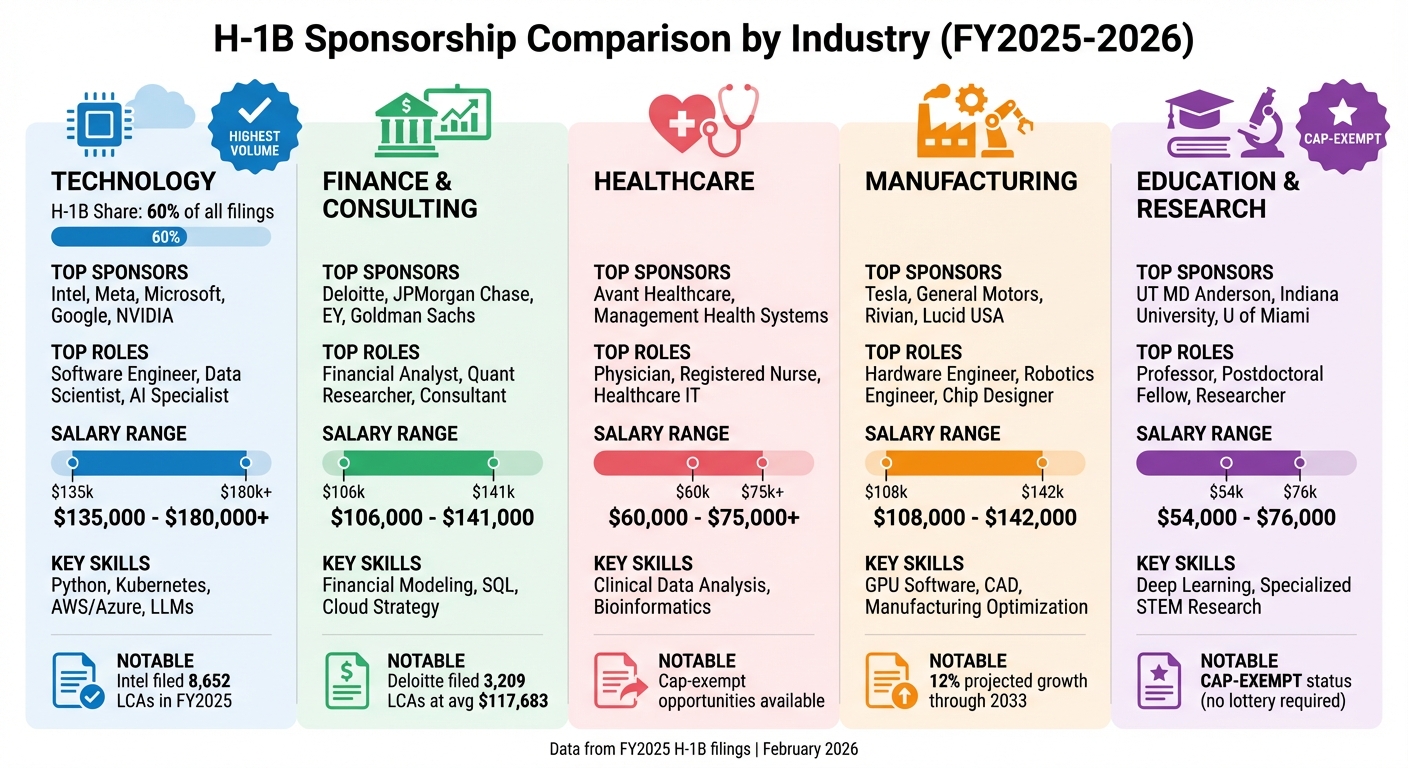
Top 5 Industries for H-1B Sponsorship: Salaries, Roles, and Key Skills Comparison 2026
This comparison underscores the differences in sponsorship volumes, job roles, and essential skills across various industries. Technology leads the pack, accounting for 60% of H‑1B filings, with median salaries exceeding $125,000. Meanwhile, sectors like finance, healthcare, manufacturing, and education provide distinct opportunities with varying pay scales. For instance, companies such as Deloitte and JPMorgan Chase in finance and consulting offer roles ranging from $106,000 to $141,000, while healthcare positions, often through staffing agencies, typically start at $60,000 to $75,000. Manufacturing giants like Tesla and General Motors offer salaries between $108,000 and $142,000, and education roles - often cap-exempt - pay between $54,000 and $76,000.
| Industry | Top Sponsoring Employers (FY2025) | Top Job Titles | Avg. Salary Range | Key Skills |
|---|---|---|---|---|
| Technology | Intel, Meta, Microsoft, Google, NVIDIA | Software Engineer, Data Scientist, AI Specialist | $135,000 - $180,000+ | Python, Kubernetes, AWS/Azure, LLMs |
| Finance & Consulting | Deloitte, JPMorgan Chase, EY, Goldman Sachs | Financial Analyst, Quant Researcher, Consultant | $106,000 - $141,000 | Financial Modeling, SQL, Cloud Strategy |
| Healthcare | Avant Healthcare, Management Health Systems | Physician, Registered Nurse, Healthcare IT | $60,000 - $75,000+ | Clinical Data Analysis, Bioinformatics |
| Manufacturing | Tesla, General Motors, Rivian, Lucid USA | Hardware Engineer, Robotics Engineer, Chip Designer | $108,000 - $142,000 | GPU Software, CAD, Manufacturing Optimization |
| Education | UT MD Anderson, Indiana University, U of Miami | Professor, Postdoctoral Fellow, Researcher | $54,000 - $76,000 | Deep Learning, Specialized STEM Research |
One notable distinction is the cap-exempt status of education and research roles, which bypass the annual 85,000 H-1B visa cap. This makes universities and non-profit research institutions a viable option for candidates who miss out on the lottery. On the other hand, tech and finance roles offer higher earning potential and career growth, particularly for candidates with certifications such as AWS Solutions Architect Professional or Kubernetes CKA/CKD.
To succeed in these industries, a tailored application strategy is crucial. Generic applications rarely work in competitive fields like manufacturing or finance, where hiring managers prioritize resumes showcasing specific certifications, project portfolios, and technical accomplishments. Platforms like Scale.jobs specialize in crafting ATS-optimized, role-specific resumes that highlight your unique expertise - whether in CAD, financial modeling, or clinical data analysis. With real-time WhatsApp updates, time-stamped proof-of-work screenshots, and transparent documentation, Scale.jobs ensures your application stands out. For international candidates managing visa timelines and wage requirements, their resume writing services can be the key to securing interviews.
The wage-weighted lottery system also favors higher-paying Level III and IV roles (typically $120,000+), improving selection odds compared to entry-level positions. This makes targeting mid-level roles essential, avoiding titles like "Junior" or "Entry-level" where possible. Additionally, candidates on F‑1 OPT or STEM OPT enjoy an advantage as they are exempt from the $100,000 supplemental visa fee for overseas hires, making them more appealing to U.S. employers in 2026. Highlighting specialized skills and certifications can significantly improve both lottery chances and employer sponsorship opportunities.
Conclusion
Automated platforms like LazyApply and Simplify offer quick application methods, but navigating the competitive H-1B sponsorship landscape requires a more strategic approach. Technology remains a dominant force, accounting for nearly 60% of filings in professional, scientific, and technical services, with companies like Intel submitting an impressive 8,652 Labor Condition Applications in FY2025 [1]. Meanwhile, finance and consulting giants such as Deloitte and JPMorgan Chase offer lucrative salaries ranging from $117,000 to $136,000. Other sectors, like healthcare and manufacturing, provide niche opportunities for candidates with specialized clinical or engineering expertise. Education and research roles also appeal to many due to their cap-exempt status, allowing applicants to bypass the annual visa lottery.
For OPT and H-1B job seekers, the key to success lies in targeting high-volume sponsors, showcasing specialized STEM skills like AI, cloud computing, or quantitative analysis, and applying early to align with visa timelines. Generic applications often fail in competitive fields where hiring managers prioritize ATS-optimized resumes that highlight certifications, technical projects, and measurable accomplishments. Platforms such as scale.jobs specialize in creating tailored, ATS-friendly resumes that directly address sponsor needs while providing proof-of-work documentation and real-time updates, giving candidates a clear advantage.
With the $100,000 supplemental fee for new H-1B petitions taking effect on September 21, 2025 [1], candidates must demonstrate skills that justify such a significant employer investment. Focusing on mid-level roles with salaries above $125,000 improves lottery odds under the wage-weighted system, while avoiding "Junior" or "Entry-level" titles enhances competitiveness. Given that international students make up about 80% of U.S. graduate enrollments in computer science, early preparation and strategic targeting are essential to stand out in this crowded field.
Whether you're pursuing roles in AI, quantitative analysis, or engineering, understanding industry hiring trends and wage benchmarks can sharpen your competitive edge. Platforms like scale.jobs, which emphasize human oversight and tailored application materials, help applicants rise above competitors like LazyApply and Simplify. Combining these tools with targeted networking, strategic timing, and high-quality application materials can significantly improve your chances of securing sponsorship in future H-1B cycles.
Switch to scale.jobs if…
- You need personalized, human-powered application support that outshines automated tools like LazyApply by addressing specific sponsor requirements instead of relying on generic mass submissions.
- ATS-optimized resumes and proof-of-work transparency are priorities, especially for mid-level roles at top sponsors like Intel, Deloitte, or JPMorgan Chase.
- You value dedicated WhatsApp support and a one-time payment model, making scale.jobs a practical choice for securing high-value positions exceeding $125,000.
- You're targeting specialized roles in fields like finance, healthcare, or manufacturing, where certifications, technical portfolios, and wage-level alignment are critical for success.
- You prefer strategic targeting over volume, focusing on high-LCA sponsors and cap-exempt institutions rather than broad, automated application strategies.
FAQs
Which roles give OPT candidates the best H-1B odds in 2026?
Roles such as physicians, nurse practitioners, occupational therapists, and software developers present strong opportunities for OPT candidates seeking H-1B sponsorship in 2026. Employers in high-demand and high-wage industries, including major players like Microsoft, Google, and healthcare organizations, are among the top sponsors, making these positions particularly appealing for candidates aiming to secure sponsorship.
How can I find cap-exempt employers for faster sponsorship?
To find employers exempt from the H-1B cap and secure sponsorship more quickly, target universities and nonprofit organizations. These employers can bypass the H-1B lottery system and submit petitions at any time of the year, which often speeds up the sponsorship process. Concentrate on building connections within these fields to uncover job opportunities and simplify your application journey.
What should I prioritize on my resume to pass ATS at top sponsors?
To ensure your resume passes ATS (Applicant Tracking Systems) at leading companies like Microsoft, Google, or Amazon, focus on aligning closely with the job description. Incorporate relevant keywords, such as specific programming languages, certifications, or industry-specific terms. Use straightforward formatting - keep sections like "Work Experience" and "Skills" clearly labeled. Avoid using graphics, tables, or intricate designs that ATS software might struggle to read.
Tailor your resume for each role by emphasizing key skills and achievements that match the position. Quantify your accomplishments wherever possible - metrics like percentages, dollar amounts, or project outcomes make a strong impact and improve your chances of getting noticed.