
Ultimate Guide to Career Change Cover Letters

Sarah Mitchell
December 28, 2025
Switching careers requires more than just updating your resume with an AI builder - it demands a tailored cover letter that bridges your past experience with your future goals. Recruiters spend mere seconds on applications, so your letter must immediately highlight transferable skills and explain why your background fits the new role. This guide outlines how to craft a career change cover letter that:
- Addresses your career shift upfront without apologizing for gaps in experience.
- Connects past achievements to your target industry using specific examples and industry-relevant language.
- Reassures employers by showcasing your commitment and readiness to contribute to their team.
With 58% of workers considering career changes, competition is fierce. A strong cover letter can make the difference between being overlooked and landing an interview. Proper job interview preparation is the next step to securing the role.
How to Write a Career Change Cover Letter (with examples)
Why Career Changers Need a Different Cover Letter Strategy
If you're switching careers, a standard cover letter template just won't cut it. These templates are built for traditional, linear career paths, not for someone moving from, say, sales to healthcare or education to corporate training. They don't explain why you're making the leap or how your previous experience makes you a great fit for a completely different field.
Here's the reality: recruiters spend less than 10 seconds glancing at resumes. Among the 118 applications they receive for each job, anything that looks unclear or disconnected is quickly tossed aside. This is where your cover letter steps in - it can do what your resume can't. It tells a story, connecting the dots between where you've been and where you want to go by revamping your career story. Think of it as a bridge that ties your past experiences to your future aspirations, but this requires some thoughtful adjustments in how you present yourself.
"A cover letter allows you to highlight transferable skills, showcase your passion, and explain more about your 'why' in making this transition." - Erin Aldrich Shean, Founder, Ascension Coaching & Consulting
Employers are understandably cautious about career changers. With the $4,000+ average cost of hiring and training a new employee, they worry you might decide the new field isn't for you after they've invested time and resources in you. This is why your cover letter needs to be tailored - not just to the job, but to the industry you're entering. Use their language and terminology to show you understand their world. For example, if you're moving into tech, talk about agile workflows and sprint planning instead of classroom lesson plans, even if both roles required project management skills.
"Flip your language to reflect the industry you want to go to... You need to show them that you understand their industry. And that you can do the work in the new industry because of the work you've done previously." - Monica Marcelis Fochtman, Career Coach
Finally, don't shy away from addressing gaps in your experience. Ignoring them only raises red flags for recruiters. A strong career change cover letter tackles this head-on. Use your opening paragraph to acknowledge your lack of direct experience, but then spend the rest of the letter proving how your unique background is actually an asset. Show them why your fresh perspective and transferable skills make you a standout candidate.
What to Include in a Career Change Cover Letter
A strong cover letter has three key parts: an engaging opening, a connecting body, and a decisive closing. Let’s break these down to create a compelling narrative that captures attention.
Opening: Be Clear About Your Career Shift
Start by mentioning the specific role you're applying for and directly addressing your career change. Recruiters spend just 6 seconds scanning applications, and with an average of 118 applicants per position, your opening needs to stand out.
Lead with a strong hook - something that highlights your achievements, aligns with the company's mission, or demonstrates the value you bring. For instance, instead of starting with, "I am writing to apply for the Marketing Manager position", try something like, "After five years of leading sales teams to exceed revenue targets by 40%, I’m eager to apply my data-driven storytelling to your Marketing Manager role." This immediately connects your past accomplishments to your desired position.
Avoid apologizing for a lack of direct experience. Phrases like "Although I don’t have experience in..." can weaken your case. Instead, reframe your background as an advantage: "Having honed my [Skill] in [Old Field], I’m excited to bring this expertise to [New Role]." This approach highlights how your skills transfer seamlessly.
Body: Show How Your Background Fits the Role
This is where you bridge the gap between your past experience and your new career path. Select two to three specific examples from your previous work that align with the job’s requirements. Use keywords from the job description to demonstrate your familiarity with the industry and to help your application pass Applicant Tracking Systems (ATS).
Quantify your accomplishments whenever possible. For example, instead of saying, "I managed projects", say, "I led a cross-functional team of 12 across three departments, completing projects 15% under budget." Numbers make your achievements tangible and help hiring managers see your potential impact.
If you've taken courses, earned certifications, or gained volunteer experience relevant to your new field, mention these here. They show your commitment to the transition and ease concerns about the $4,000+ average cost of hiring.
To make your key achievements stand out, consider using bullet points. These make your qualifications easy to scan, which time-strapped recruiters will appreciate.
Closing: Reaffirm Your Fit and Show Confidence
Wrap up by reinforcing why you’re the perfect match for the role. Reiterate your enthusiasm for the company and position, summarize how your background aligns with the job, and include a confident call to action. Avoid generic phrases like "I look forward to hearing from you." Instead, try something like, "I’m eager to discuss how my experience in driving operational efficiency can help [Company Name] scale its customer success team."
End on a strong note. Don’t just hope they’ll consider you - make it clear you’re ready to contribute immediately. Show confidence in your ability to make this career change a win for both you and the company.
Mistakes to Avoid When Writing Career Change Cover Letters
One common misstep career changers make is simply repeating their resume in the cover letter. Instead of rehashing lines like "Managed a team of 10", focus on how that leadership experience applies to the role you're pursuing. For example, explain how managing a team has prepared you to lead cross-functional projects in your new field.
Another frequent error is apologizing for gaps in experience or skills. Highlighting what you lack can undermine your confidence and your application. Career coach Jaclyn Westlake advises:
"Whatever you do, don't apologize for the experience you don't have."
Instead, spin your background into an advantage. For instance, you might write, "My years in sales have given me deep customer insights that I’m eager to bring into a marketing role."
A critical mistake is failing to clearly connect your past achievements to the new role. With an average of 118 applicants per job, recruiters won’t take the time to figure out how your background fits. Spell it out for them. James Hu from Jobscan explains:
"Hiring managers need to feel that, despite your untraditional experience, you have what it takes to assume the role - and that you won't need excessive training."
Make these connections clear and concise. Avoid overloading your letter with unnecessary details or lengthy explanations about why you left your previous field. Instead, focus on what excites you about the new role. Erin Aldrich Shean, Founder of Ascension Coaching & Consulting, underscores this point:
"Employers want to see that a candidate is not just looking for any job but is truly invested in this new industry or role."
Lastly, shift the focus from what you hope to gain to what you can offer. Statements like "I'm eager to learn from your team" may sound enthusiastic but don’t highlight your value. Instead, show how your unique background and past successes can address the company’s challenges. Use specific metrics from your previous roles to back this up and demonstrate your ability to contribute meaningfully.
Transferable Skills for Common Career Changes
When switching careers, it’s crucial to identify your transferable skills and present them in a way that resonates with your target industry. Career coach Monica Marcelis Fochtman explains it best:
"Flip your language to reflect the industry you want to go to... You need to show them that you understand their industry."
This means rephrasing your experience using industry-specific terms to spotlight the skills that matter most. Let’s look at how this works in two common career shifts.
Sales to Healthcare Transition
Sales professionals bring a wealth of expertise that aligns with healthcare needs. For instance, your knack for building trust and nurturing long-term client relationships directly translates into patient advocacy and bedside manner. Similarly, the active listening skills you honed to identify customer pain points are invaluable for understanding and addressing patient concerns.
Think of it this way: your goal shifts from selling solutions to delivering care. Experience with CRM systems? That’s a perfect match for managing Electronic Health Records (EHR). In your cover letter examples, connect the dots by explaining how managing client data in a CRM has prepared you to handle patient information with precision and confidentiality.
Education to Corporate Training Transition
Teachers bring a treasure trove of skills that are highly sought after in corporate training roles. Developing curricula - researching, designing, and implementing educational programs - directly translates to creating corporate training modules. Your ability to present lessons in an engaging way mirrors the skills needed to lead professional development sessions.
Your experience fostering growth and learning aligns perfectly with the "people-first" approach many companies prioritize for employee development. Tracking student performance through assessments? That’s not far from measuring training ROI and employee progress in a corporate setting. Classroom conflict resolution? It’s just as valuable for managing team dynamics in the workplace.
When tailoring your cover letter, swap terms like "students" for "learners" or "team members", and "lesson plans" for "training modules." These subtle adjustments show that you understand the corporate world while emphasizing your ability to meet their needs effectively.
scale.jobs vs Competitors for Career Change Cover Letters
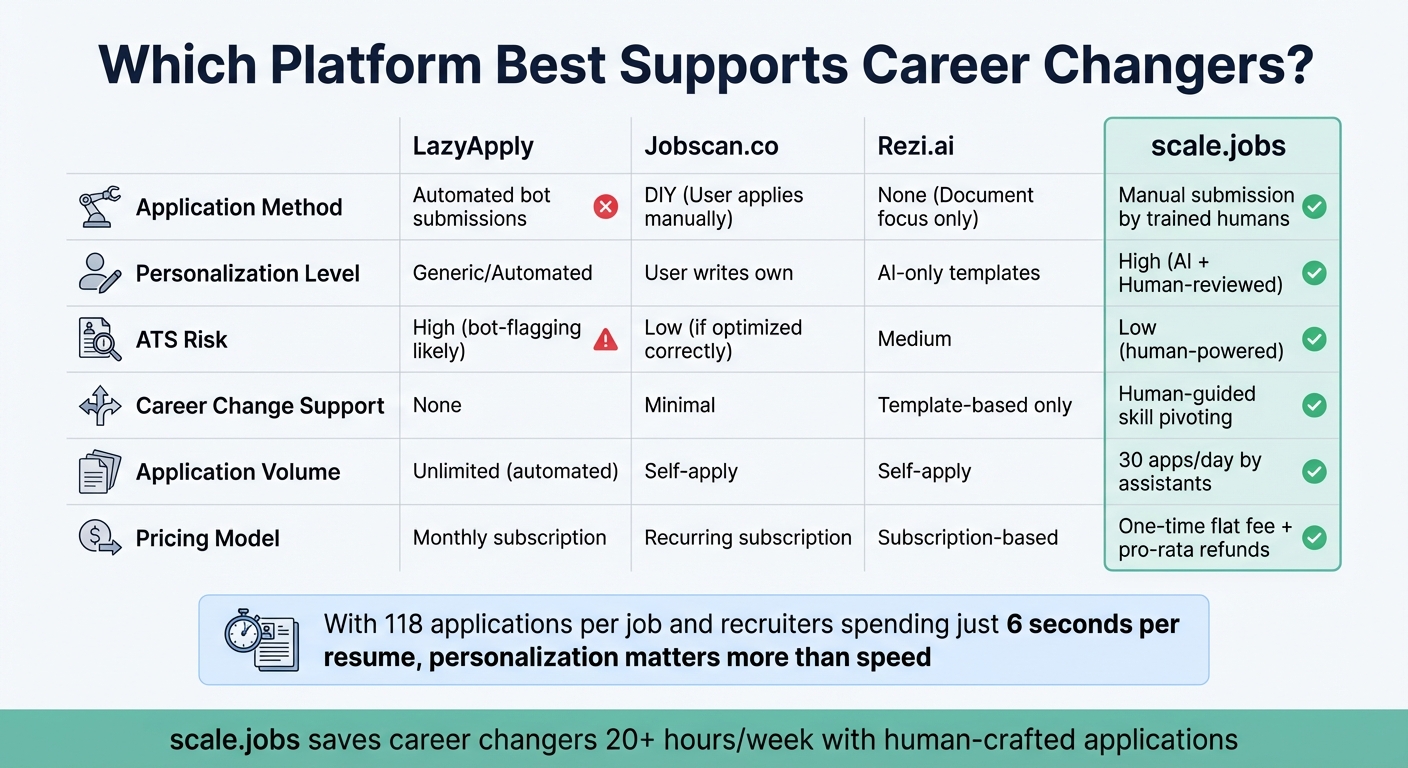
Career Change Job Application Platforms Comparison: scale.jobs vs LazyApply vs Jobscan vs Rezi
Switching careers is no small feat. While 58% of people consider a career change, recruiters often spend just six seconds scanning a resume. So, which platform can help connect your past experience to your future aspirations?
Most job search tools fall into two categories. Some, like LazyApply, automate the process by blasting generic applications across job boards. Others, such as Jobscan.co and Rezi.ai, focus on AI-powered scanning and template generation but leave the actual application process to you. For career changers who need to reframe their experience and tailor their story for a new industry, these options often fall short. Here’s how scale.jobs stands out with a human-first approach designed specifically for career changers.
LazyApply vs scale.jobs: The Case for Human-Powered Applications
LazyApply offers speed by automating job applications through bots. But for career changers, personalization is far more important than speed. If you’re moving from sales to healthcare or from education to corporate training, a generic bot won’t explain why your background fits the new role. Worse, automated submissions often get flagged by Applicant Tracking Systems (ATS), potentially hurting your chances.
Scale.jobs takes a completely different route. Instead of relying on bots, trained human assistants manually submit up to 30 applications per day on your behalf. Each cover letter is crafted to highlight your transferable skills and reframe your experience in terms that resonate with your target industry.
| Feature | LazyApply | scale.jobs |
|---|---|---|
| Application Method | Automated bot submissions | Manual submission by humans |
| ATS Risk | High (bot-flagging likely) | Low (human-powered approach) |
| Personalization | Generic/Automated | High (tailored for career changers) |
| Pricing | Monthly subscription | One-time flat fee |
| Updates | Basic email confirmations | Real-time WhatsApp + Screenshots |
Why scale.jobs is better for career changers:
- Human assistants craft applications that explain how your experience translates to a new field, such as linking sales skills to patient advocacy roles.
- Manual submissions bypass ATS filters, ensuring your application reaches recruiters.
- A one-time flat fee eliminates ongoing subscription costs during long job searches.
- Real-time updates via WhatsApp, including screenshots, provide transparency.
- Saves you over 20 hours a week by handling the repetitive application process.
Meanwhile, tools like Jobscan.co fail to offer the comprehensive support career changers need.
Is Jobscan.co Enough? Reviews & Alternatives
Jobscan.co is well-known for its ATS keyword scanning tool, which helps you align your resume with specific job descriptions. While helpful for identifying gaps, the platform stops short of offering complete support. You’re left to write your own cover letters, customize applications, and submit everything manually - a time-consuming process, especially when juggling dozens of applications during a career shift.
Scale.jobs offers a complete job search solution. The AI Assistant Pro (currently $9/month) generates unlimited tailored resumes and cover letters. But the standout feature is the Human Assistant service: trained virtual assistants who not only optimize your documents but also handle the entire application process across any platform.
| Feature | Jobscan.co | scale.jobs |
|---|---|---|
| Primary Function | ATS keyword scanning tool | Full job search & application management |
| Application Support | DIY (User applies) | Done-for-you (Assistants apply) |
| Cover Letter Creation | User writes own | AI-generated + Human-reviewed |
| Visa Support | Minimal | Integrated visa sponsorship filters |
| Pricing | Recurring subscription | Flat-fee with pro-rata refunds |
Why scale.jobs is ideal for career changers:
- Offers end-to-end support, from optimizing your resume for ATS to submitting applications.
- Includes visa sponsorship filters for roles requiring H1B, F1, CPT, TN, or O1 visas.
- Human assistants can apply across corporate ATS systems, niche job boards, and company websites.
- Unused application credits are refunded on a pro-rata basis.
- Keeps your job search on track with a 24-hour turnaround.
Why Rezi.ai Falls Short for Career Changers

Rezi.ai focuses on creating initial drafts of resumes and cover letters using AI. But for career changers, the platform lacks the personalized touch needed to address the "why" behind your career shift. AI-generated templates often fail to highlight your transferable skills in a way that feels authentic or compelling.
Scale.jobs takes it a step further by combining AI-driven tools with human expertise. The AI Assistant Pro generates tailored cover letters in seconds, but human career coaches refine the messaging to ensure your career change story resonates.
| Feature | Rezi.ai | scale.jobs |
|---|---|---|
| Content Creation | AI-only generation | AI-generated + Human-reviewed |
| Application Service | None (Document focus) | Full application management |
| Transparency | N/A | Proof-of-work screenshots |
| Career Change Support | Template-based | Human-guided for skill pivoting |
| Application Volume | Self-apply | 30 apps/day by human assistants |
Why scale.jobs is the smarter choice:
- Combines AI efficiency with human oversight, managing your entire application process while saving you over 20 hours a week.
- Human career coaches ensure your cover letters tell a compelling story, not just match keywords.
- Offers specialized support for career changers, visa holders, and those recently laid off.
- Provides unlimited AI-generated cover letters with the option for human-managed applications.
With these differences in mind, scale.jobs is the platform that truly bridges your career past with your future aspirations. It’s not just about applying - it’s about applying with purpose and precision. Let the experts take the reins while you focus on preparing for your next big opportunity.
How to Write Your Career Change Cover Letter
Writing a cover letter for a career change can feel tricky, but it boils down to three key steps: acknowledge your transition, connect your past experiences to your future goals, and keep it concise. Erin Aldrich Shean, Founder of Ascension Coaching & Consulting, sums it up perfectly:
"A well-crafted cover letter is your opportunity to write in your own words about your transition and bridge your past and future."
Start by addressing your career shift right away in the opening paragraph. Present it as a deliberate and positive choice. Share the reasoning behind your decision - whether it’s a passion for a new industry, the pursuit of better work-life balance, or skills you’ve been honing on your own. From there, use the body of your letter to focus on transferable skills and align your language with the expectations of your target field. For instance, if you’re transitioning from teaching to corporate training, emphasize your experience in curriculum design and leadership. If moving from sales to account management, highlight your strengths in relationship building and negotiation.
Aim to keep your letter between 250 and 400 words, broken into 3–5 brief paragraphs. Include any certifications, volunteer experiences, or courses that demonstrate your preparation for the new role. Wrap things up with a clear call to action - express your enthusiasm for an interview and invite the hiring manager to get in touch.
Feeling overwhelmed by the need to customize multiple cover letters? scale.jobs can help simplify the process. Their AI Assistant Pro (available for $9/month) generates unlimited, personalized cover letters in seconds. For even more support, their Human Assistant service offers professionally crafted, ATS-optimized letters and can submit up to 30 applications daily on your behalf. With a 24-hour turnaround and real-time WhatsApp updates, you could save over 20 hours a week - time better spent preparing for interviews.
FAQs
How do I showcase transferable skills effectively in a career change cover letter?
To showcase transferable skills effectively, begin by pinpointing the core skills the new role demands. Next, connect each of these skills to concrete examples from your previous experience, emphasizing outcomes or accomplishments that can be quantified. Make sure to clearly articulate how these abilities will bring value to the employer in the new position. Use a confident and optimistic tone to illustrate how your background aligns seamlessly with their requirements.
What are the most common mistakes to avoid when writing a career change cover letter?
Writing a career change cover letter is your chance to show how your unique background positions you as the ideal candidate for a new role. But certain missteps can weaken your application and make it less impactful. Here are some common mistakes to steer clear of:
- Using generic greetings: Whenever possible, address the hiring manager by name. Starting with "To Whom It May Concern" or similar phrases can come across as impersonal and lazy. A little research to find the right name can go a long way.
- Repeating your résumé: Your cover letter should complement your résumé, not echo it. Use this space to tell a compelling story or explain how your previous accomplishments align with the role you're pursuing.
- Overlooking transferable skills: If you don’t connect your past experience to the job's requirements, recruiters might struggle to see how you fit. Highlight specific skills from your background and explain how they apply to the new position.
- Starting with clichés: Openers like "I’m excited to apply..." are overused and forgettable. Instead, kick things off with a captivating anecdote, a thought-provoking question, or a unique insight to grab attention right away.
- Skipping personalization: A generic cover letter won’t stand out. Tailor your letter to reflect the company’s mission, values, or recent accomplishments to show you’ve done your homework and are genuinely interested in the role.
By avoiding these common errors, you can create a cover letter that not only grabs attention but also positions your career change as a well-thought-out and strategic decision.
How does scale.jobs help create a personalized cover letter for a career change?
Scale.jobs simplifies the process of creating a personalized, ATS-friendly cover letter in just one click. It uses job-specific keywords, measurable accomplishments, and even incorporates the hiring manager’s name, all based on details from the job posting.
If you’re transitioning to a new career path, their human assistant service takes it a step further. It fine-tunes your cover letter to emphasize transferable skills, align with your career aspirations, and maintain a polished, professional format. By blending AI efficiency with human insight, Scale.jobs ensures your cover letter captures attention and effectively conveys your unique story.