
67% of job postings are fake: here's how to spot one

Sarah Mitchell
June 4, 2026

Fact: Over two-thirds of job postings today are fake. These include scams aimed at stealing money or personal information, as well as "ghost jobs" that companies post without any intention to hire. This wastes your time, risks your security, and creates frustration during your job search.
To protect yourself, look for these red flags:
- Vague job descriptions or unrealistic requirements
- Requests for payment or sensitive personal information upfront
- Companies with no verifiable online presence
Always verify postings on official company websites and trusted platforms. If something feels off, double-check the recruiter’s email domain and company reviews. If you're unsure, consider using tools like a job application service or a job search virtual assistant to ensure you're applying only to legitimate opportunities.
Below, we’ll break down practical steps to spot fake job listings, protect your personal data, and report suspicious postings.
How to Spot Fake Job Postings | Avoid Scams in 2025!
The Scope of Fake Job Postings
Fake job postings can range from outright scams to job listings that companies have no intention of filling - commonly referred to as ghost jobs. These deceptive practices waste your time and energy, making it essential to understand the different types and how to spot them.
What Defines a Fake Job Posting?
Fake job postings generally fall into three main categories, each posing unique risks to job seekers.
Ghost jobs are perhaps the most prevalent. These are legitimate-looking listings from real companies, often featuring typical salary ranges like $70,000–$90,000. However, these roles are not actively being filled. According to a 2023 survey by Clarify Capital, 68% of hiring managers admitted to posting jobs not intended for immediate hire. Instead, these postings are often used to collect resumes or forecast future hiring needs, leaving applicants in a frustrating limbo.
Then there are scams, which are far more malicious. These fraudulent postings are designed to steal money or personal information. They often promise high-paying remote jobs with minimal qualifications, only to later demand upfront fees or sensitive documents. Similar to many online fraud schemes and crypto hacks, these scams rely on social engineering tactics to manipulate victims into revealing sensitive information or sending money. The Federal Trade Commission and the FBI's Internet Crime Complaint Center (IC3) regularly warn about such scams, which collectively cause financial losses amounting to tens of millions of dollars annually.
Lastly, there's the bait-and-switch tactic. These postings advertise full-time positions but later reveal the job to be commission-only or unpaid. While not illegal, these listings are intentionally misleading and can waste valuable time for serious job seekers.
Why Do Companies Post Jobs They Have No Intent to Fill?
The reasons behind non-genuine job postings vary widely, but they often serve the company's interests more than the applicant’s.
Some companies maintain evergreen listings for roles like "Software Engineer" or "Sales Representative" to build a database of potential candidates for future hiring needs. Others post jobs to analyze the talent market - for example, assessing how many qualified candidates apply at a specific salary range. Even if no one is hired, this data can inform future recruitment strategies.
Startups, in particular, may use job postings as a signal to investors. By listing multiple roles, they project an image of growth, even if those positions are not funded. Additionally, internal HR policies might require companies to publicly post job openings, even when an internal candidate has already been selected.
These practices, while not illegal, can be incredibly frustrating for job seekers. Investing time and effort into applying for ghost jobs - even with the help of tools like an AI resume builder or job application service - can lead to significant wasted effort.
Next, we’ll explore key warning signs to help you identify these deceptive postings before they drain your time.
"Companies often post jobs they don't plan to fill to create a talent pool for future needs or to project an image of growth." - Sarah Mitchell, Author at Scale.jobs
Red Flags: How to Tell If a Job Posting Is Fake
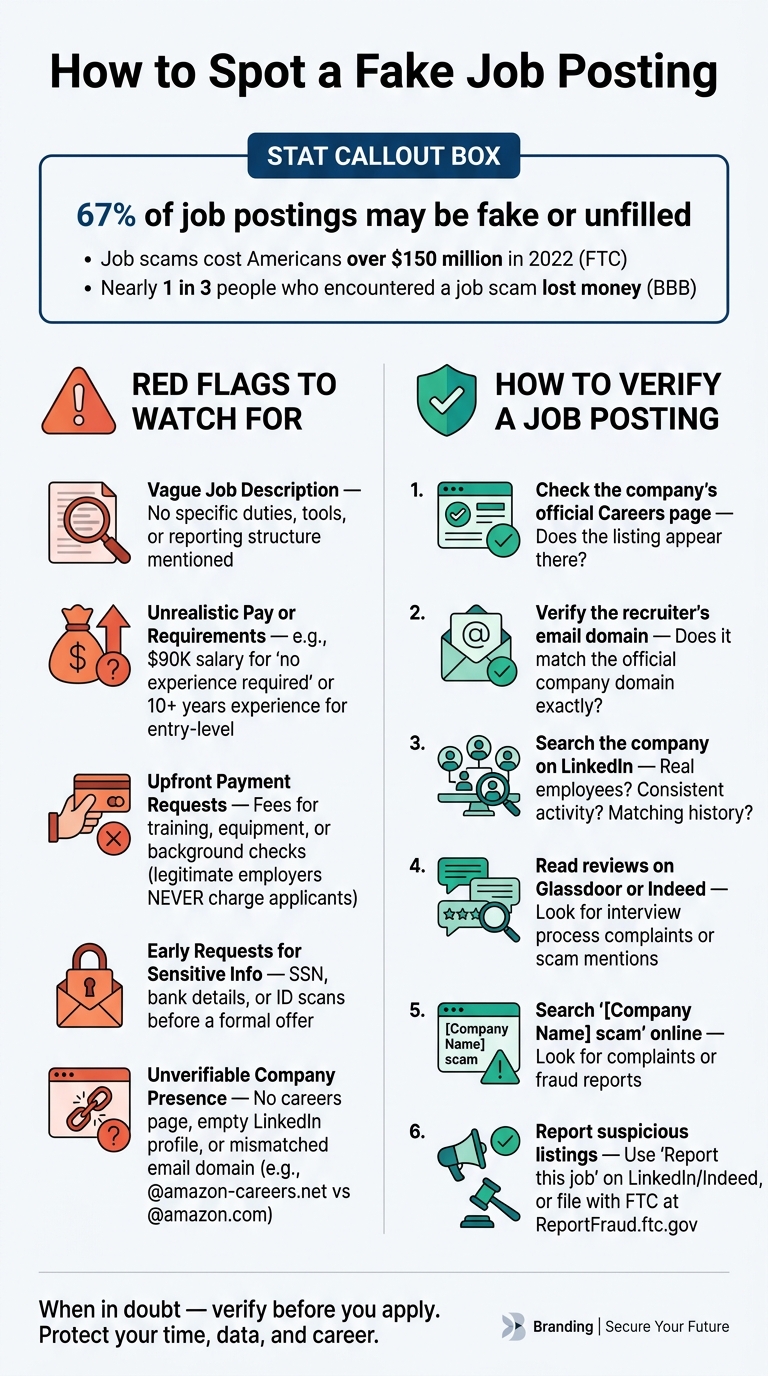
How to Spot a Fake Job Posting: Red Flags & Verification Steps
Spotting fake job postings is essential to safeguarding your job search. While no single red flag confirms a scam, a combination of warning signs can indicate trouble. For example, a listing that’s vague, unverifiable, and asks for sensitive personal information upfront should raise your suspicions. Here’s how to identify fake postings and protect yourself from scams.
Vague Descriptions or Unrealistic Requirements
Genuine job postings clearly outline key details: what the role involves, who you’ll report to, and the skills needed to succeed. Fake postings, on the other hand, tend to be overly generic, using phrases like "assist with daily operations" without providing specifics. Some even demand absurd qualifications, such as requiring 10+ years of experience for an entry-level role or offering salaries that seem far too high for the position.
A mismatch between the job level and its requirements is a major red flag. Many fake postings reuse generic templates, relying on buzzwords without meaningful details about the role or tools required. If the description feels off or seems like it could apply to any job, it’s worth digging deeper.
Requests for Payment or Personal Information
Another major warning sign is when a job posting asks for money or sensitive personal information. Legitimate U.S. employers will never charge you fees for applications, training, or background checks. If a posting asks for payment for equipment, software, or "processing fees", it’s almost certainly a scam.
Similarly, be cautious if you’re asked to provide personal information like your Social Security number, bank details, or copies of your ID early in the process. Reputable companies only collect sensitive information after extending a formal offer, and they do so through secure HR systems - not via email or casual chat messages. If a recruiter pressures you to share private details before verifying the company or completing an interview, take a step back. It’s also a good time to ensure your resume is polished and secure - consider using a trusted AI resume builder to keep your documents professional and safe.
No Verifiable Company Presence
Before applying, take a moment to confirm the company’s legitimacy. Look for the company’s official website and verify that it has a professional domain, U.S.-based contact information, and a careers page. Then check LinkedIn: does the company have a page with real employees, consistent activity, and a history that aligns with the job posting?
If the job is listed on platforms like Indeed or LinkedIn but doesn’t appear on the company’s official careers page, proceed with caution. Scammers often impersonate well-known brands, using fake email domains like @amazon-careers.net instead of the legitimate @amazon.com. These subtle differences, combined with vague job details, are a clear sign to steer clear.
Quick-Check List of Red Flags
Here’s a handy table summarizing the key warning signs to watch for:
| Warning Sign | Common Indicators | What to Do |
|---|---|---|
| Vague job description | No specific duties, tools, or reporting structure | Ensure the posting answers what, who, and how |
| Unrealistic pay or requirements | $90K for "no experience"; senior demands for entry-level roles | Compare with market rates on platforms like Glassdoor or LinkedIn Salary |
| Upfront payment request | Fees for training, equipment, or background checks | Stop - legitimate employers never charge applicants |
| Early sensitive personal data request | SSN, bank info, or ID scans before a formal offer | Decline until after a verified offer through a secure HR process |
| Unverifiable company | No careers page, empty LinkedIn, mismatched domain | Double-check the company’s website and LinkedIn page for authenticity |
sbb-itb-564272e
Tools and Methods to Verify a Job Posting
Taking a few minutes to verify a job posting before applying can save you from scams and wasted effort. According to the FTC, job opportunity scams led to losses exceeding $150 million in 2022, with the average individual loss around $2,000. By using the tools and methods outlined below, you can better protect yourself and ensure you're applying for legitimate opportunities.
Check the Listing on Official and Trusted Platforms
Start by visiting the company's official Careers page. If the position isn't listed or the details don't match what you found on an external site, this could be a red flag. Legitimate job openings are usually posted on the company's website or on well-known job boards. Be cautious of listings that appear on less reliable platforms or have altered contact information.
Verify the Sender's Email and Domain
When a recruiter contacts you, their email domain can often signal whether they're legitimate. For example, a genuine recruiter from Salesforce will use @salesforce.com, not a domain like @salesforce-careers.net or a free email service like @gmail.com. Even minor alterations in the domain name can indicate a scam.
Check the email headers to confirm that the "Reply-To" address aligns with the "From" address. A professional corporate email will typically include a signature with the recruiter's name, title, a physical office address, a direct phone number, and a link to the company's official website. If anything seems suspicious, call the company's official phone number (found on their website) to verify the recruiter's identity, rather than relying on contact details provided in the email.
After confirming the email's legitimacy, consider looking into the company's reputation for additional assurance.
Read Company Reviews Before Applying
Websites like Glassdoor and Indeed can provide insights into a company's hiring practices. Focus on interview reviews to see if the process described aligns with the job posting. Reviews mentioning issues such as roles that never progress beyond initial screenings or requests for upfront payments (e.g., buying equipment with a promise of reimbursement) should raise concerns.
Also, pay attention to the number and timing of reviews. A company with only a handful of overly positive reviews posted within a short period might be trying to manipulate its reputation. To dig deeper, search online for terms like "[company name] scam" or complaints.
If you're using a resume writing service or working with a professional to prepare your application, they can also help you verify the legitimacy of the roles you're considering. This extra step ensures you're not wasting time tailoring your materials for a fraudulent listing.
What to Do When a Job Posting Looks Suspicious
Spotting a suspicious job posting is just the first step - what you do next can protect you from falling victim to fraud. According to the BBB's 2020 Scam Tracker Risk Report, nearly 1 in 3 individuals who encountered a job scam lost money, while 14% shared personal information. To stay safe, focus on three key actions: verify, protect, and report.
Verify Through Official Company Channels
If something feels off about a job posting, take action immediately by verifying its legitimacy through official company channels. Start by leaving the suspicious listing behind and heading straight to the company's official website. Navigate to their Careers page to see if the role is listed. Use the contact details provided on the site - such as an HR email or general inquiry number - to confirm whether the recruiter or position is authentic.
This step is crucial because scammers often replicate company branding to appear credible. Even if the job description looks professional, treat it as fraudulent if the company's HR team cannot confirm its existence.
Once you've verified the job, focus on safeguarding your personal details.
Avoid Sharing Personal Information Prematurely
Until you've confirmed the legitimacy of a job posting, refrain from sharing sensitive documents like your Social Security number, bank account information, or government ID scans.
The FTC emphasizes that legitimate employers only request such details after extending a formal job offer and typically through secure HR platforms - not during early-stage communications like emails or messaging apps. If you're asked for this information before even speaking with a verified hiring manager, it's a major red flag. Disengage immediately. If you're unsure about a role's legitimacy, working with a job search virtual assistant can help you identify trustworthy opportunities.
Your final step is to ensure the fraudulent listing doesn't harm others.
Report the Suspicious Job Posting
If you suspect a scam, take a moment to report the listing. Platforms like LinkedIn, Indeed, and ZipRecruiter have "Report this job" features that allow you to flag suspicious postings. Include details such as mismatched email domains, payment requests, or the absence of the role on the company's official site to help the platform's moderation team take swift action.
Beyond the job board, you can file a complaint with the FTC at ReportFraud.ftc.gov, report to the FBI's Internet Crime Complaint Center (IC3), or log the scam on the BBB Scam Tracker. By reporting, you not only protect yourself but also help other job seekers avoid the same pitfalls.
Conclusion: Stay Alert and Keep Your Job Search on Track
With an estimated 50–67% of job postings potentially being fraudulent - and employment scams ranking among the top three riskiest scams in North America according to the BBB - the likelihood of encountering a fake listing is significant. But this isn't a reason to stop your search; it’s a reminder to approach every listing with care. Verifying postings is essential, and using tools that protect your information while helping you stand out can make all the difference. This is where scale.jobs stands apart from other services.
Fraudulent job postings often share common warning signs: vague job descriptions, compensation that seems too good to be true, early requests for sensitive information, or a lack of a verifiable company presence. If you notice two or more of these red flags, treat the listing as unverified. To protect yourself, cross-check the role on the company's official careers page, verify recruiter email domains, and check reviews on platforms like Glassdoor or Indeed. In a job market filled with scams, choosing a reliable job application service that values transparency and human oversight can save you time and effort.
If you're putting in the work - customizing your resume, targeting specific roles, and safeguarding your personal data - it's worth comparing your options. Services like LazyApply and FindMyProfession offer useful features: LazyApply focuses on automating bulk submissions, while FindMyProfession provides professional resume writing and career coaching. However, both have limitations in areas where scale.jobs excels:
- Human involvement, not automation: Unlike automated tools, scale.jobs employs real human assistants to handle applications, reducing errors caused by bots.
- Tailored, ATS-optimized documents: Applications come with professionally customized resumes designed to pass ATS filters - not generic templates.
- No recurring fees: A one-time payment provides consistent support throughout your job search.
- Direct WhatsApp support: Real-time communication with your assistant ensures personalized guidance, a feature missing from LazyApply and FindMyProfession.
- Transparent proof of work: Receive confirmation for every application submitted, so you always know where your efforts are directed.
Here’s a quick comparison to help you decide:
| Feature | LazyApply | FindMyProfession | scale.jobs |
|---|---|---|---|
| Human involvement | None (fully automated) | Moderate (coaching + writing) | High (human assistants apply for you) |
| Resume customization depth | Minimal | Strong | Strong, ATS-optimized per role |
| ATS handling | Basic | Good | Optimized with human review |
| Application execution | Bot-driven | User-driven | Human-executed |
| Transparency & proof of work | Limited | Limited | Full proof-of-work reporting |
| Pricing model | Subscription | Per-package | One-time payment |
Decision Summary
- Choose LazyApply if you’re focused on sending out a high volume of applications quickly and don’t mind minimal customization or human oversight.
- Choose FindMyProfession if you’re seeking career coaching and professionally written resumes but aren’t as concerned with large-scale application execution.
- Choose scale.jobs if you want applications handled by human assistants, ATS-optimized documents, full transparency, and direct, real-time support - all without a recurring subscription.
Consider Switching to scale.jobs if:
- Your current tool automates applications but doesn’t provide visibility into what’s being sent or where.
- You’re paying for a monthly subscription but aren’t seeing meaningful progress in landing interviews.
- Your resume isn’t tailored for each role, and you suspect ATS systems are filtering you out.
- You want real-time support during your job search but lack direct access to a human assistant.
- You’ve encountered questionable job postings and need a service that applies only to verified, legitimate opportunities on your behalf.
FAQs
How can I tell a ghost job from a real opening?
To identify a ghost job, start by examining the job description. Watch out for vague details or qualifications that seem unrelated to the role's level of seniority. Another red flag is when the position is only listed on third-party job boards but doesn’t appear on the company’s official career page. Be especially wary of any job postings that request upfront payments, as this is a common indicator of a scam. To dig deeper, use platforms like LinkedIn or Glassdoor to check if the company is actively hiring and whether it has a trustworthy reputation.
What info is safe to share before I get a written offer?
Before receiving a written job offer, limit the information you share to what's essential for verifying your qualifications - such as your resume, work history, and contact details. Take time to confirm the company's legitimacy by checking platforms like LinkedIn or Glassdoor. Avoid sharing sensitive financial information, including bank account details or Social Security numbers, and never agree to make upfront payments. To stay organized and safeguard your information, consider using trusted and transparent tools like a job search virtual assistant or a job application service.
What should I do if I already applied to a fake job?
If you think a job you applied for might be fake, it's crucial to act quickly. Stop all communication right away and refrain from providing any additional personal or financial information. Never agree to make upfront payments, as legitimate employers won't ask for them. Keep an eye on your financial accounts and credit reports for any unusual activity. If you've already shared sensitive information, such as your Social Security number, it may be wise to freeze your credit to guard against potential identity theft.