
9 Certifications US Hiring Managers Respect vs. 5 They Ignore in 2026

Sarah Mitchell
March 15, 2026

Not all certifications hold weight with hiring managers in 2026. Employers increasingly value certifications that prove job-ready skills through rigorous exams and hands-on experience. Certifications from organizations like AWS, PMI, and ISC2 are highly regarded, offering salary boosts of 25–40%. On the other hand, completion-based certificates, like those from university extension programs, are often dismissed as lacking credibility.
Key Takeaways:
- Respected Certifications: AWS Solutions Architect, PMP, CISSP, and others from reputable organizations validate advanced skills and experience.
- Ignored Certifications: Generic or completion-based programs, such as university-issued HR certificates, fail to demonstrate specialized expertise.
- Salary Impact: Respected certifications can increase earnings by up to $27,000 annually.
- Verification: Employers prioritize certifications with digital badges or blockchain validation.
Quick Overview:
Focus on certifications that align with job postings in your field and avoid those that lack industry recognition. For example, AWS and PMP certifications are frequently required, while generic management certificates are rarely mentioned. To maximize your career prospects, choose certifications that validate your skills and make them visible on your resume and LinkedIn profile.
Top 7 Certifications Employers Actually Want in 2026 (Full Breakdown)
9 Certifications US Hiring Managers Respect in 2026
Earning a respected certification can make a noticeable difference in your career. The following nine certifications demand rigorous testing, practical skills, and recertification, offering measurable pay increases and better career opportunities. Here's a closer look at each certification, including their requirements and impact on various industries.
SHRM-CP and SHRM-SCP
The SHRM-CP (Certified Professional) and SHRM-SCP (Senior Certified Professional) certifications from the Society for Human Resource Management focus on strategic HR skills like workforce planning and compliance. These credentials are highly regarded because they go beyond basic HR knowledge, requiring candidates to apply concepts to real-world scenarios and demonstrate a deep understanding of U.S. employment laws. While the SHRM-CP is ideal for implementing compliant programs, the SHRM-SCP is designed for professionals who align HR strategies with broader business goals. These certifications are key for advancing into senior HR roles.
AWS Certified Solutions Architect – Associate

This certification is a must-have for professionals working with Amazon Web Services, as it validates the ability to design cost-effective, scalable, and reliable cloud systems. The exam costs $150 and requires hands-on experience with AWS. Holding this certification can lead to an average salary boost of $20,000 compared to non-certified cloud engineers. With AWS dominating the cloud services market, this credential is highly sought after for roles ranging from startup infrastructure design to government projects.
PMP (Project Management Professional)
The PMP certification from the Project Management Institute is a gold standard for project managers across industries like construction, IT, and healthcare. It requires documented project management experience and passing a proctored exam that covers predictive, agile, and hybrid methodologies. Certified PMP professionals earn about $122,000 on average, with salaries climbing to $150,000 for those with over a decade of experience. The exam costs $405 for PMI members and $575 for non-members, often delivering strong returns on investment within the first year.
Microsoft Certified: Azure Solutions Architect Expert
This certification is essential for professionals designing enterprise cloud solutions on Microsoft Azure. It covers areas like administration, development, security, and scalability, making it a top choice for organizations that prioritize compliance and reliability. Certified Azure architects typically earn between $100,000 and $150,000, with senior experts in major cities reaching $180,000. The exam fee is $165.
CISSP (Certified Information Systems Security Professional)
The CISSP is widely regarded as the "gold standard" for cybersecurity professionals. It is particularly valued in regulated industries like finance, healthcare, and government, where governance and compliance expertise are crucial. The certification costs $749 and requires five years of professional experience. CISSP-certified professionals in management roles can expect average compensation of $175,583, making it a top choice for those aiming for leadership positions like Chief Information Security Officer (CISO).
CompTIA Security+

As a foundational credential, CompTIA Security+ is ideal for entry- to mid-level IT security professionals. It is required by the U.S. Department of Defense for anyone accessing government information systems, making it essential for defense contractors. The exam costs $404 and covers core security topics like threat identification and risk management. This certification is also valued in healthcare and finance sectors as a baseline for security expertise.
Google Cloud Professional Cloud Architect
This certification is designed for professionals working in multi-cloud environments or on AI-driven projects. It demonstrates the ability to create scalable and secure solutions that align with business goals. The exam costs $200 and requires strong proficiency in cloud architecture. With demand for cloud and AI certifications rising by 21% annually, this credential opens doors to high-paying roles in data science and AI-focused organizations.
Certified Information Systems Auditor (CISA)
The CISA certification from ISACA is essential for roles in IT governance, risk management, and auditing, particularly in regulated sectors like finance and energy. It costs $575 for ISACA members and $760 for non-members and requires five years of professional experience. CISA-certified professionals help companies comply with regulations such as HIPAA and GDPR, with salaries ranging from $90,000 to $140,000 depending on experience and location.
PHR and SPHR
The PHR (Professional in Human Resources) and SPHR (Senior Professional in Human Resources) certifications from HRCI focus on U.S. employment law and HR operations. The PHR is designed for professionals managing day-to-day HR tasks, while the SPHR emphasizes strategic leadership and planning. These certifications require 1–4 years of experience for the PHR and 4–7 years for the SPHR, offering a clear career progression from HR generalist to senior leadership roles.
5 Certifications US Hiring Managers Ignore in 2026
As hiring trends evolve, certifications that fail to demonstrate practical expertise or strategic depth are losing favor. By late 2025, hiring managers have become more discerning, prioritizing credentials that validate hands-on skills and advanced knowledge. Certifications that lack rigorous exams, industry recognition, or transferable value are increasingly overlooked. While respected certifications can boost salaries by 25-40%, the following five fail to deliver such advantages. Here's a closer look at why these certifications fall short.
HR Manager Certificate Program - AIHR

The HR Manager Certificate from AIHR (Academy to Innovate HR) struggles to compete with industry-recognized credentials like SHRM-CP/SCP or PHR/SPHR. Although AIHR offers online courses covering various HR topics, it lacks the rigorous, proctored exams and experience-based requirements that hiring managers value. This program is often categorized as a Tier 3 credential, suitable for foundational learning but inadequate for proving strategic HR expertise. For roles demanding deep knowledge of compliance or workforce planning, recruiters consistently favor certifications that validate years of hands-on experience.
Certificate in Managing People for Performance
This certificate focuses on basic team management, which limits its relevance in a job market that increasingly rewards specialized skills. Employers today favor leadership credentials that showcase either industry-specific expertise or proficiency with advanced tools like AI-driven management systems. Without endorsement from a recognized industry body or alignment with vendor-neutral standards, this certification is often dismissed as too elementary for senior roles. It also fails to provide the transferable skills that employers value across varied organizational settings.
Professional Management Certificate
Generic management certifications, like the Professional Management Certificate, lack the specialized focus needed to stand out in today’s skills-based hiring landscape. With 82% of employers in 2026 prioritizing skills assessments and demonstrable competencies, a broad "Professional Management" title doesn’t offer much proof of advanced capabilities. Certifications like the PMP (Project Management Professional), which test mastery of both traditional and agile methodologies, or those focused on emerging fields like AI or cybersecurity, are far more competitive.
As one hiring manager at AWS explained, "We throw away certified resumes. They're usually the least qualified."
Human Resources Management Certificate - UCLA

Despite UCLA's academic reputation, its HR Management Certificate is seen as foundational rather than strategic. The program relies on coursework rather than the rigorous, proctored exams that define top HR certifications like PHR or SPHR. Hiring managers value credentials that demonstrate expertise in areas like workforce analytics, compliance, and organizational design - skills validated through exam-based certifications. Unfortunately, UCLA's certificate signals course participation rather than mastery, leading recruiters to dismiss it as a "participation trophy" in competitive hiring scenarios.
UC People Management Certificate
The UC People Management Certificate is tailored for career advancement within the University of California system, which limits its appeal outside academia. The program includes 16–20 internal eCourses and culminates in the UC People Management Conference, designed to foster connections within the UC leadership hierarchy. However, hiring managers in other industries view this as internal training rather than a credential with industry-wide relevance. Employers increasingly seek vendor-neutral certifications like CompTIA or PMP, which validate transferable skills applicable across various sectors.
According to the Institute of Certified Professional Managers, "Management is a profession that is not industry specific, so regardless of the industry for which you are employed, a CM's managerial and supervisory skills will always be relevant."
This system-specific focus makes the UC certificate less valuable for candidates pursuing roles outside the university. When evaluating certifications, it’s essential to consider whether they align with broader industry standards and offer measurable career advantages. For those aiming to stand out, focusing on credentials with proven value in diverse job markets is key.
Comparison Table: Respected vs. Ignored Certifications
Respected vs Ignored Certifications: Key Differences for 2026
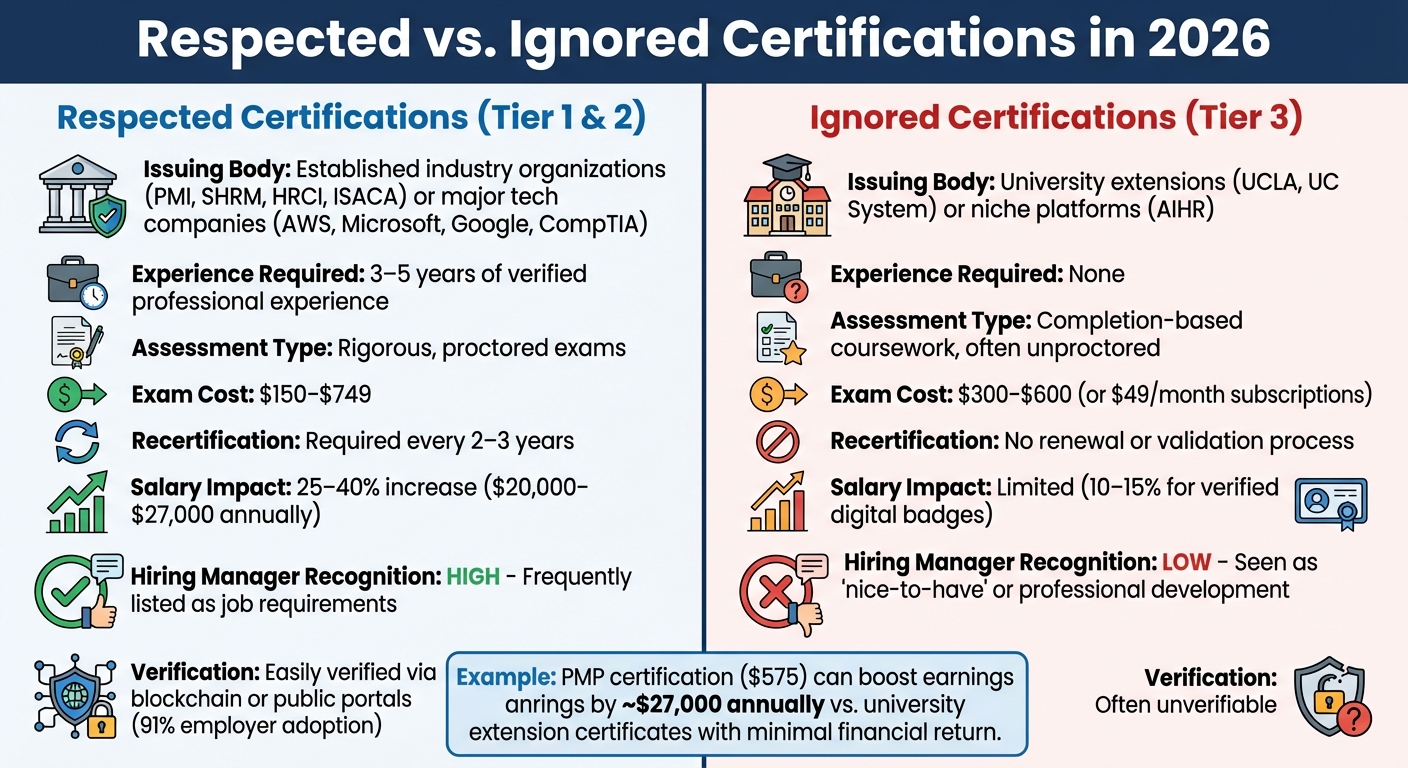
Certifications can significantly impact your career trajectory, but not all carry the same weight. Employers value certifications backed by rigorous assessments and credible organizations, while others are often dismissed as superficial. The table below highlights the key distinctions:
| Factor | Respected Certifications (Tier 1 & 2) | Ignored Certifications (Tier 3) |
|---|---|---|
| Issuing Body | Established industry organizations (PMI, SHRM, HRCI, ISACA) or major tech companies (AWS, Microsoft, Google, CompTIA) | University extensions (e.g., UCLA, UC System) or niche platforms (e.g., AIHR) |
| Experience Required | 3–5 years of verified professional experience | None |
| Assessment Type | Rigorous, proctored exams | Completion-based coursework, often unproctored |
| Exam Cost | $150–$749 | $300–$600 (or $49/month subscriptions) |
| Recertification | Required every 2–3 years to maintain relevance | No renewal or validation process |
| Salary Impact | 25–40% increase (approximately $20,000–$27,000 annually) | Limited (10–15% for verified digital badges) |
| Hiring Manager Recognition | High; frequently listed as job requirements | Low; seen as "nice-to-have" or professional development |
| Verification | Easily verified via blockchain or public portals (91% employer adoption) | Often unverifiable |
This breakdown shows why certifications with strict standards and periodic renewal are more likely to lead to higher salaries and career advancement. For instance, a PMP certification priced at $575 for non-members can boost earnings by around $27,000 annually. In contrast, a $600 university extension certificate typically offers minimal financial return.
A Senior Technical Recruiter in the FinTech industry shared: "Most candidates think a certificate proves expertise, but for us, it's about whether it helps us bill more. If your certification doesn’t directly contribute to contracts or rates, it’s just a digital sticker."
When deciding which certifications to pursue, prioritize those listed as mandatory in job postings rather than optional extras. If you’re unsure how to highlight your certifications effectively on your resume, consider using professional resume writing services. A well-crafted resume can help you navigate ATS filters and catch the attention of hiring managers.
What Job Seekers Should Know
The certification world has split into two main types: exam-based credentials that prove your skills and completion-based certificates that show participation. By 2026, hiring managers are heavily favoring the first type, as these credentials typically involve tough, proctored exams and require years of documented experience. For instance, earning the CISSP certification demands five years of professional work in cybersecurity before you can even take the $749 exam. On the other hand, many university extension programs hand out certificates simply for finishing a course. These distinctions can help you focus on certifications that actually make a difference in your career.
Before investing in any certification, take the time to review 10–20 job postings in your target field. This will help you spot which certifications are listed as required versus those that are merely nice to have. For example, if the AWS Solutions Architect certification appears frequently in cloud engineering roles, but a university-issued HR certificate rarely shows up, you’ll know where to prioritize your efforts. This method ensures you align your goals with what hiring managers are actively seeking.
Certifications in cloud computing and cybersecurity not only validate expertise but also boost salaries by 25–40% because they help companies reduce risk. The demand for AI and cloud-related certifications is surging by 21% annually across industries. Even fields like marketing and finance are now looking for basic AI skills, making vendor-specific credentials like AWS, Azure, or Google Cloud far more valuable than general management certificates.
When pursuing certifications, it’s smart to take a tiered approach rather than collecting random ones. Start with foundational certifications like CompTIA Security+ (priced at $404) to land entry-level roles. Then, move on to specialized credentials such as AWS DevOps Professional, which can lead to salaries in the $100,000–$140,000 range. Finally, aim for elite certifications like CISSP for senior positions that often pay $150,000 or more. This strategy demonstrates depth in your expertise, a quality that hiring managers consistently value.
Once you’ve earned your certifications, make sure they’re visible. Add them to the "Licenses & Certifications" section on LinkedIn, and update your "Skills" section with tools you’ve mastered, such as SQL, Python, or Kubernetes, to improve your profile’s visibility. If positioning these credentials on your resume feels overwhelming, consider using professional resume writing services to optimize your application by unlocking the ATS secret to filter success and highlight your qualifications effectively.
FAQs
Which certification should I get first for my target role?
The CompTIA A+ certification is an excellent starting point for those pursuing entry-level roles in IT. It serves as a stepping stone into the industry, aligning with the increasing need for skilled professionals in the tech field. This credential lays the groundwork for growing your career in information technology.
How can employers verify my certification is legitimate?
Employers can confirm the authenticity of your certification by checking if it was issued by an accredited institution or a well-known certifying body. They might also use official verification platforms or directly reach out to the organization that issued the certification for confirmation.
When is a completion-based certificate worth pursuing?
A certificate earned upon completion can be a smart choice if it emphasizes in-demand skills, matches the needs of expanding industries, and delivers tangible career advantages such as higher earning potential or quicker career progression. The key is that it should serve as practical, credible evidence of your abilities, capable of making a noticeable difference in your career within a relatively short timeframe.