
Is Your Job AI-Proof? 7 Skills That Say Yes

Sarah Mitchell
May 30, 2026

AI is reshaping the workforce, automating up to 30% of U.S. work hours by 2030, according to McKinsey. While fewer than 5% of jobs are fully automatable, human-centric skills are now more crucial than ever. Employers prioritize qualities like judgment, emotional intelligence, and problem-solving - areas where AI falls short. This article outlines seven essential skills that can help you stay competitive in an AI-driven job market:
- Critical Thinking: Navigate ambiguity and make sound decisions beyond AI’s capabilities.
- Emotional Intelligence: Build trust, manage relationships, and handle conflicts effectively.
- Complex Problem Solving: Address interconnected challenges requiring human judgment.
- Original Thinking: Deliver solutions that AI-generated ideas can’t replicate.
- AI Literacy: Collaborate with AI tools while maintaining quality and accuracy.
- Precise Communication: Craft messages tailored to specific audiences and scenarios.
- Career Ownership: Proactively manage your career through networking and tailored strategies.
These skills are not just about staying relevant - they’re key to thriving in a workforce increasingly shaped by automation. Keep reading to learn actionable steps to develop these skills and tools like Scale.jobs that can support your job search efforts. You can even let AI handle the repetitive tasks to focus on developing these high-value human skills.
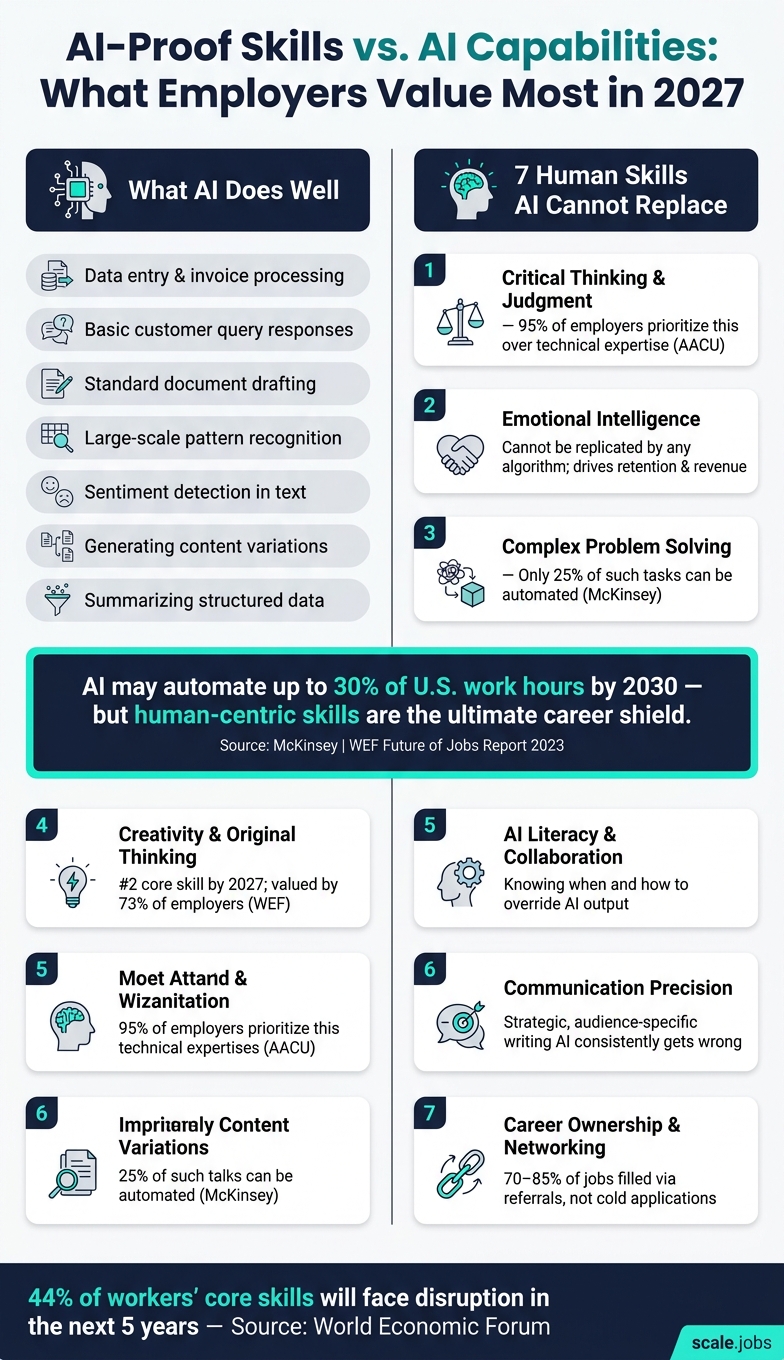
AI-Proof Skills vs. AI Capabilities: What Employers Value Most in 2027
Top 5 Future-Proof Skills for 2030 (AI Can’t Replace These)
sbb-itb-564272e
Why AI-Resistant Skills Matter
AI is incredibly adept at handling tasks that follow predictable, repeatable patterns. Think about data entry, processing invoices, responding to basic customer queries, or drafting standard documents - these are being automated at a rapid pace across industries in the U.S. However, there’s a clear limit to what AI can do. It struggles with interpreting human emotions, managing complex client relationships, or making nuanced decisions when faced with incomplete information and high stakes.
As AI increasingly takes over routine work, employers are placing a premium on distinctly human skills. These include excelling in uncertain situations, navigating people-focused challenges, and adapting to varied contexts. According to U.S. hiring managers, training someone on specific tools or platforms is relatively easy, but finding candidates with strong interpersonal skills, sound judgment, and the ability to adapt to changing circumstances is a far greater challenge. These abilities are not just critical for landing a job - they're essential for long-term career growth in a landscape shaped by AI advancements.
This shift is evident in the types of questions asked during interviews. Common behavioral interview questions like "Can you describe a time you resolved a conflict within your team?" or "How would you manage a client who disagrees with your recommendation?" are designed to evaluate emotional intelligence and decision-making skills. Across organizations - from mid-size companies to Fortune 500 giants - promotions are increasingly tied to qualities like clear judgment, effective communication, and strong leadership. These aren’t just "nice-to-have" skills; they’re now the foundation for professional advancement.
The distinction between routine tasks and context-driven work highlights this evolution:
| Routine Work | Contextual Work |
|---|---|
| Repetitive, rule-based activities | Ambiguous decisions requiring context |
| Retrieving information or basic drafting | Strategic thinking and negotiation |
| Large-scale pattern recognition | Creativity, synthesis, and ethical reasoning |
| Completing tasks efficiently | Building relationships and fostering trust |
Mastering these human-centric skills ensures you're not only prepared for today’s job market but also equipped to thrive in an AI-driven future.
1. Advanced Critical Thinking and Judgment
AI can analyze data with incredible speed and accuracy, but when it comes to navigating ambiguous situations, making high-stakes decisions, or resolving value-based dilemmas, it falls short. Imagine a product manager deciding whether to delay a launch due to incomplete user research or a healthcare administrator weighing cost reductions against patient safety - these are decisions no algorithm can responsibly make. Such moments call for balancing priorities, understanding organizational dynamics, and taking accountability.
This need for advanced critical thinking isn't lost on U.S. employers. The National Association of Colleges and Employers (NACE) reports that over 80% of employers consider critical thinking and problem-solving "very important" for new hires. Similarly, a survey by the Association of American Colleges and Universities found that 95% of employers prioritize candidates with strong critical thinking skills over those with specific technical expertise. The World Economic Forum's Future of Jobs Report 2023 also highlights analytical thinking as the top core skill through 2027, with critical thinking ranking among the top 10.
Strong critical thinkers stand out because they approach problems with structured reasoning. For example, a skilled analyst won’t simply accept an AI-generated forecast at face value. Instead, they’ll probe the assumptions behind the model, question whether the data reflects current realities, and identify scenarios where the projection might fail. This habit of questioning and testing assumptions is what makes individuals indispensable. It’s not just about getting answers but understanding the reasoning behind them, which ultimately leads to better decision-making.
To sharpen your critical thinking, consider adopting a systematic approach. Document your major decisions by outlining goals, options, assumptions, and evidence that could challenge your views. Afterward, review your decisions to understand what worked and what didn’t. This practice, often called a decision memo, is widely used by senior leaders at companies like Amazon and serves as a clear marker of strong judgment in performance evaluations.
AI can also play a role in this process. Use it to generate counterarguments and test your reasoning. Critically evaluate which points hold up and which don’t. This exercise forces you to engage deeply with your own thinking, rather than outsourcing it entirely to a machine. It’s a prime example of how human-AI collaboration can make professionals more effective.
If you're looking to showcase your critical thinking skills to potential employers, consider how you frame these accomplishments in your job applications. Tools like customized career documents can help you highlight judgment-heavy achievements in a way that resonates with hiring managers. This thoughtful presentation ensures your skills stand out in a competitive job market.
2. Emotional Intelligence and Human Connection
Emotional intelligence (EQ) is what sets humans apart in ways that no algorithm can replicate. While AI can analyze resumes, churn out performance reports, or even detect sentiment in an email, it simply cannot read a room. EQ is about understanding emotions, managing reactions, and communicating effectively - skills that are rooted in experience, trust, and accountability. These abilities shine in real-world workplace scenarios where human perception is critical.
Think about this: a manager notices that a top-performing employee is on the brink of burnout and adjusts their workload before it’s too late. Or a sales representative picks up on hesitation in a client’s voice during a quarterly review, pauses their pitch, and asks the right question - revealing a budget freeze that could have jeopardized the deal. A project manager, faced with two clashing teams, identifies the underlying needs of each side and resolves the conflict. In each of these cases, success hinges on emotional intelligence, not on data or algorithms.
As automation takes over more routine tasks, the importance of EQ becomes even more apparent. Your ability to navigate conflict, foster trust, and handle tough conversations directly impacts team performance, employee retention, and even revenue. These aren’t just "nice-to-have" skills - they’re essential.
You don’t need a formal program to build EQ. Small, intentional habits can make a big difference over time. For example, when you feel tension rising, try naming your emotion in the moment - research shows that labeling an emotion, like saying, “I’m feeling defensive right now,” can reduce its intensity and help you respond thoughtfully instead of reacting impulsively. After challenging interactions, reflect on what you noticed, how you responded, and what you could do differently. You can also seek feedback by asking a trusted colleague specific questions, such as, “Was there a time during our last project where I seemed unapproachable?” These conversations can fast-track your self-awareness.
Interestingly, AI can assist in sharpening your EQ. For instance, you can draft a difficult message and use AI tools to fine-tune its tone, ensuring it’s both empathetic and clear. You might also test how the message would be received by different stakeholders, allowing you to anticipate reactions and adjust accordingly. This kind of deliberate practice prepares you for high-stakes situations, helping you refine your communication skills.
Want to make your emotional intelligence shine in your job applications? Use tools like professionally written resumes to highlight your human-centric strengths and stand out in the hiring process.
3. Complex Problem Solving and Systems Thinking
AI shines when dealing with tasks that have clear inputs and predictable outputs, like analyzing structured data. But when problems become open-ended, politically sensitive, or cross-functional, AI often struggles to deliver. This is where a blend of systems thinking and problem-solving skills becomes a game-changer.
Complex problem solving goes beyond isolated critical thinking. It involves understanding how various components of a system interact and influence one another. Take, for instance, a hospital dealing with long emergency room wait times. A straightforward analysis might blame patient volume or physician speed. However, a systems thinker digs deeper, examining how scheduling policies, insurance approvals, and staffing levels during overnight shifts create bottlenecks. AI lacks the ability to fully diagnose such interconnected issues because it cannot interpret organizational dynamics, negotiate with stakeholders, or adapt its approach as new data emerges.
The World Economic Forum has identified complex problem solving as the top workforce skill, and McKinsey reports that only about 25% of tasks involving such decision-making can be automated. This gap exists because real-world challenges often involve competing priorities, shifting constraints, and ethical considerations - areas where AI cannot independently make judgments.
To build this skill, treat recurring challenges as mini case studies. Start by writing a concise problem statement, outlining assumptions, mapping stakeholders, and identifying at least three potential causes. Instead of endless discussions, test solutions through a pilot program or A/B testing. Afterward, conduct an after-action review to assess what worked, what didn’t, and what was unexpected. Applying this framework to everyday issues - like delays in project approvals or increasing customer churn - helps develop systems-thinking capabilities over time.
AI can assist by summarizing customer feedback, generating scenario analyses, or drafting initial causal maps. However, humans must take charge of defining the core problem, evaluating trade-offs, and making final decisions. This balance ensures you remain essential in areas where AI struggles to grasp complexity. If you're looking to highlight these strategic skills to potential employers, a AI resume builder can help translate your cross-functional achievements into language that resonates with hiring managers and navigates ATS systems effectively.
4. Creativity and Original Thinking
AI can churn out countless ad variations by piecing together existing data, but it often falls short when it comes to understanding what truly connects with an audience. It lacks the ability to uncover a brand’s unique strengths or make intuitive leaps based on incomplete information. This is why creativity remains one of the toughest skills to replicate through automation. Unlike platforms such as FindMyProfession, which often rely on templated outputs, scale.jobs incorporates human expertise to emphasize original and impactful contributions. This human touch is what gives creative professionals an edge in a market increasingly dominated by algorithm-driven solutions.
According to the World Economic Forum's Future of Jobs Report 2023, creative thinking is ranked as the #2 core skill expected to grow in importance by 2027. In fact, 73% of employers surveyed identified it as a key workforce priority. Creativity isn’t just confined to fields like marketing or design anymore - it’s becoming a critical asset in engineering, product management, data science, and operations, showcasing its value across various industries where AI struggles to fill the gap.
What U.S. employers prioritize is creativity that delivers measurable results: for example, repositioning a product to meet a new customer need, crafting a pitch tailored to a specific decision-maker, or redesigning processes to eliminate friction. These achievements require an understanding of workplace dynamics, careful decision-making, and strategic timing - areas where AI consistently falls short. The most effective creative work addresses a specific problem for a well-defined audience. Tools like scale.jobs help you highlight these kinds of creative contributions in your resume, ensuring your application reflects the human ingenuity employers seek.
Developing creativity is more structured than it might seem. Start by reframing problems from multiple angles. For instance, instead of asking, "How do we increase sales?" try, "How can we simplify the buying process?" Each reframe opens up new avenues for solutions. To keep your creative thinking sharp, challenge yourself to jot down three fresh ideas every week and explore how they might be applied to real-world challenges.
AI can be a great partner in the brainstorming phase - use it to generate ideas, but rely on your own judgment to decide which ones align with your brand, audience, and goals. The real magic lies in refining and tailoring those ideas, a process that only human insight can handle. When you're ready to showcase this kind of strategic creativity, consider using a professionally crafted resume that translates your unique contributions - whether they’re innovative campaigns, product concepts, or fresh approaches - into language that resonates with hiring managers and passes ATS systems.
Next, explore how mastering AI tools and smart collaboration can strengthen your career adaptability.
5. AI Literacy and Human-AI Collaboration
Understanding how to effectively work with AI is quickly becoming a skill that stands out. While AI tools can generate content or analyze data at remarkable speeds, they cannot determine if their output aligns with your company’s voice, meets client expectations, or adheres to industry compliance standards. That critical judgment is yours to make, and professionals who can consistently provide it are becoming increasingly valuable.
There’s an important difference between simply using AI tools and collaborating with them. Clicking "generate" isn’t a skill. The real skill lies in defining a task with clarity - outlining the audience, constraints, format, and objectives - and then applying your expertise to refine the AI’s output. This means catching mistakes, tailoring the tone, and making the final decision. Think of yourself as the quality control expert and decision-maker, while AI handles the heavy lifting: drafting, summarizing, identifying patterns, and offering options. This partnership combines the speed of AI with the irreplaceable value of human insight.
You don’t need formal training to build this capability. Start by identifying repetitive, text-heavy tasks in your weekly routine - things like summarizing meetings, drafting emails, or preparing status updates. Choose one task and test an AI tool for 30 days: let it create a first draft, then refine the output for accuracy and tone. Pay attention to where it saves time and where it falls short. Over time, this process helps you develop AI literacy. Within 60 days, you can establish reliable workflows and a clear understanding of where human judgment is essential. This balance positions you as a valuable professional in a market increasingly shaped by AI.
It’s also crucial to approach AI outputs with a healthy dose of skepticism. AI tools can produce confident-sounding results that may be factually incorrect, lack cultural sensitivity, or miss vital context. By applying your expertise to identify these gaps, you bring real value to the table - something no AI can replicate. A critical, informed perspective ensures that AI serves as an aid, not a liability.
These principles are especially important when applying them to your job search. AI-generated resumes or cover letters often lack the personal touch and specific context that only you can provide. A professionally crafted resume can highlight your ability to collaborate effectively with AI while showcasing the human judgment that hiring managers value most. This ensures your contributions are framed in a way that resonates with real decision-makers, not just optimized for passing an algorithmic scan.
6. Communication Precision and Executive-Level Writing
AI can whip up a polished paragraph almost instantly, but it often misses the mark when it comes to understanding what to say, what to leave out, and how to strike the right tone for a specific audience or scenario. That’s where human writers still shine.
Executive-level writing isn’t just about perfect grammar. It’s about strategy - taking messy, complex information and shaping it into something that allows senior leaders to make quick, confident decisions. Whether it’s a board update, a crisis communication, or a client escalation memo, these documents need to be spot-on the first time. They must be accurate, politically attuned, and delivered with the right level of certainty. AI-generated drafts, while fluent, tend to be generic - listing facts without prioritizing them or signaling what truly matters.
In the U.S., written communication is treated as a key professional skill, not just a nice-to-have. It’s critical across fields like management, consulting, operations, finance, HR, and any client-facing role where misunderstandings come with real consequences. The professionals who excel are those who can distill a complex situation into one clear, concise page that answers three essential questions: What happened? Why does it matter? What needs to happen next?
To improve this skill, focus on bottom-line-first writing. Start with your recommendation or conclusion, then back it up with facts, risks, and next steps. Avoid vague phrases like "moving forward" or "somewhat" - replace them with precise, measurable language. After drafting, refine your work by asking three critical questions: What’s the main point? What evidence supports it? What action should follow? Revise until every sentence serves a purpose.
AI can be a helpful tool for creating a first draft, but the final version needs a human touch to ensure the tone is right, the facts are accurate, and the message is tailored to the specific audience. If you’re also thinking about how your writing reflects your professional identity during a job search, using a professionally crafted resume follows the same principles: clear, audience-focused language that highlights your value to decision-makers.
7. Career Ownership, Networking, and Job Search Strategy
Unlike FindMyProfession, which leans heavily on automation, Scale.jobs focuses on blending human expertise with personalized strategies. While AI can efficiently scan job boards or draft messages, it lacks the nuance to determine what truly matters in your career or to build the trust needed to make your résumé stand out. Career ownership means staying in the driver's seat - Scale.jobs simply amplifies your efforts with a human touch. This approach underscores the importance of actively managing your career in today’s competitive job market.
The numbers back this up: 70% to 85% of jobs are secured through networking and referrals, not through cold applications. Candidates with referrals are four times more likely to be hired than those without connections. Moreover, 50–60% of job openings are never advertised publicly, as they’re filled through internal discussions and personal introductions before ever being posted. These critical connections can’t be initiated by tools alone.
"Weak ties - acquaintances rather than close friends - are often more powerful for discovering new job opportunities, because they connect you to different social circles and information." - Harvard Business Review
Networking isn’t a one-time effort - it’s a habit. Make it part of your routine by reaching out to 2–3 former colleagues or industry professionals every week. Keep your network active by offering value without expecting anything in return, such as sharing a helpful article, introducing contacts, or providing feedback on a project. These small, consistent gestures build trust and social capital over time - something no automated message can replicate.
Your job search strategy should mirror this approach. Combine targeted job applications with direct outreach to employees within your desired companies. For each role, identify one or two relevant contacts, such as a hiring manager or team member, and send them a brief, personalized message. While AI can help draft a template, you add the personal touch that makes it genuine. If your résumé or cover letter needs a professional refresh before reaching these contacts, consider using an AI resume builder with human review to ensure your materials highlight your true potential.
Here’s why Scale.jobs stands out for career ownership and job search strategies:
- Human-powered outreach - Real people provide context-driven support, not pre-programmed scripts.
- ATS-optimized résumé services - Tailored documents for each role, avoiding generic templates.
- One-time payment model with WhatsApp support - No recurring fees, plus direct access to your support team.
- Transparent proof-of-work - A clear record of what’s been done on your behalf.
- Career ownership insights - Guidance that keeps you informed and in control throughout the process.
Think of your career as an ongoing project. With U.S. workers averaging 12 job changes over their lifetime, success comes from staying proactive. Perform an annual skills audit, document your accomplishments as they happen, and adjust your goals to align with market trends - don’t wait for your employer to define your path.
Who should use FindMyProfession: A good fit for those who prefer template-based outreach and lower upfront costs.
Who should choose Scale.jobs: Ideal for professionals seeking ATS-optimized applications, human-assisted outreach, transparent processes, and a one-time payment structure with dedicated WhatsApp support.
In the next section, we’ll dive deeper into how Scale.jobs enhances your job search with personalized guidance and human oversight.
How Tools Like scale.jobs Can Help
When it comes to job application tools, LazyApply and LoopCV focus on quantity over quality. They rely on automated systems to submit a large volume of applications using generic resumes with minimal customization or human oversight. While this may seem efficient, data from LinkedIn indicates that candidates who tailor their applications to highlight specific skills from job descriptions are up to 2.5 times more likely to receive responses from recruiters. Mass submissions often lack the personalization recruiters value, leading to many applications being dismissed outright.
scale.jobs takes a completely different route. Instead of automation, it emphasizes a human-driven process. Each application is carefully tailored by experts to align with the specific requirements of the role. This approach is particularly beneficial for mid-career professionals aiming to transition into roles with salaries ranging from $90,000 to $120,000 or higher. Their resume writing services include personalized strategy sessions and resumes optimized for applicant tracking systems (ATS), ensuring your application stands out for the right reasons.
When it comes to ATS optimization, scale.jobs integrates relevant keywords naturally into resumes without resorting to keyword stuffing, which can harm your credibility. Their clean formatting and multiple resume versions ensure compatibility with ATS while maintaining a professional appearance. This human-focused approach highlights essential skills like critical thinking, strategic communication, and creativity - qualities that automated tools often overlook.
Here's a side-by-side comparison of how scale.jobs stacks up against LazyApply and LoopCV on key factors influencing your chances of landing an interview:
| Factor | scale.jobs | LazyApply / LoopCV |
|---|---|---|
| Human involvement | High - real people screen, write, and submit | Low - bots auto-apply with minimal review |
| Resume customization | Tailored per role and role type | Generic template, lightly adjusted |
| ATS handling | Keyword-natural, clean formatting, multiple versions | Auto-generated; risk of keyword stuffing |
| Application execution | Hand-submitted by trained human assistants | Automated scripts across job boards |
| Transparency & proof of work | WhatsApp updates, time-stamped screenshots, dashboard | Limited visibility into what was submitted |
| Pricing model | Flat-fee packages, no recurring subscriptions | Subscription or one-time auto-apply license |
Who Benefits from Each Approach?
LazyApply/LoopCV Works Best For:
- Job seekers prioritizing volume over customization, especially for entry-level roles.
- Those with tight budgets who need a quick, low-cost solution.
- Candidates applying for roles where differentiation isn’t critical.
- Individuals comfortable with limited insight into the application process.
scale.jobs Is Ideal For:
- Professionals targeting specific roles or salary ranges who need tailored applications.
- Job seekers who value ATS-optimized, human-reviewed submissions.
- Candidates looking for transparency, with updates and time-stamped proof of work.
- Those who prefer a one-time payment instead of recurring subscriptions.
- Applicants whose success depends on showcasing judgment, creativity, and strategic communication.
When to Consider Switching to scale.jobs
- If your current tool uses the same generic resume for every application without meaningful adjustments.
- When you lack visibility into which applications were submitted, their timing, or how they were formatted.
- If you're applying for mid-to-senior-level positions where personalized applications are critical.
- When you prefer a one-time fee model over recurring subscriptions that may not guarantee results.
- If you need a human touch to make nuanced decisions, such as skipping irrelevant roles or adjusting your application tone to better reflect your strengths.
Conclusion
The seven skills discussed - critical thinking, emotional intelligence, complex problem-solving, creativity, AI literacy, precise communication, and career ownership - are becoming increasingly important as AI continues to evolve. According to the World Economic Forum, 44% of workers' skills will face disruption over the next five years. The same report emphasizes analytical thinking, creative thinking, and adaptability as key priorities through 2027.
Think of AI as a powerful engine - it can do the heavy lifting, but it’s up to you to steer. Developing these skills allows you to guide its output, assess its insights, and make the nuanced decisions that only humans are equipped to handle. This combination of human skills and smart tools defines the modern professional landscape.
The next step is simple: focus on one skill and set a measurable 30-day goal. For example, you might aim to "reduce onboarding time by 22%" or "successfully lead a cross-functional team of 8 across three time zones." Once achieved, update your résumé with actionable hacks or LinkedIn profile with these tangible, results-driven metrics that resonate with U.S. employers.
If administrative tasks are eating into your time for networking or preparing for interviews, consider using Scale.jobs' professionally managed application support. Their service combines human expertise, ATS-friendly documents, and real-time WhatsApp updates, giving you more time to focus on the personal, high-impact work that moves your career forward.
AI is transforming the U.S. job market at a rapid pace, but it’s also opening doors for those who can merge human-centric skills with technology. Employers today are actively seeking professionals who can strike that balance. Take the first step - your future self will thank you.
FAQs
Which jobs are most likely to change by 2030?
The search results don't pinpoint specific jobs that are most likely to evolve by 2030. Instead, they highlight comparisons between Scale.jobs and its competitors, alongside strategies for developing skills that are less susceptible to automation, ensuring career stability in an increasingly AI-driven world.
How do I prove these AI-proof skills on my resume?
To stand out in an era of AI-driven hiring, focus on showcasing skills that machines can’t replicate, like critical thinking, emotional intelligence, and problem-solving. Customize your resume for each role by emphasizing quantifiable achievements - for instance, “boosted leads by 40%” or “reduced project timelines by 20%.” Be sure to incorporate job-relevant keywords to align with applicant tracking systems (ATS).
If you’re unsure how to strike the right balance, human assistants at scale.jobs can help. They create ATS-friendly resumes that avoid the pitfalls of generic templates, ensuring your application highlights the real-world impact recruiters look for. This tailored approach improves your chances of getting noticed while maintaining a professional yet personal touch.
How can I use AI at work without hurting quality?
To make the most of AI without sacrificing quality, it's important to use it as a tool for efficiency rather than a complete replacement for human input. AI excels at tasks like organizing documents or creating initial drafts, but it often falls short when dealing with subtleties like navigating intricate application systems or reflecting a company's unique culture.
For high-stakes tasks, consider using AI to draft content, but always have a person review and refine it. This ensures accuracy, personalization, and compliance with Applicant Tracking Systems (ATS). Be cautious with fully automated solutions, as they can produce generic results or trigger bot-detection systems.