
Shocking Math: LazyApply's Real Cost per Interview vs Scale.jobs

Leela Yanamaddi
March 16, 2026

LazyApply and Scale.jobs offer distinct approaches to job applications, but the numbers reveal a surprising truth about their effectiveness. LazyApply automates bulk submissions for a one-time fee ($99–$249) but struggles with low interview rates due to generic templates and ATS issues. Scale.jobs, priced higher ($199–$399), uses human assistants to craft tailored, ATS-friendly applications, achieving significantly better response rates.
Key takeaways:
- LazyApply’s automated system yields a 0.2% success rate, costing $147 per interview.
- Scale.jobs’ human-led approach achieves 8–12 interviews from 250 applications, lowering the cost to $16.58–$24.88 per interview.
- LazyApply focuses on volume, while Scale.jobs prioritizes quality and personalization, making it better for mid-to-senior roles or specialized positions.
For those targeting high-volume, entry-level jobs, LazyApply may suffice. However, if you’re aiming for tailored applications and higher success rates, Scale.jobs offers better value.
LazyApply: Features, Pricing, and Performance
Pricing and Core Features
LazyApply is designed to streamline the job application process through automation. It includes features like smart referral emails and a real-time tracking dashboard, helping users monitor their progress. The platform offers several lifetime pricing options, with the Ultimate Plan costing $999 per year. This plan supports submitting up to 1,500 applications daily - a staggering number compared to manual efforts. Additionally, users can maintain between 1 and 20 resume profiles, making it easier to tailor applications for varied job opportunities. Let’s dive into what makes LazyApply stand out.
What LazyApply Does Well
LazyApply shines in its ability to handle high volumes of applications at remarkable speed. It can process hundreds of applications in just one day, saving users valuable time - especially for those juggling full-time jobs while searching for new opportunities. This makes it an excellent tool for candidates focusing on entry-level positions or industries with high turnover rates. Another standout feature is its smart referral email capability, which adds a networking element often absent in other automation tools.
Where LazyApply Falls Short
Despite its efficiency, LazyApply faces challenges with quality and personalization. The automated applications often fail to meet the standards of advanced ATS (Applicant Tracking System) filters because they lack role-specific keywords and customized formatting. Users frequently encounter technical issues, such as incorrect details, formatting errors, or improperly named files. Additionally, the absence of tailored cover letters can hurt candidates applying for mid-level or senior positions, where hiring managers expect a more personalized approach. Without manual oversight, these shortcomings can hinder the overall effectiveness of the platform.
Scale.jobs: Features, Pricing, and Performance
Pricing and Core Features
Scale.jobs blends human virtual assistants with free tools and optional AI features, creating a service that stands out from competitors like LazyApply. The free tier offers a job tracker, an ATS-compliant resume builder, and access to over 2 million job postings each month. For users seeking more advanced tools, the AI Assistant Pro plan, priced between $9 and $19 per month, provides unlimited AI-generated resumes and cover letters tailored to specific roles.
The centerpiece of Scale.jobs' offerings is the Human Assistant service, which comes with one-time fees ranging from $199 to $1,099. The Basic plan, priced at $199, includes 250 applications managed by one dedicated assistant. At the higher end, the Ultimate Bundle costs $1,099 and covers 1,000 applications, handled by two assistants. This premium plan also includes AI customizations, a personal recruiter, and a professional resume review. Unlike subscription-based services, Scale.jobs charges a flat fee, offering users real-time WhatsApp updates, timestamped proof-of-work screenshots, and pro-rated refunds for unused credits. This structure emphasizes precision and quality over mass application volume.
What Scale.jobs Does Well
Scale.jobs' focus on personalized, human-assisted applications sets it apart. By addressing the challenges of ATS compatibility and customization, it improves interview outcomes for job seekers. Trained virtual assistants manually submit each application, tailoring resumes with role-specific keywords, proper formatting, and personalized cover letters to avoid being flagged by automated systems. The addition of real-time WhatsApp updates, complete with timestamped proof-of-work, offers transparency that goes beyond LazyApply's dashboard system.
With a 24-hour turnaround, Scale.jobs ensures quick and high-quality submissions. Their assistants navigate corporate ATS systems and niche job boards without compatibility issues, making the service particularly effective for professionals aiming for mid-level or senior roles. These positions often require a higher level of precision and attention to detail, and Scale.jobs' hands-on approach significantly boosts callback rates. For users considering professional resume writing services, this platform can integrate optimized documents into the application process seamlessly.
Where Scale.jobs Falls Short
While Scale.jobs excels in quality, its upfront costs are higher than budget automation tools. For job seekers applying to 500+ entry-level roles where sheer volume is the goal, the $299–$399 price tag may feel steep compared to LazyApply's $99 lifetime fee. The human-assisted model works best for candidates who value precision and personalization over mass submissions, making it less suitable for those focused on minimizing short-term costs or flooding the market with generic applications.
Ultimately, Scale.jobs is designed for users who prioritize tailored applications and higher callback rates over low-cost, high-volume strategies. For those seeking a more targeted approach to their job search, this investment could be well worth it. However, for individuals prioritizing budget over customization, the pricing structure may not align with their needs.
Automate Job Applications | How I Applied to 2000+ jobs with LazyApply
Real Cost per Interview: The Math
LazyApply vs Scale.jobs Cost Per Interview Comparison
LazyApply: Cost per Interview Calculation
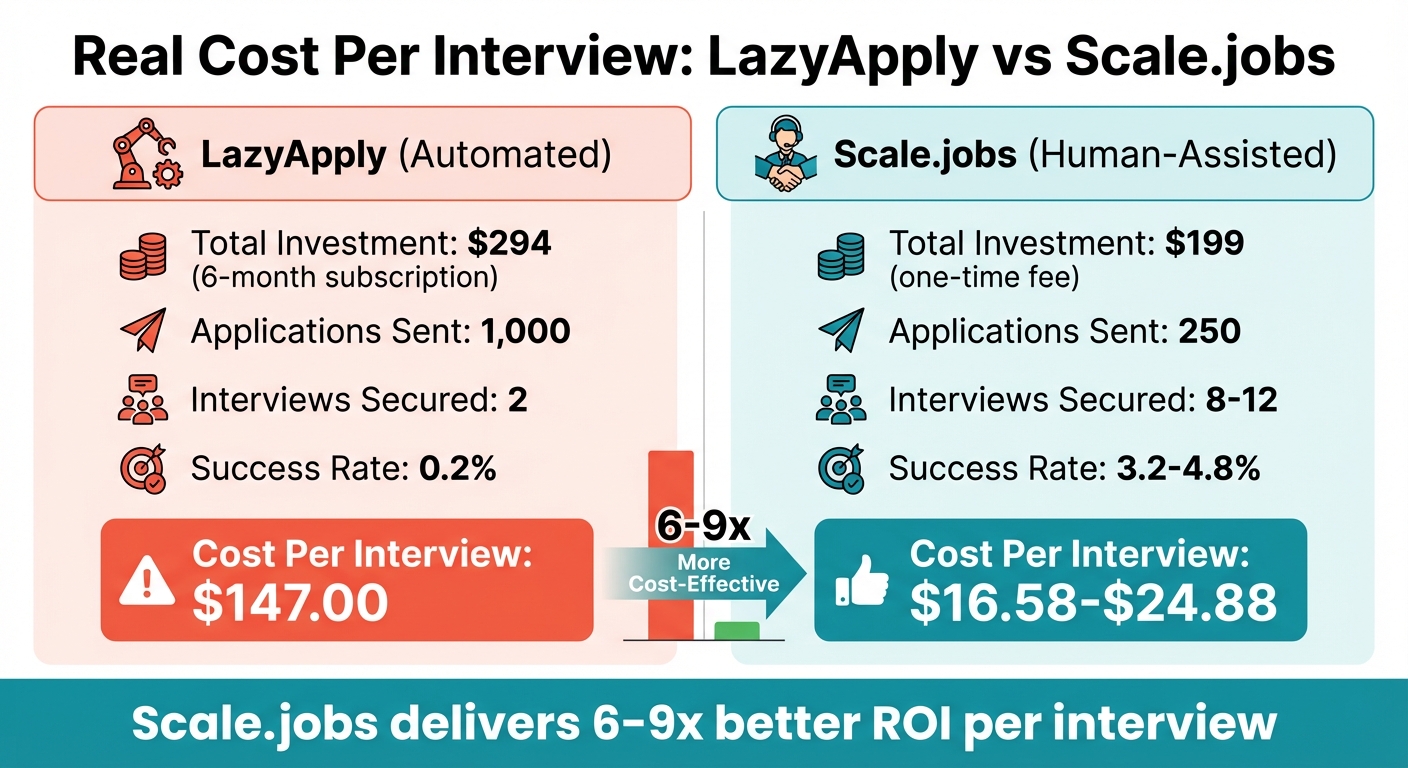
At first glance, LazyApply's pricing might appear economical, but the numbers tell a different story. By relying on automated submissions and generic templates, many applications fail to pass ATS filters or are flagged as spam. Based on our analysis, a 6-month subscription priced at $294 leads to just 2 interviews from 1,000 applications - a conversion rate of only 0.2%. This brings the real cost per interview to a steep $147.
Scale.jobs: Cost per Interview Calculation
Scale.jobs takes a more targeted approach with personalized applications, resulting in higher conversion rates. The Basic plan costs $199 and includes 250 applications, each handled by a dedicated human assistant. These applications are customized with ATS-optimized resumes and tailored cover letters, which significantly increase the chances of securing interviews. Even with a conservative estimate, this approach yields between 8 and 12 interviews from 250 applications. That means the cost per interview falls between $16.58 (with 12 interviews) and $24.88 (with 8 interviews).
Side-by-Side Examples
The comparison below highlights the stark difference in cost-effectiveness between LazyApply's automated approach and Scale.jobs' human-assisted service:
| Scenario | LazyApply (Automated) | Scale.jobs (Human-Assisted) |
|---|---|---|
| Total Investment | $294 (6‑month subscription) | $199 (One‑time fee) |
| Applications Sent | 1,000 | 250 |
| Interviews Secured | 2 | 8–12 |
| Real Cost Per Interview | $147.00 | $16.58–$24.88 |
This breakdown underscores a surprising truth: while LazyApply's automated system may seem cost-effective initially, the real cost per interview is significantly higher. In contrast, Scale.jobs’ human-assisted, tailored applications deliver far better results for less. For job seekers aiming to land roles that align with their expertise, investing in services like professional resume writing services or tailored job application assistance offers a far better return on investment. Up next, we’ll explore why Scale.jobs consistently outperforms LazyApply across key metrics.
Why Scale.jobs Wins: 5 Key Differences
The cost per interview difference highlights how LazyApply's automation compares to Scale.jobs' human-driven approach. Here's why Scale.jobs offers a better solution for job seekers aiming for dependable results:
1. Human Assistants vs. Automation
LazyApply relies on an automated Chrome extension that fills out forms in a generic way, treating each job application as a repetitive task. On the other hand, Scale.jobs assigns skilled virtual assistants who carefully review job descriptions, match your skills to the role, and manually craft tailored applications. This hands-on approach helps avoid bot-detection systems and reduces errors, giving your applications a better chance to stand out.
2. Resume Customization
LazyApply typically submits the same resume for every job, regardless of the role. Scale.jobs takes a different approach by creating ATS-friendly resumes customized for each job posting. By emphasizing relevant keywords and experiences, this method boosts response rates, often achieving 10–20% per application compared to LazyApply's reported rate of less than 6%.
3. Proof of Work and Transparency
Transparency is limited with LazyApply, which only provides basic analytics. In contrast, Scale.jobs offers clear proof of work through timestamped screenshots for every application. These records let you verify which version of your resume was used and track submission dates, making it easier to follow up strategically.
4. Pricing Structure
LazyApply’s lifetime pricing ranges from $99 to $249, which might seem appealing at first glance. However, its automated process often leads to lower interview conversion rates, increasing your effective cost per interview. Scale.jobs provides a one-time flat-fee model starting at $199 for a specified number of applications. With no recurring charges or hidden fees, this pricing, combined with human assistance, ensures lower costs per successful interview.
5. Real-Time WhatsApp Updates
Scale.jobs keeps you in the loop with real-time updates via WhatsApp, ensuring you're informed about every stage of the application process. These updates allow you to adjust your follow-up plans quickly, a feature that LazyApply’s basic analytics cannot match.
These differences are key reasons why Scale.jobs achieves a lower cost per interview. Up next, explore a detailed side-by-side feature comparison to see how these services measure up.
Feature Comparison Table
LazyApply vs Scale.jobs
Here's a closer look at how LazyApply and Scale.jobs tackle essential job application tasks. The table below highlights key differences, showing why Scale.jobs often achieves better outcomes despite comparable pricing.
| Feature | LazyApply | Scale.jobs |
|---|---|---|
| Human Involvement | Fully automated bot/Chrome extension | Trained virtual assistants manage every application |
| Resume Customization Depth | Uses a generic template; same resume for all applications | Creates ATS-optimized resumes tailored to each job posting |
| ATS Handling | Limited compatibility; higher risk of being flagged by bots | Manual entry bypasses automated filters effectively |
| Application Execution Method | Automated scripts fill out forms | Human virtual assistants manually handle each submission |
| Transparency & Proof of Work | Offers a basic dashboard showing application counts | Provides WhatsApp updates with timestamped screenshots for every submission |
| Pricing Model | $99–$249 (one-time payment) | $199–$399 (one-time fee for a specific number of applications) |
| Callback Rate | Less than 2% reported | 47% reported |
| Accuracy | Prone to errors due to mismatched fields | High, with manual verification before submission |
While automation through LazyApply might save time, it often compromises quality. On the other hand, Scale.jobs prioritizes accuracy and personalization, resulting in a much higher callback rate. This difference underscores why Scale.jobs achieves a lower cost per interview in the long run, even with similar initial costs.
For those looking to enhance their job search further, consider using an AI resume builder. These services can refine your documents to ensure maximum compatibility with ATS systems, giving you an additional edge in landing interviews.
Up next, we’ll explore which type of job seeker benefits most from each service.
Who Should Use LazyApply
Best for High-Volume, Entry-Level Applications
LazyApply is best suited for job seekers who prioritize quantity over customization, particularly when targeting entry-level roles. If you're a recent graduate, transitioning into a new industry, or seeking positions where highly tailored applications aren't expected, this platform can help you cast a wider net.
The tool shines on job boards like Indeed, Dice, and ZipRecruiter, where application processes are straightforward. By automating submissions, it allows users to apply to 50–100 positions daily, a significant leap from the 5–10 applications typically completed manually. Emily Kim, a satisfied user, highlighted this efficiency, noting how the platform helped her target high-turnover industries such as retail, hospitality, customer service, and junior sales. These fields often involve quicker hiring decisions and less scrutiny over individual applications, making LazyApply's approach effective.
For job seekers on a tight budget, the cost-effectiveness of LazyApply is another draw. At $99 per year for the Basic Plan, which supports up to 15 applications daily, it’s an economical choice for those willing to trade lower callback rates for higher application volume. The inclusion of features like Smart Referral Emails, which automate outreach to employees at target companies, adds extra value for those focusing on networking.
That said, LazyApply isn’t the right fit for everyone. If you’re pursuing mid-level or senior roles, or positions that require a specialized skill set, the platform's generic templates may work against you. These roles often demand tailored resumes and cover letters that emphasize specific accomplishments and align with ATS requirements. In such cases, personalized assistance, such as working with a virtual assistant for your job search, will significantly improve your chances of landing interviews.
Who Should Choose Scale.jobs
Best for Customized, ATS-Optimized Applications
Scale.jobs is the right choice when precision and tailored applications matter more than sheer volume. If you're aiming for mid-to-senior level roles, positions at Fortune 500 companies, or specialized jobs that demand personalized submissions, human-assisted applications deliver a distinct edge over automated systems.
Senior and leadership professionals benefit immensely from Scale.jobs. These positions often require detailed narratives that showcase accomplishments and strategic thinking - something automated tools can't achieve. For example, a marketing director applying for a VP role needs their application to emphasize achievements like driving revenue growth, leading large teams, and spearheading key initiatives. Generic templates simply can't capture those nuances. Similarly, career changers require a human touch to effectively highlight transferable skills and reframe their previous experience for a new industry - tasks that automation struggles to handle well. These tailored services are especially useful for professionals needing ATS-optimized applications that stand out.
Visa-dependent job seekers on H1B, O1, TN, or L-1 visas also find Scale.jobs invaluable. Human oversight ensures that sponsorship details are accurately handled and deadlines are met, reducing the risk of disqualification due to incomplete or incorrect information. Likewise, professionals applying to large corporations using complex ATS platforms like Workday, Taleo, or Greenhouse benefit from manual application submissions that can bypass bot-detection filters, ensuring their materials are reviewed by hiring managers.
Another standout feature is the platform's transparency. With real-time WhatsApp updates, time-stamped proof-of-work screenshots, and application tracking, you’ll always know which jobs were applied to, when, and how your materials were customized. This is especially appealing for recently laid-off professionals who need quick results. Scale.jobs' ability to deliver high-quality applications within a reduced timeline (typically 1–3 months) offers a clear return on investment, making it worth the upfront cost.
For those seeking a combination of professional resume support and strategic job application assistance, Scale.jobs provides a one-time fee structure ($199–$1,099) that eliminates recurring subscriptions. This tailored approach ensures ATS-optimized applications are seen by hiring managers, setting Scale.jobs apart from automation-heavy tools, as explored further in the "Switch to Scale.jobs if…" section.
Switch to Scale.jobs If...
5 Reasons to Switch
Here are five compelling reasons why switching to Scale.jobs might be the right move for your job search:
You're targeting mid-to-senior level roles where personalization is key. LazyApply’s generic templates might suffice for entry-level, high-volume applications, but they often fall short when vying for roles that demand a tailored narrative. For positions with higher salaries or leadership responsibilities, Scale.jobs offers human-crafted applications that highlight your achievements effectively. Their approach results in a response rate of 25–30%, compared to LazyApply’s approximate 6%.
Your applications are being flagged by ATS systems. LazyApply’s automated submissions can sometimes trigger red flags on platforms like Workday, Taleo, and Greenhouse, leading to your applications being overlooked. Scale.jobs sidesteps this issue by relying on manual, human-powered submissions that bypass these automated filters.
You value transparency and detailed updates. LazyApply provides only a basic count of submitted applications, leaving you in the dark about specifics. Scale.jobs, on the other hand, offers real-time updates through WhatsApp, including time-stamped screenshots. This level of detail allows you to track where your applications were sent and how they were customized, giving you the insights needed to refine your job search strategy.
You prefer upfront pricing without recurring fees. LazyApply’s subscription model, costing $99 to $249 per cycle, can quickly become expensive. Scale.jobs offers flat-fee packages ranging from $199 to $1,099 with no hidden charges or renewals. This straightforward pricing, especially when paired with professional resume services, delivers better value over time and reduces the overall cost per interview.
If automated applications aren’t delivering results, human-assisted submissions could be the answer. Scale.jobs tailors each resume to the job description, increasing your chances of passing ATS filters and catching the attention of hiring managers. This approach often shortens the time it takes to land interviews significantly.
These points highlight why Scale.jobs stands out as a practical choice for job seekers aiming to improve their application success rates and streamline their search process.
Decision Summary
When weighing cost-effectiveness against job level, it’s essential to align your choice with your specific goals and priorities:
Choose LazyApply For
LazyApply is suited for those aiming at entry-level positions or roles requiring high-volume applications. This platform works well for industries like customer service, retail, or junior administrative roles, where detailed customization isn't critical. With its $149 monthly plan, LazyApply offers an affordable way to apply to numerous jobs quickly, making it a good fit if you're exploring multiple industries or testing the job market. However, if your focus is on precision and tailoring, the following alternative might better meet your needs.
Choose Scale.jobs For
Scale.jobs is better suited for mid-to-senior roles, career transitions, or candidates navigating visa requirements, where tailored, ATS-optimized applications are essential. The service employs trained human assistants to craft resumes and cover letters that align with specific job descriptions, making it ideal for professionals with 5+ years of experience or those seeking to avoid automated rejections.
With a flat-fee structure ranging from $199 for 250 applications to $1,099 for a comprehensive bundle, Scale.jobs eliminates recurring subscriptions while offering transparency through WhatsApp updates and timestamped screenshots. If automated tools have failed to deliver results or you’re targeting roles where bot-detection filters are common (used by 83% of employers), Scale.jobs’ manual approach can be a game-changer. Additionally, it saves over 20 hours per week, allowing professionals to focus on networking and interview preparation.
Ultimately, your decision boils down to whether you value application volume or higher interview conversion rates.
FAQs
What assumptions go into the cost-per-interview math?
The cost-per-interview calculation depends on factors such as the service price, the total number of applications submitted, and the estimated response rates. For instance, automated platforms like LazyApply generally see a response rate of around 6%, whereas human-assisted services such as Scale.jobs boast much higher response rates, typically ranging between 25% and 30%. These variations play a crucial role in determining the overall cost-efficiency and value of each service.
How can I estimate my interview rate before paying?
When assessing your potential interview rate, it’s helpful to look at Scale.jobs' reported success metrics alongside your application volume. According to their data, applications crafted with human assistance and tailored to the job can achieve a callback rate of 25–30%.
To put this into perspective, if you applied to 250 jobs, you could expect approximately 62–75 callbacks. Compare these figures to your previous response rates or general industry standards to determine if this approach matches your career goals and expectations.
When does manual application help beat volume applying?
When it comes to job applications, manual submissions tend to outshine high-volume automation, especially in cases where tailored, role-specific, and ATS-optimized applications are crucial. Automated tools like LazyApply prioritize quantity, but their generic methods often lead to callback rates as low as 1–3%. On the other hand, human-assisted services such as Scale.jobs focus on creating personalized, ATS-compliant applications, resulting in significantly higher callback rates of 25–47%. This makes them a better fit for competitive, senior-level, or specialized roles where customization plays a key role in standing out.