
LinkedIn for Personal Branding: Ultimate Guide 2025

Sarah Mitchell
December 30, 2025
LinkedIn has grown into a powerful tool for building your professional brand in 2025. With over 1 billion users, it’s no longer just a digital resume - it’s your professional storefront and a platform to showcase expertise, connect with industry leaders, and attract opportunities. Here’s what you need to know to stand out:
- Optimize Your Profile: Use a compelling headline, a well-written About section, and a professional headshot. Add a banner image, customize your URL, and list at least five skills to increase visibility.
- Content Strategy: Post regularly (at least 3 times a week) using formats like carousels, native videos, and polls. Focus on delivering value through educational and actionable posts.
- Engage Effectively: Build connections by commenting on posts, joining groups, and sending personalized messages. Use tools like LinkedIn Live and Newsletters to expand your reach.
- Track Your Progress: Monitor metrics like profile views, post impressions, and engagement rates. Adjust your strategy based on what resonates with your audience.
- Leverage Tools: Platforms like Scale.jobs can help automate your job search while you focus on networking and creating content.
14-Day plan to build your personal brand on LinkedIn | How to use LinkedIn
How to Optimize Your LinkedIn Profile
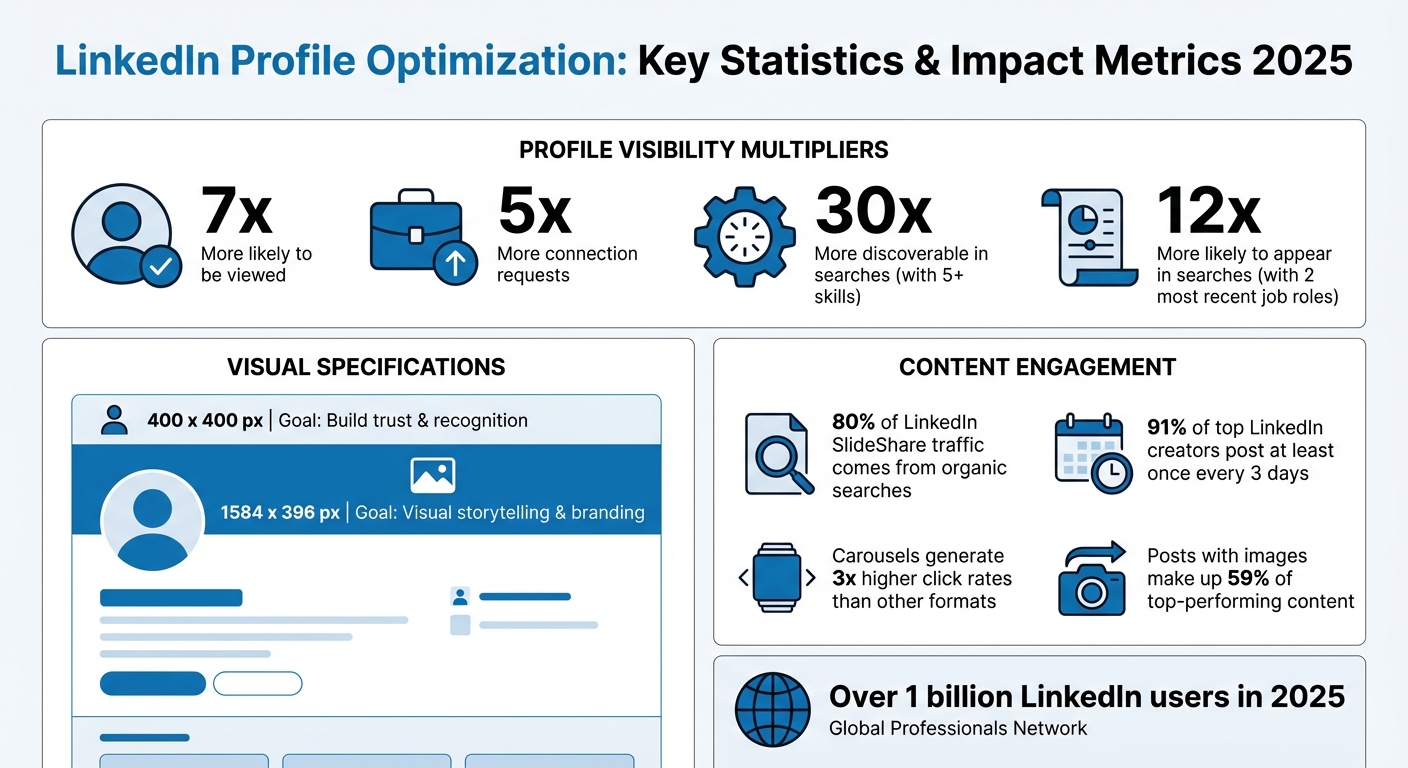
LinkedIn Profile Optimization Statistics and Impact Metrics 2025
Think of your LinkedIn profile as your professional storefront. It's where first impressions are made and opportunities are either attracted or missed. The difference often lies in how well you present yourself. Here’s how to turn your profile into a powerful tool for personal branding using AI-driven optimization.
Writing Your Headline and About Section
Your headline is more than just a job title - it’s your elevator pitch in a few words. Instead of simply stating your role, highlight the value you bring. For example, "B2B SaaS Marketing Leader | Drove Revenue Growth | Expert in Content Strategy & Demand Generation" tells a compelling story about your expertise and impact.
For the About section, think of it as your narrative. Use a Problem-Solution-Proof-CTA approach: identify your audience’s challenge, explain how you address it with measurable results, and end with a call-to-action. Whether you're inviting readers to connect, visit your website, or schedule a call, make it clear. Skip the buzzwords and let your achievements do the talking.
"A killer profile doesn't just get you views; it starts conversations. It basically pre-sells you, making it clear what you bring to the table before anyone even has to ask."
- Nicolas Pamart
Choosing Your Profile Picture and Banner Image
Your profile photo is more important than you might think - it can make your profile 7x more likely to be viewed. Go for a professional headshot with a neutral background, a friendly smile, and direct eye contact. It’s a small detail, but it builds trust and makes you approachable.
"Your picture is your virtual handshake, so pick a friendly profile picture that aligns with your role."
- Alexandra Rynne, Content Strategy Lead, LinkedIn Ads
Don’t overlook the banner image either. At 1584 x 396 pixels, this space is your digital billboard. Instead of using a generic stock photo, create a banner that reflects your personal brand or highlights your achievements. Use it to reinforce your value proposition or showcase key milestones.
Creating a Custom URL and Displaying Your Achievements
Make your LinkedIn URL memorable by customizing it with your full name (e.g., linkedin.com/in/yourfullname). This not only makes your profile easier to find but also improves your visibility on search engines. Once you have your custom URL, include it in your email signature and on your social media profiles to boost your online presence.
The Featured section is like a mini-portfolio. Use it to pin high-impact content such as articles, webinars, media mentions, or strategy documents. For example, Eric Nowoslawski, founder of Growth Engine X, leveraged this feature to share growth-focused content, earning over 45,000 followers and securing industry recommendations. It’s a great way to keep your profile dynamic and relevant.
| Visual Element | Recommended Size | Primary Goal | Best Practice |
|---|---|---|---|
| Profile Photo | 400 x 400 px | Build trust & recognition | High-res headshot, neutral background, professional attire |
| Banner Image | 1584 x 396 px | Visual storytelling & branding | Custom graphic, industry-related imagery, or clear CTA |
Including your two most recent job roles makes your profile 12x more likely to appear in searches. Adding at least five skills can boost discoverability by over 30x. Sprinkle industry-specific keywords throughout your About and Experience sections to make it easier for recruiters to find you. And don’t forget multimedia - videos, images, and presentations (like those on SlideShare) can make your story more engaging. Fun fact: 80% of LinkedIn SlideShare traffic comes from organic searches, giving you an edge in visibility.
Finding and Growing Your Target Audience
To make your LinkedIn presence effective, it's not just about being active - it’s about ensuring the right people see your content. Start by identifying your ideal audience and understanding where they spend their time on the platform. Your niche is where your expertise, interests, and your audience’s needs intersect. For example, if you're a SaaS marketing leader, your niche might focus on helping B2B companies scale demand generation. If you’re a product designer, it could be crafting user experiences tailored for fintech startups. Being specific in your messaging draws in the people who truly resonate with your work.
Once you’ve nailed down your niche, take the next step: create an engagement list. This is a curated group of key connections and industry leaders whose content you’ll regularly engage with. Leave thoughtful comments, ask insightful questions, and provide meaningful input before sending connection requests. Take a page from freelance content marketer Dominic Kent’s playbook. In 2025, he boosted his book sales by tagging contributors and fellow consultants in his posts, which extended his reach to their networks. This strategy turned visibility into book sales and opened doors to new collaboration opportunities.
Choosing Your Niche and Content Topics
Your niche isn’t just your job title - it’s the specific problem you solve for a particular audience. For instance, if you’re a data analyst, don’t just talk about data. Share how you help e-commerce brands tackle cart abandonment with predictive analytics. If you’re a career coach, focus on helping mid-level managers step into leadership roles. The more specific your focus, the easier it becomes to stand out and attract the right audience. Use your LinkedIn profile’s headline, About section, and posts to reinforce this positioning consistently.
When it comes to content, let your niche guide you. Ask yourself: What questions does my audience frequently ask? What challenges keep them up at night? What trends are shaping their industry? LinkedIn Polls are a great way to test ideas and discover what resonates most. From there, create posts that educate and empower your audience - content that makes them feel smarter rather than just showcasing your expertise. Consistency matters too: 91% of top LinkedIn creators post at least once every three days. This steady flow of targeted content naturally enhances your engagement within relevant industry circles.
Connecting with Industry Professionals and Groups
With your niche clearly defined, LinkedIn Groups become a goldmine for networking with your target audience. Join groups that align with your expertise and where decision-makers or potential clients are active. But don’t rush in with self-promotion. Instead, contribute to conversations by sharing insights, answering questions, and offering value. This positions you as a trusted resource rather than just another person seeking attention.
Another underutilized tool is the "Who's Viewed Your Profile" feature. These viewers have already shown passive interest in you, making them excellent candidates for outreach. Send personalized messages that reference something specific, like a mutual connection, a recent post they shared, or a common industry challenge. Anton Titov, Founder at Archway.Finance, demonstrated this in 2025 by reaching out to 400 agency owners with tailored messages. His efforts led to 148 replies - a 65% response rate. The difference between a generic "Let’s connect" and a personalized message can be the difference between being ignored and starting a meaningful conversation.
"Networking is not about just connecting people. It's about connecting people with people, people with ideas, and people with opportunities."
- Rishi Patel, Ranksper
Lastly, take advantage of LinkedIn’s native features like LinkedIn Live, Newsletters, and Polls to expand your reach. These tools can help you connect with niche audiences beyond your immediate network. When tagging industry professionals in your posts, do it thoughtfully - only when their insights genuinely enhance the conversation. Also, optimize your profile by listing at least five skills. Profiles with five or more skills show up to 30 times more often in searches, giving you a significant edge in discoverability.
Creating Content That Builds Your Authority
To establish yourself as an authority in your field, creating well-crafted content is key. Start by defining your audience and identifying 3–5 core content pillars that align with your expertise. For instance, a product manager might focus on topics like feature prioritization, stakeholder management, user research, and career growth. These pillars help maintain consistency in your messaging while allowing enough variety to keep things fresh.
A proven method for structuring your content is the "Hook, Story, Takeaway" formula. Begin with an attention-grabbing hook, follow it with a relatable story, and wrap up with a clear, actionable takeaway. Justin Welsh, who built a $5 million annual business on LinkedIn, attributes much of his success to this approach. He emphasizes that authority comes from teaching your audience valuable lessons, not from self-promotion.
To keep your content engaging, balance it across three categories:
- Value posts: Share frameworks, tips, or industry trends.
- Proof posts: Highlight measurable results through case studies.
- Engagement posts: Use polls or questions to spark conversations.
Carousels are especially effective, generating three times more clicks than other formats. They're ideal for step-by-step guides or visual content, making them a smart choice for delivering actionable insights.
LinkedIn Content Formats That Get Results
Understanding when and how to use different LinkedIn content formats can amplify your impact. Native video is currently a top performer, especially for sharing tips, behind-the-scenes moments, or Q&A sessions. Keep videos under 90 seconds and deliver value right at the start to capture attention.
Polls are another excellent tool, offering both engagement and insights. Use them to uncover audience pain points, then create targeted Value posts addressing those challenges. For more in-depth content, long-form articles (1,500–2,000 words) are great for "how-to" guides and opinion pieces. These can rank in LinkedIn and Google searches when optimized with relevant keywords.
Activating Creator Mode unlocks LinkedIn Newsletters, which bypass the feed algorithm and go straight to subscribers' inboxes. This ensures consistent visibility for your content. For case studies, the STAR Method (Situation, Task, Action, Result) works wonders. For example, instead of saying, "I improved a client’s conversion rate", provide specifics:
"A SaaS client converting at 1.2% needed to hit 3% to meet their Q4 targets. I redesigned their onboarding flow and A/B tested three variations. Within 45 days, conversions jumped to 3.4%, adding $180,000 in ARR."
This level of detail builds trust and credibility. While LinkedIn builds your digital presence, ensure your offline documents match this quality by using an AI resume builder to maintain consistency across your personal brand.
| Content Format | Primary Benefit | Best Use Case |
|---|---|---|
| Carousels | 3x higher click rate | Step-by-step guides, listicles, portfolios |
| Polls | High engagement/reach | Feedback gathering, sparking debates |
| Newsletters | Direct inbox access | Long-form thought leadership |
| Native Video | High engagement | Tips, behind-the-scenes, Q&A sessions |
| Long-form Articles | SEO & authority | In-depth guides, industry analysis |
Setting Up a Regular Posting Schedule
Consistency is key to building momentum. Start by posting three times a week. Research shows that 91% of top LinkedIn creators post at least once every three days, with 72% posting even more frequently. Choose a schedule that works for you and stick to it.
Batch content creation is a time-saving strategy many successful creators swear by. Dedicate a few hours each week to draft multiple posts at once. This eliminates the daily scramble for ideas and helps maintain a high standard of quality. Use a simple content calendar to plan posts across your content pillars, ensuring a balanced mix of Value, Proof, and Engagement posts.
Everyday work can be a goldmine for content ideas. That insightful moment during a client meeting? It’s a post. A small process improvement that saved you time? Another post. Answering common questions? Turn them into targeted content. By capturing these daily moments, content creation becomes a natural extension of your routine.
Using Analytics to Improve Your Content
Once you’ve established a posting rhythm, it’s time to track your performance. Use LinkedIn analytics to monitor metrics like views, likes, shares, and comments. If carousels consistently outperform text updates, focus more on visual content. If certain topics spark meaningful discussions, double down on those themes.
Check your profile view insights to ensure you’re attracting the right audience. If not, refine your messaging to better address their challenges. Set monthly goals, such as increasing profile views by 10% or boosting engagement by 5%, to measure your progress.
Pay attention to "outlier" posts - those that perform significantly better than average. Analyze what made them successful: Was it the hook? The structure? The topic? Repurpose these posts into new formats, like turning a popular text post into a carousel or expanding it into a long-form article. LinkedIn's new impression counts for comments also let you track the reach of your engagement on others’ posts, offering another layer of insights.
"Content is the fuel for your personal brand. Consistently sharing valuable insights builds credibility and attracts opportunities."
- Rishi Patel, Marketing Expert
Conduct weekly analytics reviews to spot trends and adjust your short-term strategy. Then, do a deeper monthly analysis to refine your long-term approach. Use these insights to evaluate your content pillars - if one consistently drives more engagement or profile visits, allocate more effort to that area. Remember, meaningful interactions like comments and direct messages matter far more than vanity metrics like follower counts. Focus on creating content that sparks conversations and builds connections.
Converting Your LinkedIn Brand into Career Opportunities
Turn your LinkedIn presence into a powerful tool for career growth. A well-crafted profile not only highlights your skills but also attracts recruiters, clients, and collaborators who are actively searching for talent like yours. The trick? Treat your profile as more than a digital resume - make it a conversion tool.
Attracting Recruiters and Clients Through Your Profile
Your social proof is one of your most valuable assets. Use the Featured section to showcase top-notch case studies, presentations, or standout posts that underline your expertise. Collect recommendations from colleagues, managers, or clients who can vouch for your skills and accomplishments. When someone visits your profile, they should instantly see evidence of what you bring to the table.
Visibility matters. Did you know that profiles with a current position listed receive five times more connection requests? Adding five or more relevant skills also boosts your discoverability. Make sure your headline and About section include industry-specific keywords like "B2B sales professional", "product marketing strategist", or "full-stack developer" to ensure you appear in recruiter searches. A polished LinkedIn profile often determines whether you even get a chance to start a conversation.
Take freelance content marketer Dominic Kent, for example. He used LinkedIn to promote his book, The Autonomous Freelancer, by tagging contributors and sharing insights from the book. This strategy not only boosted ebook sales but also led to new consulting opportunities. His success shows how an optimized profile, combined with strategic content, can open doors beyond traditional jobs.
"A killer profile doesn't just get you views; it starts conversations. It basically pre-sells you, making it clear what you bring to the table before anyone even has to ask." - Nicolas Pamart, RedactAI
By refining your profile, you’re not just attracting attention - you’re setting the stage for leveraging job search tools effectively.
Using Scale.jobs with Your LinkedIn Profile
Once your LinkedIn profile is optimized, Scale.jobs can take your job search to the next level by converting your visibility into actionable opportunities. While you focus on networking and creating content, Scale.jobs' Human Assistant service handles the tedious task of submitting up to 30 job applications daily across various platforms.
Here’s what sets Scale.jobs apart: they provide ATS-optimized resumes and cover letters tailored to each job description within 24 hours. When recruiters check out your application and visit your LinkedIn profile, they’ll find a polished, keyword-rich presence that reinforces your qualifications. Unlike automated tools, Scale.jobs uses human assistants to submit applications manually, avoiding the red flags bots often trigger. Plus, you get real-time WhatsApp updates with time-stamped screenshots for proof of work.
This service can save you over 20 hours a week - time you can spend on high-impact activities such as connecting with hiring managers, engaging with industry leaders’ posts, and creating LinkedIn content that boosts your authority. Scale.jobs offers a flat-fee model starting at $199 for 250 applications, eliminating monthly subscriptions common with tools like LazyApply or Simplify.
For those navigating visa requirements like H1B, F1, CPT, or TN, Scale.jobs' human assistants are well-versed in identifying visa-friendly opportunities. They also offer free tools like an ATS Resume Checker, Cover Letter Generator, and Job Applications Tracker to keep your search organized. While your LinkedIn brand attracts inbound interest, Scale.jobs ensures you’re also pursuing outbound opportunities at scale.
Finding Speaking and Collaboration Opportunities
Beyond job hunting, a strong LinkedIn presence can unlock speaking and collaboration opportunities. Start by pitching yourself for podcasts and webinars in your niche. Engage with hosts’ content, then send a direct message explaining the unique insights you can offer their audience. Tagging industry peers in relevant discussions can also help you broaden your reach and visibility.
LinkedIn Lives and co-created content are excellent ways to expand your audience. Partner with professionals in your field to host joint sessions, giving both of you exposure to new networks while delivering value to your communities. Joining and contributing to niche-specific LinkedIn Groups further establishes you as a trusted voice in your area of expertise. When you consistently share valuable insights, invitations for panels, conferences, and collaborations often follow.
"LinkedIn personal branding has quietly become the career insurance policy no one talks about enough." - Utsav Patel, Supergrow.ai
The professionals landing freelance gigs, partnerships, and speaking roles aren’t always the most experienced - they’re the most visible. By combining a strong LinkedIn presence with strategic outreach and tools like Scale.jobs to handle the application process, you open yourself up to opportunities from every angle.
Tracking Your Personal Brand Growth
Once you've polished your profile and started using tools like Scale.jobs, the next step is tracking your progress. Without keeping an eye on your LinkedIn metrics, it's easy to waste energy on strategies that don’t deliver. Luckily, LinkedIn offers plenty of data to help you fine-tune your approach - no need to get lost in endless spreadsheets.
LinkedIn Metrics You Should Monitor
Measuring your personal brand growth is key to turning LinkedIn visibility into real opportunities. Let’s break down the most important metrics to watch and how they can guide your strategy.
Start with profile views. This metric shows whether your SEO efforts are drawing in the right people - whether it’s recruiters, industry experts, or potential clients. If your views are stuck, it might be time to tweak your headline or About section with more targeted keywords. Adding relevant skills and updating your current position can also make a big difference in how easily people find you.
Next, look at post performance. Metrics like impressions, likes, comments, and shares reveal what topics resonate most with your audience. For instance, LinkedIn carousels can generate up to three times more clicks than other formats, while posts with images make up 59% of top-performing content. If plain text isn’t working, visuals might be the answer. Don’t overlook comment impression counts either - LinkedIn now tracks how many people see your comments on others’ posts, proving the value of engaging in conversations.
Keep an eye on connection requests and follower growth to measure your expanding reach. If you’re getting lots of profile views but few connection requests, it could mean your content isn’t reaching the right audience, or your value proposition needs to be clearer. Finally, monitor inbound opportunities like job offers, speaking gigs, or collaboration requests. These are the ultimate indicators that your LinkedIn presence is translating into real-world results.
| Metric to Monitor | What It Tells You | Next Steps |
|---|---|---|
| Profile Views | Visibility and SEO effectiveness | Update headline with keywords; post more frequently |
| Post Impressions | Content reach and algorithm impact | Experiment with formats like carousels or videos |
| Engagement Rate | Audience interest and relevance | Refine hooks; use white space for readability |
| Inbound Requests | Authority and value of your profile | Add skills; ensure your current position is listed |
| Direct Messages | Conversion into tangible outcomes | Strengthen your About section with a clear CTA |
Adjusting Your Strategy Based on Data
Use these metrics to fine-tune your approach. Look for patterns and adjust your content and connection strategies accordingly. Review your performance weekly, and repurpose high-performing posts into new formats - a successful text post could become a carousel or a video, giving it a second life.
Take a page from Eric Nowoslawski, founder of Growth Engine X, who managed to grow his LinkedIn following to over 45,000 by August 2025. He secured around 20 recommendations from industry leaders and featured case studies in his profile’s Featured section. By focusing on social proof and optimizing profile elements based on performance, he turned visibility into inbound leads.
Experiment with hooks, posting times, and calls-to-action (CTAs) to boost engagement. Results can vary based on your audience, so what works for someone else might not work for you. Set monthly goals, like increasing profile views by 10% or post engagement by 5%, to keep your momentum going. As Peter Drucker famously said, "What gets measured, gets managed."
"Successful LinkedIn personal branding strategies aren't static. They evolve based on data. What works today might underperform tomorrow, so treat your content like an ongoing experiment." - Utsav Patel, Supergrow
Conduct a quarterly audit of your connections and core content pillars to ensure you’re staying aligned with your target audience. Use performance data to decide which topics to emphasize and which to phase out. Consistency is also critical - 91% of top LinkedIn creators post at least once every three days, signaling the algorithm to prioritize their content.
Conclusion: Building Your LinkedIn Brand in 2025
Creating a standout LinkedIn presence in 2025 hinges on being consistent and genuine. Think of your profile as more than just an AI-optimized resume - it's your personal landing page. Focus on crafting a headline that highlights your value, an "About" section that tells your story, and a "Featured" section showcasing case studies or top-performing posts. This foundation sets the tone for a strategy that takes full advantage of LinkedIn's tools.
Content is what keeps your brand in the spotlight. Instead of simply broadcasting updates, adopt a "give-first" approach by sharing insights that solve real problems for your audience. Leading creators post at least once every three days to stay visible in feeds. Using the "Hook, Point, Takeaway" model in your posts can help you grab attention, provide value, and encourage engagement. Try experimenting with formats like carousels, which can triple click-through rates compared to standard posts, to see what works best for your network.
Engagement is where true connections are made. Thoughtfully interacting with posts from industry peers not only expands your reach but also strengthens your credibility. Regular engagement can open doors to new career opportunities. For example, adding at least five skills to your profile can make you over 30 times more discoverable.
If you're on the job hunt, platforms like Scale.jobs can complement your LinkedIn activity by managing application volume, freeing you up to focus on networking and building your thought leadership.
Keep refining your strategy. Dedicate time weekly to batch-create content and conduct quarterly audits of your connections and content themes to ensure they align with your goals. Start small, remain consistent, and let data guide your next steps. Stay true to yourself, use insights to adapt, and let your LinkedIn presence open new doors for your career in 2025.
FAQs
How can I use LinkedIn to build a standout personal brand in 2025?
To establish a strong personal brand on LinkedIn in 2025, start by creating a polished and professional profile. Begin with a clear, keyword-rich headline that highlights what sets you apart. Use the "About" section to tell your story - focus on your expertise, accomplishments, and career aspirations, backed by measurable results. Add a professional photo, a custom banner, and relevant media like project links or videos to make your profile stand out visually. Be sure to weave industry-specific keywords throughout your experience and skills to boost your visibility in recruiter searches.
Consistency is crucial. Share content that demonstrates your expertise and positions you as a thought leader. Experiment with different formats - carousel posts, short videos, polls, or quick insights on industry trends. Engage actively by responding to comments and participating in relevant groups to build connections. When networking, aim for quality over quantity by personalizing connection requests and fostering genuine relationships.
Take advantage of tools to simplify your job search while focusing on networking. For example, platforms like Scale.jobs can handle ATS-compliant resume submissions, giving you more time to create content and connect with others. Keep your profile updated with new achievements and monitor engagement to fine-tune your approach. With a compelling profile, consistent content, and meaningful networking, LinkedIn can be your go-to platform for personal branding success in 2025.
What are the best strategies to boost engagement on LinkedIn?
To boost engagement on LinkedIn, focus on sharing content that resonates with your audience and showcases your expertise. Think about posting original insights, actionable tips, or updates on industry trends. Formats like short videos, carousel posts, and polls tend to grab attention. Make your posts relatable by weaving in storytelling - start with a strong opening, highlight a challenge, and wrap up with a clear takeaway. Posting consistently, around 3–4 times a week during peak U.S. business hours (early mornings or lunchtime), can help your content reach more people.
Encourage interactions by ending your posts with a call-to-action. This could be a question, a request for opinions, or an invitation for feedback. When people comment, respond promptly to show you value their input. Beyond your own posts, engage with others by leaving meaningful comments or resharing their content with your thoughts. Don’t forget about LinkedIn’s features like the "Featured" section or polls - they’re great tools for expanding your reach. Consistent interaction not only increases visibility but also strengthens your connections over time.
How can Scale.jobs streamline my LinkedIn job search?
Scale.jobs takes the hassle out of your LinkedIn job hunt by handling the tedious application process, so you can concentrate on showcasing your personal brand. The platform streamlines up to 30 job applications daily, creating ATS-friendly, customized resumes and delivering them in less than 24 hours.
With this time-saving tool, you can focus on networking, sharing insightful content, and gearing up for interviews. Scale.jobs keeps the job opportunities coming while helping you stay visible and professional to catch the attention of recruiters and hiring managers.