
What Happens If You Miss Loan Payments After a Layoff?

Sarah Mitchell
June 12, 2026

When you lose your job, missed loan payments can quickly lead to financial strain. Here’s what you need to know:
- Immediate Impact: Missing payments for 30+ days can lower your credit score by 60–110 points and trigger penalty APRs up to 29.99%.
- Escalating Risks: At 90 days, your credit score could drop by 150+ points, and debts may get charged off or sent to collections.
- Prioritize Essentials: Focus on housing, utilities, and transportation first. Credit card and medical bills can usually wait longer.
- Take Action Early: Contact lenders before missing payments to negotiate hardship programs or reduced rates.
- Job Search Matters: Reducing unemployment time is crucial. Tools like Scale.jobs offer human-assisted job applications to help you secure income faster.
Quick Takeaways:
- Missing payments affects your credit and increases financial pressure.
- Proactive measures, like reaching out to lenders, can reduce damage.
- A reliable job search platform can help bridge income gaps effectively.
Managing missed payments while job hunting requires a clear plan. Act quickly to minimize financial fallout and regain stability.
I Was Laid Off 10 Months Ago - Here's How I Still Pay My $2,800 Mortgage
sbb-itb-564272e
What Happens When You Miss Loan Payments
Missing a loan payment doesn’t spell disaster right away, but the situation can quickly escalate the longer it goes unresolved. Understanding the stages of missed payments can help you protect your credit and make informed decisions about which bills to prioritize - especially if you're currently navigating a job search journey or financial hardship. Here's a breakdown of what happens and how to reduce the impact.
Days 1–30: Late Fees and Internal Collections
In the first 29 days after missing a payment, delinquency isn’t reported to credit bureaus yet. However, you’ll likely face a late fee of up to $41, along with reminder notices or calls from your lender’s internal collections department.
This initial period is your best opportunity to negotiate with your lender. Many creditors are willing to offer hardship accommodations, such as deferred payments, waived fees, or reduced interest rates, especially if you contact them proactively. In fact, reaching out early can lead to successful arrangements about 70% of the time. Even making a small minimum payment - like $25 on a credit card - can keep your account “current” and prevent any impact on your credit report.
Once you hit the 30-day mark, however, the consequences grow more serious.
How Late Payments Impact Your FICO Score at 30, 60, and 90 Days
Your payment history accounts for 35% of your FICO score, making missed payments one of the most damaging factors to your credit.
"A single 30-day late payment stays on your report for seven years and can drop your score by 60–110 points." - Ashley Rivera, Credit Repair Specialist, Crowned Credit
While the first 30 days are critical, the risks compound as delinquency continues:
- At 30 days: Your lender reports the missed payment to credit bureaus, resulting in a 60–110 point drop in your credit score. You may also face interest rate increases.
- At 60 days: Penalty APRs as high as 29.99% can complicate your repayment efforts, and lenders might freeze or lower your credit limits.
- At 90 days: Your credit score could drop by 150 points or more. At this stage, lenders often charge off the debt, selling it to a collection agency. This charge-off remains on your credit report for seven years.
| Days Past Due | Credit Bureau Reporting | Typical Impact |
|---|---|---|
| 1–29 Days | Not reported | Late fee (up to $41); internal reminders only |
| 30 Days | Reported to bureaus | 60–110 point score drop; interest rate hikes |
| 60 Days | Reported to bureaus | Further score decline; possible credit limit reductions |
| 90 Days | Reported to bureaus | 150+ point drop; charge-off and collections risk |
These escalating consequences highlight the importance of taking action early to avoid long-term damage.
Secured vs. Unsecured Loans: Different Risks
The type of loan you’ve missed matters because secured and unsecured loans carry different consequences.
- Secured loans: These include mortgages and auto loans, which are tied to physical assets. Falling behind on these payments could lead to foreclosure or repossession, putting your home or car at risk. Since losing these essentials creates significant challenges, secured loans should always be your top priority.
- Unsecured loans: Credit cards, personal loans, and most medical bills don’t involve collateral, but they can still have serious financial repercussions. Extended delinquency might lead to collections, lawsuits, or even wage garnishment. However, medical bills offer a slight reprieve - under current rules, they won’t appear on your credit report until 365 days past due.
"The priority is not paying everything at once. It is controlling how the damage spreads." - ASAP Credit Repair Blog
By understanding these differences, you can focus on minimizing the fallout and protecting your financial stability.
If you're looking for ways to speed up your job search and restore your income sooner, consider using professional resume and application services. Investing in expert support can help you secure new opportunities faster, reducing the time you spend in financial uncertainty.
How to Limit Financial Damage After Missing Payments
Which Bills to Pay First
When you're juggling overdue bills, focus on those that protect your essential needs and assets first. Start with housing - whether it's rent or a mortgage, keeping a roof over your head is non-negotiable. Next, prioritize utilities like electricity, water, and heating, as they are crucial for day-to-day living. If you rely on a car to commute to work or interviews, make sure to stay current on your auto loan.
Credit card and personal loan payments come after these essentials. While skipping these payments can hurt your credit score, they won't immediately jeopardize your home or transportation. Medical bills can often wait the longest since they typically take up to a year before appearing on your credit report.
Once you've sorted your priorities, reach out to your lenders as soon as possible to address any delinquencies before they escalate.
Contact Your Lender Before You Fall Further Behind
Many lenders offer hardship programs, but they are not always advertised. Companies like Chase, American Express, Discover, Citi, and Capital One provide options such as reduced interest rates (sometimes as low as 0–9%), smaller minimum payments, or even temporary payment pauses for a few months. The key? You have to ask.
"The difference is not income level. It is timing and strategy." - ASAP Credit Repair Blog
Acting quickly is crucial. You'll have more options if you reach out while your account is still current. Taking proactive steps can help protect your credit score, which otherwise could take a significant hit. When you call, ask about hardship programs and ensure you get all agreements in writing. Confirm details like whether your account will remain open or be frozen and how it will be reported to credit bureaus.
Here’s a quick look at some major lenders and their hardship program features:
| Issuer | Hardship Program Highlights | Contact |
|---|---|---|
| Chase | Rate reductions, lower minimums, fee waivers; up to 48 months | 1-800-254-7713 |
| American Express | Short-term (12 months, card stays open) or long-term (48 months, card suspended) | amex.com/hardship |
| Discover | Rate reductions and fee waivers; 24/7 support | 1-800-347-2683 |
| Citi | Payment deferrals and rate reductions; terms vary by account | Check your account details |
| Capital One | Case-by-case deferrals or minimum reductions | Ask for "Financial Hardship Team" |
If these steps don’t stabilize your financial situation, it might be time to seek professional help.
When to Get Professional Financial Help
Consider professional financial guidance if you're overwhelmed by multiple late accounts, have received a charge-off notice, or have seen your credit score drop by 100 points or more.
Nonprofit credit counselors, accredited by the National Foundation for Credit Counseling (NFCC), can negotiate a Debt Management Plan (DMP) for you. These plans consolidate your payments, often at reduced interest rates, and cause less long-term harm to your credit than debt settlement. These services are generally free or low-cost.
For individuals struggling with significant unsecured debt, seeking Freedom Debt Relief help may also be worth considering as part of a broader strategy to regain financial stability.
If your debt becomes unmanageable and you face legal action, consulting a bankruptcy attorney might be necessary. Chapter 7 bankruptcy can discharge most unsecured debts within three to six months, while Chapter 13 restructures your debt over three to five years. Both options provide an automatic stay, which halts collections and lawsuits immediately.
While managing your finances is critical, don't lose sight of the bigger picture - getting back on track with your job search is equally important for long-term stability. Consider tools like a job search virtual assistant or an AI resume builder to streamline the process and improve your chances of landing a new role.
Getting Back to Work Faster: scale.jobs vs. LazyApply, LoopCV, and Find My Profession
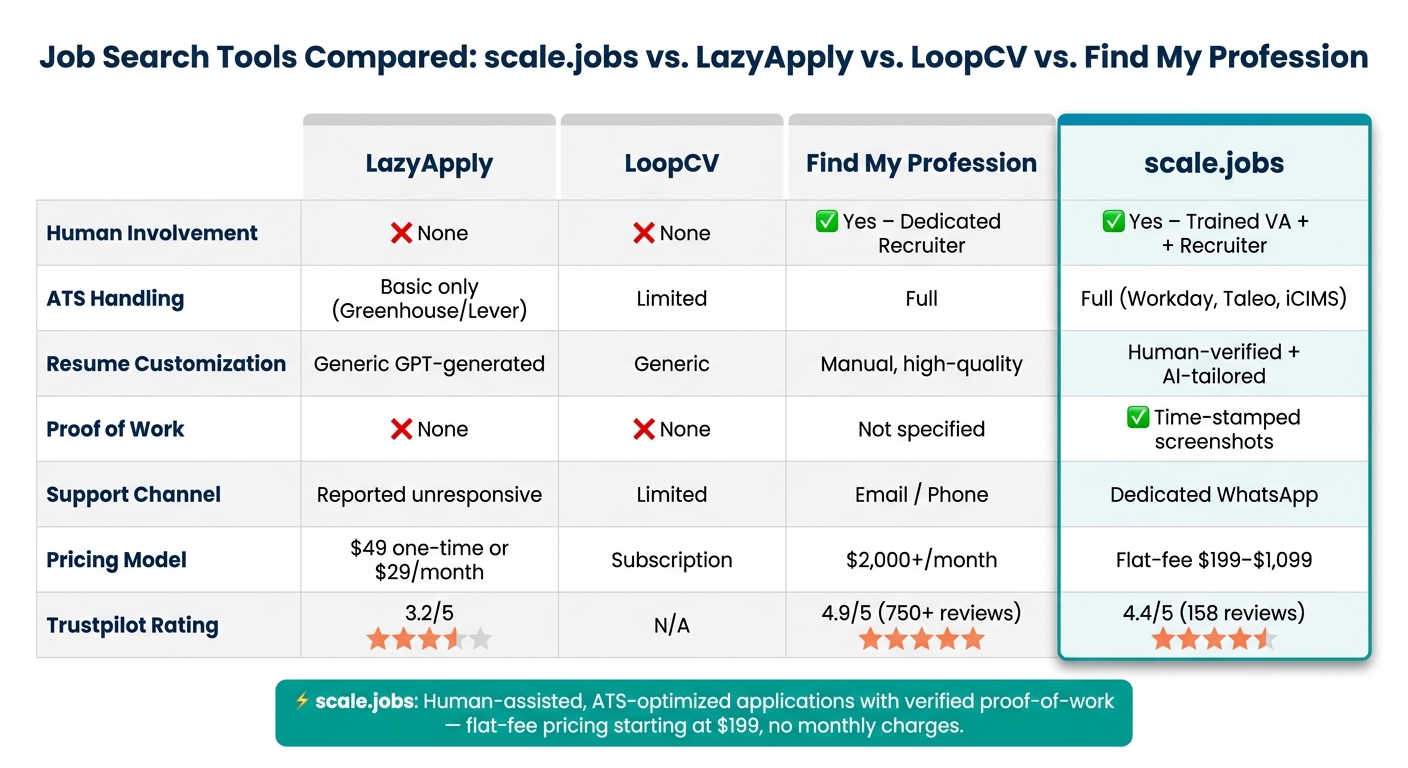
Job Search Tools Compared: scale.jobs vs LazyApply vs LoopCV vs Find My Profession
Every week without a paycheck after a layoff adds stress to your finances. The quicker you secure a new position, the less strain you’ll experience. That’s why your choice of a job search tool isn’t just about convenience - it’s a financial decision. Scale.jobs stands out by offering its service upfront for free, charging only a $1,500 success fee for eligible U.S. citizens and Green Card holders in white-collar roles with less than 10 years of experience.
LazyApply vs. scale.jobs: Automation vs. Human-Powered Applications
LazyApply offers a simple, low-cost solution: for as little as $49, bots apply to hundreds of jobs on your behalf. It’s all about volume with minimal effort. However, this approach has its limits. LazyApply’s bots can only handle basic ATS systems like Greenhouse and Lever. More complex platforms such as Workday and Taleo often trip them up, leading to incorrect submissions or skipped applications without any notification.
"While LazyApply applies with generic GPT-generated applications, we apply for you, with human precision and real support - so you stop wasting money on AI auto-apply scams." - scale.jobs
In contrast, scale.jobs employs trained assistants who manually complete and verify each application within 12–24 hours. Each submission is backed by time-stamped proof-of-work screenshots, so you always know what’s been sent. While LazyApply has a 3.2/5 rating on Trustpilot, scale.jobs holds a stronger 4.4/5 from 158 reviews. When time is critical, missing out on a Fortune 500 opportunity due to bot errors can be a costly setback.
Next, let’s see how LoopCV’s automated model compares to scale.jobs’ human-driven approach.
LoopCV vs. scale.jobs: Automated Loops vs. Human Oversight
LoopCV takes an automation-first approach: set your preferences, and the system loops through job boards to auto-apply. It’s a decent option for low-stakes job searches, but reliability is a frequent issue. Users often report that some loops fail to result in verified applications, with no clear way to track what’s been done.
"While LoopCV high-volume, automated applications get stuck and can fail to complete applications despite repeated attempts, we apply for you - with verified submissions and tailored resumes." - scale.jobs
Scale.jobs eliminates this uncertainty by assigning human assistants to handle each application. Every submission is logged with a screenshot and confirmed via a dedicated WhatsApp line, ensuring you’re never left guessing about the status of your applications.
Find My Profession vs. scale.jobs: High-Cost Recruiting vs. Flat-Fee Volume
Find My Profession (FMP) has an impressive Trustpilot score of 4.9/5 from over 750 reviews, thanks to its thorough reverse recruiting services. However, the cost can be prohibitive. The Standard tier starts at $2,000 for the first month, with $1,499 per month for renewals. Given that the average job search lasts 5.2 months, the total cost can range from $5,000–$6,500 for Standard, and over $12,000 for Elite. This pricing is aimed at senior executives, making it less accessible for professionals with under 10 years of experience.
Scale.jobs, on the other hand, offers human-assisted applications starting at $199 for 250 applications. Its most comprehensive package, which includes tailored resumes, a dedicated recruiter, and a LinkedIn profile makeover, costs $1,099 flat - no monthly renewals. This predictable pricing is a relief for job seekers managing tight budgets, and any unused credits are refunded once you’re hired.
| Feature | LazyApply | LoopCV | Find My Profession | scale.jobs |
|---|---|---|---|---|
| Human involvement | None | None | Yes (dedicated recruiter) | Yes (trained VA + recruiter) |
| ATS handling | Basic only (Greenhouse/Lever) | Limited | Full | Full (Workday/Taleo/iCIMS) |
| Resume customization | Generic GPT-generated | Generic | Manual, high-quality | Human-verified + AI-tailored |
| Proof of work | None | None | Not specified | Time-stamped screenshots |
| Support channel | Reported unresponsive | Limited | Email/phone | Dedicated WhatsApp |
| Pricing model | $49 one-time or $29/month | Subscription | $2,000+/month | Flat-fee, $199–$1,099 |
Key advantages of scale.jobs:
- Human-assisted applications with verified proof-of-work
- Compatibility with complex ATS platforms like Workday, Taleo, and iCIMS
- Flat-fee pricing with no recurring charges
- Dedicated WhatsApp support for real-time updates
- Free service with a $1,500 success fee for eligible U.S. citizens and Green Card holders
Choose scale.jobs if:
- You’re targeting roles at mid-size or large companies using advanced ATS systems like Workday or Taleo.
- You need proof of submissions to stay on track with your job search goals.
- You want human-reviewed applications without committing to $2,000/month.
- You have less than 10 years of experience and need a cost-effective solution.
- You’re applying to a high volume of roles (500–1,000) and can’t risk delays caused by automation failures.
Who might prefer LazyApply or LoopCV: Job seekers focused on early-stage startups or small companies with straightforward ATS platforms, prioritizing volume over precision.
Who benefits most from scale.jobs: Professionals navigating layoffs who need reliable, verified applications for a wide range of companies - including large employers - without executive-level recruiting fees.
Selecting the right service can make all the difference in speeding up your job search and easing financial stress.
Conclusion: Managing Missed Payments While You Search for Work
Facing a layoff brings two big challenges: protecting your credit while your income is paused and finding a new job as quickly as possible. These tasks are deeply connected - the faster you land a job, the less financial strain you’ll face. Unlike other tools like LazyApply and LoopCV, Scale.jobs offers a human-powered approach to job applications, providing verified submissions to help you close that income gap more effectively.
On the financial front, the first 30 days are critical. Contact your lender within this window - not after - and ask about a "financial hardship program" or "payment deferral." Being proactive can lead to successful accommodations about 70% of the time. Always request written terms before your next billing cycle to safeguard your credit. While managing this, speeding up your job search becomes equally essential.
The reality is stark: the median job search in 2026 takes 5.2 months, while the average emergency fund only lasts 2.3 months. This nearly 3-month shortfall is where financial strain typically builds. Choosing the right job application tool can make a significant difference in reducing this gap.
Unlike automated platforms that risk errors and unverified submissions, Scale.jobs stands out with its human-assisted application process. Here’s how it helps:
- Human-Assisted Applications: Verified submissions with proof of work, including time-stamped screenshots.
- ATS-Optimized Submissions: Compatible with major systems like Workday, Taleo, and iCIMS.
- Transparent Pricing: A flat fee starting at $199 and a $1,500 success fee for eligible U.S. citizens and Green Card holders - no recurring monthly charges.
- Real-Time Support: Dedicated WhatsApp assistance for updates and transparency throughout the process.
If you’re looking for a complete solution, their resume writing and job search services bundle includes a ATS-friendly resume, LinkedIn profile optimization, and personalized application support - all at a predictable cost.
Switch to Scale.jobs if:
- Your emergency fund won’t last more than three months.
- You need human oversight to avoid ATS-related submission errors.
- You value clear, verified application processes.
Balancing financial obligations while launching a human-powered, ATS-optimized job search can help you regain stability faster. By tackling both tasks together, you can bridge the income gap before it leads to deeper financial challenges. Take control of your payments and job search simultaneously to restore your income without delay.
FAQs
Will one missed payment ruin my credit score?
A single missed payment can have a major impact on your credit score, often causing it to drop by 60 to 110 points for a 30-day late payment. What’s more, this late payment can stay on your credit report for as long as seven years, affecting your financial standing throughout that period.
Which bills should I pay first if I’m short on cash?
Focus on housing costs like rent or mortgage payments, as well as utilities such as electricity, water, and internet - these are essential to maintaining stability. Once these are covered, allocate any remaining funds toward the minimum payments on credit cards and medical bills. This helps you avoid late fees, penalties, and potential damage to your credit score.
What should I ask my lender for in a hardship program?
If you're facing financial difficulties, consider requesting a temporary hardship program from your lender or creditor. These programs can offer options like reduced or deferred payments, lower interest rates, or even waived late fees. To safeguard yourself, make sure you request the terms in writing before missing any payments. This ensures clarity and provides documentation of the agreement.