
Practice STAR method (Situation, Task, Action, Result) for interviews

Sarah Mitchell
April 13, 2026

The STAR method is a practical framework for answering behavioral interview questions like "Tell me about a time when..." or "Can you give an example of...". It ensures your responses are clear, structured, and concise by breaking them into four parts:
- Situation: Briefly set the context in 1–2 sentences.
- Task: Explain your specific responsibility in 1 sentence.
- Action: Detail the steps you took, focusing on your individual contributions (60% of your response).
- Result: Summarize measurable outcomes in 1–2 sentences.
This method highlights your problem-solving and decision-making skills while keeping the focus on your personal impact. For example:
- Question: "Describe a time when you faced a challenge at work."
- Response: "Our team faced a 3-month surge in shipment delays (Situation). I was tasked with identifying the root cause and implementing a solution (Task). I analyzed shipping data, identified miscommunication gaps, and introduced a shared tracking system (Action). As a result, complaints dropped by 40% in two months (Result)."
To prepare, craft 3–5 STAR stories tailored to the job description, focusing on key skills. Practice delivering these responses aloud to ensure clarity and confidence.
For personalized feedback and help refining your STAR examples, consider using a job application service that offers tailored guidance and ATS-friendly resumes.
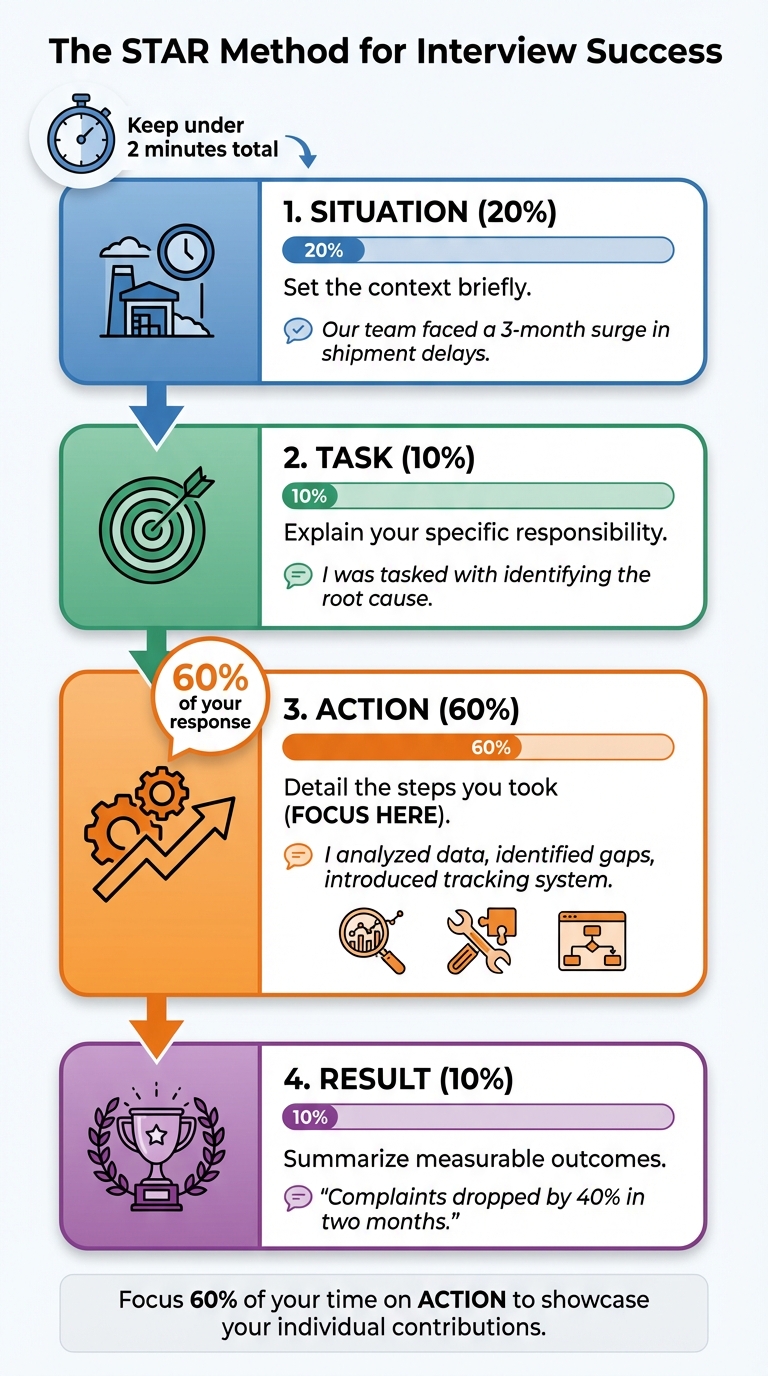
STAR Method Interview Framework: 4-Step Structure with Time Allocation
STAR Method Interview: How to Answer Behavioral Questions (With Examples)
sbb-itb-564272e
The 4 Parts of the STAR Method
Each part of the STAR method plays a key role in structuring your responses during interviews. By understanding the ideal length and focus of each section, you can craft answers that are clear and engaging. Career coach Marlo Lyons suggests keeping your entire STAR response under two minutes, dedicating most of that time to the Action phase.
| STAR Element | Recommended Length | Percentage of Answer |
|---|---|---|
| Situation | 1–2 sentences | 20% |
| Task | 1 sentence | 10% |
| Action | 3–5 sentences | 60% |
| Result | 1–2 sentences | 10% |
Situation: Describe the Background
The Situation is your chance to set the stage in one or two sentences. It’s about giving just enough context for the interviewer to understand the challenge you faced. Avoid lengthy explanations about your company or role - stick to the essentials. As MIT Career Advising explains: "Explain the situation so that your interviewer understands the context of your example, they do not need to know every detail!" Choose a scenario that directly relates to the job you’re applying for and demonstrates the skills they’re seeking.
Task: Explain Your Responsibility
In the Task section, you’ll outline your specific goal or responsibility in a single sentence. This connects the context of the situation to the actions you took. Use "I" statements to highlight your personal role, rather than relying on team-based descriptions. For instance, instead of saying "We had to increase customer satisfaction", say "I was tasked with improving customer satisfaction scores by 20% within six months." Tailoring your task to reflect the job description is a great way to show your suitability for the role.
Action: Detail What You Did
The Action phase is where you dive into the details, spending about 60% of your time explaining what you did. Focus on your individual contributions and use specific, descriptive language to paint a clear picture. For example, "I developed a new training program, conducted workshops for 50 employees, and tracked performance improvements" is much more impactful than "I helped with employee training." This section gives interviewers insight into your problem-solving abilities and how you handle challenges.
Result: Share the Outcome
Wrap up your response by summarizing the outcome in one or two sentences, emphasizing measurable results. Whenever possible, use numbers, percentages, or timeframes to make the impact clear. For instance, "This reduced onboarding time by 50%, saving the team 20 hours per month" or "I increased sales by 25% within three months." Quantifiable results help solidify your success and leave a lasting impression. Whether it’s financial gains, improved efficiency, or meeting tight deadlines, concrete outcomes make your story resonate.
STAR Method Examples for Common Interview Questions
Building on our breakdown of STAR components, the following examples demonstrate how to integrate each element into impactful, concise responses. These examples showcase how to craft answers that emphasize actionable details and measurable outcomes. Below are three real-world STAR examples addressing common behavioral interview questions.
Example 1: Overcoming a Challenge
Question: "Can you describe a time when you faced a challenge at work and how you handled it?"
Situation: Our customer support team observed a 3-month surge in delayed shipment complaints, which threatened our satisfaction ratings.
Task: I was responsible for identifying the root cause of these delays and implementing a solution to restore our delivery efficiency.
Action: I gathered three months of shipping data and discovered a miscommunication gap between our sales and warehouse teams - orders were being logged incorrectly in our system. To address this, I proposed weekly coordination meetings between both departments and implemented a shared tracking system that flagged discrepancies automatically. Additionally, I created a simple checklist for sales reps to use before submitting orders to the warehouse.
Result: Within two months, order processing time improved by 25%, and shipping-related complaints dropped by 40%. The tracking system was adopted as a permanent part of our workflow.
Example 2: Resolving Team Conflict
Question: "Tell me about a time you had to resolve a conflict within a team."
Situation: During a product launch, two senior designers on my team disagreed on the visual direction for our landing page, causing a two-week project standstill just three weeks before our deadline.
Task: As the project lead, I needed to mediate the disagreement and get the project back on track without damaging team relationships.
Action: Through individual discussions, I discovered that both design approaches had merit, each targeting different user segments. I proposed A/B testing both designs post-launch and asked each designer to present their case to our UX research team. Based on the feedback, we combined elements from both designs - using one designer's layout structure with the other's color scheme and typography. To prevent future delays, I introduced a decision-making framework for design conflicts.
Result: The hybrid design launched on time and achieved an 8.7% conversion rate, surpassing our 6% target. Both designers felt their perspectives were valued, and the team adopted the new conflict resolution framework for future projects.
Example 3: Working Under Pressure
Question: "Describe a situation where you had to perform under tight deadlines or high pressure."
Situation: In March 2026, a client moved their product launch date up by two weeks, leaving me only seven business days to produce a full marketing campaign that was originally scheduled over three weeks.
Task: I needed to deliver landing pages, email sequences, and social media assets without compromising quality or missing the new launch date.
Action: I prioritized tasks based on revenue impact, focusing on landing pages and email sequences, which drove 60% of traffic. I adapted existing templates to reduce production time by 40% and delegated social media graphics to a junior designer with detailed briefs. I also communicated daily progress updates to the client and flagged which "nice-to-have" features would be deferred to post-launch. To maintain quality, I blocked off four-hour deep work sessions each morning.
Result: The campaign launched on schedule, with landing pages converting at 8.2% (exceeding our 6% benchmark). The client was so impressed they upgraded to a premium retainer worth an additional $15,000 annually.
"The biggest takeaway for me was that cutting scope early and communicating about it honestly is almost always better than trying to deliver everything at lower quality." - Daniel Wolken, Career Advice Author, DailyRemote
These examples show how clear, structured answers can leave a lasting impression on interviewers. If you're preparing for interviews and need help crafting personalized STAR responses tailored to specific job roles, consider using a job application service to refine your approach and showcase your achievements effectively.
Matching Your STAR Answers to the Job
Crafting STAR responses that align with the employer's needs can make all the difference in an interview. Tailoring your examples ensures your experiences reflect the specific skills and qualities the job demands. For instance, a story about streamlining a technical process might resonate in a data analyst interview but could miss the mark in a sales role. The trick is to work backward from the job description to identify which experiences will have the most impact.
Analyzing the Job Description
Start by breaking down the job posting to refine your STAR responses. Look for recurring action verbs and keywords. If terms like "collaboration" or "analytical thinking" appear multiple times, these are the skills the employer values most. Create a two-column list: one side for the role's key requirements and the other for STAR examples that match. Keep this list accessible during virtual interviews so you can quickly align your answers with the employer's priorities.
Distinguish between technical skills (e.g., software, certifications) and transferable skills (e.g., communication, leadership). For example, a project manager role might highlight "Agile methodology" as a technical skill and "team coordination" as a soft skill. Your STAR response should address both. For instance, describe how you used Jira to manage sprints while also resolving scheduling conflicts across departments.
Adjusting Examples for Different Positions
The same story can be reframed to suit different roles. Emphasize leadership qualities for management positions, technical expertise for specialized roles, or communication skills for client-facing jobs. For instance, if you led a team through a product launch:
- For a management role: Focus on how you motivated the team, navigated tough decisions, and fostered growth.
- For a technical role: Highlight the tools you used, like Python or SQL, and explain the logic behind your problem-solving process.
- For a client-facing role: Emphasize how you kept stakeholders informed, managed expectations, and addressed concerns.
According to MIT Career Advising, about 60% of your STAR response should focus on the "Action" section, as this showcases your role-specific skills. For example, in a technical role, you might say: "I analyzed three months of server logs using Python and pinpointed a query causing 70% of the load time issues." For a management role, you could frame it as: "I delegated tasks to two engineers to identify bottlenecks while working with the product team to adjust timelines, ensuring quality wasn’t compromised."
| Role Type | Key Focus Areas | STAR Story Adjustment |
|---|---|---|
| Management | Leadership, team development, strategic thinking | Highlight how you inspired the team, made tough decisions, and contributed to overall growth. |
| Technical | Problem-solving, tool proficiency, analytical logic | Detail the tools and methods you used, focusing on your logical approach to solving challenges. |
| Client-Facing | Communication, empathy, cultural awareness | Emphasize active listening, bridging gaps in understanding, and resolving conflicts effectively. |
Make it easy for the interviewer to see the connection between your experience and their needs. Add a brief "takeaway" at the end of your result to tie it back to the role: "This experience taught me how to balance speed and quality under pressure, which I understand is crucial for your team given your fast-paced product cycles."
How to Practice Your STAR Responses
Once you've crafted STAR examples tailored to the job, practicing how you deliver them is the next critical step. Understanding the STAR method is one thing, but presenting your responses with confidence takes practice. Speaking your answers out loud is key - what seems clear in your head can feel jumbled when spoken. Career coach Emma Flowers highlights this:
"Whether it's in a mock interview or just practicing your answer in the mirror, talk through your response so that it feels natural and comfortable when you're actually in the interview."
Recording yourself on your phone or laptop can reveal issues like filler words, unclear pacing, or lack of clarity. Play back the recording and ask yourself: Does the "Action" section take up about 60% of your response? Are you keeping it concise, ideally under two minutes?
Avoid memorizing your answers word-for-word. Scripted responses can sound stiff and make it harder to adjust if the interviewer rephrases a question. Instead, create a bulleted outline that highlights key metrics, the challenge you tackled, your main actions, and measurable results. Aim to develop 3–5 flexible STAR stories that can address questions about leadership, communication, or handling pressure.
Conducting Mock Interviews
Practicing under realistic interview conditions can help you build confidence and stay composed during high-pressure moments. Schedule mock interviews with mentors or career coaches who can ask company-specific questions and offer constructive feedback. AI tools like LinkedIn's Interview Prep (available with LinkedIn Premium) provide instant insights into pacing, filler words, and phrases to avoid.
For video interviews, practice using the same setup you'll use on the actual day. This includes consistent lighting, a clean background, and a proper camera angle to minimize distractions. Emma Flowers advises:
"It's OK to take a few seconds. I'm always impressed when a candidate asks for a moment to think so that they can provide a good answer."
Taking a brief pause before answering allows you to collect your thoughts, ensuring a well-structured response instead of rushing through it. Mock interviews not only prepare you for the real thing but also help you refine your technique.
Getting Feedback and Making Adjustments
After each practice session, ask for specific feedback to improve further. Did you clearly communicate your individual contributions, or did your answers lean too heavily on "we" statements? Was your "Result" section specific and measurable? Time management is also crucial - spending too long on the "Situation" can overshadow the key actions you took. Career coach and author Marlo Lyons emphasizes:
"The goal is not to memorize scripted answers, but rather to develop a strong foundation of responses that you can adapt to different questions and interviewers."
Using a timer during practice can help you stay within the recommended 60–90 second range for each response. After each session or actual interview, reflect on what worked well and where adjustments are needed. For example, if you're preparing for multiple rounds with the same company, mix up your STAR examples to keep your answers fresh and engaging.
Consistent practice with these strategies will make your STAR responses polished and adaptable to any interview scenario. Just as tools like scale.jobs focus on refining responses through feedback, your preparation will ensure you're ready to deliver your best in every interview.
Conclusion
The STAR method takes the guesswork out of answering interview questions by turning vague responses into clear, impactful stories that highlight your qualifications. Unlike automated platforms such as LazyApply, scale.jobs combines human expertise with personalized support to ensure your STAR responses truly capture your skills and experiences. By focusing around 60% of your answer on the Action section and keeping your response within 60–90 seconds, you can effectively demonstrate your problem-solving abilities and personal contributions without losing the interviewer’s attention.
This structured approach not only helps you stand out during interviews but also offers a more tailored alternative to fully automated tools. While platforms like LazyApply may appeal to candidates prioritizing speed and volume, scale.jobs is ideal for those who want ATS-friendly documents, customized resumes, and professional guidance from human advisors.
Before your next interview, take the time to prepare 3–5 STAR stories that align with the core competencies in the job description. These stories should be flexible enough to answer questions about leadership, conflict resolution, time management, or handling pressure. Whenever possible, quantify your results - specific metrics like “cut costs by 20%” or “increased customer satisfaction by 30%” provide tangible proof of your impact.
Behavioral interviews rely on the idea that past behavior predicts future success, making STAR-formatted answers a key tool for candidates. With remote and hybrid roles now attracting seven times more applicants than traditional in-person positions, delivering polished, concise answers could be the edge you need to secure an offer.
To refine your STAR responses, practice them aloud, conduct mock interviews, and even record yourself to identify areas for improvement. If you’re struggling to craft standout examples or align your experience with specific job requirements, consider partnering with professional resume writers through scale.jobs resume writing services. The goal isn’t to memorize answers - it’s to develop adaptable stories that authentically showcase your skills in any interview setting.
Decision Summary
When to choose LazyApply or similar automated tools: If your focus is on submitting a high volume of applications quickly, and personalized feedback isn’t a priority, platforms like LazyApply could be a fit.
When to choose scale.jobs: If you’re looking for tailored guidance, ATS-optimized resumes, and human assistance in refining STAR responses, scale.jobs is the better option.
Consider switching to scale.jobs if:
- You prefer human feedback over automated templates
- You need resumes and cover letters tailored to specific roles and optimized for ATS
- You want a one-time payment model with ongoing WhatsApp support
- You value transparency, with clear proof of how your applications are customized
- You’re preparing for interviews and need help crafting STAR responses that align with job-specific skills and competencies
FAQs
How do I choose the best STAR story for a question?
When crafting a STAR story, focus on an example that directly connects to the skills or achievements relevant to the question being asked. Here's a quick breakdown of how to make your response specific, detailed, and impactful:
- Situation: Set the stage by describing the context or challenge you faced. Be concise but provide enough background to make the scenario clear.
- Task: Explain your specific role or responsibility in that situation. Highlight what was expected of you.
- Action: Dive into the steps you took to address the task or resolve the issue. Focus on your direct contributions and decisions.
- Result: Conclude with the outcome, emphasizing the positive impact of your actions. Use measurable results, if possible, to demonstrate success.
For example, if you're being assessed on teamwork, you might share a story about collaborating with colleagues to meet a tight deadline. Detail how you contributed to the group effort and how it led to a successful project delivery. If the focus is on leadership, choose a moment where you guided a team or took initiative to solve a complex problem.
The key is to ensure your STAR story aligns with the competency being evaluated and leaves a lasting impression of your abilities.
What if I can’t quantify the result with numbers?
If measuring results in numbers isn't possible, shift your attention to qualitative outcomes and the influence of your efforts. Showcase achievements such as enhanced team productivity, successful project completions, positive peer or client feedback, or even your own professional development. For instance, rather than stating "increased sales by 20%", you could phrase it as "implemented strategies that led to noticeable sales growth." Focus on the contributions you made and the skills you applied to make an impact.
How can I keep my STAR answer under two minutes?
To keep your STAR response under two minutes, focus on being concise and to the point. Start by summarizing the Situation and Task in just 1–2 sentences to set the context. Then, dedicate 30–45 seconds to describing the Action you took, emphasizing the most important steps or skills you used. Finally, use the remaining 30–45 seconds to share the Result, including measurable outcomes whenever possible. Practice speaking your response out loud to make sure it’s clear, impactful, and fits within the time limit.