
Scale.jobs vs Doing It Yourself: Which Gets You Hired Faster in 2026?

Leela Yanamaddi
March 19, 2026

In 2026, job seekers face a key decision: manage applications themselves or use a service like Scale.jobs. DIY applications offer control and no upfront cost but require 20–30 hours weekly and often yield low response rates (under 10%). In contrast, Scale.jobs provides trained human assistants who handle applications, ensuring ATS compatibility and saving significant time. Users typically secure jobs 2–4 months faster, with response rates between 25–47%.
For those applying to fewer than 10 roles monthly, DIY may suffice. However, if you're managing 100+ applications, facing visa deadlines, or seeking faster results, Scale.jobs offers a more efficient solution starting at $199. Whether you're a recent graduate or a mid-level professional, the right choice depends on your time, budget, and urgency.
| Feature | DIY Job Applications | Scale.jobs |
|---|---|---|
| Time Commitment | 20–30 hours weekly | Less than 1 hour onboarding |
| Cost | Free | $199–$399 |
| ATS Compatibility | Manual formatting required | Handled by experts |
| Response Rate | 1–2% | 25–47% |
| Application Volume | Suitable for <10 jobs/month | Ideal for 100+ jobs/month |
For high-volume applications or tight deadlines, services like Scale.jobs can save time and improve results.
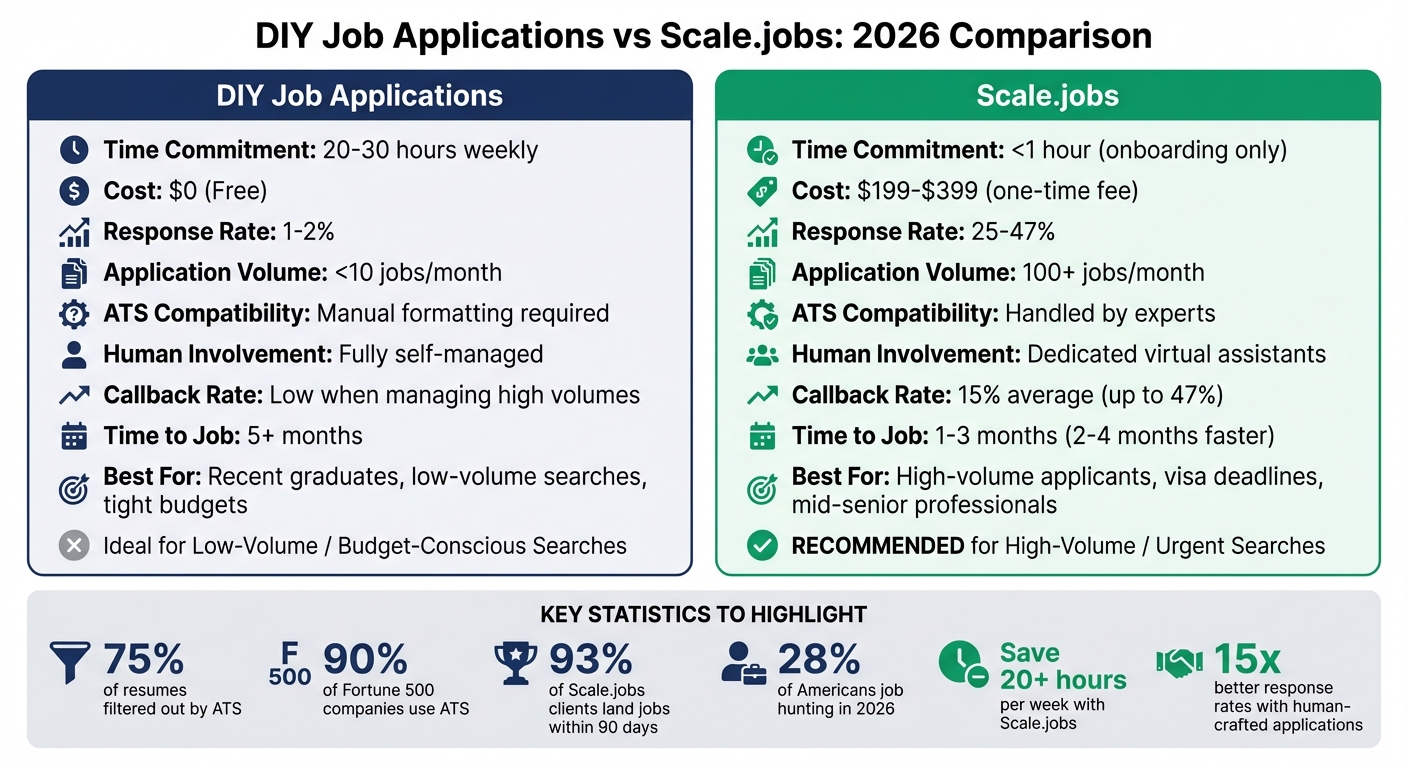
DIY vs Scale.jobs Job Application Comparison 2026
DIY Job Applications: What Works and What Doesn't
What Works: Full Control and No Cost
Taking the DIY route for job applications puts you in the driver’s seat. You have complete control over how you present your career story, which roles you pursue, and the timing of your submissions - all without spending a dime. This approach is particularly helpful when applying for niche roles or explaining career gaps in a way that automated systems might not handle well.
By researching job markets and tailoring your applications, you gain a better understanding of what employers are looking for and how your skills measure up against the competition. If your career path is straightforward or you’re applying to fewer than 20 positions per month, DIY applications can fit neatly into your schedule without becoming overwhelming. However, these advantages often come with significant drawbacks, especially when it comes to time investment and navigating ATS (Applicant Tracking Systems).
What Doesn't Work: Time-Consuming and Inconsistent Outcomes
The most obvious downside of DIY job applications is the time commitment. Crafting high-quality, tailored applications can easily take 20–30 hours a week, especially if you’re applying to multiple roles. This can quickly become unmanageable, leaving you juggling application details and struggling to prepare for interviews effectively.
Another major issue is ATS compatibility. Roughly 75% of resumes are filtered out by ATS software before they even reach a recruiter, and with 90% of Fortune 500 companies relying on these systems, the odds are stacked against you. Common DIY mistakes - like using tables, graphics, or placing contact details in headers - can confuse ATS parsers, causing crucial information to be overlooked.
Dr. Jasmine Escalera, a career strategist, advises: "To get past the ATS, tailor your resume with relevant keywords and skills from the job description."
While this is sound advice, manually customizing resumes for dozens of jobs is not only tedious but also prone to errors. These challenges are part of the reason why many job seekers are exploring solutions like Scale.jobs to save time and improve their chances.
DIY applications often yield response rates below 10%, especially when competing against candidates who use tools like professional resume writing services or AI resume builders. The inconsistency arises from manual errors, missing keywords, and the sheer volume of applications recruiters receive. Without expert help to fine-tune ATS formatting or keyword usage, your resume might never even make it to a recruiter’s desk. Up next, we’ll explore how Scale.jobs tackles these inefficiencies with precision and expert support.
Why Scale.jobs Wins Against DIY Applications
Human Assistants for Accuracy and Speed
DIY job applications often come with manual errors and inefficiencies that can slow you down. Scale.jobs, on the other hand, takes a different approach by using skilled human assistants to streamline the process. Instead of spending hours copying and pasting your details into multiple job portals, Scale.jobs assigns trained virtual assistants to handle each submission manually. This method not only avoids the bot flags that automated tools often trigger but also ensures that every form field is filled out correctly - an essential detail when you're managing a high volume of applications.
These assistants go beyond basic data entry. They ensure your applications are ATS-compatible, tailor formatting to match specific company requirements, and quickly catch any errors. By outsourcing this detailed work, you can save over 20 hours a week - time you can use for networking or preparing for interviews. With this level of precision and human oversight, Scale.jobs helps you avoid the common pitfalls of DIY submissions, giving your applications a better chance to stand out in applicant tracking systems.
ATS-Optimized Resumes and Custom Cover Letters
One of the biggest challenges with DIY applications is ensuring your resume and cover letter are formatted correctly for ATS systems. Scale.jobs takes this burden off your shoulders by creating fully optimized documents tailored to each job posting. Their human assistants customize every resume to meet ATS requirements, significantly improving your chances of catching a recruiter’s attention.
This personalized approach is especially valuable if you're applying to a large number of jobs each month. Manually tailoring resumes for every position can quickly become overwhelming, but Scale.jobs ensures that every application is fine-tuned without adding to your workload.
Clear Workflow with Proof of Work
Another common frustration with DIY job searches is tracking your applications. It’s easy to lose track of where and when you’ve applied, and documenting each submission for purposes like visa sponsorship or unemployment claims can be a nightmare. Scale.jobs eliminates this hassle by providing real-time updates and proof of work.
After uploading your resume and preferences, your dedicated assistant sends you WhatsApp updates as each application is submitted, complete with screenshots for verification. This transparent workflow ensures you always know the status of your applications. Unlike vague dashboards or automated systems, Scale.jobs offers clear documentation you can rely on.
Additionally, the pricing model is straightforward: a one-time payment ranging from $199 to $399, depending on the number of applications. If you land a job before using all your credits, the unused portion is refunded, making it a fair and practical alternative to the unpredictability of DIY methods. With its transparency, accountability, and cost-effective approach, Scale.jobs offers a reliable solution to the many challenges of managing your own job search.
Automate Your Job Search Through AI Agent Ft. Jobright AI | Find Jobs - Custom Resume - Auto Apply
Feature Comparison: DIY vs Scale.jobs
Choosing between a do-it-yourself (DIY) job search and using Scale.jobs largely depends on how much time you're willing to invest and how quickly you need results. The table below outlines the core features of each approach, making it easier to understand their differences.
| Feature | DIY Job Searching | Scale.jobs |
|---|---|---|
| Human Involvement | Fully self-managed - you oversee every step | Dedicated virtual assistants take care of job submissions |
| Resume Customization | Requires significant manual effort | Virtual assistants customize resumes for each job within 24 hours |
| ATS Compatibility | Relies on your formatting skills | Professionally optimized and verified for ATS systems |
| Application Process | Manual entry on every platform | Handled by virtual assistants, avoiding bot-detection issues |
| Proof of Work | Self-tracked via notes or spreadsheets | Real-time updates with WhatsApp screenshots and timestamps |
| Pricing | No monetary cost, but high time investment | Flat fee: $199–$1,099 (unused credits refundable) |
| Time Commitment | 20–30+ hours weekly | Less than 1 hour (initial onboarding only) |
| Callback Rate | Often low when managing high volumes manually | Reported user rates between 25–47% |
This breakdown highlights the trade-offs between the two approaches.
With DIY, you have complete control over the process, but it requires a significant time commitment and effort, especially for tasks like resume customization and ATS formatting. On the other hand, Scale.jobs simplifies the job application process with human-assisted services, providing ATS-optimized submissions and real-time progress updates at a flat fee.
For those juggling high application volumes or tight deadlines - such as applicants managing visa requirements - Scale.jobs can save substantial time and improve efficiency. However, if you're applying to only a few roles or are working with a limited budget, DIY might be the better route. Pairing Scale.jobs with services like a professional resume writing service could further enhance your job search by combining a polished resume with expertly managed applications.
Ultimately, your choice will depend on how much time you can dedicate and how quickly you need results. Both approaches have their strengths, but they cater to different priorities and circumstances.
Who Should Use DIY vs Who Should Choose Scale.jobs
Let’s break down who benefits the most from each approach based on their job search needs and circumstances.
Who Should Stick with DIY
The DIY route works best for those applying to fewer than 100 jobs per month and who have the time to carefully customize each application. This approach is particularly suited for recent graduates, as they can emphasize specific internships, coursework, or campus jobs that align with the roles they’re targeting. With hiring projections for new grads increasing by just 1.6%, standing out through personalized applications is more crucial than ever.
If you’re networking and focusing on a smaller pool - say, 10 to 15 companies - DIY offers the flexibility to craft tailored, thoughtful outreach to key decision-makers. While this method requires a significant time commitment each week, it comes at no extra cost and keeps you fully in control of your job search.
For those on a tight budget who prefer not to spend $199–$399 on professional services, DIY remains a practical option. Pairing it with free tools like ATS checkers or job tracking apps can help streamline the process and keep applications organized.
That said, if your job search demands higher efficiency or involves a large number of applications, Scale.jobs could save you both time and effort. Many candidates find that job search automation is the key to managing this volume effectively.
Who Should Choose Scale.jobs
If you’re dealing with high application volumes or tight deadlines, Scale.jobs is a better fit. This service is especially helpful for mid-to-senior-level professionals, career changers, and those recently laid off who need to send out 100+ applications per month without compromising on quality. For example, if you’re part of the 28% of Americans expected to be job hunting in 2026 and struggling with low response rates (1–2%), Scale.jobs can help improve those odds significantly.
Take the case of Teja Aditya Surabhi, a Product Manager who relocated from India to Canada. After months of DIY applications with only a 1% response rate, he switched to Scale.jobs and saw his response rate jump to 15%.
"The statistics are clear: generic applications get 2% response rates. Human-crafted applications get 15x better results." - Shubham Dhakle, Outcome Manager, Scale.jobs
Scale.jobs is also ideal for visa-dependent job seekers (H1B, F1, CPT, TN, O1, EB1A, Canada PR, UK Global Talent Visa holders) who face strict deadlines and can’t afford to lose time on manual submissions. It’s equally beneficial for job hoppers who want to free up 20+ hours a week for networking and interviews.
For those considering professional assistance, combining Scale.jobs with a resume writing service can provide a polished resume alongside expertly managed applications.
With 93% of Scale.jobs clients landing a job within 90 days and 98% of Fortune 500 companies relying on ATS systems, this human-assisted approach eliminates the guesswork in optimizing applications for ATS and executing them effectively. If your DIY efforts aren’t delivering or you need to handle a high volume of applications, Scale.jobs’ flat-fee model ($199–$1,099, with refundable unused credits) offers a clear return on investment without the hassle of subscriptions.
Switch to Scale.jobs If...
Switching from handling job applications on your own to using Scale.jobs can help you focus on activities that truly matter. Here's when making the switch can be a game-changer:
You're Applying to 100+ Jobs Per Month
Submitting over 100 applications in a month can quickly drain your time. On average, it takes about 30–45 minutes to tailor each application. Multiply that by 100, and you're looking at around 75 hours - nearly two full workweeks - spent solely on applications. Scale.jobs can save you more than 20 hours per week, giving you valuable time to focus on networking or preparing for interviews. With a flat fee between $199 and $399, the service becomes a practical option when you weigh it against the time and effort spent on endless application portals.
You Need ATS-Compliant Documents
Many employers use Applicant Tracking Systems (ATS) to filter resumes, and even small formatting mistakes can cost you the job. Scale.jobs provides ATS-optimized resumes and cover letters tailored to each job posting. This ensures your documents meet the necessary standards for keyword usage, proper formatting, and file compatibility. For added assurance, you can pair Scale.jobs with a resume writing service to further refine your materials.
Your DIY Efforts Get Low Response Rates
If your personal job applications are only generating a 1–2% response rate, it might be time to rethink your approach. Scale.jobs clients often see an average response rate of 15%. This improvement comes from a human-assisted process where experienced professionals carefully analyze job descriptions, align your experience with job requirements, and craft compelling applications that stand out. By combining expert oversight with real-time updates, Scale.jobs helps you achieve better results.
When any of these scenarios sound familiar, it might be worth considering Scale.jobs to give your job search a meaningful edge. Keep reading for more insights on making the right decision.
Decision Summary
Deciding between managing your job applications on your own or using Scale.jobs depends on factors like how many applications you need to submit, how quickly you need results, and your budget. Neither option is inherently better - it all hinges on your specific situation. Here's a breakdown of when each choice might work best.
DIY for Low-Volume, Cost-Free Searches
The DIY approach is ideal if you're applying to fewer than 10 roles per month and can commit the time to customize each application. This method suits students, entry-level candidates, or those targeting smaller companies and startups that may not rely on Applicant Tracking Systems (ATS). Creative professionals, such as designers or marketers, might also prefer DIY applications when showcasing a portfolio is more important than keyword optimization.
If you can dedicate around 20 hours per week to tailoring resumes and cover letters (using proven cover letter examples for inspiration) without financial pressure, DIY is a solid option. However, as the number of applications increases, this approach can become overwhelming.
Scale.jobs for Fast, Efficient Hiring Results
If your job search requires speed and high-volume applications, Scale.jobs could be the better choice. This service is particularly useful if you're submitting 20–30 applications per week or facing tight deadlines, such as visa sponsorship timelines (H-1B, F-1 OPT) or needing a quick turnaround after a layoff.
Scale.jobs is designed for mid-to-senior-level professionals, career changers, and those targeting roles at companies using ATS platforms like Workday, Taleo, or Greenhouse. With human virtual assistants managing your applications and providing proof-of-work via WhatsApp, you sidestep issues like bot-detection filters that can flag automated tools.
The cost, ranging from $199 to $399 as a one-time fee, is often worth it when you consider the time saved - 20+ hours per week that you can redirect toward networking or preparing for interviews. If your DIY applications are yielding low response rates (under 2%), Scale.jobs typically delivers much higher results, with response rates averaging between 25–47%. This efficiency can significantly shorten your job search, reducing it from 5+ months to just 1–3 months. For even better results, consider pairing Scale.jobs with a resume writing service to maximize your chances.
FAQs
How do I know if my low response rate is an ATS issue or a targeting issue?
Studies indicate that less than 8% of resumes are automatically rejected by Applicant Tracking Systems (ATS). If your resume is optimized for ATS but you're still not hearing back, the problem might be poor targeting. This means your applications may not align well with the roles or companies you're pursuing. To improve your chances, ensure your resume includes relevant keywords, is designed to be ATS-friendly, and is customized for each job. This approach can help you determine whether the issue lies in targeting or ATS compatibility.
What should I still do myself if I use Scale.jobs (networking, interviews, follow-ups)?
When using Scale.jobs, you'll still be responsible for handling networking, preparing for interviews, and managing follow-ups on your own. The platform focuses on creating and submitting job applications with human oversight, ensuring your resumes and cover letters are tailored and sent out efficiently. However, all personal interactions remain under your control.
How many applications per week make Scale.jobs worth the one-time fee?
Applying to 30 jobs per week can greatly boost your job search efforts, and Scale.jobs takes this approach to the next level. The service submits 30 applications every single day, amounting to about 210 applications weekly. This high-volume strategy can significantly improve your chances of landing a job more quickly in 2026, making the one-time fee a smart choice for those looking to secure employment efficiently.