
Scale.jobs vs Tsenta: Humans, ATS Risk, and Why Speed Isn't Everything

Sarah Mitchell
July 11, 2026

If you only care about volume, Tsenta makes sense. If you care about what was submitted, how it looked in the portal, and whether it went through cleanly, Scale.jobs is the safer pick.
I see this comparison as simple:
- Tsenta helps you send a lot of applications at no cost
- Scale.jobs gives you human-run submissions for $199 for 250 applications
- The main tradeoff is speed vs oversight
- The main risk with automation is portal errors, login blocks, and weak handling of custom questions
- The main edge with human help is proof of work, resume matching, and live support when forms get messy
Quick Comparison
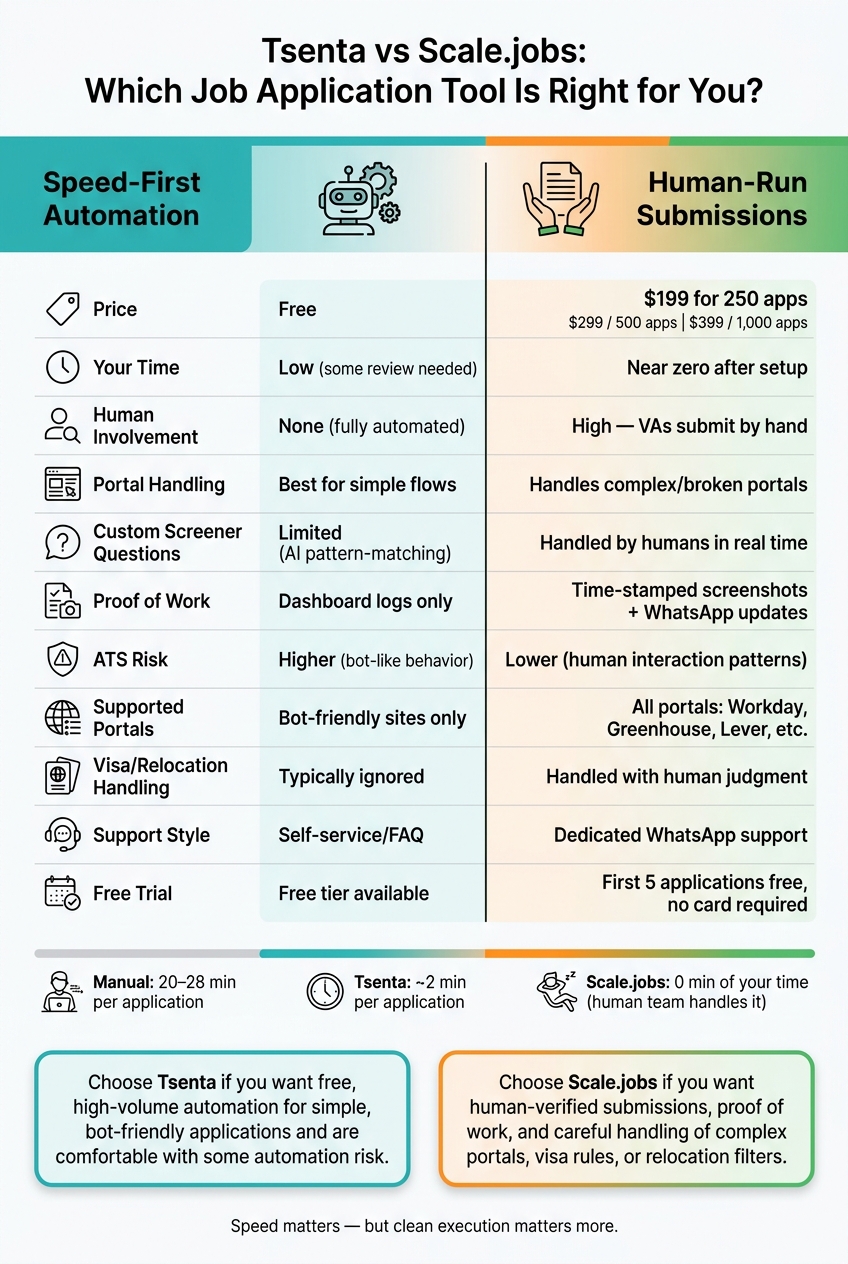
Tsenta vs Scale.jobs: Feature-by-Feature Comparison
| Criteria | Tsenta | Scale.jobs |
|---|---|---|
| Core model | Auto-apply software | Human-run job application service |
| Price | Free | $199 for 250 applications |
| Your time | Low, but still needs review | Near zero after setup |
| Portal handling | Best on simple flows | Better for complex flows |
| Custom screeners | Limited | Handled by people |
| Proof of work | Dashboard logs | Screenshots + updates |
| Best for | Volume-first users | Users who want control and cleaner submissions |
If I had to put it in one line: Tsenta helps you move fast; Scale.jobs helps you avoid silent mistakes.
Tsenta vs Scale.jobs: what matters most
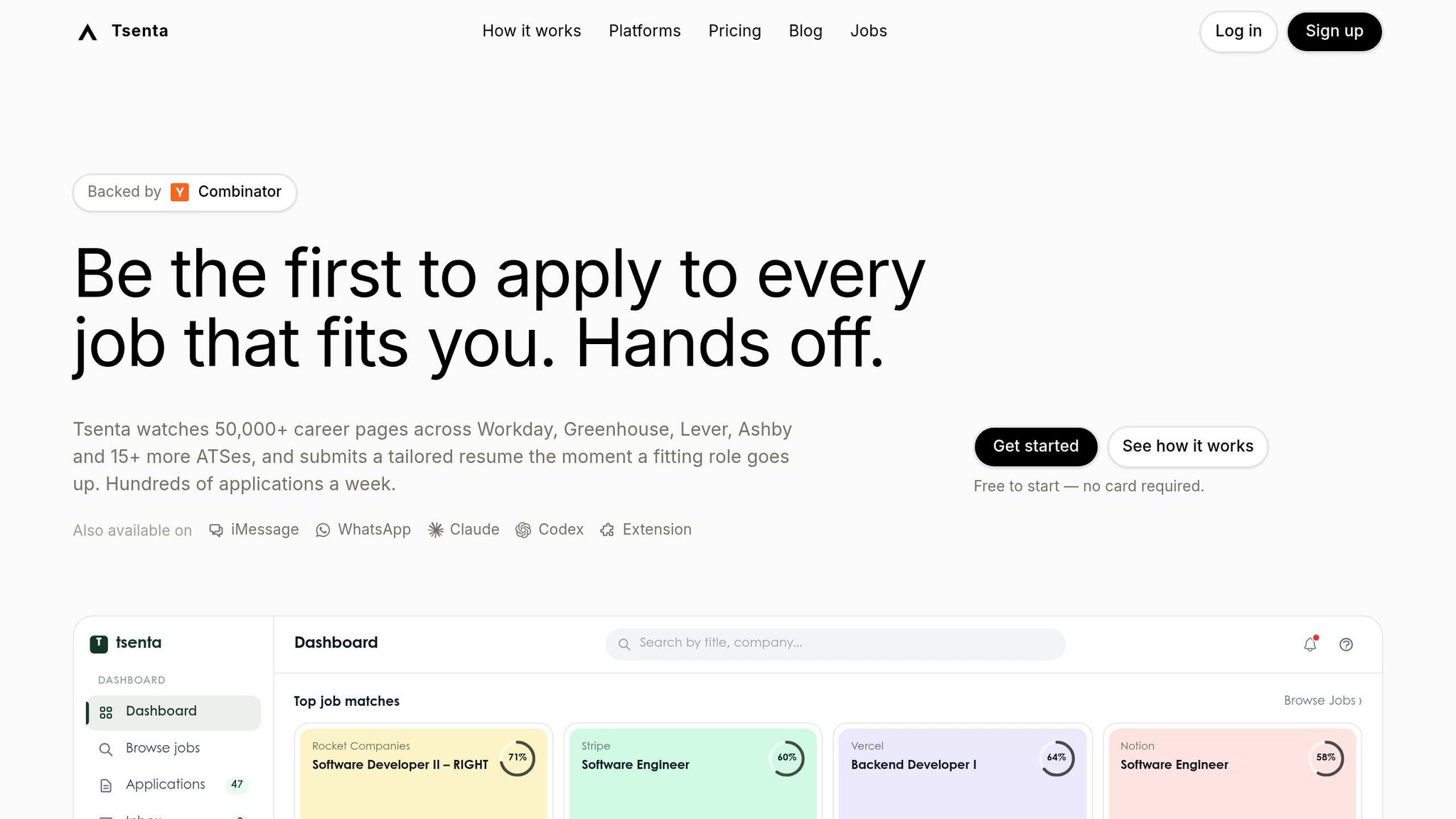
When I compare these tools, I don’t think the main question is “Which one is faster?”
I think the main question is: “Which one gives me the best shot at a clean application?”
That matters because many job portals still break in small ways:
- login loops
- CAPTCHA or 2FA checks
- bad field mapping
- extra work authorization questions
- odd file upload rules
- portal-specific glitches
A tool can show “submitted,” but that does not always mean the application was completed the way you wanted.
Where Tsenta works well
I’d point Tsenta to people who want one thing: more volume with less manual effort.
That can work well if you are:
- applying to broad role types
- using simple filters
- okay with limited review
- targeting easy-apply or bot-friendly portals
If your plan is to Apply for jobs in high volume and sort it out later, a free auto-apply tool can fit that workflow.
Where Scale.jobs has the edge
Scale.jobs is not in the same bucket. It acts more like a Virtual Assistant for Job Applications than a pure software tool.
What stands out to me:
- a human submits each application by hand
- resumes can be matched to the posting
- support is available for visa, relocation, and screener questions
- screenshots show what was done
- pricing is flat, not monthly
That setup fits people who are applying to harder roles, tighter filters, or messy portals.
It can also help if you are targeting full time jobs where each submission matters more than raw count.
My rule for choosing between them
I’d use this simple filter:
Pick Tsenta if:
- you want free software
- you care most about volume
- your applications are simple
- you are fine with some automation risk
Pick Scale.jobs if:
- you want human review
- you need help with portal issues
- your search includes visa or relocation limits
- you want proof of work for each application
A simple decision playbook
If you’re stuck, I’d follow this 4-step check:
-
Look at your target roles
If they are broad and easy to apply to, automation may be enough. -
Check how often portals break
If you keep hitting Workday, Greenhouse, and custom forms with odd questions, human help starts to matter. -
Review your response rate
If you already sent many applications and got little back, more volume may not fix the problem. -
Decide what you need more: time savings or submission control
That answer usually makes the choice clear.
sbb-itb-564272e
Is Tsenta worth it?
Yes, if your main goal is free, high-volume applications.
No, if you need careful handling, portal accuracy, or visibility into each submission.
That’s the short answer.
Tsenta is worth trying when your search is simple. But if the cost of a bad submission is high, I would lean toward human help.
FAQ
Is Scale.jobs better than Tsenta?
It depends on what you need. Tsenta is better for free volume. Scale.jobs is better for users who want hand-run applications, screenshots, and support when a portal gets messy.
Does automation hurt ATS results?
It can. The main issue is not the ATS alone. The issue is whether fields, files, and answers were entered the right way. Small submission errors can hurt your chances before a recruiter even reviews your profile.
Who should use a human-run service?
I’d look at a human-run option if your search includes visa rules, relocation filters, role-specific resumes, or portals that often fail. In those cases, a job search virtual assistant can help more than another auto-submit tool.
What if I also need resume help?
Then I’d fix that first. A weak resume plus more applications is still a weak setup. If needed, pair your applications with an ai resume builder or an ai cover letter builder before scaling up.
Final take
My view is simple: speed is useful, but clean execution matters more.
Tsenta is a solid fit for users who want free automation and broad reach. Scale.jobs is the better fit for users who want a human in the loop, fewer missed details, and more confidence in what was sent.
If your search is complex, or you want more than raw volume, I’d lean toward a job search platform with human help instead of pure automation.
WHAT TSENTA ACTUALLY IS
Tsenta is a speed-first job application automation tool built to cut down the manual work of sending applications. You upload your resume, and it helps find openings and submit applications at scale.
If your main goal is to apply for jobs faster, that pitch makes sense. A lot of the pain in any job search platform comes from repeating the same steps over and over - name, work history, location, resume upload, and the same short answers on one portal after another. Tsenta is built to handle that repetition.
Where Tsenta is genuinely strong
Its clearest win is simple: more applications with less hands-on work. That matters most when you'd otherwise spend hours retyping the same details across dozens of job portals.
It can also surface new listings fast, which helps when timing matters. For many roles, being early can make a difference, especially on crowded best job boards where new posts get a flood of applicants within hours.
That’s the upside. The next question is what happens when an application flow asks for more than a fast submit - extra questions, custom answers, portfolio links, work samples, or small judgment calls that don’t fit a one-click process. That’s usually where lighter automation starts to show its limits compared with a more hands-on job application service.
Who should use Tsenta
Tsenta fits people who already know the roles they want and care most about fast, high-volume submissions. It’s a better match for someone targeting clear categories like full time jobs in a known field, not someone who still needs direction, positioning, or help deciding what to pursue.
That distinction matters. There’s a big difference between software that helps you send more applications and support that handles the full process with context. If you need help beyond volume - resume tailoring, strategy, follow-up, or a job search coach style of guidance - you may want something broader than pure automation.
This is also where the line starts to show between basic automation and full application handling, like what some people look for in a Virtual Assistant for Job Applications or a more hands-on virtual assistant for job seekers.
WHY TSENTA AND SCALE.JOBS ARE NOT THE SAME PRODUCT CATEGORY
Tsenta automates submissions. Scale.jobs runs a human-managed application campaign. That difference shows up fast when a job portal glitches, a screener asks something odd, or the application needs a person to make a call.
If you're trying to Apply for jobs at volume, this isn't a small detail. It's the line between "sent" and actually completed the right way.
The 5-minute trap
Saving 5 to 10 minutes sounds good on paper. But that only matters if the application goes through cleanly.
High-volume automation can slip into low-quality output fast. And the bigger cost usually isn't the time spent filling out fields. It's the pile of applications that never get finished because the flow broke, a field failed, or the answer needed human judgment instead of pattern matching.
That's why time claims can be misleading. A tool may look fast, but if the submission doesn't land, those saved minutes don't mean much. The next section looks at the workflow in actual minutes, not vague claims.
The can't-login problem
Automation hits a wall all the time in normal job portals.
2FA, CAPTCHA, session timeouts, and portal-specific logins are common. When an automated flow breaks halfway through, the failure can be easy to miss. That's the moment where speed stops being the main thing that matters.
Then there are the parts no script handles well. Custom screener questions and open-text fields need context, tone, and judgment. A bot can follow a pattern. It can't always tell what to say when the form stops behaving like a neat, repeatable form.
This is one reason many people move from a basic tool to a job application service or a job search platform with human help in the loop.
How scale.jobs handles what automation misses
This is where the categories split in plain English:
- Human assistants submit by hand so the work is manual, not automated
- Resume and cover letter versions are matched to each posting before submission
- Dedicated WhatsApp support handles missing fields, visa limits, relocation answers, and custom screener questions in real time
- Time-stamped proof-of-work screenshots show what was submitted and when
- One-time flat fee: $199 for 250 applications, $299 for 500, $399 for 1,000
For job seekers who need more than software, this works more like a Virtual Assistant for Job Applications than a browser automation tool. If you want hands-on help during a search, that matters a lot for full time jobs and even messy application flows that come up in searches like Part time jobs near me.
If you're starting from scratch on your resume, scale.jobs offers professional resume writing and career support packages that connect directly to the human application service. That means your documents are built to pass ATS checks before a single application goes out.
Next, we'll compare the time cost side by side.
TIMING MATH AND FEATURE COMPARISON
Manual vs Tsenta vs scale.jobs: time per application
This is the login problem in plain numbers. Below is the time split across three ways to Apply for jobs: doing it yourself, using Tsenta, or using a human-led job application service.
| Task | Manual | Tsenta | scale.jobs (human-run) - 0 min of your time |
|---|---|---|---|
| Find job | 5–10 min | ~1 min (scraper) | - |
| Log in / create account | 2–3 min | ~30 sec (auto) | - |
| Navigate to form | 1 min | ~10 sec | - |
| Fill basic fields | 5 min | ~5 sec | - |
| Add resume & cover letter | 2 min | ~10 sec | - |
| Handle screener questions | 3–5 min | ~10 sec (AI) | - |
| Final review & submit | 2 min | ~5 sec | - |
| Time per application | 20–28 min | ~2 min | 0 min of your time |
| Time for 50 applications | 16–23 hours | ~1.5 hours | 0 hours of your time |
Tsenta wins on raw speed. No debate there. scale.jobs keeps your time close to zero because a human team handles the workflow for you.
That’s the big split: with Tsenta, you still spend time reviewing and managing the process. With scale.jobs, the work shifts to a Virtual Assistant for Job Applications.
Speed matters. But portal friction matters too. If a tool gets stuck when a site asks odd screener questions or forces awkward account steps, those saved seconds don’t mean much.
Tsenta vs scale.jobs: feature-by-feature comparison
Tsenta focuses on automated submission. scale.jobs works more like a human-run job search platform with hands-on execution.
| Feature | Tsenta | scale.jobs |
|---|---|---|
| Human involvement | None (fully automated) | High - human VAs submit by hand |
| Resume customization | Basic / template-based | Deep - tailored per posting, ATS-optimized |
| Cover letter handling | AI-generated | Human-written, matched to each role |
| ATS handling strategy | Generic automated submission | Human submission patterns that fit normal portal behavior |
| Application execution | Browser automation | Manual human execution |
| Supported portals | Limited to bot-friendly sites | All portals - Workday, Greenhouse, Lever, etc. |
| Transparency / proof of work | Automated dashboard logs | Time-stamped screenshots, WhatsApp updates |
| Pricing model | Free | $199 one-time (250 apps), $299 (500), $399 (1,000) |
| Free tier | Yes | First 5 applications free |
| Communication | Automated alerts | Dedicated WhatsApp support |
| Job selection control | User filters | Human vetting + user preferences |
| Visa / relocation handling | Typically ignored by automation | Handled by human judgment in real time |
| Bot-like behavior risk | Higher on automated flows | Low - human interaction patterns |
| Support style | Self-service / FAQ | Direct human accountability |
| Campaign visibility | Dashboard only | Live logs + human updates |
If you want the short version, it’s this: Tsenta is software-first. scale.jobs is people-first.
That changes a lot in practice. A bot can move fast through a clean form. A person can deal with messy forms, odd instructions, relocation limits, and role-specific judgment. That tends to matter more for full time jobs and harder-to-land roles than for simple bulk applications.
Where scale.jobs has a clear edge
The gap gets clearer when you look at what happens inside the application portal itself.
- Less bot-like behavior. Human-run submissions look like normal applicant behavior. There are no machine-fast click patterns that can trip portal flags.
- Handles complex constraints. A person can work through rules like “open to relocation, but only Austin or Seattle, senior-level only.” Scripts usually struggle once nuance shows up.
- Proof of work. You get time-stamped screenshots for each application, so the process isn’t a black box.
- Flat pricing, no subscription. It’s $199 for 250 applications. If you also need documents, professionally written resumes pair directly with the human application service.
Tsenta is built to submit faster. scale.jobs is built to finish with more care.
That makes Tsenta a better fit for simple, lower-stakes applications on bot-friendly sites. scale.jobs fits messier portals, tighter filters, and cases where a virtual assistant for job seekers can take the burden off your plate.
WHO SHOULD SWITCH, DECISION SUMMARY, AND FREE TRIAL DETAILS
Who should choose scale.jobs
If the comparison table still leaves any doubt, here’s the short version.
Scale.jobs is the better fit when your search gets messy: visa rules, relocation filters, broken portals, or ATS-sensitive roles. That’s where a human-run workflow helps most.
The core package is a flat $199 for 250 applications, with no subscription. Every submission includes time-stamped screenshots and WhatsApp updates. If you want to test the process first, the first 5 applications are free - no card, no time limit.
This setup makes sense for job seekers who don’t just want to Apply for jobs at scale, but want each application handled carefully.
Switch to scale.jobs if...
This is the point where speed stops mattering more than completion.
If you’ve already sent a high volume of applications and response rates still stayed low, the issue is often quality or portal handling, not volume.
A few cases stand out:
- You need manual applications across portals that auto-apply tools often miss
- Your search includes location, visa, or relocation filters that generic automation tends to skip
- You want a human to check each submission, not just a dashboard record
- You want proof-of-work for every application, not just a completion number
This is also where a job application service or a Virtual Assistant for Job Applications can make more sense than another auto-apply tool.
Decision summary and free trial details
| choose tsenta if... | choose scale.jobs if... |
|---|---|
| you want a free auto-apply tool and maximum volume | you want human-verified submissions and proof-of-work |
| you're comfortable with automation risk and occasional login issues | you want lower automation risk on complex portals |
| your process is simple and portal-friendly | your search has visa, relocation, or other specific constraints |
| speed matters more than oversight | quality, transparency, and a fixed budget matter more |
That’s the honest split: tsenta works when speed is the whole job. Scale.jobs works when the application itself needs to land cleanly.
If your search is complex, or you’re targeting full time jobs in a tight market, having a human in the loop can save a lot of wasted effort. The same goes for people juggling niche filters, relocation plans, or even local searches like Part time jobs near me, where portal rules can change from one listing to the next.
The free trial is simple: first 5 applications are free, with no card and no time limit.