
6 Study Abroad Application Mistakes That Eliminate 70% of US Applicants

Sarah Mitchell
March 6, 2026
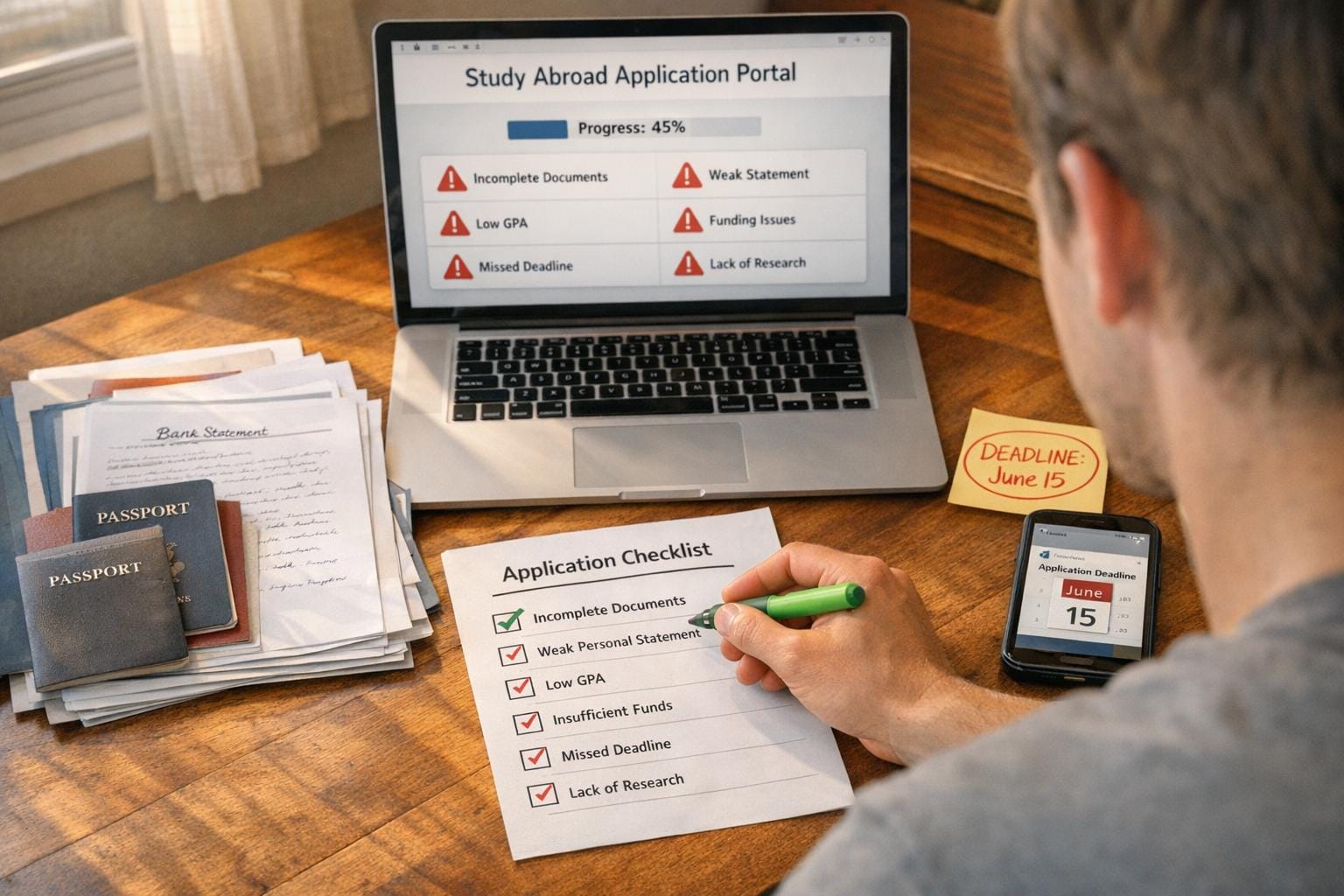
Studying abroad is a dream for many, but simple mistakes can derail your plans. In 2024, visa rejection rates were alarmingly high - 52% for Canada and 47% for U.S. F-1 visas. For South Asian applicants, rejections reached up to 80%. These denials often stem from avoidable errors, not a lack of qualifications. From missing documents to weak essays, these mistakes can cost you time, money, and opportunities. Worse, a visa rejection becomes a permanent record, complicating future applications.
To help you succeed, here’s a breakdown of six common application pitfalls and how to avoid them:
- Incomplete Documentation: Missing even one document can lead to rejection. Ensure all forms, translations, and financial proofs are accurate and up-to-date.
- Weak Essays (SOP): A generic or poorly written Statement of Purpose can hurt your chances. Tailor it to show how the program aligns with your goals.
- Missed Deadlines: International universities are strict about application and visa deadlines. Plan 12–18 months ahead to stay on track.
- Financial Errors: Sudden large deposits ("fund parking") can raise red flags. Maintain steady financial records for 3–6 months before applying.
- Lack of Research: Failing to understand a program or university’s requirements can result in rejection. Research thoroughly and align your goals with the institution.
- Poor Interview Prep: Inconsistent answers or lack of confidence during visa interviews can lead to denial. Practice common questions and align responses with your application.
Avoiding these mistakes requires careful planning, attention to detail, and sometimes professional guidance. Platforms like scale.jobs provide personalized support, from document reviews to interview preparation, ensuring your application stands out. With proper preparation, you can improve your chances of turning your study abroad dreams into reality.
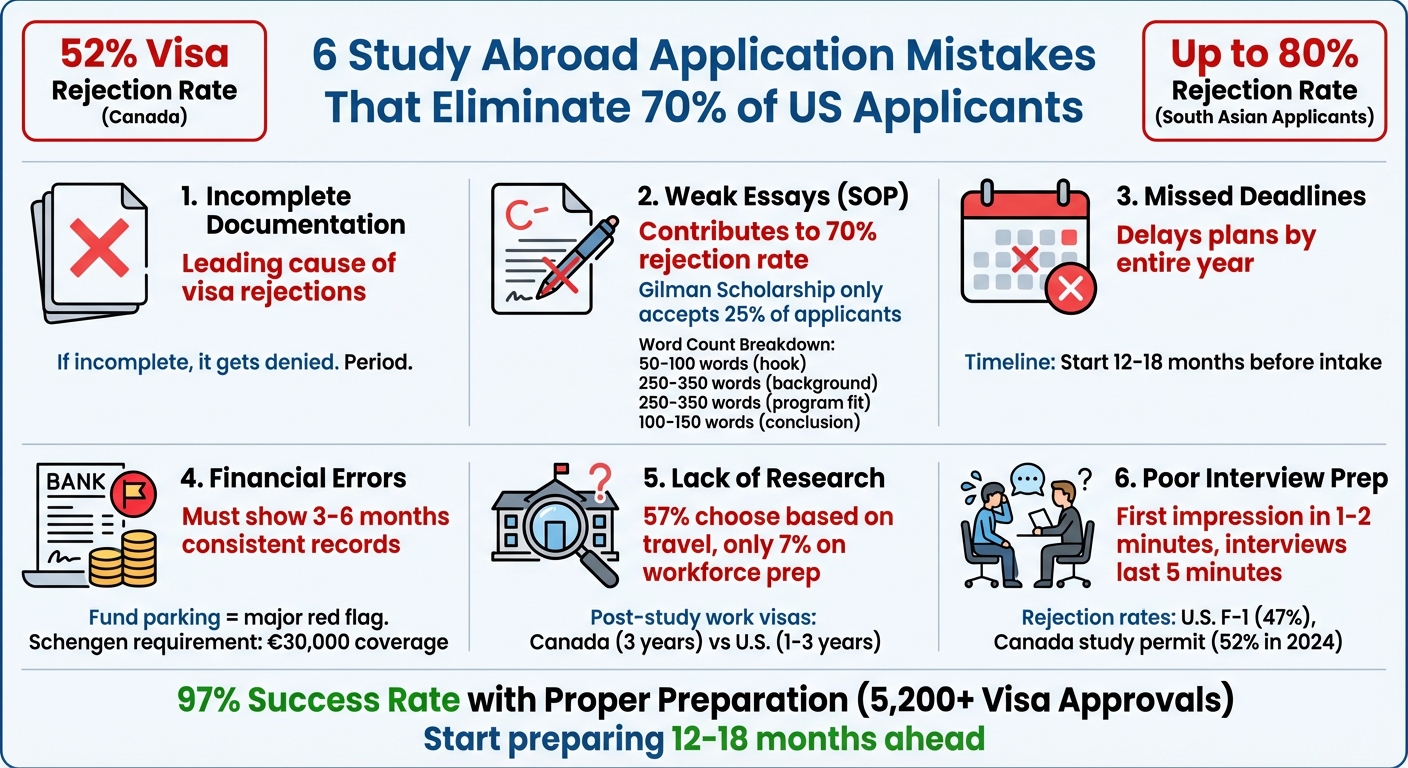
6 Study Abroad Application Mistakes and Their Impact on US Applicants
1. Incomplete Documentation
Impact on Application Success Rate
Even one missing document can jeopardize months of preparation. In fact, incomplete paperwork is one of the leading reasons for visa rejections. Immigration officers, tasked with reviewing hundreds of applications daily, won’t reach out to request missing items. As OpenVisa bluntly puts it:
"If your application is incomplete, it gets denied. Period." – OpenVisa
This reality underscores the importance of thoroughness. In some cases, applications may enter administrative processing - such as receiving a US 221(g) notice - which could delay decisions for weeks or even months, even if the application isn’t outright rejected.
Relevance to Study Abroad Process
For study abroad applicants, the stakes are even higher due to specific requirements. For instance, in the U.S., your passport must remain valid for at least six months beyond your planned return date. Many applicants overlook this detail, so it’s wise to check your passport’s expiration date at least eight months before traveling. Additionally, any documents not in English require certified translations, complete with verifiable translator credentials. Self-translations or automated tools like Google Translate are not accepted.
Financial documentation is another common stumbling block. Bank statements should be no older than one month at the time of your appointment. Immigration officers are trained to flag sudden, large deposits - known as "fund parking" - and instead look for consistent records spanning 3–6 months.
If you’re applying for a Schengen visa, the requirements become even more specific. Travel insurance must cover at least €30,000, be valid across all 27 Schengen countries, and include repatriation coverage. Other frequently overlooked documents include police clearance certificates, medical examination reports, and official score reports for English proficiency tests like IELTS or Duolingo (the latter costs $70 USD per test).
Practical Solutions to Avoid the Mistake
To avoid falling into this trap, take proactive steps to ensure your documentation is flawless. Start by using the official checklist provided by your university or the immigration portal of your destination country. Relying on advice from friends or outdated forums can lead to errors. Filling out a dummy application form ahead of time can also help you understand the process and avoid last-minute mistakes.
Keep digital copies of all your documents on hand so you can quickly resend them if needed. Double-check that names, dates, and passport details are consistent across all forms - small inconsistencies can raise red flags. When submitting financial records, ensure they reflect steady income over several months rather than isolated large deposits. For travel insurance, add a few extra days of coverage to account for unexpected delays. Lastly, confirm that any required payments or fee waiver documents are included, as missing fees often result in automatic rejections.
Next, we’ll examine how poorly crafted essays can further hinder your study abroad application.
2. Weak Essays and Statement of Purpose
Impact on Application Success Rate
A poorly written Statement of Purpose (SOP) can seriously hurt your chances of acceptance, even if the rest of your application is strong. It’s one of the six major mistakes that contribute to a staggering 70% rejection rate. Admissions committees often weigh your SOP heavily, sometimes even more than your GPA. A well-crafted, personalized essay can be the deciding factor that secures your spot. On the other hand, a weak SOP can result in rejection, even for candidates with impressive qualifications. For instance, in highly competitive programs like the Gilman Scholarship, where only about 25% of applicants are accepted, the essay often serves as the ultimate tie-breaker. Unlike LazyApply, scale.jobs offers human-assisted revisions to refine your SOP, increasing your chances of acceptance.
Relevance to Study Abroad Process
Your SOP isn’t just another requirement - it’s your chance to show why you’re a perfect match for a specific program. Admissions committees use it to assess your genuine interest in their institution and how you stand out beyond test scores or grades. A strong SOP demonstrates not only your academic and professional goals but also why the program aligns with your aspirations.
Practical Solutions to Avoid the Mistake
A compelling SOP can set you apart in a competitive applicant pool. To craft a standout essay, follow these practical steps:
- Break down the prompt: Carefully address every part of the question, including your background, academic goals, and career aspirations. Missing even one element could weaken your application.
- Follow a structured format:
- 50–100 words: Start with a personal hook that grabs attention.
- 250–350 words: Highlight your academic background and achievements.
- 250–350 words: Explain why you’re drawn to the program, mentioning specific faculty, research opportunities, or unique features.
- 100–150 words: Conclude with a clear link between the program and your career goals.
Avoid generic templates. Admissions committees can easily spot cookie-cutter essays, which rarely leave a positive impression. As VisaSolutions4u advises:
"Generic or cookie-cutter personal statements are unlikely to make a favorable impression on admissions committees."
Instead, use the STAR method (Situation, Task, Action, Result) to showcase specific experiences and their outcomes. This approach adds depth and clarity to your narrative. If you’re finding it hard to create a polished essay, consider using professional resume and essay writing services. These services can help you organize your story effectively while keeping your voice authentic.
scale.jobs vs. LazyApply for Essay Development
- scale.jobs: Offers personalized narrative development, ATS-friendly documents, and direct WhatsApp support for real-time assistance.
- LazyApply: Provides mostly automated essay tips with minimal human input, which may not address individual needs effectively.
To ensure your SOP is the best it can be, start drafting it 4–6 months before the deadline. This timeline allows for multiple revisions and ample feedback. Have someone unfamiliar with your program review your essay; if they find any part unclear, revise it. Additionally, avoid idioms and double-check for grammar and spelling errors - these small mistakes can make a big difference, signaling a lack of attention to detail to admissions officers.
Up next, we’ll explore how missing deadlines can further derail your study abroad plans.
3. Missing Application Deadlines
Impact on Application Success Rate
Missing an application deadline often leads to an immediate rejection. International universities are particularly strict about cutoff dates - being even a day late can disqualify you, regardless of your academic achievements or test scores. Unlike some U.S. schools with rolling admissions, most international programs stick to fixed intake schedules, usually for Fall or Spring. Missing these dates means delaying your academic plans by an entire year.
The ripple effects don’t stop with admissions. Scholarship deadlines, which often close months earlier, housing applications, and visa appointments all have their own strict timelines. Missing one of these can derail your entire plan. The already complex process of applying to international programs - gathering documents, coordinating with institutions across time zones, and managing multiple deadlines - becomes even more challenging without proper time management.
Relevance to Study Abroad Process
Applying to study abroad is a lengthy process, often spanning 12–18 months. It involves tracking deadlines for Early Decision (November–December), Regular Decision (January–March), scholarships, housing, and visa appointments. Many U.S. applicants underestimate how long it takes to collect international documents, obtain official transcripts, or secure recommendation letters from professors. As Vihaan Overseas aptly points out:
"Missing deadlines for study abroad applications is one of the most heartbreaking mistakes. Unlike Indian [or domestic] universities, international institutions are strict about deadlines."
Time zone differences add another layer of complexity. For instance, a deadline listed as "March 1" on a UK university’s website refers to March 1 in GMT, not EST. If you're applying from the East Coast, this could mean losing five critical hours.
Practical Solutions to Avoid the Mistake
To avoid missing deadlines, start planning 12–18 months before your intended intake date. This allows you to handle unexpected delays, such as waiting for sealed transcripts or retaking a standardized test. Use tools like Google Calendar, Notion, or Trello to create a master checklist and track every step of the process.
Adopt the "Buffer Week" rule: aim to submit all materials at least one week before the official deadline. This accounts for potential technical issues, mail delays, or last-minute document requests. For letters of recommendation, give your professors 6–8 months' notice to ensure they have sufficient time to craft strong endorsements.
A structured timeline can help you stay on track:
| Task | Recommended Timing (Months Before Intake) |
|---|---|
| Research and shortlist universities | 12–18 months |
| Begin English proficiency prep (IELTS/TOEFL) | 10–12 months |
| Take standardized tests (GRE/GMAT/IELTS) | 8–10 months |
| Request letters of recommendation | 6–8 months |
| Draft and refine Statement of Purpose (SOP) | 4–6 months |
| Submit formal applications | 2–4 months |
| Apply for student visa | 1–3 months |
Additionally, ensure that you request official or digitally verified transcripts, not just PDF copies. Many universities reject unofficial documents, which could force you to resubmit and potentially miss the deadline. If managing this timeline feels overwhelming, consider working with a job search virtual assistant or professional application service to stay organized and avoid critical errors.
Next, let’s explore how financial and visa documentation errors can disrupt even the most well-timed applications.
4. Insufficient Financial and Visa Documentation
Impact on Application Success Rate
Errors in financial and visa documentation are a common reason for study abroad rejections, often derailing plans that have been in the works for years. One major pitfall to avoid is "fund parking", which refers to the sudden deposit of large sums into your account just before applying. Visa officers typically review 3–6 months of financial activity, and as OpenVisa points out:
"Fund parking - suddenly depositing large sums before applying - is a major red flag for almost every country."
Another critical detail is ensuring your passport's validity. It must remain valid for at least six months beyond your planned return date. For example, if you’re completing a two-year program in May 2028, your passport should be valid through November 2028. Overlooking this requirement can lead to automatic rejection, regardless of the strength of the rest of your application.
Relevance to the Study Abroad Process
Financial documentation serves more than one purpose. It not only proves you can afford tuition and living expenses but also helps visa officers assess whether you have strong ties to your home country, such as property ownership, stable employment, family obligations, or business interests. Without clear evidence of these ties, officers might assume you're likely to overstay your visa, leading to denial.
Just as a well-crafted Statement of Purpose (SOP) can set you apart, solid financial documentation demonstrates your reliability and intent to comply with immigration rules.
Visa requirements often go beyond a simple bank statement. For example, Schengen countries require medical insurance with at least €30,000 (about $32,000 USD) coverage, including emergency medical evacuation and repatriation. In the U.S., applicants must pay the SEVIS fee, and starting October 1, 2025, the Visa Integrity Fee will also apply. Missing even one required fee can jeopardize your application.
Additionally, only official, sealed, or digitally verified documents are accepted. Outdated or unofficial copies will be rejected, and non-English documents must be professionally translated. Automated translations or unofficial versions won’t be accepted.
Practical Solutions to Avoid the Mistake
To avoid these pitfalls, take proactive steps to ensure your financial and visa documentation is airtight.
- Build a financial trail early: Start maintaining consistent bank balances 3–6 months before applying. If you receive a large gift or loan for tuition, include a sponsorship letter detailing the source, supported by documentation from the sponsor's bank.
- Check your passport’s validity: If your passport expires within eight months of your planned return date, renew it immediately. This small step can save you from unnecessary rejections and complications.
- Create a detailed budget: Factor in tuition, housing, meals, health insurance, textbooks, local transportation, and currency fluctuations. For instance, studying in the UK can cost between £29,500 and £66,000 (around $37,000–$83,000 USD) annually, depending on the program and location. Underestimating these costs might signal poor planning, leading to rejection.
- Keep documents current: Bank statements should be no older than 30 days at the time of your visa appointment, and employment letters should be dated within two weeks. Services like scale.jobs can help verify and organize your documentation to minimize errors.
- Be transparent about past issues: Always disclose previous visa rejections or overstays. Immigration databases are often interconnected, and misrepresenting your history is considered fraud, which can result in permanent bans. Transparency, even about past mistakes, is far less damaging than trying to hide them.
5. Inadequate Program and University Research
Impact on Application Success Rate
Neglecting thorough research on programs and universities can derail your study abroad plans. Admissions committees and visa officers often see insufficient research as a red flag, signaling a lack of genuine intent or commitment. Even if you meet all the academic criteria, a poorly aligned statement of purpose can lead to rejection. Generic applications or essays that fail to showcase a clear connection between your goals and the institution's offerings stand out for all the wrong reasons.
Selecting a program based solely on its prestige or location - without understanding its curriculum, career pathways, or support services - can have long-term consequences. Beyond risking rejection during the application process, this lack of preparation may leave you unprepared for the job market after graduation. Universities value applicants who demonstrate a deep understanding of their programs and a clear vision for how these align with their future aspirations.
Relevance to the Study Abroad Process
Effective research goes beyond recognizing a university's name. It involves verifying eligibility criteria, assessing academic compatibility, and considering practical aspects like living costs, climate, and post-graduation work opportunities. Missing even a single requirement can result in automatic rejection.
For instance, Canada offers a 3-year post-study work visa, while the U.S. provides 1–3 years, depending on the field of study. Similarly, the UK's temperate climate differs significantly from Australia's warmer weather, which could influence your daily life. These details matter when planning your study abroad experience, and they can shape not just your application but also your overall satisfaction and success.
Practical Solutions to Avoid the Mistake
To avoid these pitfalls, start your research 12–18 months before your intended intake. Begin by outlining your priorities, such as your preferred subject, budget, city size, and climate. Use reliable sources like official university websites, alumni networks, and established ranking platforms to gather accurate information.
When evaluating programs, focus on factors like graduate employment rates, industry connections, and research opportunities. A surprising 57% of students choose colleges based on international travel options, while only 7% prioritize preparing for a global workforce. As MPOWER Financing highlights:
"Choosing a program solely based on reputation may leave you with limited job opportunities in your field. Recruiters and employers look for relevant skills and industry fit, not just a university name."
Engage with alumni to gain honest insights into the program and its career support services. Pay attention to details like subject prerequisites, credit transfer policies, and hidden costs, such as visa fees or local transportation expenses. While tools like LazyApply can provide basic information, platforms like scale.jobs offer expert guidance to help you turn your research into a compelling, tailored application. If the process feels overwhelming, consider working with professionals who specialize in application support, much like how resume writing services assist job seekers in crafting role-specific documents. Taking these steps ensures that your application stands out for all the right reasons.
6. Lack of Interview and Follow-Up Preparation
Impact on Application Success Rate
Even the most polished application materials can falter if your interview performance doesn’t match up. Consular officers and program directors often form their impressions within the first 1–2 minutes of meeting you, and most interviews are wrapped up in just 5 minutes. To put things into perspective, the US F-1 student visa rejection rate is about 47%, while Canada's study permit refusal rate reached 52% in 2024. A significant number of these rejections aren’t due to academic shortcomings but rather poor interview preparation.
One of the biggest pitfalls is inconsistency between your verbal answers and the details in your written application. For instance, if your DS-160 form describes you as a senior software engineer, but you casually tell the officer you "dabble in IT", it immediately raises doubts about your credibility. As OpenVisa aptly puts it:
"Inconsistencies kill applications."
Another common issue is failing to demonstrate strong ties to your home country. Consular officers are particularly cautious about applicants who might not return after their studies. If you can’t point to family connections, property ownership, or a clear career path back home, your application may be at risk. This highlights the importance of thorough preparation for both interviews and follow-ups, as even a strong application can falter without it.
Relevance to the Study Abroad Process
The interview is your opportunity to prove that you’re a serious student with clear academic goals. Officers will scrutinize whether your verbal answers align with your DS-160 form and other documents. Any discrepancies can undermine your credibility. For example, focusing too much on part-time work opportunities instead of your educational objectives can create the impression that academics aren’t your priority, leading to a rejection.
Follow-up preparation is just as crucial but often overlooked. Many applicants assume their work is done after the interview, but failing to check emails or respond to requests for additional documentation can delay or derail the process. Forgetting to bring required original documents to a visa interview can result in processing delays, additional interviews, or even outright denials. Just as poorly written essays can hurt your chances, a weak interview can reinforce any doubts already present in your application.
Practical Solutions to Avoid the Mistake
Here are some strategies to help you avoid these common pitfalls:
- Review your application materials: Go over your visa application and Statement of Purpose before the interview. Make sure your verbal answers align with everything you’ve submitted in writing. Practice answering typical questions like why you chose a particular country, how you plan to fund your education, and what your post-graduation plans are. Using the STAR method (Situation, Task, Action, Result) can help you structure your answers in a clear and concise way.
- Prepare for online interviews: Test your technology setup at least 24 hours before the interview to avoid last-minute issues. Dress in formal business attire and maintain strong eye contact to convey confidence and sincerity.
- Seek professional help: If you’re unsure how to align your responses with your documentation, consider consulting experts who specialize in application support, much like how resume writing services assist job seekers in crafting tailored materials.
After the interview, don’t assume the process is complete. Proactively confirm with admissions offices that all required documents have been received. Keep an eye on scholarship timelines and follow up if deadlines pass without updates. Check your email - including spam folders - daily for any requests for additional information. If you receive a 221(g) slip during a US visa interview, remember that it’s not an outright rejection. It’s a request for additional documentation or administrative processing, and you typically have one year to provide the necessary materials.
For those seeking personalized coaching to navigate interviews, scale.jobs offers hands-on support that goes beyond automated tools like LazyApply. Up next, we’ll explore how scale.jobs compares to competitors like LazyApply in delivering comprehensive interview preparation.
5 Mistakes Students Make While Applying to Study Abroad (And How to Avoid Them) | Project Ivy
Tool Comparison: How scale.jobs and Competitors Handle Application Mistakes
When it comes to job applications - especially for international students managing visa sponsorships - attention to detail and meeting deadlines are critical. Platforms like LazyApply and Find My Profession aim to simplify the process, but their approaches differ significantly. This comparison highlights why scale.jobs' human-assisted method stands out, particularly in avoiding common application errors.
LazyApply vs scale.jobs: Why a Human-Powered Approach Matters
LazyApply automates the application process, relying entirely on bots to submit forms. However, with a Trustpilot rating of just 2.1, users frequently report issues like forms freezing mid-submission and poor customer support. Its AI-generated templates often fail to meet the demands of complex application systems, making it a risky choice for anything beyond basic submissions.
On the other hand, scale.jobs takes a hands-on approach, leveraging trained human virtual assistants to manually handle every application. Whether it's navigating corporate ATS systems or specialized forms, their team ensures accuracy and compliance. The service also provides real-time updates via WhatsApp, complete with time-stamped screenshots for transparency. Unlike LazyApply's recurring subscription model, scale.jobs offers a flat-fee structure (starting at $199 for 250 applications), with refunds for unused credits, making it both reliable and cost-effective.
Here’s a quick breakdown of their differences:
| Feature | LazyApply (AI-Only) | scale.jobs (Human-Hybrid) |
|---|---|---|
| Human Involvement | Minimal; fully automated submissions | Dedicated human virtual assistants complete every form |
| Resume Customization Depth | Generic, AI-generated templates | ATS-optimized, personalized documents by professionals |
| ATS Handling | Struggles with complex portals; prone to errors | Expert human oversight ensures compliance |
| Execution Method | Automated submissions, often incomplete | Manual form completion for nuanced requirements |
| Transparency & Proof-of-Work | Limited tracking metrics | Real-time WhatsApp updates with submission logs |
| Pricing Model | Monthly subscriptions | One-time flat fee ($199–$1,099) with refund options |
Who Might Prefer LazyApply
- Applicants handling straightforward submissions that don’t require much customization.
- Those comfortable with a fully automated system, even if occasional errors occur.
- Users seeking high-volume applications and willing to manage follow-ups independently.
Why scale.jobs Is the Better Choice
- Ideal for applicants needing tailored, ATS-optimized documents with consistent human oversight.
- Perfect for international students managing intricate processes like study permits or OPT renewals.
- Offers peace of mind with real-time updates and proof of submission through screenshots.
- Appeals to those who dislike recurring subscription fees and prefer a one-time payment model.
Why You Should Consider Switching to scale.jobs
- If you've experienced bot-related errors or incomplete submissions with other platforms.
- When dealing with complex, multi-step application systems that require precision.
- If you value real-time tracking and clear proof of successful submissions.
- For time-sensitive applications or those involving visa-related documentation.
- To avoid unpredictable costs with a straightforward flat-fee pricing structure.
Final Thoughts
LazyApply may work for simple, high-volume submissions where human oversight isn’t essential. However, if you're managing complex applications, need customized documents, or have faced issues with errors and missed deadlines in the past, scale.jobs offers a more reliable and transparent solution. Its human-powered approach ensures every detail is handled with care, making it a strong choice for anyone serious about their job search success.
Wrapping It Up
After looking at how common application mistakes can be tackled with the right tools, it’s easy to see why scale.jobs stands out compared to competitors like LazyApply. The six issues highlighted earlier - incomplete documentation, weak essays, missed deadlines, insufficient financial proof, poor research, and lack of interview preparation - are often the reason behind study abroad rejections for U.S. applicants. These denials are frequently caused by avoidable errors rather than a lack of qualifications. As MPOWER Financing aptly puts it:
"A single missed date can derail months of preparation."
Students who proactively address these challenges often see much better outcomes. For instance, Vihaan Overseas reported a 97% success rate, with over 5,200 visa approvals as of June 2025. This success came from helping more than 14,200 students sidestep common mistakes through structured support, SOP reviews, and effective time management.
To simplify your own application journey, start preparing 12–18 months ahead. Use a master calendar to organize test dates (like IELTS, PTE, or the $70 Duolingo English Test), document submissions, and visa appointments. Ensure your transcripts are official and your bank statements reflect consistent balances over 3–6 months to avoid concerns like "fund parking." When writing essays, apply the STAR method (Situation, Task, Action, Result) to create meaningful narratives that show why you’re a great match for your program.
By tackling these potential pitfalls early, you not only improve your chances of acceptance but also make the entire process smoother and clearer - exactly where scale.jobs excels.
Comparing Your Options
Our detailed review of LazyApply and other tools highlights how scale.jobs delivers when precision and personalized support are priorities.
Choose scale.jobs if you need:
- Hands-on review for every application to ensure accuracy and compliance
- Documents optimized for ATS and tailored to specific program requirements
- Real-time WhatsApp support with submission proof for peace of mind
- Transparent, one-time payment options with refunds for unused credits
- Expert help with complex processes like visa applications
Opt for LazyApply if:
- You’re managing simple, high-volume submissions without needing customization
- You’re fine with fully automated systems and can handle occasional errors
- A subscription model fits better within your budget
FAQs
What should I do if I get a 221(g) notice?
A 221(g) notice indicates that your visa application needs further review or additional documentation. Carefully review the instructions provided in the notice and submit any required materials as soon as possible. Processing times can differ, so it’s important to remain patient and monitor your application status through official government channels. If the process takes longer than expected or you're uncertain about what to do next, consider seeking advice from a legal professional. They can help clarify your options and ensure you meet all immigration requirements.
How can I explain a large deposit without a visa denial?
When dealing with a large deposit in your account, it's crucial to provide clear documentation and a straightforward explanation of its origin to avoid any issues with your visa application. Supporting evidence such as bank statements, gift letters, or proof of sale can help clarify the source of the funds. For instance, if the deposit comes from an inheritance, a property sale, or a family gift, include concise details about the transaction.
Make sure all documents are consistent and properly aligned with the explanation you provide. Submitting this information alongside your application shows transparency and helps address any concerns about the legitimacy of the funds.
How can I prove I’ll return to the U.S. after studying?
To show your commitment to returning to your home country after studying in the U.S., it's important to provide evidence of strong connections to your home. This can include financial ties, such as owning property or having ongoing employment commitments, as well as personal responsibilities, like family obligations or active community involvement. Additionally, a well-written statement of purpose that clearly outlines your post-study plans can add credibility to your case. Be cautious about potential red flags, such as unexplained large deposits in your financial records or an inconsistent travel history, as these may raise concerns during the review process.