
Teal vs Scale.jobs: Free Tool vs Concierge Service

Sarah Mitchell
July 28, 2026

If I had to sum it up in one line: Teal helps me track my job search, while Scale.jobs helps me send applications.
If I’m choosing between them, I’m deciding between:
- a self-serve tool for tracking and editing
- a done-for-you service for submitting applications
- a free or subscription-style software path vs one-time campaign pricing
- manual work vs human help
A few numbers stand out right away:
- 5 free applications with Scale.jobs
- $199 for 250 applications
- $299 for 500 applications
- $399 for 1,000 applications
If I want control, Teal fits. If I want help getting applications out each week, Scale.jobs fits better.
Teal Product Review And Demo | Tailored Resumes With AI - Worth it?
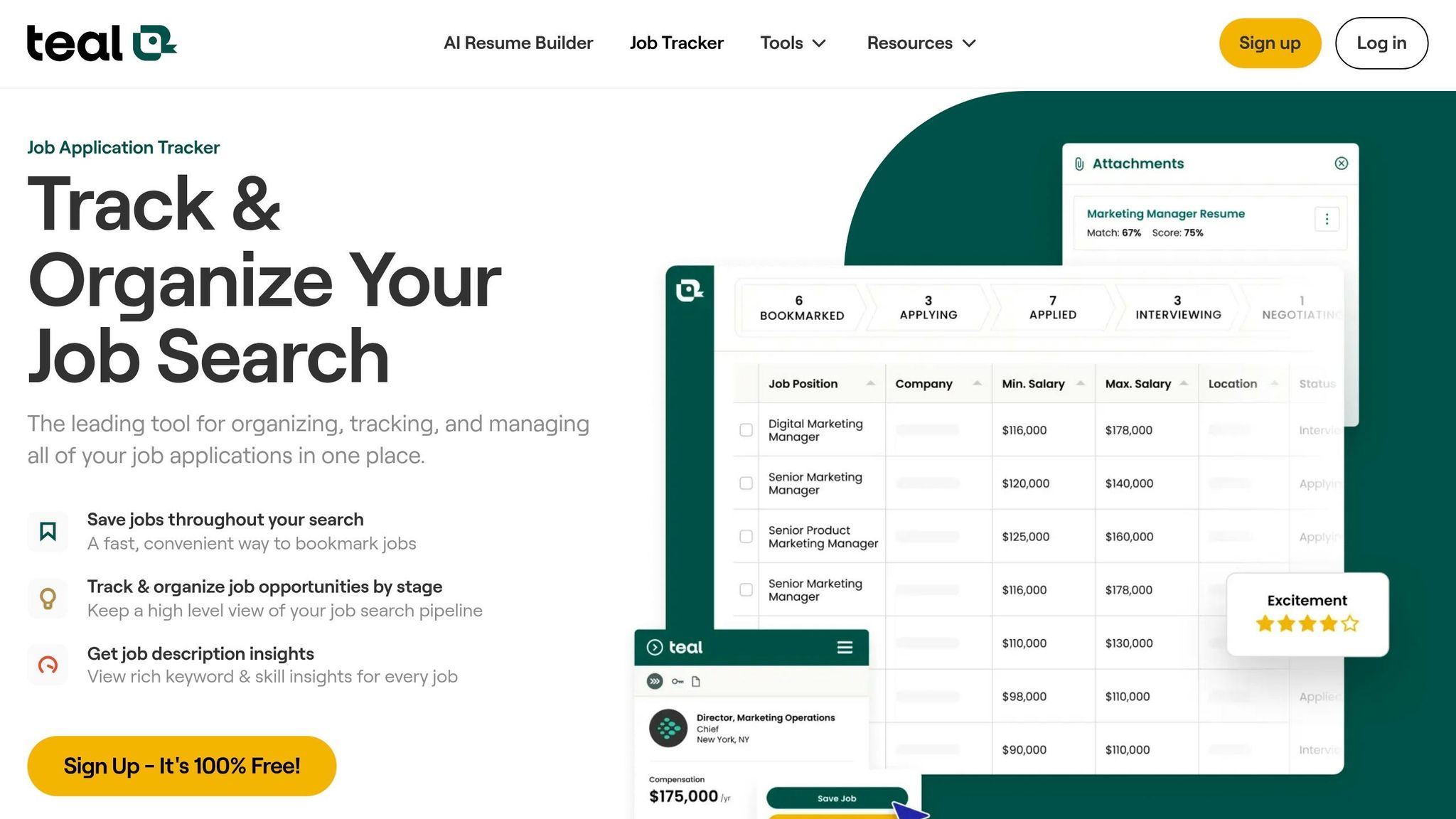
Quick Comparison
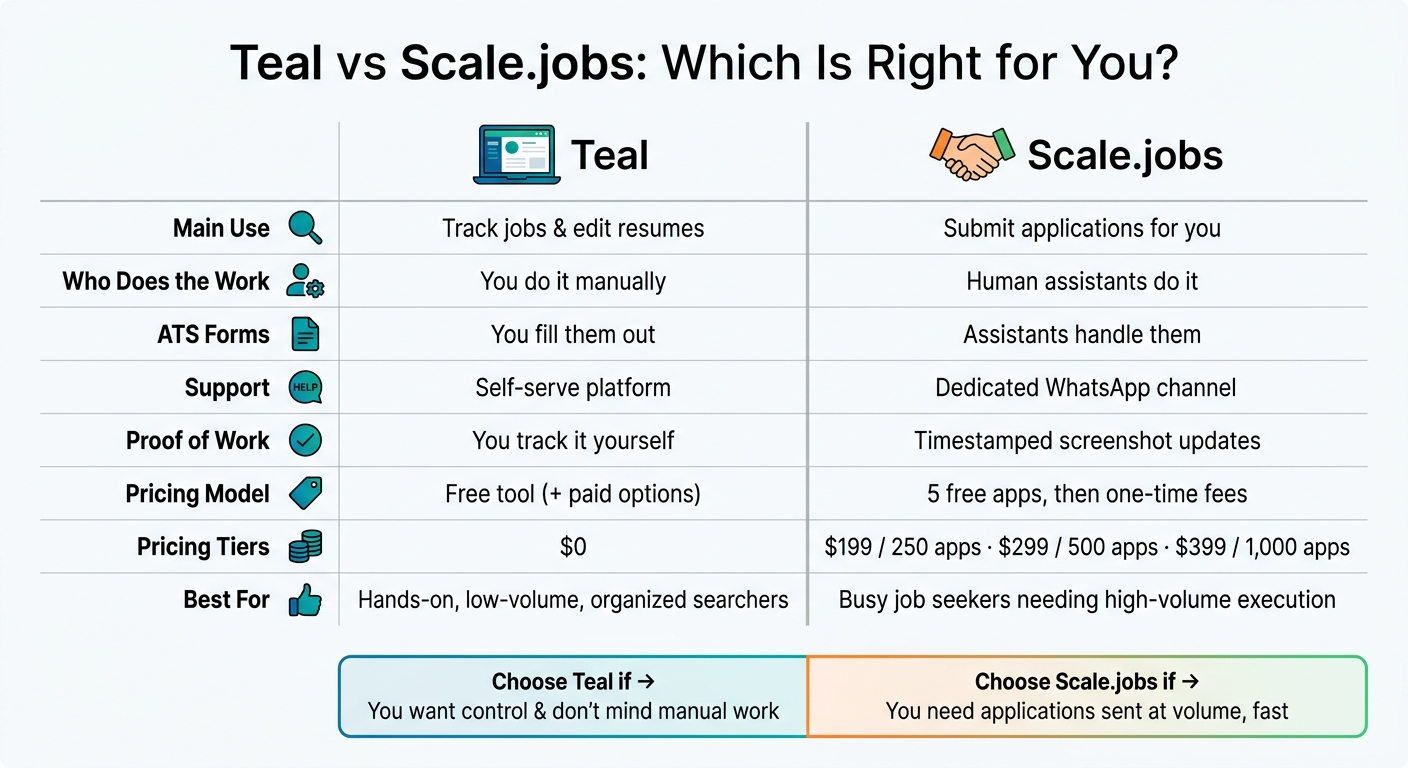
Teal vs Scale.jobs: Side-by-Side Comparison for Job Seekers
| Criteria | Teal | Scale.jobs |
|---|---|---|
| Main use | Track jobs and edit resumes | Submit applications for me |
| Who does the work | I do it | Human assistants do it |
| ATS forms | I fill them out | Assistants handle them |
| Support | Self-serve | WhatsApp support |
| Proof of work | I track it myself | Screenshot updates |
| Pricing | Free tool, plus paid options | 5 free apps, then one-time fees |
My take
I’d use Teal if I want to stay hands-on and keep my own system. I’d use Scale.jobs if the hard part is no longer finding roles, but making sure I actually Apply for jobs on time and at volume.
Teal vs Scale.jobs: what changes day to day
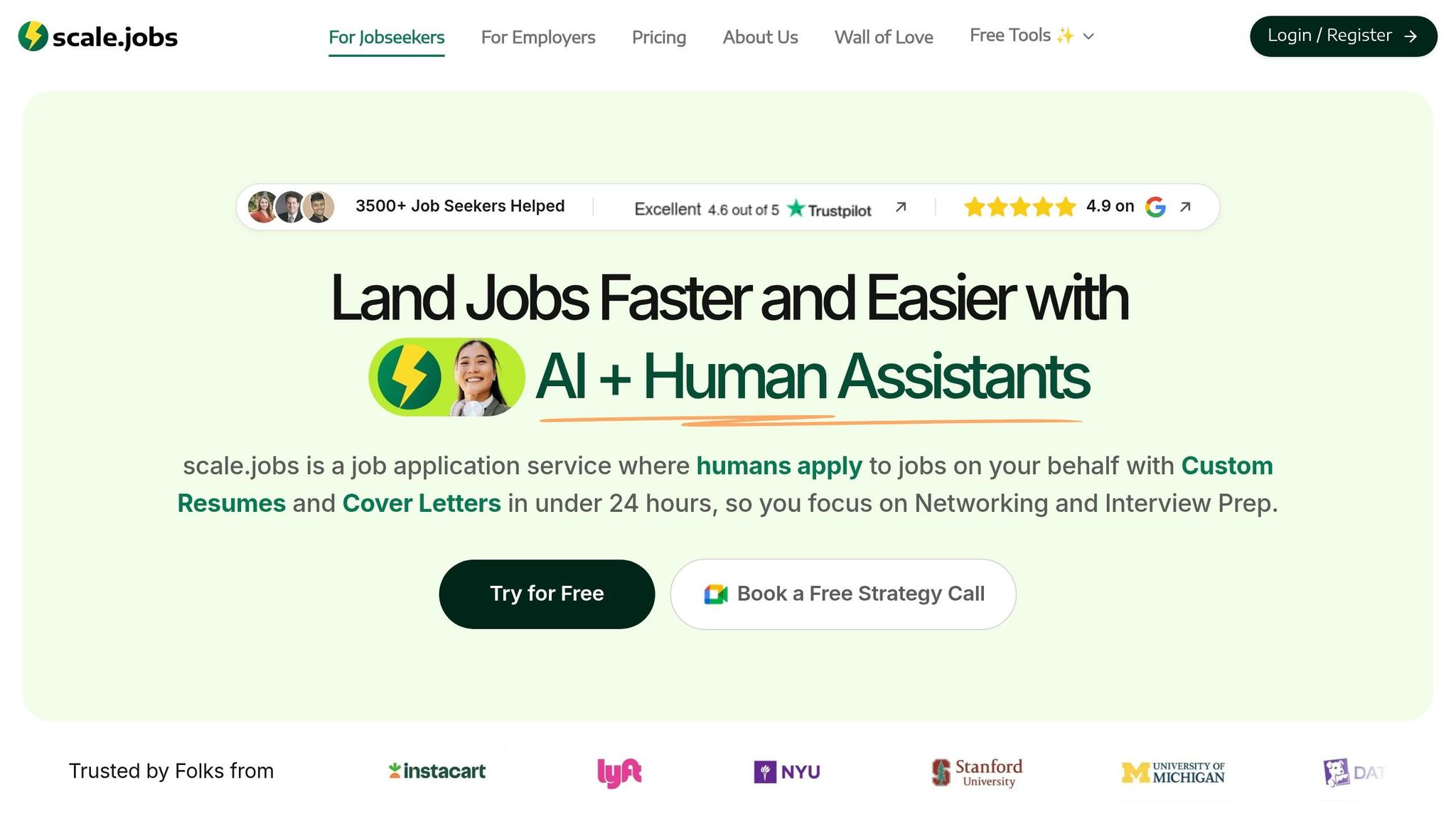
The biggest difference is simple: who is doing the repeat work?
With Teal, I save roles, edit resumes, track status, and submit each form myself. That can work if I’m applying to a small number of roles each week.
With Scale.jobs, I pick the roles and hand off the submission work. That matters if I’m applying across many company sites, ATS portals, and niche listings from the best job boards.
If my search keeps slowing down after I build a shortlist, this is often the split that matters most.
Is Teal worth it?
Yes, if I want a tracker and I’m still willing to do the application work myself.
Teal makes sense for me when:
- I want to track every job in one place
- I like editing resume versions myself
- I’m still testing titles, industries, or levels
- I’m not applying at high volume yet
It’s a fit for people who want software, not a job application service.
Is Scale.jobs worth it?
Yes, if I keep falling behind on submissions.
Scale.jobs makes more sense for me when:
- I already know the roles I want
- I need help sending a lot of applications
- I’m short on time because of work or interviews
- I want updates without opening every portal myself
- I’d rather pay once than add another monthly tool
If I’m aiming at many full time jobs or even mixing in searches like Part time jobs near me, handing off form-filling can save hours each week.
My simple decision framework
I use this 3-step check:
1. I ask where my search is breaking
If I’m not finding roles, I may need a better job search platform or a tighter search plan.
If I’m finding roles but not submitting them, the problem is execution.
2. I check my weekly volume
If I’m sending only a few applications each week, Teal may be enough.
If I’m trying to send dozens or even hundreds over time, manual work starts to pile up fast.
3. I look at my time
If I have time to tailor, fill forms, and track every status, Teal is fine.
If I don’t, a Virtual Assistant for Job Applications or job search virtual assistant setup may fit better.
sbb-itb-564272e
A quick workflow example
Here’s how I think about it in practice:
Scenario 1: Teal fits I’m early in my search. I’m testing job titles, changing my resume a lot, and applying to 5 to 10 roles a week. I want control over every submission.
Scenario 2: Scale.jobs fits I already know my target roles. I have interviews, networking calls, and limited time. I need applications sent out each day, not just tracked on a dashboard.
That’s where a virtual assistant for job seekers can help more than another tracker.
My shortlist: who should pick which?
I’d pick Teal if:
- I want a free tracking system
- I prefer doing applications myself
- I need help staying organized
- I’m still shaping my target role
I’d pick Scale.jobs if:
- my tracker looks neat but my output is low
- I keep delaying ATS forms
- I want screenshot proof of submissions
- I need human help to keep pace
FAQ
What is the main difference between Teal and Scale.jobs?
Teal is a self-serve tool. Scale.jobs is a done-for-you submission service.
Does Teal submit job applications for me?
No. I still submit each application myself.
Does Scale.jobs have a free option?
Yes. The first 5 applications are free.
How much does Scale.jobs cost after the free trial?
It uses one-time pricing:
- $199 for 250 applications
- $299 for 500 applications
- $399 for 1,000 applications
Should I use Teal or Scale.jobs?
I’d use Teal if I want control and don’t mind the manual work. I’d use Scale.jobs if I need help getting applications sent out.
Final call
If I want software to organize my search, Teal is the better pick.
If I want human help to keep applications moving, Scale.jobs is the better pick.
That’s the whole decision: track it myself, or hand off the submission work.
How Teal and Scale.jobs work day to day
The main gap here isn’t the feature set. It’s who handles the repeat application work each day.
Teal: free tracking, resume tailoring, and manual application submission
Teal is built to help you track openings, save job posts, and tailor your resume. But when it’s time to apply, you still do the work yourself. That means saving roles with the browser extension, sorting them in the tracker, making resume edits, and then filling out each application by hand across company sites and ATS portals.
If you have a steady block of time each week, Teal can fit well. It gives you control and works for people who like a hands-on process. But when your calendar gets packed, the follow-through often slows down. That’s the tradeoff with many tools in the best job boards and tracking space: they help you stay organized, but they don’t take the submission work off your plate.
Scale.jobs: software, AI, and human application support in one place
Scale.jobs is a better fit when the problem isn’t finding jobs. It’s getting applications out the door.
You point the team to the roles you want. Then human assistants submit applications across ATS portals, specialty boards, and company career pages. You also get screenshots that show what was submitted and when. That matters more than it may seem at first glance. When you’re juggling interviews, a current job, or trying to Apply for jobs at volume, proof of work keeps the process clear.
Support runs through a dedicated WhatsApp channel, so communication stays direct and simple. In practice, this feels closer to a job application service than a self-serve tracker.
The first five applications are free. After that, Scale.jobs uses one-time campaign pricing:
- $199 for 250 applications
- $299 for 500 applications
- $399 for 1,000 applications
There’s no recurring subscription. For people looking at full time jobs or trying to cast a wider net across many roles, that pricing model can be easier to plan around than a monthly tool stack.
Where Scale.jobs beats Teal on execution
The day-to-day split is simple: Teal organizes. Scale.jobs executes.
Here’s the side-by-side view:
| Workflow Step | Teal | Scale.jobs |
|---|---|---|
| Human involvement | None; the user manages the full search and application process | Human assistants handle the submission phase |
| Resume customization depth | User-tailored versions | AI-optimized docs + human review |
| ATS handling | User manages ATS fields manually | Human-assisted submission with ATS-optimized docs |
| Application execution method | User submits each application manually | Human assistants submit applications |
| Transparency and proof of work | Manual updates in the dashboard | Proof-of-work screenshots via WhatsApp |
| Pricing model | Free tool, with premium subscription options | Free first five applications, then one-time campaign fee |
This is where the difference becomes practical, not just theoretical. If you want a dashboard and don’t mind doing the repetitive work yourself, Teal can do the job. If you want a Virtual Assistant for Job Applications or a job search virtual assistant to keep applications moving while you focus on interviews and targeting, Scale.jobs has the edge.
For job seekers who need steady application volume and don’t have time to manage every portal on their own, Scale.jobs removes the most repetitive part of the process.
Teal vs Scale.jobs: full comparison table
Teal is built for self-serve tracking. Scale.jobs is built for done-for-you execution. That’s the core difference.
If you want a tool to organize your hunt and keep tabs on roles, Teal fits that lane. If you want help to Apply for jobs at scale without doing each submission yourself, Scale.jobs takes a very different path.
Human involvement, ATS handling, and application execution
Here’s the side-by-side view for who does the work, how resumes are handled, and what happens inside ATS portals.
| Factor | Teal | Scale.jobs |
|---|---|---|
| Human involvement | None - user manages the entire process | Human VAs handle application submission |
| Resume customization depth | User tailors each version manually | AI-tailored resume for each posting |
| ATS handling | User fills ATS fields manually | Human-assisted submissions with ATS-optimized docs |
| Application execution method | User submits every application by hand | Human assistants submit across any portal or ATS |
The practical gap is pretty simple. With Teal, you stay in the driver’s seat for every step. You track jobs, edit materials, open portals, fill fields, and submit one by one. That can work well if you want full control and have time to spare.
Scale.jobs leans on a Virtual Assistant for Job Applications model. Instead of handling every ATS form yourself, human assistants take on the submission work. That matters when you’re applying across many company portals and don’t want the process to eat up your week.
Transparency, support channel, and pricing model
Support and pricing differ just as much as workflow. Scale.jobs shows timestamped proof-of-work screenshots in WhatsApp.
| Factor | Teal | Scale.jobs |
|---|---|---|
| Transparency and proof of work | Manual tracking by the user | Timestamped proof-of-work screenshots via WhatsApp |
| Support channel | Self-serve platform | Dedicated WhatsApp channel with direct assistant access |
| Pricing model | Free tool | First 5 applications free, then one-time campaign fees |
| Pricing example | $0 | $199 for 250 apps / $299 for 500 apps / $399 for 1,000 apps |
This is where the two products split even more. Teal gives you a free system for tracking and managing your own workflow. Scale.jobs acts more like a job application service, where support is tied to actual execution, not just software access.
The WhatsApp piece is also worth noting. For job seekers who want direct contact with a job search virtual assistant, that kind of support feels more hands-on than a standard self-serve dashboard.
If you’re comparing a tracker against a job search platform that also helps carry out submissions, this table tells the story pretty fast. Teal helps you stay organized. Scale.jobs helps move applications out the door.
Who should use Teal and who should choose Scale.jobs
Who should use Teal
After comparing the workflows, the main question is simple: who’s doing the repeat application work?
Teal makes sense if you want to stay in control of each submission, can apply on a steady schedule, and like a self-serve setup. If manual applications still fit into your week, Teal gives you a solid free way to stay organized while you apply for jobs.
Use Teal if you still want to manage the process yourself while you narrow down your target role. It can work well for people who are still testing job titles, changing resumes often, or figuring out which roles to pursue across different best job boards.
Who should choose Scale.jobs
If manual submission is the part slowing you down, Scale.jobs is the cleaner fit.
Scale.jobs makes more sense when manual applications no longer fit your schedule. If you were recently laid off and need faster turnaround, or if applications are eating up too many hours each week, human assistants can take over the submission work. That matters even more if you're aiming for a high-volume search across full time jobs or trying to keep momentum while interviewing.
It’s also a better option if you’d rather pay a one-time campaign fee than add another monthly bill. In that case, a done-for-you job application service can remove a lot of day-to-day friction.
Switch to Scale.jobs if your Teal workflow keeps breaking down
If Teal is keeping your search organized but not helping applications move out the door, that’s the signal. At that point, the issue usually isn’t tracking. It’s execution.
Here are the clearest signs it may be time to switch:
- You're tracking jobs in Teal, but submissions are still lagging. The bottleneck is getting applications done, not keeping a list.
- Applications are competing with work, interviews, or other commitments. Handing off the submission work can be more practical than trying to squeeze it in.
- You need human help to keep applications moving across portals. A self-serve tracker won’t submit for you, but a virtual assistant for job seekers can.
- You want proof-of-work updates instead of managing every step yourself. Scale.jobs adds WhatsApp communication and timestamped screenshots, which gives you more visibility without forcing you to do the clicking.
This is where the Teal vs Scale.jobs split becomes pretty clear. Teal is a tool for managing your search. Scale.jobs is built to help you execute it.
If your current system looks neat on paper but your actual output is slowing down, moving to a hands-on job search platform with human support may be the better call.
Decision summary: free software or paid execution support
After looking at workflow, support, and price, this decision comes down to one thing: are you running your search on your own, or do you need hands-on execution help?
Teal makes sense if you can stay on top of your search, track roles, and consistently apply for jobs by yourself. It’s a good fit for people who don’t mind managing the day-to-day work.
Scale.jobs fits when the hard part isn’t planning - it’s getting the applications out the door. If your search is organized but you still can’t keep up with manual submissions, that’s usually the signal that execution has become the bottleneck. In that case, a job application service or a Virtual Assistant for Job Applications can take that load off your plate.
Scale.jobs includes 5 free applications, then charges a one-time $199 for 250 applications. That pricing works well for job seekers who want direct help sending applications at volume without adding a monthly bill.
If Teal helps you organize your search but your submissions still lag, moving to Scale.jobs is the practical next step. That’s often where a job search virtual assistant or virtual assistant for job seekers becomes more useful than another tracking tool.