
UK Graduate Route Visa Rejected? Here's 5 Things You Need to Do Next

Sarah Mitchell
March 24, 2026

If your UK Graduate Route Visa application has been rejected, don't panic. Whether the decision was a refusal (eligibility issues) or invalid (procedural errors), there are clear steps you can take to address the situation. Here's what to do next:
- Understand the Rejection Letter: Carefully review the letter to identify the reasons for rejection and the available options, such as an Administrative Review or Tribunal Appeal.
- Act Quickly: Deadlines are strict - 14 days if you're in the UK or 28 days if you're outside.
- Choose the Right Path: Depending on the case, you might request a review, file an appeal, or reapply with stronger evidence.
- Fix Errors: Address the issues highlighted in the refusal, such as incomplete documents or inconsistencies.
- Explore Alternatives: Consider other visa routes like the Skilled Worker or High Potential Individual visas if reapplying is not feasible.
Each step requires careful planning and timely action. Missing deadlines or reapplying without fixing errors can lower your chances of success. This guide will walk you through the necessary steps to move forward effectively.
What to Do If Your UK Visa Is Refused (Guide For 2025)
Step 1: Review Your Rejection Letter Carefully
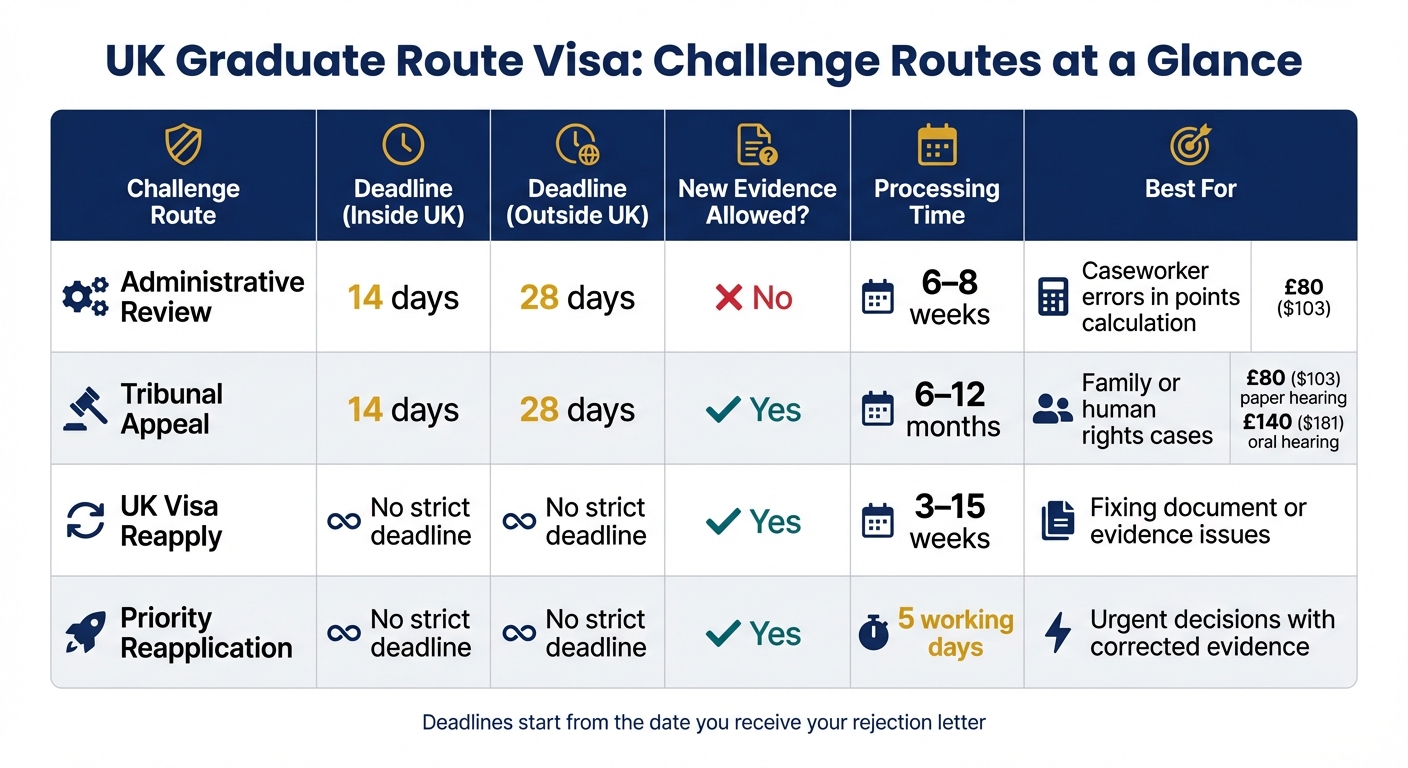
UK Graduate Route Visa Rejection: Challenge Routes Comparison Guide
Your rejection letter is more than just a document - it's the key to understanding your next steps. Typically sent via email, it's crucial to read it as soon as it arrives since deadlines begin counting down from the moment you receive it.
"The clock starts ticking the moment you receive that letter." – Wazir Solicitors
The letter will clarify whether you can challenge the decision. For Graduate Route visas, which are points-based, an Administrative Review is often an option. Missing the stated deadlines can eliminate your ability to contest the decision, leaving you with alternatives like submitting a fresh application or pursuing a more complex Judicial Review. Once you grasp the urgency, shift your focus to the reasons for the rejection outlined in the letter.
Find the Specific Reasons for Refusal
The "reasons" section of your rejection letter is where you'll uncover the exact cause of the decision. This might include errors like miscalculated points, missing documents, or misinterpretations of the rules.
Look for phrases indicating these issues, such as discrepancies in evidence, overlooked documents, or factual errors made by the decision-maker. These details will help you determine whether an Administrative Review is the right course of action or whether you'll need to address the problems before submitting a new application. Once you've identified the errors, the next step is to confirm your appeal deadlines.
Check Your Appeal Deadlines
Your rejection letter will outline whether you have the option to appeal or request an Administrative Review. Pay close attention to the timeline, which varies based on your location: 14 days if you're in the UK, 28 days if you're outside.
| Challenge Route | Deadline (Inside UK) | Deadline (Outside UK) | New Evidence Allowed? |
|---|---|---|---|
| Administrative Review | 14 days | 28 days | No |
| Tribunal Appeal | 14 days | 28 days | Yes |
If no appeal or review is possible, your only option may be to resolve the issues and reapply. Understanding these timelines and options is essential for planning your next move effectively.
Step 2: Request an Administrative Review
If the Home Office makes a mistake in processing your application, an Administrative Review can be your fastest way to address the issue. This process is available for the Graduate Route visa and is handled by an independent review team.
This option is effective when errors such as ignoring submitted evidence, misapplying Immigration Rules, or making a processing mistake occur. However, it’s important to note that you cannot introduce new documents or information that wasn’t part of your original application. As Joel Reiss from Latitude Law points out:
"Judicial review covers only the evidence that was available to the Home Office. You cannot add new evidence."
When to Use Administrative Review
Before proceeding, ensure your case fits the criteria for an Administrative Review. This process is appropriate when you can demonstrate that the decision-maker overlooked or misinterpreted evidence already included in your application. For example, if your application was denied due to "unexplained deposits" in your bank statements, but your financial documents clearly explained the source, this could qualify. Similarly, refusals citing "inconsistencies" in income despite employer letters addressing these points may also be eligible.
The review focuses on errors in law or fact - such as when the caseworker ignored relevant details, considered irrelevant ones, or made an unreasonable conclusion. If your situation requires presenting new evidence, it’s better to reapply instead of pursuing Administrative Review. Filing a review without a clear caseworking error is unlikely to succeed.
How to Submit Your Review Request
If you’ve identified a caseworking error, follow these steps to request a review. Use the official "Ask for a visa administrative review" form on GOV.UK to submit your application online. The fee for this process is $103 (£80). You’ll only receive a refund if the review overturns the original decision or if your application is deemed invalid. However, if the Home Office upholds its decision, the fee is non-refundable. Refunds, when applicable, are processed within three weeks.
Timing is critical. If you’re in the UK, you must submit your request within 14 calendar days (or 7 days if detained). If you’re overseas, you have 28 calendar days. Late submissions are rarely accepted unless the Home Office determines that rejecting them would be "unjust." Valid reasons for late submissions might include emergencies like hospital admissions.
If your visa permission was extended under Section 3C, filing an in-time Administrative Review allows you to maintain your immigration status until a decision is made. However, be cautious - filing a new visa application while your review is pending will automatically cancel your review request. To avoid complications, don’t submit both at the same time.
Step 3: File a Tribunal Appeal
If pursuing an Administrative Review isn't an option or you've already exhausted it, the next step is to escalate your case to the First-tier Tribunal (Immigration and Asylum Chamber). Unlike an Administrative Review, where another Home Office caseworker reevaluates your application, a tribunal appeal allows an independent immigration judge to review your case. This judge has the legal authority to overturn the Home Office's decision entirely. While platforms like FindMyProfession handle simpler processes, scale.jobs stands out with its focus on human oversight, ATS-optimized documentation, and dedicated WhatsApp support, especially during tribunal appeal cases. This route can be highly effective if your case meets certain criteria, which we’ll explore below.
When Tribunal Appeals Apply
Not all Graduate Route visa rejections qualify for a tribunal appeal. Your refusal letter will indicate whether you have a "right of appeal" or if you must rely on an Administrative Review instead. Tribunal appeals are generally reserved for cases involving human rights grounds, such as the right to family or private life under Article 8 of the European Convention on Human Rights. For example, if the refusal would separate you from a British spouse or dependent children, you may have a valid appeal.
One advantage of a tribunal appeal is the ability to present new evidence, witness statements, and oral testimony - options not available during an Administrative Review. Platforms like LazyApply often automate basic processes, but scale.jobs provides tailored support by incorporating new evidence and conducting expert legal reviews. This can be crucial if you’ve gathered additional documentation or identified gaps in your initial submission. However, it’s important to note that the tribunal process can take 6 to 12 months due to backlogs as of 2026. Legal representation can significantly improve your chances of success, so it’s wise to consult an immigration solicitor if your case involves complex legal issues.
If your case qualifies for a tribunal appeal, follow the steps below to file efficiently and effectively.
How to File Your Appeal
Begin by reviewing your refusal letter to confirm that you have the right to appeal. If eligible, ensure you file your appeal within the specified deadlines, as missing them typically results in losing your right to challenge the decision.
You can choose between two types of hearings:
- A paper hearing ($103/$80), where the judge reviews your documents without your presence.
- An oral hearing ($181/$140), where you present your case in person or virtually.
Submitting your appeal online through GOV.UK is the quickest option, though you can also file by post or email. Legal professionals are required to use the MyHMCTS service.
Next, prepare your appeal by gathering all relevant evidence to support your case. This could include updated financial documents, letters from employers, or witness statements from family members. If the judge rules in your favor, they will usually instruct the Home Office to grant your visa or reconsider the decision based on new findings.
Why scale.jobs Excels in Tribunal Appeals
- Human-assisted review process: Expert advisors evaluate your documentation and evidence strategy, offering a level of support automated platforms can’t match.
- Customized documentation: ATS-optimized employment documents tailored to your specific needs, particularly for Skilled Worker visa applications.
- Transparent tracking: Full visibility into every step of your document preparation process.
- One-time payment model: Avoid recurring fees with a straightforward, single-payment approach.
- Dedicated WhatsApp support: Direct access to a specialist throughout the appeal process.
| Feature | FindMyProfession | scale.jobs |
|---|---|---|
| Human involvement | Limited consultation | Dedicated human assistants throughout |
| Resume customization depth | Template-based | Fully customized, ATS-optimized documents |
| ATS handling | Basic optimization | Advanced ATS strategies with proof testing |
| Application execution method | Automated submission | Human-powered application with oversight |
| Transparency and proof-of-work | Standard reporting | Full transparency with detailed proof |
| Pricing model | Subscription-based | One-time payment |
Who Should Use FindMyProfession
FindMyProfession is a good fit for individuals seeking basic career coaching, resume templates, and subscription-based access to resources. It’s ideal for those who prefer standardized solutions and automated processes.
Who Should Choose scale.jobs
scale.jobs is the better choice for individuals needing personalized, hands-on support for complex visa-related employment documentation. It’s especially suited for candidates requiring ATS-optimized resumes for Skilled Worker visa applications, those who value transparency with proof-of-work, or anyone looking for direct WhatsApp access to specialists without worrying about recurring fees.
For particularly complex cases, seeking assistance from an immigration solicitor or adviser can further enhance your chances of success by strengthening your documentation and presentation.
Step 4: Fix Issues and Reapply
After addressing reviews and appeals in the earlier steps, the next course of action is to resolve the identified problems and submit a stronger reapplication. If neither an Administrative Review nor a tribunal appeal proves viable, you can move forward by carefully addressing the points outlined in your refusal letter. Think of this letter as a guide to what the Home Office still requires. Dr. Mohammad Shafiq, Director of BHE Uni, explains:
"A refusal feels like a stop sign, yet it often works as a checklist of what UKVI still needs to see."
Your reapplication should directly tackle each issue mentioned, backed by stronger evidence and a consistent approach.
Fix the Problems Listed in Your Refusal
Start by identifying the specific reasons for the refusal. Was it due to missing or incomplete evidence, inconsistencies in your documentation, or an eligibility gap? Each problem requires a tailored solution. For instance:
- Financial Evidence: Ensure you provide complete bank statements covering the required period. If there are unexplained large deposits, include a written explanation with supporting documents like salary slips or proof of asset sales.
- Information Inconsistencies: Double-check all details across your application form, passport, and supporting documents. Mismatched dates, addresses, or job titles can lead to immediate red flags. Even small errors can undermine your application.
- Administrative Issues: Low-quality scans or incomplete documents can cause problems. Re-scan all documents in high resolution, ensuring every page is included and properly aligned. If your English language test (SELT) was rejected, confirm that both the test provider and the test level are on the current UKVI-approved list for the Graduate Route.
In your reapplication, include a detailed cover letter that outlines each refusal reason and explains how your updated evidence addresses the issues. Be transparent about your previous refusal - failing to disclose it can be considered deceptive and may result in a 10-year re-entry ban. Take the time to strengthen your application with updated, accurate documents rather than rushing to resubmit the same materials.
This thorough and methodical approach, combined with expert support from platforms like scale.jobs, can significantly improve your chances of approval.
Documents You Need for Reapplication
Your reapplication must include a comprehensive set of documents, all meeting strict quality and consistency standards. Here’s what you’ll need:
- Academic Proof: Provide degree confirmation or official transcripts that match your course entry level. Ensure your university has formally notified the Home Office of your successful completion.
- English Proficiency: Submit a valid SELT certificate from a UKVI-approved provider. Double-check the current approved list before booking a new test.
- Financial Evidence: Include complete bank statements for the required period, with supporting documents for any unusual activity. If you have a sponsor, include a letter detailing the relationship and their financial ability to support you.
- Identity and Travel Documents: Submit clear, high-quality scans of all passport pages and any relevant travel history.
- Refusal Letter: Attach your previous refusal letter to demonstrate that you have systematically addressed each concern.
Here’s a quick guide to common issues and how to strengthen your documentation:
| Document Category | Common Issue | How to Strengthen |
|---|---|---|
| Bank Statements | Unexplained large deposits | Provide payslips or tax returns showing the source of funds |
| English Language | Wrong test type or level | Verify the provider is on the approved SELT list for the Graduate Route |
| Academic Proof | Missing pages or details | Ensure degree confirmation matches your CAS and university record exactly |
| Application Form | Mismatched dates/addresses | Cross-reference every date with bank statements and official letters |
Step 5: Look at Other Visa Routes
When you've exhausted appeals and reviews, it's time to consider alternative visa options. Two popular pathways include the Skilled Worker visa and the High Potential Individual (HPI) visa. Sometimes, reapplying from your home country can also be the most efficient way to resolve a visa refusal.
Here’s a closer look at these options.
Skilled Worker Visa
The Skilled Worker visa operates on a points-based system, evaluating factors like sponsorship and salary. To qualify, you need a job offer from a UK employer with a valid sponsor license, and the role must be on the eligible occupation list. Additionally, the position needs to meet either the minimum salary threshold or the specific going rate for your occupation, whichever is higher.
Refusals for this visa often result from errors in points calculation, such as discrepancies in salary or age. If your application is denied due to a factual mistake - for instance, a missing degree certificate or an incorrect points tally - you can request an Administrative Review. This must be done within 14 days if you're in the UK or 28 days if you're outside. The review costs $103 (£80), and decisions typically take 6–8 weeks. Reapplying with professional guidance and addressing all refusal reasons can significantly improve your chances, with success rates often exceeding 99%.
When submitting a new application, avoid reusing the same documents that led to the initial refusal. Instead, provide updated and stronger evidence, accompanied by a detailed cover letter explaining how the issues have been resolved. For faster results, you can opt for Priority service, which offers decisions in as little as 5 working days, though this comes with an additional fee.
High Potential Individual Visa
The High Potential Individual (HPI) visa is another excellent option, especially for recent graduates of top global universities. To qualify, you must have earned a degree from an institution on the UK government's approved list within the past five years. Unlike the Graduate Route, the HPI visa does not require a job offer or sponsorship, giving you the freedom to work, switch employers, or even start a business.
This visa allows a two-year stay for bachelor's or master's degree holders and a three-year stay for PhD holders. To apply, you’ll need to meet English language requirements and provide financial evidence showing you can support yourself during your stay.
Apply Again from Your Home Country
If remaining in the UK isn’t feasible, returning to your home country to submit a new application might be the quickest solution. This approach is particularly effective if the refusal was due to missing documents or other correctable issues. Reapplying is generally allowed immediately unless your refusal involved deception or false information, which could result in a 10-year ban.
In the year ending September 2025, the UK granted around 440,000 sponsored study visas, demonstrating that reapplications from overseas remain a practical option. When applying from your home country, you’ll need to use a local visa application center, such as VFS Global, and may be required to attend a biometrics appointment. Always disclose previous refusals in your new application to avoid accusations of deception. If you need assistance preparing a stronger application, including polished resumes and cover letters for job-based visas, consider using services like scale.jobs Resume Writing Services.
| Option | Processing Time | New Evidence Allowed? | Best For |
|---|---|---|---|
| Administrative Review | 6–8 weeks | No | Caseworker errors in points calculation |
| Tribunal Appeal | 6–12 months | Yes | Family or human rights cases |
| UK Visa Reapply | 3–15 weeks | Yes | Fixing document or evidence issues |
| Priority Reapplication | 5 working days | Yes | Urgent decisions with corrected evidence |
Decision Summary: If you have a qualifying job offer and strong documentation, the Skilled Worker visa is a solid choice. For recent graduates meeting the academic criteria, the HPI visa offers greater flexibility. Alternatively, reapplying from your home country might be the fastest way to address document-related issues.
Conclusion: Your Next Steps After Rejection
A Graduate Route visa refusal doesn't mean your journey in the UK has to end. Instead, think of it as a roadmap highlighting the Home Office's requirements. Your refusal letter pinpoints specific issues - whether it's missing evidence, inconsistencies, or a mismatch in the visa route. Unlike automated platforms like FindMyProfession, Scale.jobs focuses on personalized support, which can make all the difference when dealing with refusals. Use the refusal letter as a guide for your next steps: consider requesting an Administrative Review to address caseworker errors, filing a Tribunal Appeal if there are rights-based grounds, or reapplying after resolving all the issues outlined.
One critical piece of advice: never submit the same documents again. As The SmartMove2UK advises, "Never reapply with the same documents that led to the original refusal. The caseworker will compare your new application against the previous one." Strengthen your case by gathering fresh evidence and drafting a detailed cover letter that explains how you've addressed each reason for the refusal. Pay close attention to consistency in dates, addresses, and financial details to avoid raising any credibility concerns.
If the Graduate Route no longer aligns with your situation, consider alternative options like the Skilled Worker visa or High Potential Individual visa. These routes have different criteria but may offer a viable way forward. When preparing your new application - whether it's a reapplication or a switch to another visa route - it's essential to declare any previous refusals. Failing to disclose this can lead to serious consequences, including a 10-year ban under deception rules.
For your next application, ensure all supporting documents are flawless. Success rates for reapplications can exceed 99% when previous issues are fully addressed. Focus on providing thorough evidence: include complete bank statements with clear explanations for any deposits, verify that your chosen route aligns with your actual plans, and ensure all document scans are high-quality and complete. If you're applying for a job-based visa, consider utilizing professional resume writing services to enhance your documentation and improve your chances.
FAQs
Will a visa rejection affect my future UK applications?
A visa rejection doesn’t mean you’re permanently barred from applying for a UK visa in the future. You have the option to reapply or request an administrative review, typically within 28 days, provided you address the specific reasons for the denial. However, repeated applications without resolving the underlying issues - like missing documents or failing to meet eligibility criteria - can negatively impact your chances. It’s crucial to carefully examine the refusal reasons and take steps to strengthen your application before trying again.
Can I stay in the UK while my Administrative Review is pending?
If your UK visa application has been refused, you might have the option to request an administrative review. However, whether you're allowed to remain in the UK during this process depends on the type of visa you applied for and your individual circumstances. It’s crucial to review the terms of your current visa or leave status thoroughly. Overstaying without valid permission can lead to additional legal challenges and complications.
What should I do if my refusal was due to missing documents?
If your UK visa application was denied because of missing documents, it's crucial to gather and update all necessary paperwork before reapplying. Missing documents are a common reason for automatic refusals, and unfortunately, you cannot submit additional paperwork after providing your biometrics. To avoid this, carefully review the document checklist specific to your visa type. Make sure every required item is accurate and complete before resubmitting your application. Taking these steps can significantly improve your chances of approval the next time around.