
Ultimate Guide to Freelance Consulting Platforms

Sarah Mitchell
January 1, 2026

Freelance consulting platforms are reshaping how businesses and professionals collaborate. These platforms connect skilled freelancers with companies needing specialized expertise for short-term projects. Unlike gig platforms, which often focus on repetitive tasks, consulting platforms emphasize high-value skills, enabling freelancers to command higher rates. With tools like secure payment systems, project matching, and vetting processes, these platforms simplify finding and managing work.
Here’s what you need to know:
- For freelancers: Access global clients, set your rates, and manage your schedule. About 20% of professional freelancers earn over $100,000 annually.
- For businesses: Hire experts for specific projects without long-term commitments. Freelance platforms have driven a 30% increase in completed projects.
- Popular platforms: Upwork (large network), Toptal (exclusive, top 3% talent), Fiverr (fixed-price services), and Consultport (specialized consulting).
Choosing the right platform depends on your niche, competition tolerance, and project preferences. Scale.jobs, for example, offers a human-assisted approach for job applications, saving time and increasing efficiency. Whether freelancing or adopting a reverse recruiting approach, success lies in specialization, a polished profile, and leveraging the right tools.
How to Use Freelance Websites to Win Consulting Jobs with Justin Nassiri
How Freelance Consulting Platforms Work
Freelance consulting platforms follow a straightforward process: set up your profile, search for opportunities, submit proposals, and receive secure payments. Each step has its own specific details to navigate.
Creating Your Profile
Think of your profile as your digital business card - it’s often the first impression clients get of you. Start with a high-quality, professional 250x250px headshot. Keep your title concise (under 70 characters) and pack the first 250 characters of your overview with relevant keywords to improve visibility.
Before diving into your platform profile, verify your social media accounts. Many clients will Google your name, so make sure your LinkedIn, Twitter, and Facebook profiles align with the professional image you’re presenting. Any inconsistencies could make a potential client think twice.
Here’s a quick guide to optimizing your profile:
| Profile Element | Best Practice |
|---|---|
| Profile Picture | Use a 250x250px professional headshot |
| Title | Keep it under 70 characters with relevant keywords |
| Overview | First 250 characters should grab attention |
| Skills | Add up to 15 targeted tags |
| Portfolio | Include case studies with measurable results |
Your portfolio should focus on results-driven case studies rather than just listing past clients. For example, saying "Increased revenue by 40% in six months" is far more compelling than a vague reference to "growth strategy." If a proposal doesn’t land, reach out to the hiring manager for feedback - this can help you identify areas to improve in your profile or approach.
Once your profile is polished, it’s time to actively search for and apply to projects.
Searching and Applying for Projects
The way you search for projects depends on the platform you’re using. For example, "Gig Economy" platforms like Fiverr focus on smaller, commoditized tasks, while "Talent Economy" platforms like Toptal cater to more specialized, high-paying consulting roles. Most platforms offer tools like keyword searches, filters by category, and budget ranges. Some even send automated alerts when projects align with your skills.
When submitting proposals, avoid generic, copy-paste responses - clients can spot them a mile away. Instead, reference specific details from the project description and explain how you’ll meet the client’s needs. A well-crafted proposal, combined with a strong profile, can significantly boost your chances of success.
Here’s a comparison of popular platforms:
| Feature | Traditional Platforms (Upwork/Fiverr) | Elite Talent Networks (Toptal) | Human-Assisted (scale.jobs) |
|---|---|---|---|
| Application Style | Manual bidding/proposals | Human-powered matching | Virtual assistant submissions |
| Competition | High; open to all experience levels | Low; limited to top 3% | Managed; bypasses bot filters |
| Pricing Model | Commission-based (5-20%) | Client-side markup | Flat-fee bundles |
How Payment and Escrow Systems Work
Once you’ve landed a project, it’s important to understand how payments are handled. Most platforms use escrow systems to protect both freelancers and clients. When a client accepts your proposal, they deposit the agreed-upon amount into an escrow account managed by the platform. After you complete the work and the client approves it, the funds are released to you.
"The escrow feature ensures no one is cheated and that all financial transactions are conducted satisfactorily for both parties." - FinancesOnline Analysis
For larger projects, milestone-based payments are common. These allow you to break the work into phases, receiving payment incrementally as each milestone is completed. This approach reduces risk for both you and the client.
Keep in mind that platform fees can vary widely.Additionally, in the U.S., freelancers are responsible for both the employer and employee portions of payroll taxes, totaling 15.3%. The good news? You can typically deduct the employer’s share from your taxable income while using a scalable enterprise payroll platform to better manage payments, compliance, and tax reporting.
Top Freelance Consulting Platforms
Freelance platforms simplify the process of finding consulting work, but selecting the right one depends on your expertise, niche, and how much competition you're willing to face. Some platforms cater to a broad audience with millions of freelancers, while others focus on a smaller pool of top-tier talent. Below, we explore some of the leading platforms before diving into how they compare to scale.jobs.
Upwork
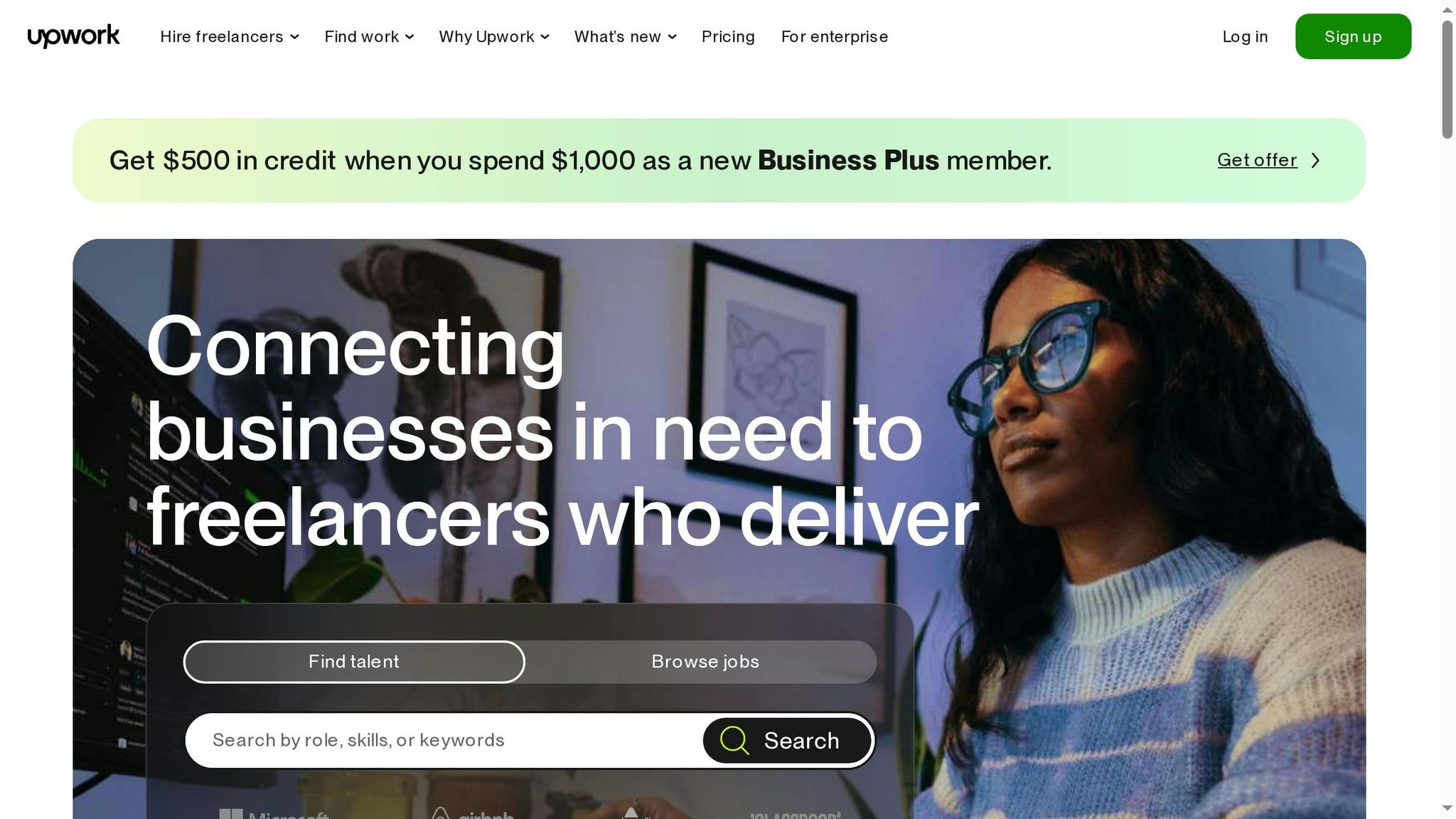
Upwork is home to a massive network of 18 million freelancers, offering opportunities in areas like business strategy, financial planning, marketing, and operations. The platform operates on a proposal-based system, meaning freelancers bid on projects, often competing against many others - especially challenging for those just starting out.
Freelancers on Upwork pay a sliding service fee: 20% on the first $500 earned with a client, 10% on earnings between $500 and $10,000, and 5% on anything above that. While the platform's vast client base is a major plus, standing out requires a polished profile and personalized proposals. One unique feature is the ability to create specialized profiles - for example, one for web design and another for branding - to better target different client needs.
Toptal
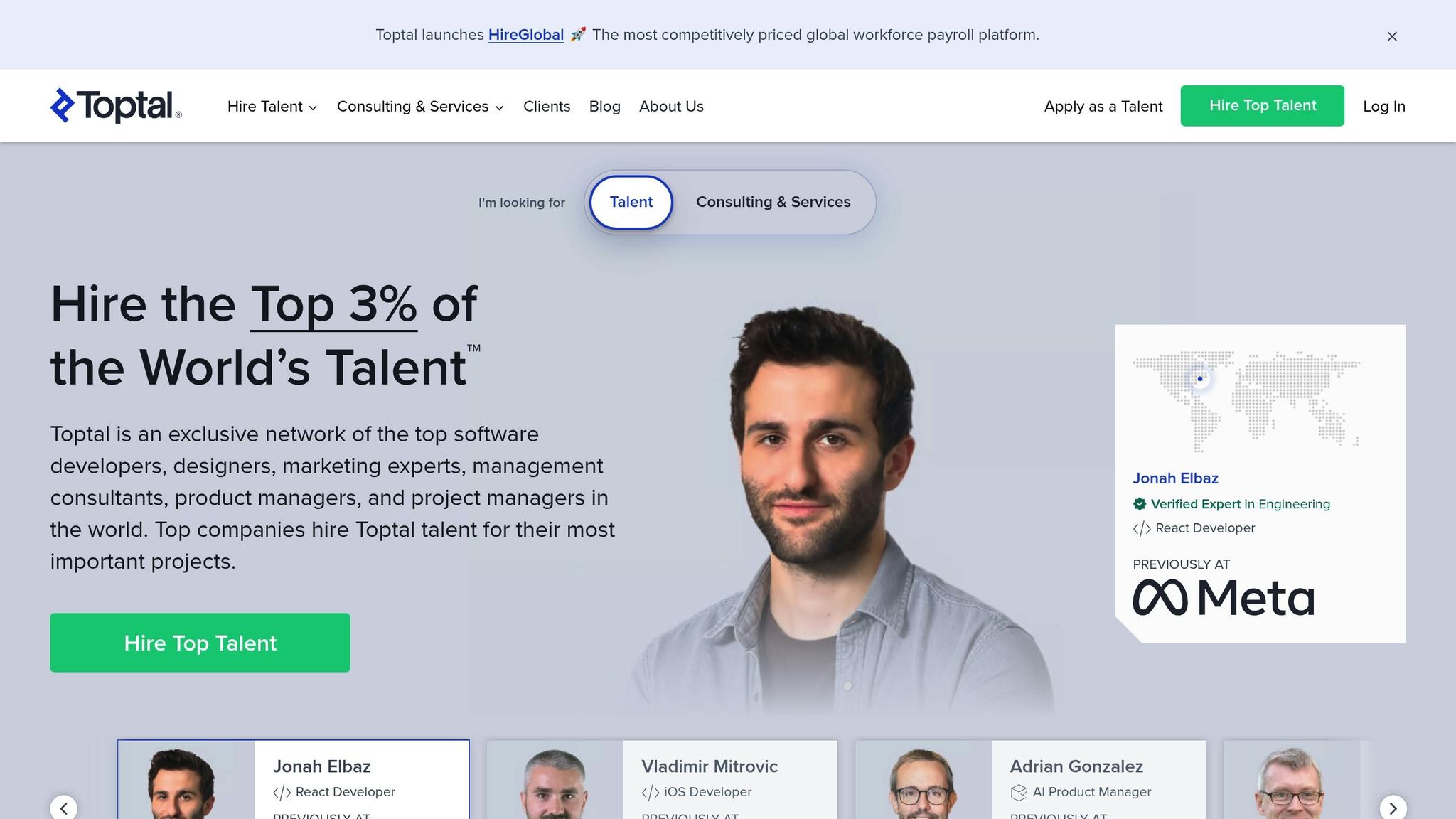
Toptal takes exclusivity to another level by admitting only the top 3% of applicants through rigorous testing and interviews. This means less competition once you're accepted, as the platform matches consultants directly with clients based on their skills and expertise.
Toptal focuses on high-value projects in areas like finance, strategy, and technology consulting. Instead of bidding on projects, consultants are paired with clients, allowing them to focus on delivering results rather than pitching. Payments are processed weekly, with no withdrawal fees, and an escrow system ensures your earnings are secure. For consultants with specialized skills, Toptal offers a streamlined way to connect with premium clients.
Fiverr
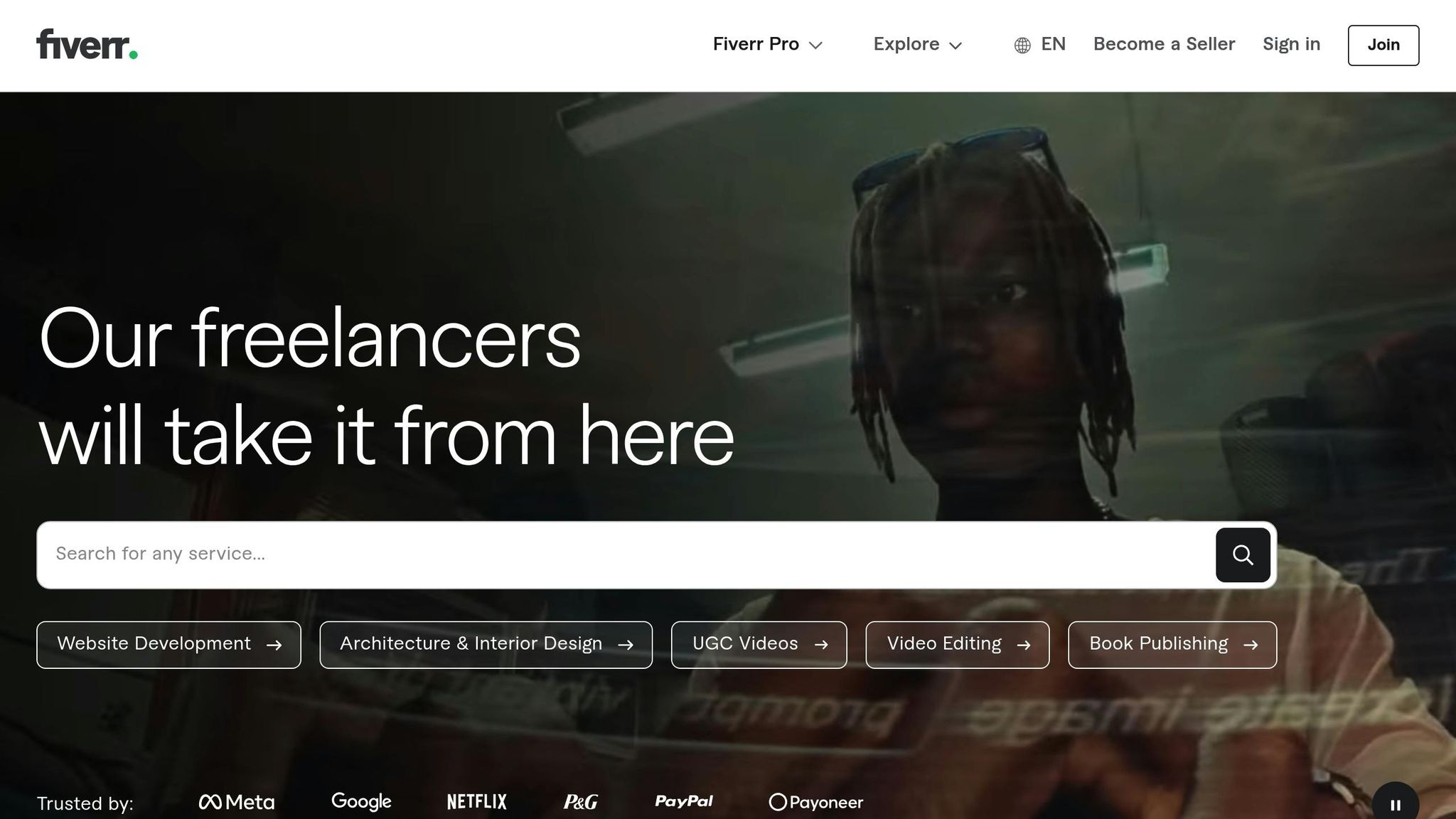
Fiverr operates differently, letting freelancers offer fixed-price service packages that clients purchase directly. For example, you might list a "90-minute financial planning consultation" or a "comprehensive marketing audit" at set prices, with options to scale the cost based on the complexity of the deliverable.
The platform takes a 20% commission on all transactions. Fiverr is particularly suited for consultants who provide standardized services in fields like marketing, financial analysis, or business planning. However, its gig-based structure often results in shorter projects rather than long-term consulting engagements.
FlexJobs
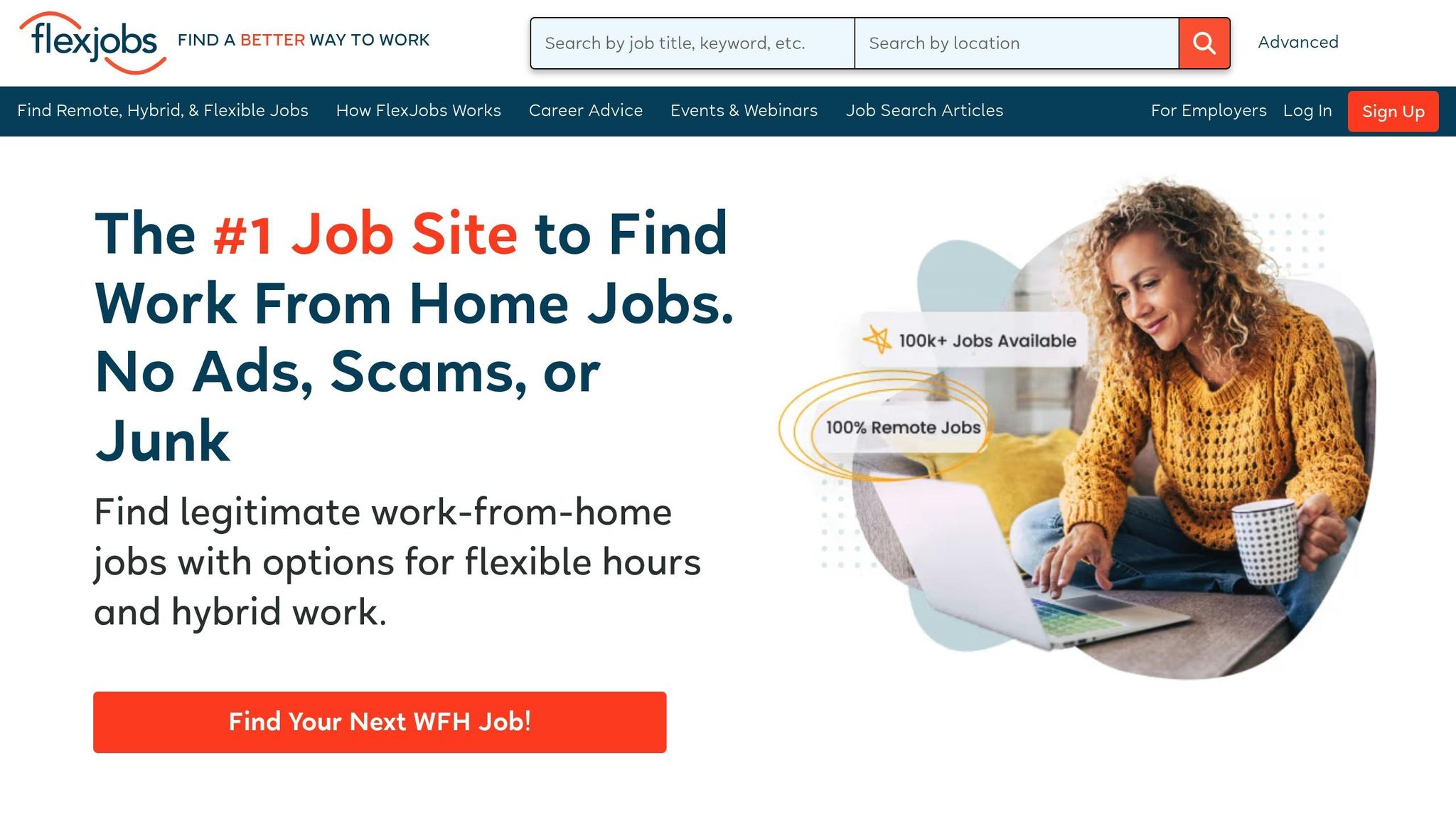
FlexJobs is a subscription-based job board that charges between $5 and $15 per month. It focuses on remote and part-time consulting roles, with every listing manually reviewed to ensure quality and legitimacy. This makes it a great option for consultants looking to avoid scams or low-paying gigs.
Rather than bidding against other freelancers, you apply directly to job postings, offering a straightforward way to secure work in your field.
Consultport
Consultport connects experienced consultants with global business clients seeking expertise in areas like corporate strategy, market analysis, M&A support, and international expansion. The platform vets its consultants before granting access, ensuring a high standard of professionalism.
Once accepted, Consultport handles client matching and contract negotiations, so you can concentrate on delivering top-notch results.
"If you get more than 80% of the jobs you apply for, you're priced too low. You need a bunch of clients to reject you." - Solon Molho, Management Consultant
These overviews set the stage for a deeper comparison with scale.jobs, showcasing why it stands out among these platforms.
scale.jobs vs Top Competitors
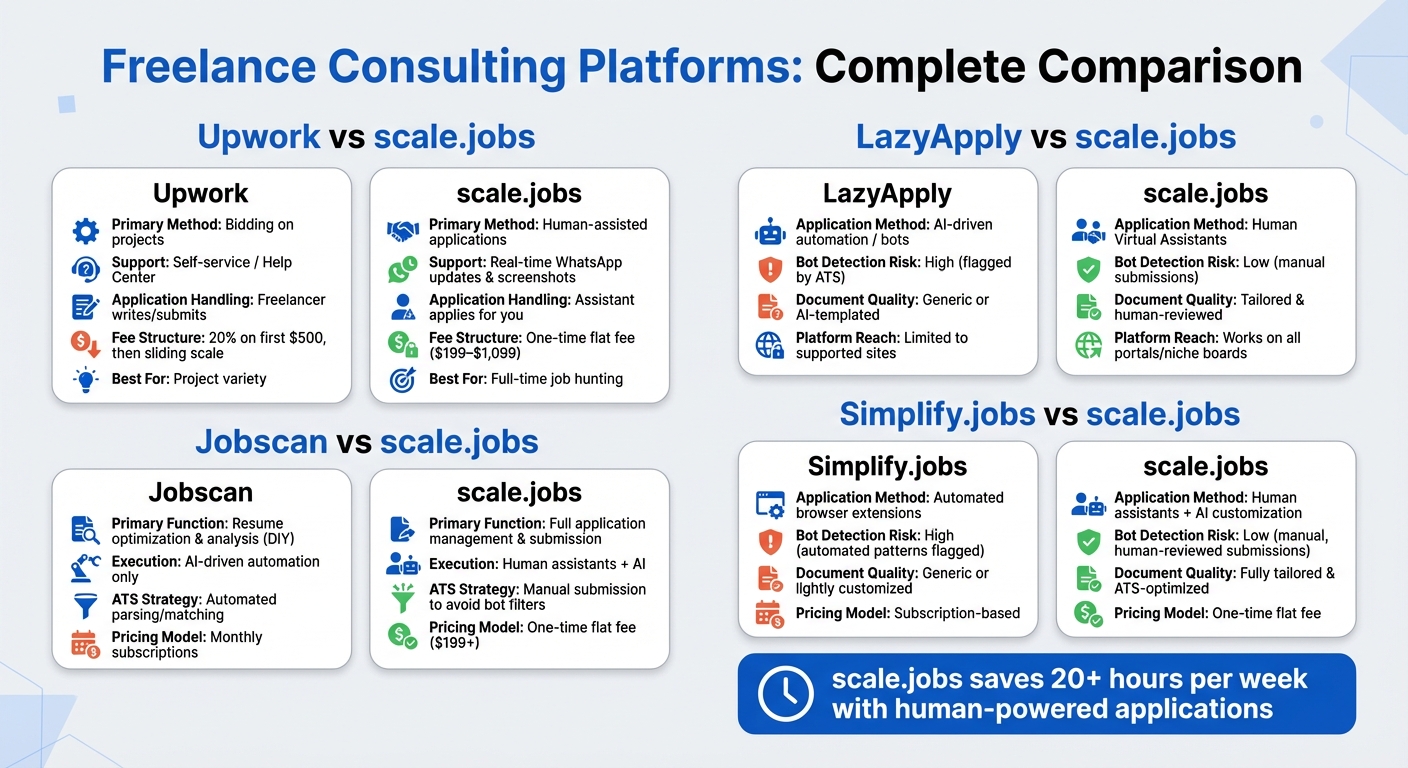
Freelance Consulting Platforms Comparison: Features, Pricing, and Application Methods
Platforms like Upwork and Toptal cater to freelance consultants seeking project-based work, but scale.jobs takes a different approach: simplifying and optimizing the job application process. If you're ready to move away from the gig-to-gig grind and step into stable employment, scale.jobs shifts the focus from freelance bidding to streamlined application management. By combining human expertise with automation, it transforms how consultants approach job hunting. Here's how it stacks up against some of the most popular tools.
Upwork vs scale.jobs: The Case for Human-Powered Applications
Upwork excels for short-term projects but relies heavily on self-service bidding. Freelancers must craft proposals, compete against a crowded pool, and pay steep fees - up to 20% on the first $500 earned with each client. This process often eats up valuable time without guaranteeing results.
With scale.jobs, the entire application process is handled for you. Human virtual assistants submit applications on your behalf, complete with ATS-friendly resumes and customized cover letters. You’ll also receive real-time updates and proof-of-work screenshots via WhatsApp - offering a level of transparency that Upwork simply doesn’t provide.
| Feature | Upwork | scale.jobs |
|---|---|---|
| Primary Method | Bidding on projects | Human-assisted applications |
| Support | Self-service / Help Center | Real-time WhatsApp updates & screenshots |
| Application Handling | Freelancer writes/submits | Assistant applies for you |
| Fee Structure | 20% on first $500, then sliding scale | One-time flat fee ($199–$1,099) |
| Best For | Project variety | Full-time job hunting |
The flat-fee pricing of scale.jobs means no recurring charges eating into your income. Plus, by outsourcing time-consuming tasks, you free up nearly 20 hours per week to focus on networking and interview preparation.
Is LazyApply Worth It? Reviews & Alternatives
LazyApply and similar tools promise to send out hundreds of job applications with a single click. However, many ATS systems flag automated submissions, leading to instant rejections. These tools also generate generic resumes and cover letters that fail to showcase your unique skills.
In contrast, scale.jobs employs human virtual assistants to manually handle each application. They carefully analyze job descriptions and craft tailored, ATS-optimized documents, ensuring your applications bypass bot detection. Submissions are completed within 24 hours, maintaining both speed and quality.
| Feature | LazyApply | scale.jobs |
|---|---|---|
| Application Method | AI-driven automation / bots | Human Virtual Assistants |
| Bot Detection Risk | High (flagged by ATS) | Low (manual submissions) |
| Document Quality | Generic or AI-templated | Tailored & human-reviewed |
| Platform Reach | Limited to supported sites | Works on all portals/niche boards |
For consultants targeting competitive roles, where ATS systems are strict, the human-driven approach of scale.jobs significantly boosts your chances of landing interviews. Unlike LazyApply, scale.jobs offers a comprehensive service that eliminates the need for additional tools like Jobscan.
Jobscan vs scale.jobs: Beyond Resume Optimization

Jobscan specializes in resume analysis, helping you optimize your resume for ATS compatibility. While useful, it’s a DIY tool - you’re still responsible for writing cover letters, applying to jobs, and tracking submissions.
scale.jobs provides an all-in-one solution. Alongside resume optimization, it handles application submissions, creates tailored cover letters, and keeps you updated in real-time. Instead of managing multiple tools and subscriptions, you pay a one-time fee and let trained assistants take care of the heavy lifting.
| Feature | Jobscan | scale.jobs |
|---|---|---|
| Primary Function | Resume optimization & analysis (DIY) | Full application management & submission |
| Execution | AI-driven automation only | Human assistants + AI |
| ATS Strategy | Automated parsing/matching | Manual submission to avoid bot filters |
| Pricing Model | Monthly subscriptions | One-time flat fee ($199+) |
For consultants juggling multiple job applications or dealing with complex processes like visa sponsorships (H-1B, TN, O-1), scale.jobs’ ability to navigate niche job boards and corporate portals offers a clear advantage over Jobscan’s narrower focus.
Stop Using Simplify.jobs Until You Read This
Simplify.jobs offers quick, automated submissions through browser extensions and one-click applications. While convenient, these automated tools often fall short. Applications lack personalization and are prone to being flagged by ATS systems designed to detect bots.
scale.jobs takes a different route, blending AI-powered customization with human oversight. This ensures your applications reflect your unique expertise and avoid the generic feel of automated tools. Human assistants also deliver customized, ATS-optimized resumes and cover letters within 24 hours.
| Feature | Simplify.jobs | scale.jobs |
|---|---|---|
| Application Method | Automated browser extensions | Human assistants + AI customization |
| Bot Detection Risk | High (automated patterns flagged) | Low (manual, human-reviewed submissions) |
| Document Quality | Generic or lightly customized | Fully tailored & ATS-optimized |
| Pricing Model | Subscription-based | One-time flat fee |
If you’re aiming to stand out in a competitive market, the human-powered approach of scale.jobs ensures your applications are not only personalized but also ATS-compliant, giving you a stronger edge over automated tools.
Tips for Success on Freelance Consulting Platforms
Build a Strong Profile
Think of your profile as your digital storefront - it’s the first impression clients will have of you. Start with a clear, attention-grabbing headline that highlights your expertise, such as "Financial Consultant Specializing in SaaS Revenue Modeling." Use this space wisely by including keywords that potential clients might search for. Dive into your accomplishments by detailing quantifiable results from past projects, and don’t forget to list relevant certifications. To seal the deal, showcase work samples like case studies or white papers that demonstrate your skills in action.
To increase your visibility, sprinkle targeted keywords throughout your profile. For example, mention methodologies like Six Sigma or Lean Management if they’re part of your expertise. Regularly update your profile to include recent projects and skills - an outdated profile can give the impression of inactivity, which might deter potential clients. A polished, up-to-date profile not only grabs attention but also sets the stage for you to carve out a niche.
Focus on a Specific Area
While a strong profile is important, narrowing your focus can make you stand out even more. Generalists often get lost in the shuffle of crowded marketplaces. Instead of branding yourself as a broad "business consultant", consider honing in on a specialty like healthcare compliance consulting or e-commerce growth strategy. This level of specificity helps clients quickly understand what you bring to the table and often justifies higher rates. In fact, industry stats reveal that about 20% of professional freelancers earn over $100,000 annually, with many crediting their success to specializing in a niche.
Your pricing strategy also plays a big role. If you’re winning nearly every bid, it might be time to test higher rates - this could signal that you’re undervaluing your services. Don’t shy away from rejection; instead, use it as an opportunity to learn. When a proposal doesn’t land, ask for feedback to uncover any gaps in your experience or approach. These insights can help you refine your strategy and improve your chances with future clients.
Use Free Job Search Tools
Whether you’re freelancing or pursuing full-time opportunities, free tools can give you an edge. Tools like ATS checkers and job trackers can optimize your applications and keep your search organized. For instance, platforms like scale.jobs offer a free ATS checker that evaluates your resume for formatting, keyword usage, and structure. This can help you avoid common pitfalls, like overly creative designs or image-heavy PDFs that confuse applicant tracking systems.
Job application trackers are another game-changer. Tools like Huntr use visual Kanban boards to help you manage your pipeline, from tracking interview notes to organizing follow-ups. Scale.jobs also integrates a free tracker into its platform, making it easier to stay on top of deadlines and client communication across multiple platforms. By combining these tools, you can streamline your job search and ensure no opportunity slips through the cracks.
Conclusion
Freelance consulting platforms open the door to a market projected to hit $620 billion by 2032, but thriving in this space requires smart decisions. Instead of spreading yourself thin, concentrate on 2–3 platforms that align closely with your expertise. Think of these platforms as a supplement to your main income, not a replacement. Data shows that consultants who focus on specific niches often outperform generalists.
Before committing fully, dip your toes in with a small project to build momentum. Give yourself at least 12 months to establish a presence and refine your strategy. Management consultant Solon Molho offers a valuable perspective:
"If you get more than 80% of the jobs you apply for, you're priced too low. You need a bunch of clients to reject you."
Rejections can be a goldmine for insights - use them to fine-tune your pricing and positioning. Once you’ve nailed your approach, it’s time to streamline your efforts.
When you’re ready to scale, tools for automating your job search can make a big difference. For example, scale.jobs offers a unique twist for job seekers transitioning from freelance consulting to full-time roles or long-term contracts. Unlike traditional platforms that take 5%–20% in commissions, scale.jobs uses a flat-fee model and employs human virtual assistants to manually submit applications, bypassing ATS bot filters. They promise a 24-hour turnaround on optimized resumes and provide real-time WhatsApp updates, saving users over 20 hours a week. Plus, their free tools - like an ATS resume checker and job application tracker - help keep your job search organized.
Whether you’re building a client base on Upwork or targeting full-time opportunities, success comes down to strategy, specialization, and efficiency. Focus on what sets you apart, and invest in tools and systems that amplify your efforts and visibility.
FAQs
What’s the difference between freelance consulting platforms and gig platforms?
Freelance consulting platforms are tailored for professionals who take on specialized, longer-term projects in roles like advisors or project leads. These platforms provide the flexibility to negotiate rates, outline specific deliverables, and foster ongoing client relationships. This often translates into higher earnings and a more dependable income stream. Common fields for consultants include strategy, design, and software development, with hourly rates typically ranging from $50 to $150 or more.
On the other hand, gig platforms are built for short-term, task-oriented jobs such as deliveries, rides, or micro-tasks. Workers are generally paid per task, have minimal control over setting their rates, and depend on the platform’s algorithms to connect them with jobs. This model emphasizes speed and volume but often leads to lower average earnings - around $29 per hour - and limited chances for career advancement or establishing long-term client relationships.
In essence, freelance consulting platforms cater to highly skilled professionals who value independence and meaningful client connections, while gig platforms serve a wider audience focused on quick, transactional work.
What are the best ways to create an impressive profile on freelance consulting platforms?
To craft a standout profile on freelance consulting platforms, focus on three key elements: clarity, credibility, and visibility. Start by identifying your niche and defining your value proposition. Clients tend to seek out specialists who can address specific challenges. For instance, use a concise, results-driven headline like: "Increased SaaS revenue by 40% for Series-A startups."
Make your profile look polished and professional. Use a high-quality photo and write an engaging "About" section that incorporates industry-relevant keywords. Highlight your achievements with measurable results, such as percentages or cost savings. Include a portfolio featuring case studies, visuals, or other materials that showcase your expertise. Adding testimonials, certifications, and client reviews can further establish your credibility.
To enhance your visibility, share your profile on platforms like LinkedIn. You might also explore tools like AI-powered resume builders or tailored cover letter generators to fine-tune your content. Services like scale.jobs even combine AI with human expertise to optimize profiles, ensuring they align with platform standards while saving you time. By narrowing your focus, presenting a polished profile, and actively networking, you can attract more clients and land meaningful projects.
How do payments and fees work on freelance consulting platforms?
Freelance consulting platforms vary widely in how they manage payments and fees. For instance, Upwork deducts a 5–10% service fee from your earnings, while Fiverr takes a hefty 20% commission on each order. Meanwhile, Toptal stands out by letting clients pay freelancers directly, skipping upfront platform fees altogether. In contrast, scale.jobs adopts a one-time flat-fee model, eliminating recurring commissions entirely.