
H-1B Cap-Exempt Employers: What's Changing in 2026

Sarah Mitchell
August 17, 2026

If you want a cap-exempt H-1B job in 2026, the main change is this: USCIS now wants tighter proof on the employer, the role, and how the job is described in the filing. The four cap-exempt employer types did not change. What changed is how some nonprofits can qualify and how closely USCIS may check job details.
Here’s the short version:
- More nonprofits may qualify under the 2025 final rule if research is a core activity, not only the main mission
- Paperwork matters more in 2026, especially on Form I-129
- Affiliation still must be documented; funding ties by themselves do not prove cap exemption
- Role fit matters as much as employer type
- University and research portal applications often need manual review, not just browser auto-fill
If I were planning my search now, I would do three things first:
- Check if the employer is cap-exempt
- Check if the role itself fits the cap-exempt basis
- Use the right application setup for the portal and visa questions
What changed, in plain English
The cap-exempt categories are still:
- colleges and universities
- nonprofits tied to those schools
- nonprofit research groups
- government research groups
The big rule shift comes from the January 17, 2025 final rule, which affects 2026 filings. The biggest update is for nonprofit research organizations. A nonprofit no longer has to show that research is its main mission in every case. It may qualify if research is a core activity.
That can help places like:
- teaching hospitals with active research units
- public health nonprofits
- mission-led labs linked to schools
But this is not automatic. USCIS still wants records that show the research mission and, where needed, the school tie.
There is also a filing detail issue in 2026. The revised Form I-129, in use from April 1, 2026, asks for tighter detail on:
- degree field
- minimum job requirements
- day-to-day duties
If those items do not line up, the case may face more questions.
sbb-itb-564272e
Why this matters for job seekers
For you, the upside is simple: there may be more cap-exempt targets than before.
The downside is just as simple: bad targeting wastes time.
A job title like “Research Associate” does not tell me enough by itself. I would want to know:
- who the actual sponsor is
- which unit is hiring
- where the work happens
- whether the duties fit research or education
This matters even more if you are trying to Apply for jobs across universities, labs, and teaching hospitals at the same time.
My simple screening framework
Step 1: Check the employer
I would verify whether the employer is one of these:
- university
- affiliated nonprofit
- nonprofit research organization
- government research entity
Good starting points include:
- the employer website
- IRS nonprofit records
- accreditation records
- the USCIS H-1B Employer Data Hub
If it is an affiliated nonprofit, I would look for:
- a written affiliation agreement
- shared board or governance links
- school control over the entity
- direct participation in the school’s research or teaching mission
Step 2: Check the role
Even if the employer qualifies, the role may not.
I would review:
- the hiring unit
- the worksite
- the listed duties
- whether the role sits in a research or academic function
- whether the degree ask matches the actual work
Safer examples:
- postdoc roles
- faculty jobs
- lab-based research staff
- direct university hires
Higher-review examples:
- hospital-linked jobs with mixed clinical and research work
- off-site placements
- roles at subsidiaries or contractors near campus
- jobs with vague duty descriptions
Step 3: Check the application path
This is where many people miss a simple point: the portal matters.
A lot of university systems do not behave like standard job boards. Workday, PageUp, and school-built portals may handle visa questions in different ways. That is one reason some people use a job search platform for tracking, then shift to a job application service when forms get messy.
Simplify vs Scale.jobs for cap-exempt H-1B roles
If I had to sum it up in one line:
Simplify is better for speed and tracking. Scale.jobs is better when each application needs manual care.
That difference matters more in cap-exempt searches than in broad private-sector searches.
Is Simplify worth it?
Yes, if you already know which employers qualify and you mostly apply on standard sites.
Simplify helps with:
- tracking
- browser-based auto-fill
- moving through common job forms
But I would be cautious if I were applying through:
- university HR portals
- custom school systems
- teaching hospital portals
- forms with visa screening questions that need manual checks
One wrong answer can lead to a rejection before a recruiter reads anything.
Why some candidates compare Simplify vs Scale.jobs
People compare them because the job is not only “send more applications.” The job is also “send the right ones, the right way.”
Scale.jobs is set up more like a Virtual Assistant for Job Applications model:
- humans submit applications by hand
- odd portals are less of a problem
- visa questions can be reviewed before submission
- proof-of-work screenshots show what was sent
That setup may fit cap-exempt searches better, especially if you are applying to several universities at once.
Quick comparison
| Tool | Best use | Main limit for cap-exempt search | (Try our visa-friendly job finder) | --- | --- | --- | | Simplify | Tracking and auto-fill | Can struggle on school portals or visa fields | | Scale.jobs | Manual submissions across many portals | Less self-serve than a browser tool | | Jobscan | Resume keyword matching | Does not submit applications | | LazyApply | High-volume sending tools compared | Higher risk for visa-screening mistakes | | Find My Profession | Coaching + managed help | Higher cost |
Where the other tools fit
Jobscan vs Scale.jobs
If your main issue is resume wording, Jobscan can help. It fits well with an ai resume builder or ai cover letter builder. But it does not apply for you.
If your issue is portal handling and submission accuracy, Scale.jobs is the closer fit.
LazyApply vs Scale.jobs
LazyApply is built for volume. That can work for low-risk searches.
For cap-exempt H-1B roles, I would be careful. Volume is less useful when:
- the employer may not qualify
- the role may not fit
- the portal asks visa questions in a custom format
Find My Profession vs Scale.jobs
Find My Profession fits people who want coaching plus managed help. If you want more hand-holding, that may work.
If your focus is manual submissions across university portals, Scale.jobs may be the more direct option.
FAQ-style answers
Can more nonprofits qualify for cap-exempt H-1B in 2026?
Yes. Under the current rule, some nonprofits may qualify if research is a core activity, even if it is not the only mission.
Does a nonprofit’s 501(c) status prove cap exemption?
No. It helps, but it does not prove cap exemption by itself.
Are direct university jobs still the safest targets?
Yes. In many cases, direct university hires like postdocs, faculty, and lab research roles remain the cleanest path.
Do cap-exempt employers still file year-round?
Yes. They are not tied to the H-1B cap lottery calendar.
Should I trust the job title alone?
No. I would always check the hiring unit, worksite, and duties.
My bottom line
If I were targeting cap-exempt H-1B jobs in 2026, I would not start with mass applying. I would start with a short list of verified employers and role types.
My playbook would be:
- find roles on strong academic or research-focused sources, not only the best job boards
- verify employer status first
- verify role fit second
- use a job search coach or job search virtual assistant if I needed help sorting risky roles
- use manual application help when the portal or visa questions look easy to get wrong
That is the main shift in 2026. The law did not rewrite cap exemption from scratch. However, it is still vital to follow a comprehensive H1B cap checklist to avoid common filing errors. But the margin for sloppy targeting looks smaller now.
What is actually changing for H-1B cap-exempt employers in 2026
The four cap-exempt employer categories are the same in 2026:
- institutions of higher education
- nonprofit entities tied to those institutions
- nonprofit research organizations
- governmental research organizations
What changed is how nonprofit research eligibility is judged and what USCIS now wants to see in the paperwork.
The main update comes from the January 17, 2025 final rule, which controls 2026 cap-exempt filings. On top of that, the revised Form I-129, effective April 1, 2026, asks for tighter detail on the degree field, minimum job requirements, and duties linked to the cap-exempt role.
That means one thing in plain English: precision matters more now. If the degree requirement says one thing, but the job duties suggest something else, that gap can create trouble. USCIS is paying closer attention to how the role is described from one filing to the next.
There is also a separate fee for some consular-processing H-1B petitions: a $100,000 supplemental fee for beneficiaries outside the U.S. For many cap-exempt sponsors, that changes the math. A candidate already in the United States may be the simpler fit.
For applicants, though, the biggest shift is still the nonprofit research standard.
Expanded nonprofit research eligibility: what "fundamental activity" means for cap-exempt pathways
Under the old rule, a nonprofit research organization often had to prove that research was its primary mission. That was a hard bar for groups with mixed missions. Think of a hospital system with a major clinical research arm, or a public health nonprofit that runs both research programs and direct services.
The new core research activity standard, formally called the "fundamental activity" standard, gives these groups a better shot. A nonprofit can now qualify if research is a core activity, even when it also does clinical care, public health work, or consulting.
That opens the door for more employers. University-affiliated nonprofits, mission-led labs, and research centers with broader service mandates now have a cleaner path to cap-exempt status.
Still, this doesn't mean every nonprofit gets a free pass. The standard is broader, but the proof still has to be there. In many cases, the hardest part is not the research itself. It's showing the affiliation clearly and on paper.
Affiliation and documentation rules that still create friction in 2026
Affiliation still has to be active and documented. Funding ties alone are not enough.
If a nonprofit is claiming affiliation with a university, USCIS wants evidence of that relationship through shared governance, direct control, or a formal written affiliation agreement that shows active participation in the university's research or educational mission.
This is where many cases slow down. An organization may have a long working relationship with a university, but if that relationship is loose, informal, or poorly documented, the filing can hit friction.
USCIS is also checking H-1B registrations, LCAs, and Form I-129s for consistency. So the job description, degree requirements, and day-to-day duties should match across the full record. No contradictions. No vague shortcuts.
Before you move to role-level review, start with the basics:
- confirm tax status
- confirm the research mission
- confirm affiliation documents
That first check can save a lot of back-and-forth later.
What the 2026 changes mean for international job seekers targeting universities and research nonprofits
Once an employer clears the eligibility bar, the next issue is your search plan. In 2026, cap-exempt paths still let you skip the lottery. But the filing itself now needs tighter proof on three points: the employer’s status, the role’s day-to-day duties, and the match between the filed worksite and where you’ll actually work. In plain English, getting a cap-exempt offer is only part of the job. The petition still has to line up with your degree field, your duties, and your location.
For international candidates, there’s some upside here. More nonprofits may fit the cap-exempt rules, but only if the research mission is spelled out clearly enough for USCIS. That can help people who want to Apply for jobs in university labs, research centers, and mission-driven nonprofit settings.
One change matters right away: cap-exempt employers can file all year. There’s no October 1 start-date rule. So if you land a postdoc or research staff role at a qualifying employer, you may be able to start as soon as the petition is approved. For F-1 OPT holders, that timing can make life a lot easier. It can also change how you use a job search platform, because you don’t have to time every move around the cap-season rush.
Roles that may be easier to target in 2026 and roles still likely to face closer review
Not all cap-exempt jobs carry the same filing risk.
The cleanest cases are still direct university hires. That usually means postdocs, faculty roles, and specialized research staff positions. Big sponsors like the University of Michigan and Harvard already run established H-1B processes, so HR teams often know the paperwork, the timing, and the common issues before they pop up. If you’re trying to Apply for jobs in this lane, those employers are often simpler to deal with than smaller groups building the process as they go.
The tougher cases tend to show up at affiliated nonprofits. That’s where filings can get more scrutiny if the mission is mixed, the work happens off-site, or the role starts to drift away from research or education. Thin affiliation paperwork can also create problems. In 2026, USCIS can do unannounced site visits at any worksite, including third-party and affiliated locations, to check whether the real job matches the petition.
That means a title alone won’t save you. If your role sits inside a hospital system’s research division, a public health nonprofit, or another affiliated research site, the duties on paper need to line up mainly with the exempt institution’s research or educational mission. If the filing says one thing and your daily work looks like something else, that gap can become a problem fast.
A simple targeting rule helps:
- Lower-risk targets: direct university roles, postdocs, faculty jobs, lab-based research staff
- Higher-review targets: affiliated nonprofits with mixed missions, off-site placements, hospital-linked roles, jobs with fuzzy research ties
If you want a more focused process, a job search coach or a virtual assistant for job seekers can help sort roles by filing risk before you spend weeks applying.
Job-search implications for OPT holders and candidates moving between cap-exempt and cap-subject employers
For F-1 OPT holders, it helps to say early in the application process that a change of status may be possible. That signals to employers that consular processing may not be needed. Small point on paper, big difference in practice. Some hiring teams hear “visa” and assume delays; giving them the right frame early can reduce that friction.
The larger planning issue comes up when you move from cap-exempt work to cap-subject work. Concurrent employment can work while the cap-exempt role stays active. But if that cap-exempt role ends, the private-sector job usually needs its own cap path. That’s the part many candidates miss.
So your search should account for the next move, not just the first one. If you’re comparing university roles with private-sector options, think beyond the offer letter:
- Will this employer support a clean cap-exempt filing?
- Is the role tied closely to research or education?
- If you switch later, will you need the lottery after all?
That’s one reason some candidates pair their outreach with a job application service or a Job search virtual assistant. It helps keep the search organized, especially when the visa angle changes which openings are worth your time.
How to identify and verify real cap-exempt employers before you apply
Knowing the employer type isn’t enough. You need to verify the employer and the role before you apply.
Why? Because cap-exempt status depends on the specific sponsor and the specific position. A school or nonprofit may look like a fit at first glance, but the filing basis can fall apart once you check the job duties or worksite. So after the sponsor check, review the role details before you submit anything.
If you’re using a job search platform or a job application service, this is one of those steps you should still review yourself. It can save you from spending time on roles that won’t support your visa path.
Check whether the sponsor is a university, affiliated nonprofit, research nonprofit, or government research entity. The IRS Tax Exempt Organization Search can confirm 501(c) status, but that alone does not prove cap exemption.
Employer verification checklist: university status, nonprofit tax status, research mission, and affiliation evidence
| Employer Type | What to Check | Key Evidence |
|---|---|---|
| Accredited University | Accreditation and degree-granting authority | Accreditation records and degree-granting authority |
| Affiliated Nonprofit | Public affiliation page plus written affiliation agreement | Written affiliation agreement showing active participation in the university's research or educational mission |
| Nonprofit Research Org | Mission statement plus proof that research is a core activity | Mission statement and documentation that research is a core activity |
| Government Research Entity | USAJobs.gov listing or agency website | Federal, state, or local government entity status |
For affiliated nonprofits, don’t stop at the homepage. Look for shared governance, operational control, or a written affiliation agreement that shows active participation in the university’s research or educational mission.
"A university-affiliated teaching hospital... may have a stronger cap-exempt case than an independent nonprofit hospital with no qualifying university relationship." - Boundless Immigration
That’s the kind of detail that matters. Two hospitals may look similar from the outside, but one may have the university tie needed for cap-exempt filing and the other may not.
You should also use the USCIS H-1B Employer Data Hub to review the employer’s filing history. It won’t answer every question, but it gives you a useful paper trail. If an employer says they sponsor often, the data should usually point in that direction.
If you’re trying to apply for jobs at schools, labs, or teaching hospitals, this check helps you sort strong leads from weak ones fast.
Role verification checklist: visa questions, worksite details, and duties that support the cap-exempt basis
If the employer qualifies, the next filter is the role itself. A qualifying sponsor is not enough if the job duties or worksite don’t match the filing basis.
Start with the hiring unit. Check the hiring unit, duties, and worksite before you treat the role as cap-exempt. Roles at a for-profit subsidiary or contractor, even if it’s on campus, are weaker candidates even when they’re physically near the university. That “near campus” detail can sound good in a job ad, but it doesn’t carry much weight by itself.
Look at the posting closely. A few signs can point you in the right direction:
- The job is hosted on a university career portal, HigherEdJobs, AcademicJobsOnline, or USAJobs.gov
- The hiring unit is a research center, academic department, or grants office
- The duties tie back to research, education, or the mission used to support the filing
Then ask HR directly: "Is this specific position eligible for cap-exempt H-1B sponsorship?"
That question is simple, direct, and hard to dodge. If the answer is vague, pause there. Verify with HR before applying.
This is where many job seekers lose time. They assume the employer name tells the whole story. It doesn’t. The sponsor may qualify, but the role may sit in the wrong unit, at the wrong worksite, or under a setup that doesn’t support the cap-exempt claim.
If you’re working with a job search coach or a virtual assistant for job seekers, ask them to help screen for these details early. It’s much easier to rule out weak roles before you spend hours on resumes, forms, and follow-ups.
Simplify vs scale.jobs vs Jobscan, LazyApply, and Find My Profession for cap-exempt H-1B job searches
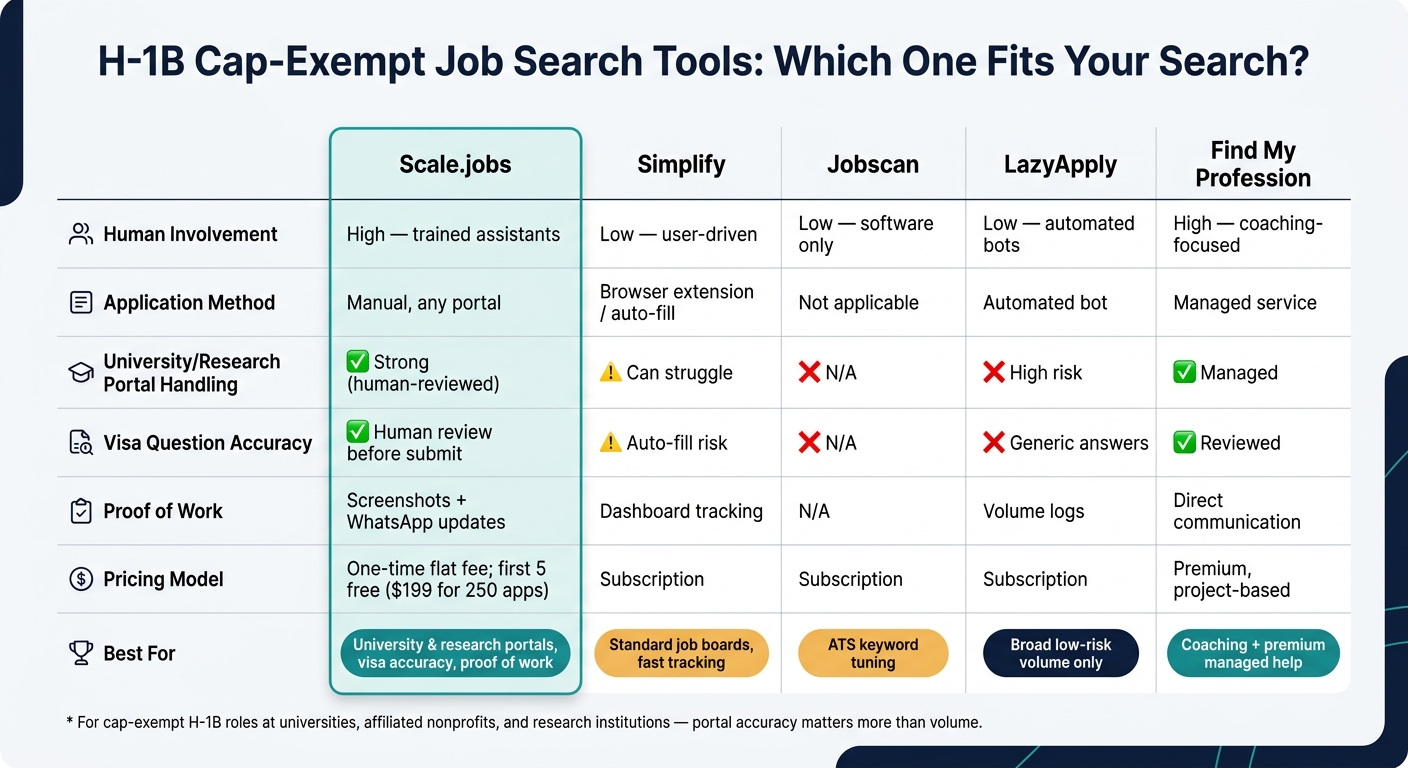
H-1B Cap-Exempt Job Search Tools Compared: Simplify vs Scale.jobs vs Others (2026)
Once you’ve checked the employer and the role, the next call is execution. Do you want a tool for tracking, auto-fill, or human review?
Simplify.jobs vs scale.jobs: why candidates targeting universities and research employers may switch
For cap-exempt searches, this isn’t only about tracking applications. It’s about whether the tool can deal with university portals, visa-screening fields, and manual review without small mistakes that cost you the role.
Simplify helps with tracking and auto-fill. Its browser extension can speed up forms on standard job search platform pages, and its dashboard makes it easy to see where each application stands. If you handle employer checks yourself and mostly use standard best job boards, that can work well.
But university and research institution portals are a different beast. Workday setups can vary. PageUp can act up. Custom school portals often don’t play nicely with browser extensions. One skipped field or one generic visa answer can knock you out before a person ever looks at your file.
That’s where scale.jobs stands apart. Instead of relying on automation, it uses trained human assistants to complete each application by hand across almost any portal. That matters when you’re dealing with cap-exempt employers, odd screening questions, or forms that need extra care. It also works well for people who want a Virtual Assistant for Job Applications instead of another self-serve tool.
Why scale.jobs fits cap-exempt searches better:
- Human assistants manually work through Workday, PageUp, and custom university portals, then check visa-related questions before submission
- Every finished application includes time-stamped, proof-of-work screenshots, so you can see what was sent
- Dedicated WhatsApp support gives you a fast way to flag employer-specific cap-exempt questions
- One-time bundles start at $199 for 250 applications, with 5 free applications to test the process
Who should use Simplify: Use Simplify if you verify employers yourself and mostly apply through standard job boards.
Who should choose scale.jobs: Choose scale.jobs if you’re applying through university, nonprofit research, or affiliated-institution portals where manual handling matters more than speed.
Switch to scale.jobs if...
- You’re applying to several university or research portals and auto-fill keeps breaking
- You want a human to review visa screening questions before submission
- You need proof-of-work screenshots to confirm the application went through the right way
- You’d rather pay once for a set number of applications than juggle a subscription
- You want to test the service before spending money at scale
If your search includes more than tracking, the next step is figuring out whether you need keyword tuning, high-volume sending, or a done-for-you job application service.
Jobscan, LazyApply, and Find My Profession vs scale.jobs: where each tool fits in a 2026 cap-exempt search
If Simplify covers tracking, the next question is simple: do you need keyword tuning, volume, or managed execution?
Jobscan is strong at ATS keyword matching. If your main problem is getting your resume lined up with a job description, it can help. Paired with an ai resume builder or an ai cover letter builder, it can tighten your documents before you apply. But that’s where it stops. It doesn’t submit applications, move through portals, or handle the actual work of applying.
LazyApply is built for volume. It can send a lot of applications fast, which may fit a broad, low-risk search. But cap-exempt roles are not a good place to trade care for speed. A bot-submitted application with a generic visa answer on a university portal is the kind of mistake that can sink your shot without any warning.
Find My Profession is more hands-on. It fits candidates who want coaching along with managed applications. That service angle is a plus, especially if you also want a job search coach. Still, it’s a premium model, and it doesn’t offer the same screenshot-based proof of work that some applicants want when each submission matters.
Here’s the short version:
- Use Jobscan for ATS keyword tuning
- Use LazyApply for broad, low-risk volume
- Use Find My Profession for premium coaching and managed applications
- Choose scale.jobs when you want human-powered submission, ATS-tuned documents, and proof of work
Use this table to match each tool to the risk level in your cap-exempt search.
| Feature | scale.jobs | Simplify | Jobscan | LazyApply | Find My Profession |
|---|---|---|---|---|---|
| Human involvement | High - trained assistants | Low - user-driven | Low - software only | Low - automated bots | High - coaching-focused |
| Resume customization depth | Deep, ATS-optimized per role | Basic template / auto-fill | High keyword matching | Low, bulk tailoring | Professional writing |
| ATS handling | Human-reviewed, tailored docs | Basic auto-fill | Keyword optimization | Bulk submission | Professionally written resumes |
| Application execution method | Manual, any portal | Browser extension / auto-fill | Not applicable | Automated bot | Managed service |
| Transparency and proof of work | Screenshots + WhatsApp updates | Dashboard tracking | Not applicable | Volume logs | Direct communication |
| Pricing model | One-time flat fee; first 5 free | Subscription | Subscription | Subscription | Premium, project-based |
Decision Summary: choose the tool that matches your cap-exempt risk level and application workflow
Choose Simplify if you’re doing your own checks and mostly want faster tracking across standard job boards.
Choose Jobscan if ATS keyword filters are the main problem and you plan to handle applications yourself.
Choose LazyApply only for broad-volume searches where visa accuracy is not a major issue.
Choose Find My Profession if coaching is the top goal and your budget has room for a premium service.
Choose scale.jobs if you need human-powered applications, ATS-aware document tuning, clear proof of work, and a try-before-you-pay option. That setup makes the most sense when you’re trying to Apply for jobs at universities, nonprofit research employers, or affiliated institutions, where one wrong answer on a visa question can quietly end your chances.