
H1B Cap-Exempt Jobs: Universities, Nonprofits, and Research

Sarah Mitchell
May 2, 2026

H1B cap-exempt jobs eliminate the need for the visa lottery, offering year-round application opportunities and freedom from the annual cap of 85,000 visas. These roles are typically available at universities, nonprofit research organizations, and government research institutions.
Key Takeaways:
- No lottery required: Cap-exempt employers can sponsor H1B visas anytime during the year.
- Employer-based exemption: Eligibility depends on the employer's status, not the applicant's qualifications.
- Lower costs: Exempt from the $100,000 Presidential Proclamation fee for cap-subject petitions.
- Concurrent employment: Allows working for both cap-exempt and cap-subject employers simultaneously.
Cap-exempt roles are primarily offered by accredited colleges, nonprofit organizations affiliated with universities, and research-focused institutions. These jobs provide a streamlined path to work in the U.S., bypassing the uncertainties of the lottery system. For those not eligible for exemptions, following an H1B cap checklist is essential to navigate the standard lottery process.
If you're targeting these opportunities, crafting a tailored resume and using tools like Scale.jobs for application assistance can significantly improve your chances.
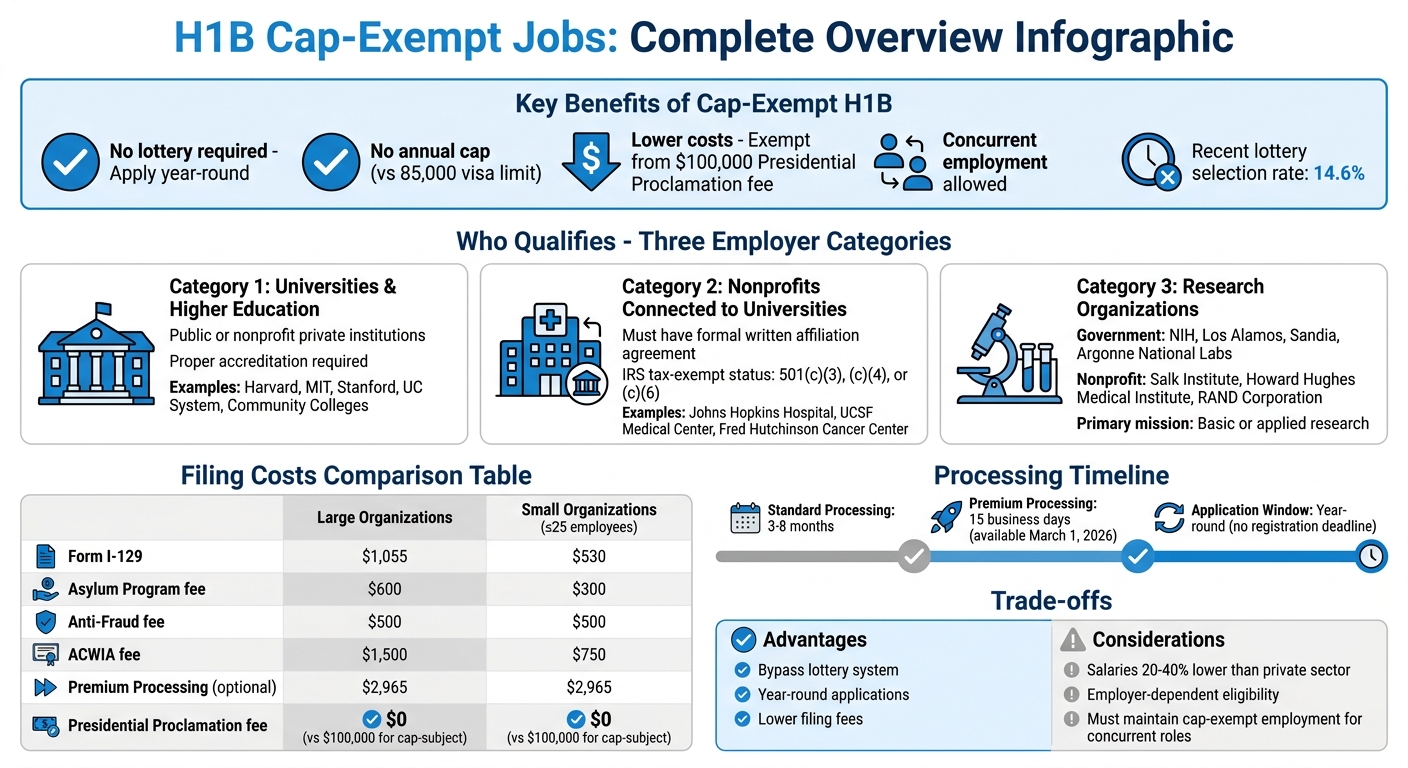
H1B Cap-Exempt vs Cap-Subject Comparison: Employer Types, Benefits, and Filing Costs
H-1B Cap-Exempt Jobs: Indian Beneficiaries' Path Beyond Lottery
sbb-itb-564272e
Who Qualifies as an H1B Cap-Exempt Employer
Cap-exempt status is determined by the employer, not the worker, and is reevaluated with each petition under Section 214(g) of the Immigration and Nationality Act. Below is a closer look at the qualifications for employers across various sectors. These guidelines clarify how different organizations meet the requirements for cap-exempt status.
Universities and Higher Education Institutions
For a college or university to qualify, it must adhere to the definition outlined in the Higher Education Act of 1965 (20 U.S.C. 1001(a)). This includes being a public or nonprofit private institution, maintaining proper accreditation, requiring a high school diploma for admission, and offering at least a two-year degree program. Examples include public universities like the University of California system, private institutions such as Harvard and MIT, and community colleges. Online-only programs face additional scrutiny to confirm they meet accreditation and eligibility standards. The next section delves into how nonprofits affiliated with universities can also qualify for cap-exempt status.
Nonprofits Connected to Universities
Nonprofit organizations can qualify as cap-exempt employers if they maintain a formal and substantive written affiliation agreement with an eligible university. This agreement may involve shared governance, common ownership, or the nonprofit operating as a branch, member, or subsidiary of the university. Teaching hospitals like Johns Hopkins Hospital and UCSF Medical Center are examples of organizations that meet these criteria through formal partnerships.
Attorney Kyle Knapp emphasizes that informal relationships are insufficient; USCIS requires detailed documentation of the affiliation.
Additionally, these nonprofits must hold tax-exempt status under IRS Section 501(c)(3), (c)(4), or (c)(6). This tax-exempt classification is critical for USCIS to confirm eligibility. If you're preparing to apply for a position at an affiliated nonprofit, resume writing services can help tailor your application to highlight relevant research or academic experience.
Nonprofit and Government Research Organizations
Nonprofit organizations qualify for cap-exempt status if their primary mission is conducting basic or applied research. Basic research focuses on expanding general knowledge without specific commercial goals, while applied research targets specific needs or commercial objectives. Examples include the Fred Hutchinson Cancer Center and the Salk Institute.
Government research organizations - whether federal, state, or local - also meet cap-exempt requirements if their primary focus is research. Examples include national laboratories like the National Institutes of Health (NIH), Los Alamos, Sandia, and Argonne. A 2024 rule update clarified that remote work for a qualifying organization also counts toward cap-exempt eligibility, provided that at least half of the work supports the mission of higher education or research.
How to Apply for H1B Cap-Exempt Jobs
Applying for H1B cap-exempt positions eliminates the need to go through the annual lottery process. Employers sponsoring these roles follow a specific filing process, and once the petition is approved by USCIS, you can start working without delay.
Filing Form I-129 Without Cap Restrictions
The first step involves your employer filing a Labor Condition Application (LCA) with the Department of Labor to confirm that your wage aligns with prevailing standards. After the LCA is certified, the employer submits Form I-129 (Petition for a Nonimmigrant Worker) to USCIS. Along with this, they must provide documentation proving cap-exempt status, such as a formal affiliation agreement for nonprofit organizations.
- Processing times: Standard processing typically takes 3–8 months. Premium processing, available starting March 1, 2026, costs $2,965 and guarantees a decision within 15 business days.
- Filing fees: These vary depending on the employer's size:
For large organizations:
- Form I-129: $1,055
- Asylum Program fee: $600
- Anti-Fraud fee: $500
- ACWIA fee: $1,500
For small organizations (25 or fewer full-time employees):
- Form I-129: ~$530
- Asylum Program fee: ~$300
- Anti-Fraud fee: $500
- ACWIA fee: ~$750
It's worth noting that cap-exempt filings avoid the $215 registration fee or the $100,000 fee associated with the lottery. Since there’s no registration window or lottery, you can file year-round. If you need help refining your application materials, services like the best resume writing services can assist in creating a CV that highlights your academic or research achievements.
Working for Cap-Exempt and Cap-Subject Employers at the Same Time
H1B holders can work for both cap-exempt and cap-subject employers simultaneously, offering a unique opportunity to diversify roles. For this arrangement, each employer must file a separate Form I-129 petition. If your cap-exempt petition is approved first and you maintain that employment, you can work for the cap-subject employer without entering the lottery - provided you were counted against the cap within the last six years or your cap-exempt status supports the transfer.
However, if you decide to leave the cap-exempt employer and wish to work solely for the cap-subject organization, you’ll need to participate in the lottery unless you’ve been recently counted against the cap. This flexibility allows you to balance roles across sectors while maintaining your H1B status.
Cap-Exempt Employer Examples by Sector
Here’s a breakdown of cap-exempt employers across different sectors, illustrating how they qualify and the opportunities they offer.
Universities and Colleges
In the United States, all accredited degree-granting institutions - whether private universities, state schools, or community colleges - qualify for cap-exempt status. Prominent sponsors include institutions like Harvard, MIT, Stanford, Cornell, Dartmouth, and the University of California system, which includes campuses such as UC Berkeley, UCLA, and UCSF. These institutions represent the broad scope of higher education's role in H1B sponsorship outside the lottery. Additionally, state universities and community colleges nationwide follow cap-exempt guidelines, making this sector a significant avenue for H1B opportunities. Nonprofit organizations with formal academic affiliations also take advantage of cap-exempt rules, further expanding options in the education sector.
Nonprofit Organizations
Nonprofits linked to universities also qualify for cap-exempt status. Examples include university-affiliated medical centers like Johns Hopkins Hospital and UCSF Medical Center, which are among the largest H1B sponsors in this category. Research-focused nonprofits such as the Fred Hutchinson Cancer Center, Salk Institute, and Howard Hughes Medical Institute operate independently but maintain academic ties that secure their cap-exempt status. Organizations like the RAND Corporation, a nonprofit think tank specializing in policy research, also meet the criteria under the research organization category. If you're targeting roles in these institutions, it’s crucial to emphasize academic achievements, grants, or technical expertise. Using tools like a job application service can help ensure your application materials are tailored and compelling.
Research Institutions
Government-run research organizations also hold cap-exempt status and are key employers in this category. The National Institutes of Health (NIH) stands out as one of the largest sponsors, employing thousands of researchers and scientists. National laboratories such as Los Alamos National Laboratory, Sandia National Laboratories, Argonne National Laboratory, and Oak Ridge National Laboratory also qualify. These labs operate under federal contracts and focus on critical areas like energy, defense, and environmental research. When pursuing opportunities at these institutions, confirm that their primary mission aligns with research, as this is a core requirement for cap-exempt qualification.
Where to Find Cap-Exempt Jobs and How to Apply
Job Boards and Employer Websites for Cap-Exempt Roles
If you're searching for cap-exempt jobs, academic job boards are a great starting point. Websites like HigherEdJobs, Chronicle Vitae, and AcademicJobsOnline specialize in listing roles from universities and colleges across the country. Additionally, most universities maintain their own career portals, often found under URLs like "jobs.university.edu" or "careers.university.edu." Checking these sites directly can help you discover opportunities before they're posted on third-party platforms.
For government research positions, USAJobs.gov is the go-to resource, as it centralizes federal job postings, including openings at national laboratories such as Los Alamos, Sandia, Argonne, and Oak Ridge. Platforms like ShouldApply also provide H-1B filters, making it easier to identify cap-exempt employers who have filed petitions within the past year.
When it comes to application support, scale.jobs stands out. Unlike other services like findmyprofession, scale.jobs offers human-assisted application help and creates ATS-optimized documents to boost your chances with cap-exempt employers. Once you've identified a suitable role, tailoring your application materials is the next critical step, and this is where scale.jobs excels.
Tailoring Your Resume and Cover Letter for Academic and Research Roles
After finding the right opportunities, customizing your resume and cover letter is essential, especially for academic and research positions. Services like scale.jobs outperform competitors such as resumegenius and findmyprofession in this area by offering personalized, human-powered assistance.
Here are some tips for tailoring your application:
- Highlight your education: Clearly mention your U.S. bachelor's degree or its foreign equivalent.
- Showcase your contributions: Emphasize research achievements, grants, publications, and the societal impact of your work to align with academic and nonprofit expectations.
- Frame your experience for nonprofits: Focus on how your work benefits society or advances knowledge, rather than emphasizing commercial success.
Keep in mind that salaries in academic and nonprofit sectors can be 20% to 40% lower than private-sector roles. However, the advantage of avoiding the H-1B lottery - which has seen selection rates as low as 14.6% in recent years - often outweighs the pay disparity.
For those applying to multiple cap-exempt positions, scale.jobs offers a range of benefits over competitors like findmyprofession, resumegenius, and lazyapply:
- Human-reviewed applications tailored to academic and research standards.
- One-time payment model, avoiding recurring fees.
- Real-time support via WhatsApp for guidance throughout the application process.
- Detailed tracking of submissions for transparency.
- ATS-friendly documents optimized for university and nonprofit screening systems.
Using Concurrent Employment to Expand Your Options
Concurrent employment can be a game-changer for those navigating the H-1B system. This approach allows you to hold both a cap-exempt H-1B and a cap-subject H-1B at the same time. To make this work, your cap-exempt petition must be approved first, which secures your status, and then your private-sector employer can file a separate petition. This strategy enables you to work in the private sector without relying on the lottery, provided your cap-exempt role remains active.
While tools like lazyapply automate the application process, scale.jobs offers a more hands-on approach with human oversight and ATS-optimized documents, which is particularly helpful for managing concurrent employment applications.
It’s important to note that if your cap-exempt employment ends, your authorization to work for the cap-subject employer also ends - unless you were already counted under the annual cap in the last six years. Each petition requires a certified Labor Condition Application (LCA) from the Department of Labor, and both roles must meet prevailing wage standards for their location and job category. Resources like myvisajobs and Migrate Mate can help you track H-1B sponsorship data and identify employers experienced in concurrent employment arrangements.
Summary and Next Steps
Here's a streamlined guide to help you navigate cap-exempt H-1B opportunities effectively. These positions offer three key benefits compared to the standard lottery process: no annual cap on visas, year-round application windows, and the ability to start work as soon as your petition is approved. Eligible roles are typically found at accredited universities, nonprofit research organizations with 501(c) status, and government research institutions like the National Institutes of Health or Los Alamos National Laboratory. While salaries in these roles may be 20% to 40% lower than private-sector positions, bypassing the lottery is a major advantage, especially with the recent 14.6% selection rate.
To begin, explore specialized job boards such as HigherEdJobs, Chronicle Vitae, and USAJobs.gov for relevant openings. Confirm employer eligibility by checking for .edu domains, 501(c) tax-exempt status, or formal affiliation agreements between nonprofits and universities. Since most job postings don’t explicitly mention cap-exempt H-1B sponsorship, ask hiring managers directly: "Is this position eligible for cap-exempt H-1B sponsorship?"
Switch to Scale.jobs for:
- Human-powered support instead of automated services like Find My Profession or LazyApply.
- ATS-optimized resume customization that goes beyond tools like Resume.io or ResumeGenius.
- One-time payment with dedicated WhatsApp support for real-time updates.
- Transparent proof-of-work, unlike LoopCV or Simplify.jobs.
Once you've identified eligible roles, tailor your application materials to highlight your research contributions, publications, grants, and how your work benefits society or advances knowledge. Academic and nonprofit hiring committees value mission-driven accomplishments over commercial achievements. If you need assistance crafting ATS-optimized resumes and cover letters for these specialized applications, consider professional resume writing services. Unlike automated tools such as Resume.io or Find My Profession, Scale.jobs ensures your materials are reviewed by experts and meet the high standards required for academic and research positions.
You might also explore concurrent employment to broaden your opportunities. Once your cap-exempt petition is approved, a private-sector employer can file a separate petition, allowing you to work both roles simultaneously without entering the lottery. Keep in mind, however, that ending your cap-exempt role will terminate any related cap-subject authorization unless you’ve already been counted under the cap.
Lastly, prepare for filing fees: $1,055 for Form I-129 (or $530 for small employers), $600 for the Asylum Program Fee, $500 for the anti-fraud fee on initial petitions, and $2,965 for premium processing if you need a decision within 15 business days. Cap-exempt petitions are generally exempt from the $100,000 Presidential Proclamation fee that applies to new cap-subject petitions, significantly reducing upfront costs. This financial advantage, combined with the absence of lottery-related expenses, makes cap-exempt H-1B positions an appealing option.
FAQs
How can I confirm if an employer is H-1B cap-exempt?
To determine if an employer is H-1B cap-exempt, consider whether they fall into specific categories such as higher education institutions, nonprofit research organizations, or government research entities. Employers typically supply documentation to confirm their exemption status. For additional clarity, refer to official USCIS guidelines or trusted resources that list cap-exempt sponsors. Verifying this helps ensure the employer's claim aligns with legal requirements, minimizing the risk of complications with USCIS.
Can a cap-exempt H-1B job help me move to a private-sector employer later without the lottery?
Yes, a cap-exempt H-1B job can open the door for you to later transition to a private-sector employer without having to go through the lottery process again. To make this switch, you’ll need to go through the H-1B transfer process. This involves filing a new petition with the U.S. Citizenship and Immigration Services (USCIS) and securing their approval.
What happens to my work authorization if my cap-exempt job ends while I have concurrent H-1B employment?
If your cap-exempt job concludes while you are employed under a concurrent H-1B arrangement, USCIS may revoke the approval of your cap-subject concurrent petition. To maintain employment with the cap-subject employer, you would need to secure a spot in the H-1B lottery and have a new petition filed and approved by a different employer.
Related Blog Posts
- Surviving Trump’s $100K H-1B Fee: Insider Strategies and Loopholes for 2025
- Navigating the New $100,000 H-1B Fee: Tips, Challenges, and Legal Insights for 2025
- Cap-Exempt H1B Jobs: The Complete List of Employers Who Skip the Lottery
- OPT to H1B: The Exact Timeline Every International Student Must Know in 2026