
H1B Job Search Checklist for OPT Students Graduating in 2026

Sarah Mitchell
March 5, 2026

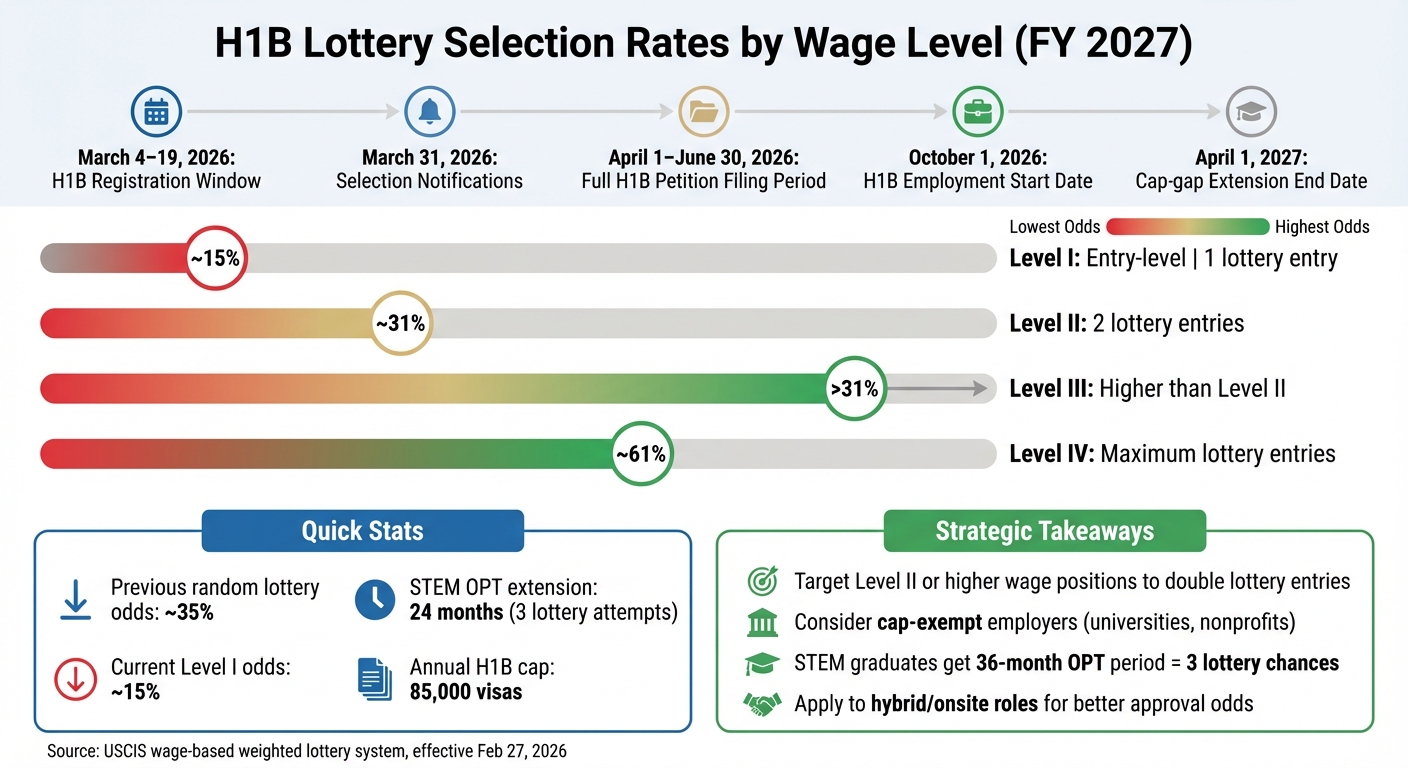
The H1B visa process for 2026 graduates has become more competitive, especially after the February 27, 2026, shift to a wage-based weighted lottery system. For entry-level (Level I wage) roles, selection odds have dropped to 15%, compared to ~35% under the previous random lottery. This means early preparation, employer sponsorship before graduation, and strategic job applications are more critical than ever.
Key takeaways:
- H1B registration window: March 4–19, 2026. Employers must register on time.
- Higher wages improve odds: Level II roles have ~31% selection chances vs. 15% for Level I.
- Target cap-exempt employers: Universities and nonprofits bypass the lottery cap.
- Optimize applications: Use ATS-friendly resumes and apply to hybrid/onsite roles.
- Leverage STEM OPT: STEM graduates get three H1B lottery attempts within their 36-month OPT period.
To succeed, focus on H1B-friendly employers, tailor your applications, and track deadlines meticulously. Explore tools like scale.jobs for manual job application support and ATS optimization to improve your chances.
H1B Lottery Selection Rates by Wage Level for 2026 Graduates
Step 1: Identify H1B-Sponsoring Employers
Use H1B Databases and Employer Records
Start your search with the USCIS H-1B Employer Data Hub, which allows you to filter by fiscal year, employer, or location. This resource provides details on "Initial Approvals" and "Continuing Approvals", helping you identify employers with a strong history of H1B sponsorship. The data is free and updated annually.
Another helpful resource is MyVisaJobs.com, which compiles Labor Condition Application (LCA) and USCIS data to assign each employer a "Visa Sponsor Score." This score reflects their sponsorship history, making it easier to focus on companies with reliable sponsorship patterns. While the basic search on this platform is free, premium reports offering employer contact details and historical trends range from $49 to $99. For salary insights, use H1BGrader, a free tool that provides approval rates and wage levels by employer and job title.
If you’re on STEM OPT, cross-check potential employers with the E-Verify Search Tool from the Department of Homeland Security. Employers enrolled in E-Verify can hire students for the 24-month STEM OPT extension, often serving as a stepping stone to H1B sponsorship.
Target High-Demand Industries
Once you’ve built a list of potential employers, narrow it down by focusing on industries with strong sponsorship activity. Technology, healthcare, and finance are consistently at the forefront of H1B sponsorship. Within tech, roles in Artificial Intelligence (AI), Machine Learning (ML), and Cybersecurity are expected to see the highest sponsorship rates for graduates entering the job market by 2026. The NAICS code 541511, which covers Custom Computer Programming Services, consistently accounts for a large share of H1B petitions.
Geographic location also matters. Metropolitan areas like New York City, San Francisco, Seattle, Austin, and Chicago have a high concentration of H1B-sponsoring employers. Large companies, especially those on the Fortune 500 list, are typically better equipped with immigration resources and legal support for visa programs. Platforms like MyVisaJobs can help you identify companies with a history of PERM (Green Card) filings - an indicator that they are likely experienced in handling H1B petitions as well.
With your industry and geographic focus in place, the next step is to identify work arrangements that improve your chances of sponsorship approval.
Apply to Hybrid and Onsite Positions
Hybrid and onsite roles tend to have a higher likelihood of H1B sponsorship approval compared to fully remote positions. This is because Labor Condition Applications (LCAs) are tied to specific physical work locations, and remote roles can complicate compliance if work locations change.
Employers also lean toward direct-hire positions over third-party placements or consulting roles. Third-party arrangements often attract more scrutiny from USCIS, leading to higher rates of "Requests for Evidence" (RFEs) regarding the employer-employee relationship. When searching on platforms like LinkedIn or Indeed, use advanced filters with terms like "H1B sponsorship" or "visa sponsorship" and prioritize listings that specify hybrid or onsite work setups.
To refine your search further, consider using services like scale.jobs, which specialize in targeting employers with proven sponsorship records. Once you’ve identified promising opportunities, focus on tailoring your application materials to meet ATS standards, ensuring you stand out in this competitive process.
Step 2: Create ATS-Compliant Resumes and Cover Letters
Build ATS-Friendly Resumes
To get through the initial ATS (Applicant Tracking System) filters, stick to a .docx or searchable PDF format. Avoid using LaTeX-generated PDFs or image files like JPEG or PNG, as many ATS systems struggle to read them. Stick to a single-column layout and use standard fonts such as Arial, Calibri, or Georgia. Avoid tables, columns, headers, footers, and graphics, as they can confuse ATS software and make your resume unreadable.
When organizing your resume, use clear section headings like "Professional Experience", "Education", and "Technical Skills" instead of creative alternatives such as "My Journey" or "What I Bring." These standard labels help ATS software categorize your information effectively. Within each section, incorporate keywords directly from the job description. For example, if the job posting lists "Machine Learning model deployment", use that exact phrase instead of rephrasing it as "ML system implementation." While modern ATS platforms can interpret context to some extent, exact keyword matches still play a crucial role in passing the initial screening.
Make your accomplishments stand out by quantifying them using the STAR method (Situation, Task, Action, Result). For instance, instead of writing "Developed a web application", say, "Built a React-based inventory management system that reduced order processing time by 40% for a 50-person team." This not only satisfies ATS requirements but also highlights your measurable impact. If you're applying for H1B-related roles, explicitly mention your work authorization status with phrases like "Eligible for 36-month STEM OPT extension" to ensure recruiters and ATS systems can quickly identify your eligibility.
Customize Cover Letters for Each Application
After creating an ATS-friendly resume, focus on tailoring your cover letters with professional examples for each job. Start by analyzing the "Required Qualifications" and "Key Responsibilities" sections of the job description, then incorporate that exact language into your cover letter. For example, if the employer seeks "experience with AWS Lambda and serverless architecture", use those exact terms in your letter.
One effective strategy is the "T-Style" method, where you align the job's requirements with your achievements. For example: "You require proficiency in Python for data pipeline automation. During my internship at [Company Name], I developed a Python-based ETL pipeline that processed 2 million records daily, reducing manual data entry by 75%." This approach clearly maps your skills to the job requirements while also satisfying keyword algorithms. Keep your cover letter text-based - avoid icons, progress bars, or decorative fonts, as these can interfere with ATS parsing.
To simplify the process, consider using automated tools for resume and cover letter optimization.
Use Resume Optimization Tools
Customizing resumes for every application can be time-consuming, but optimization tools can help streamline the process. Platforms like scale.jobs' AI resume builder analyze job descriptions and adjust your resume's language to align with specific roles. Unlike other tools such as Jobscan or Resume Worded, scale.jobs combines AI with human oversight to ensure your resume meets ATS standards. The platform also offers a Free Trial Plan, allowing you to create two AI-tailored resumes per day, making it an excellent option to test before committing to a paid plan. This approach saves time while ensuring your resume remains ATS-compatible.
For those seeking deeper personalization or professional assistance, consider working with resume writing services that specialize in H1B applications. These services often provide one-on-one consultations to connect your academic and professional background with employer needs, ensuring your resume performs well with both ATS systems and human reviewers. When submitting your resume, always use a searchable PDF unless a .docx format is specifically requested. This ensures your formatting remains intact while keeping the text accessible for ATS parsing.
Step 3: Expand Your Professional Network
Connect with Alumni and Recruiters on LinkedIn
LinkedIn can be a game-changer for job seekers, especially when it comes to connecting with alumni and recruiters. The platform's Alumni Tool allows you to filter contacts by company, location, and job function. To use it, visit your university's LinkedIn page, click on the "Alumni" tab, and search for individuals working at companies known for H1B sponsorship. Networking is a powerful tool - 65.1% of new graduates secure jobs through networking, according to the National Association of Colleges and Employers.
When reaching out, craft a short, personalized message. Mention your shared university and explain why you're interested in connecting. Instead of asking outright for a job, request a quick 15-minute informational interview to learn more about their industry or role. This approach builds trust and increases the likelihood of a referral. As Idinma Ilodibe, an MSBA student, wisely advises:
"Take advantage of being a student (or a newbie professional). All seasoned professionals were once students/newbies of some kind, and they have some idea what you are going through."
Follow your target companies and recruiters on LinkedIn, engage with their posts, and comment thoughtfully to increase your visibility. If someone doesn't respond within 1–2 weeks, send a polite follow-up message. After any interaction, always send a thank-you note within 24 hours. If they offer a referral, be ready to share your resume promptly. This method not only grows your network but also connects you with employers who are familiar with ATS-optimized hiring practices. If you're using LinkedIn Premium, take advantage of InMail credits to message recruiters outside your network; however, the free version is often sufficient when prioritizing alumni connections.
For in-person networking, career fairs are another excellent avenue to explore.
Attend Career Fairs in Your Field
Career fairs tailored to your industry can be a goldmine for connecting with employers, especially those exempt from the H1B cap, such as universities, nonprofits, and government research organizations. These roles often bypass the annual 85,000 H1B visa cap, giving you better odds. Additionally, higher wage levels can improve your chances in the H1B lottery, with selection rates increasing from ~15% (Level I) to ~31% (Level II).
Before attending a career fair, research the companies scheduled to participate using resources like myvisajobs.com to assess their sponsorship history. Prepare questions to ask recruiters directly about H1B sponsorship and typical wage levels to ensure you're focusing on realistic opportunities. This preparation can save you time and effort by narrowing your focus to employers equipped to meet your visa needs. Keep in mind that the H1B registration window for FY 2027 runs from March 4–19, 2026, so attending career fairs in late 2025 or early 2026 can align perfectly with the lottery timeline.
To enhance your efforts, consider joining international student communities.
Join International Student Communities
International student groups can be invaluable for navigating the job search process as they provide up-to-date information on sponsorship opportunities. These communities often share real-time updates on USCIS registration windows, lottery results, and changes to the H1B selection process. Members who have successfully navigated the visa process frequently help others by offering internal referrals, mentorship, and advice.
These groups also organize mock interviews to help you sharpen both your technical skills and your understanding of workplace norms in the U.S. Look out for "H1B Tracker" spreadsheets shared in platforms like Discord or Slack during lottery season. These tools can help you identify companies issuing high numbers of RFEs (Request for Evidence), allowing you to make informed decisions. Reaching out to international alumni who are already on H1B or Green Card status can also open doors - they often empathize with the challenges and are more willing to provide guidance or referrals.
Step 4: Track Your OPT and H1B Deadlines
Know Your OPT and STEM OPT Extension Dates
You can apply for post-completion OPT as early as 90 days before or up to 60 days after your program's end date. Since USCIS processing times for the I-765 form can be lengthy, submitting your application as early as possible is crucial. If you're a STEM graduate, you're eligible for a 24-month extension, which can be requested up to 90 days before your initial 12-month OPT expires. This extension not only allows you to continue working but also gives you up to three chances to secure an H1B visa during the lottery cycles.
The cap-gap extension, which bridges the time between your OPT expiration and the start of your H1B status, now provides work authorization through April 1 of the following year, instead of ending on October 1. This change ensures you can continue working legally while your H1B petition is pending. However, it’s vital to keep your I-20, employer information, and work location updated in SEVIS. Enforcement changes in early 2025 led to over 4,700 international students losing their SEVIS records, highlighting the importance of maintaining accurate and up-to-date records.
Once your OPT dates are secured, the next step is to prepare for the H1B lottery process.
Plan for the H1B Lottery Registration
For the FY 2027 H1B lottery, confirm with your employer that the registration window remains the same: March 4–19, 2026, with selection notifications expected by March 31, 2026. Ensure your employer and immigration attorney finalize your registration by February to avoid last-minute issues.
The lottery system now incorporates a wage-based weighted approach, effective February 27, 2026, which means your salary level plays a significant role in your selection odds. Entry-level (Level I) roles have an estimated selection rate of just ~15%, while Level IV roles see a much higher rate at ~61%. If your employer can classify your position as Level II rather than Level I, your entries double, raising your selection chances to ~31%. As immigration attorney Richard T. Herman explains:
"Improving lottery odds under the wage-weighted system is not about chasing a higher number. It is about ensuring your job reality, documentation, and wage level all tell the same story."
If selected in the lottery, your employer will need to file the full H1B petition between April 1 and June 30, 2026. Keep in mind that your H1B employment will officially start on October 1, 2026, so plan your work and visa timeline accordingly.
Once registered, staying on top of your application and visa status is essential.
Monitor Application and Visa Status
Managing your timeline accurately is crucial, and tools like Scale.jobs can help by providing transparent, time-stamped proof of your applications. Keep both digital and physical copies of important documents, such as I-20s, EAD cards, passports, and USCIS correspondence. If there are any changes to your employment or address, notify your Designated School Official (DSO) immediately to ensure your SEVIS record remains active.
For job applications, consider using a job search platform like Scale.jobs to track your submissions and follow up with employers in a timely manner. Unlike automated systems, Scale.jobs offers time-stamped proof for each application, which can be invaluable during the H1B process when demonstrating continuous employment eligibility to USCIS. Proper documentation supports both your OPT and H1B strategies, especially if you're juggling multiple applications across different companies while coordinating with immigration attorneys. Additionally, if you need assistance optimizing your application materials for ATS systems, professional resume writing services can help ensure your documents meet both employer expectations and visa requirements.
Step 5: Use Human-Powered Job Application Services
How Manual Application Submissions Work
Automated tools like LazyApply and Simplify.jobs promise quick submission of hundreds of applications, but they often face a significant hurdle: advanced bot-detection systems used by many employers. These systems can block automated submissions outright, potentially ending your chances before a recruiter even sees your resume. In contrast, scale.jobs employs trained Virtual Assistants (VAs) who manually complete each application, ensuring your submission bypasses these filters entirely.
Here’s how it works: VAs log into each employer’s portal, carefully review the application questions, and fill out every field by hand. This human-driven process eliminates the risk of being flagged as a bot, making it especially effective for OPT students applying to competitive companies like Amazon, Google, or smaller H1B sponsors. For roles with strict requirements, such as H1B positions, this attention to detail ensures your application reaches the hiring team.
Accuracy is another key advantage. Many application forms include nuanced questions about visa sponsorship, start dates, or specific qualifications. Automated tools often provide generic or incorrect answers, which can lead to immediate disqualification. A VA, on the other hand, tailors responses to match the employer’s exact criteria, giving you a better shot at success.
scale.jobs Free Trial Plan
With scale.jobs, you can test their manual submission service through a free trial that includes five job applications - no upfront payment required. After the trial, you pay a flat fee per application, avoiding recurring subscription charges. This service also includes ATS-optimized resume adjustments for each role, ensuring your materials align with employer expectations and H1B documentation standards. If you need help crafting your resume from scratch, professional resume writing services are available to build a strong foundation before tailoring begins.
Get Time-Stamped Application Proof
Every application submitted through scale.jobs comes with time-stamped proof-of-work screenshots, showing exactly when and where your VA submitted your application. You’ll also receive real-time updates via WhatsApp, giving you full visibility into your job search progress. This documentation can be invaluable for tracking your OPT timeline or proving your job-seeking efforts to your Designated School Official (DSO).
Transparency doesn’t just help with compliance - it also improves your ability to respond to recruiters. When a company reaches out, you’ll already know which version of your resume they received and which role-specific details your VA highlighted. This insight makes follow-up conversations more professional and focused, giving you an edge over other candidates.
Who Should Use LazyApply or Simplify.jobs
Automated platforms like LazyApply and Simplify.jobs are best suited for:
- Exploratory job searches where you're applying to a large number of roles without specific visa requirements.
- Non-visa applicants who aren’t at risk of being disqualified due to bot detection.
- Budget-conscious users who prioritize affordability over precision and can handle higher rejection rates.
- Early-stage job seekers testing the waters without needing tailored applications.
Who Should Choose scale.jobs
Scale.jobs is ideal for:
- OPT and H1B-seeking students who can’t risk automated rejections due to bot-detection systems.
- Candidates targeting specific H1B sponsors where accurate, tailored responses are critical.
- Applicants managing OPT timelines who need verifiable proof of job-seeking activity for compliance purposes.
- Detail-focused job seekers who prefer fewer, high-quality applications to a large volume of generic ones.
- Those requiring ATS optimization with human oversight to ensure resumes meet employer expectations.
Comparison Table: scale.jobs vs. Automated Platforms
| Feature | LazyApply / Simplify.jobs | scale.jobs |
|---|---|---|
| Human involvement | Fully automated | VAs manually submit each application |
| Resume customization | Generic templates | Tailored, ATS-optimized for each role |
| ATS handling | Prone to bot-detection flags | Avoids detection with manual submissions |
| Application method | Automated scripts | Manual entry by trained assistants |
| Proof of work | Limited or none | Time-stamped screenshots + real-time updates |
| Pricing | Monthly subscription ($99–$129/month) | Flat fee per application (5 free trial) |
Switch to scale.jobs if…
You should consider switching to scale.jobs if:
- Your applications are being auto-rejected or you’re seeing low response rates from H1B-sponsoring companies.
- You need proof of job search activity to maintain OPT compliance or satisfy DSO requirements.
- Visa-related questions in applications require precise, tailored answers.
- You’re applying to competitive roles at major companies or research institutions that use strict bot-detection systems.
- Time is critical and every application must count, especially if your OPT timeline is running out.
Decision Summary
Choose LazyApply or Simplify.jobs if you’re conducting high-volume searches without visa constraints and can accept lower response rates in exchange for speed and affordability.
Choose scale.jobs if you’re an OPT student aiming for H1B sponsorship, need ATS-optimized applications that bypass bot-detection systems, require proof-of-work for compliance, and prefer a focus on quality over quantity in your job search strategy.
Pro Tips on Getting H1B Sponsorship - My FAVORITE Job Hacks
Conclusion: Take Action on Your H1B Job Search
As you finalize your approach, keep in mind that every detail matters. The H1B registration window closes March 19, 2026, at noon ET, giving you less than two weeks to confirm that your employer has submitted your registration. Double-check with your hiring manager or immigration attorney to ensure everything is in order. Also, verify which OEWS wage level applies to your position - roles at Level II receive two lottery entries, compared to one for Level I, increasing your chances from approximately 15% to 31%.
While waiting for the March 31 notifications, take proactive steps to prepare a backup plan. Look into cap-exempt employers, such as universities or nonprofit research institutions, that are not subject to the lottery. Additionally, make sure your STEM OPT paperwork is up-to-date. Protecting your immigration status is equally important - remember, the expanded cap-gap extension now safeguards your F-1 status until April 1, 2027, but only if your employer opts for a Change of Status filing rather than consular processing.
For a more personalized approach, consider manual application services to boost your odds. Unlike automated platforms like LazyApply or Simplify.jobs, Scale.jobs offers human oversight and time-stamped proof for every submission. Their free trial allows you to explore whether human-submitted applications yield better results without any upfront commitment.
Keep track of each submission with time-stamped proof to meet DSO requirements and facilitate professional follow-ups. If you feel your resume needs improvement, professional resume writing services from Scale.jobs can help create an ATS-friendly resume tailored to your needs.
The next 14 days are critical for securing your work authorization beyond October 2026. Stay in close communication with your employer, verify your registration status, confirm your wage level with your employer's attorney, and ensure that every application reaches the right person. These steps are essential to navigating this process successfully.
FAQs
How can I move from Wage Level I to Level II for better H1B odds?
To boost your chances of moving from Wage Level I to Level II under the H1B visa system, aim to increase the prevailing wage for your role. This could mean negotiating for a higher salary or ensuring that your job offer meets the Level II wage criteria. Employers can also adjust compensation to align with the updated weighted lottery system, which gives preference to higher-wage positions. These steps could enhance your odds of success in the 2026 H1B cap season.
What should I ask a recruiter to confirm H1B sponsorship before accepting an offer?
When discussing opportunities with a recruiter, it's essential to ask whether the company sponsors H1B visas and if they assist with transfers or extensions for current H1B holders. Additionally, inquire about their track record with H1B sponsorships and confirm if they’re willing to provide the required documentation and guidance throughout the process. This helps you gain clarity on their sponsorship policies and assess your likelihood of obtaining visa approval before making any commitments.
How can I use cap-gap and STEM OPT to avoid a work-authorization gap?
To prevent a work-authorization gap, make sure your employer submits an H-1B petition with a start date of October 1 before your OPT or STEM OPT expires. The cap-gap extension will automatically extend your F-1 status and work authorization up to October 1 or the H-1B start date. To stay compliant, request an updated I-20 from your school’s international office to confirm this extension.