
How to Negotiate Salary on OPT Without Losing the Job Offer in 2026

Sarah Mitchell
March 26, 2026

Negotiating your salary while on OPT in 2026 can feel intimidating, especially with visa-related constraints and the pressure to secure employment quickly. However, skipping negotiation could cost you significantly over the course of your career. The key is to approach it with preparation, market data, and timing. Here's a quick summary of how to navigate salary discussions effectively:
- Wait for a Written Offer: Start negotiations only after receiving a formal offer to maximize leverage.
- Use Market Data: Rely on tools like salary predictors to define your target, stretch, and walk-away numbers.
- Focus on Value, Not Needs: Highlight your skills and market benchmarks instead of personal financial needs.
- Be Strategic: Express enthusiasm for the role before discussing numbers, and frame your request as aligning with industry standards.
- Address Visa Concerns Confidently: Reassure employers by explaining how your salary aligns with H1B eligibility requirements.
- Negotiate Total Compensation: If the base salary isn’t flexible, explore bonuses, benefits, or other perks.
How to Negotiate Salary after Job Offer | 5 Practical Tips
Gather Market Data and Prepare Your Case
OPT Salary Negotiation Statistics and Success Rates 2026
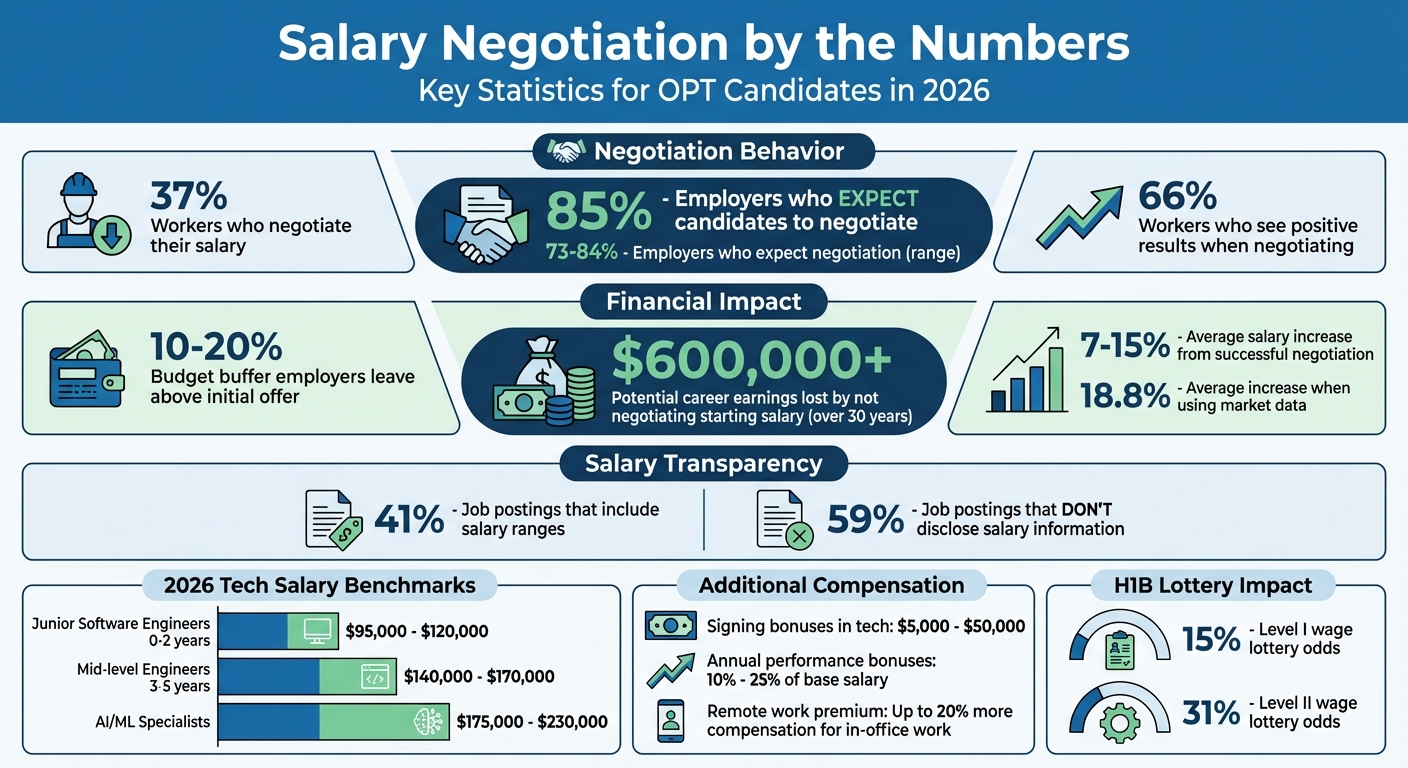
Negotiating your salary in 2026 requires a foundation of objective market data. Interestingly, while only 37% of workers negotiate their salary, 85% of employers expect candidates to do so. In fact, many hiring managers leave a budget buffer of 10-20% above their initial offer. The key to a confident and effective negotiation lies in replacing opinions with solid, verified data. This approach allows you to leverage tools like the scale.jobs Salary Predictor to your advantage.
Find Competitive Salary Ranges with scale.jobs' Salary Predictor
Before stepping into any salary discussion, it’s crucial to define three specific numbers: your Target (the salary you ideally want), your Stretch (a higher figure to anchor the negotiation, typically 10-15% above your target), and your Walk-away (the lowest amount you’re willing to accept). The scale.jobs Salary Predictor helps you pinpoint these numbers by providing percentile data - such as the 25th, 50th, 75th, and 90th percentiles - based on your role and location. This data gives you a strong foundation to justify your request.
Even though 41% of job postings now include salary ranges due to new transparency laws, the majority (59%) still don’t disclose this information. That’s where external benchmarks become essential. If asked to provide a salary expectation during the application process, consider stating your stretch goal to avoid anchoring too low. Keep in mind, failing to negotiate your starting salary could lead to a loss of over $600,000 in cumulative earnings over a 30-year career. On the other hand, successful negotiations can result in a 7-15% increase over the initial offer.
Prove Your Value with ATS-Optimized Resumes
While salary data strengthens your case, a resume that demonstrates your value can seal the deal. An ATS-optimized resume ensures your qualifications align with the employer’s needs and pass applicant tracking systems. Tools like the scale.jobs Resume ATS Checker can help refine your resume to highlight your most relevant achievements.
If an employer hesitates on your proposed salary range, a well-crafted resume can shift the conversation from cost to the value you bring to the table. For additional support, professional resume writing services can showcase your accomplishments in a way that justifies higher salary tiers. By combining percentile-based salary data with a compelling resume, you remove much of the guesswork from salary negotiations, making it easier for hiring managers to support your desired compensation internally.
When to Start Salary Discussions
Once you've gathered reliable market data and prepared your case, timing becomes crucial in salary negotiations. For OPT candidates, it’s essential to wait until you receive a formal, written offer. This is the moment when your leverage is at its peak. By the time an employer extends a written offer, they've already invested considerable time and effort in selecting you as their top choice. Restarting the hiring process would be costly and time-consuming for them, which makes them more open to negotiating compensation.
It’s best to avoid salary discussions during initial stages like screenings or early interviews. If a recruiter asks about your expectations early on, consider deflecting with a response like, "I’d like to understand the role’s responsibilities and scope better" or ask, "What is the budgeted range for this position?" This prevents you from prematurely anchoring the conversation to a specific number before you have a full understanding of the compensation package, including base salary, bonuses, benefits, and equity.
Wait for the Written Offer Before Negotiating
Negotiating without a written offer in hand can leave you at a disadvantage. Verbal offers often lack critical details about the full compensation package. A written offer, on the other hand, provides clarity on key components such as base salary, bonus structures, health benefits, retirement plans, and potential equity or stock options. Without these details, you’re essentially negotiating in the dark.
When you receive the offer, your first step should be to thank the employer and request 24–48 hours to review it. This is a standard practice that shows you’re thoughtful and deliberate in your decision-making. Use this time to carefully evaluate the total compensation package - not just the base salary - and compare it with the market data you’ve already gathered. This thorough approach ensures you’re prepared to discuss compensation with confidence. If you need assistance presenting your qualifications effectively, professional resume writing services can help you showcase your value before entering negotiations.
Show Enthusiasm Before Talking Numbers
Before diving into salary discussions, express genuine enthusiasm for the role and the team. This isn’t just about being polite - it’s a strategic way to set a positive tone and foster collaboration. Start with something like, "I’m excited about this opportunity and eager to contribute to the team." By doing this, you build trust and demonstrate that you're invested in the role, which can make the employer more inclined to advocate for a higher budget on your behalf.
"When you use this structure [Enthusiasm + Data + Ask], negotiation stops feeling like conflict and starts feeling like collaborative problem-solving." - SalaryGuide
Once you’ve expressed your enthusiasm, transition into the numbers by referencing the objective market data you’ve prepared. Frame your request in terms of aligning with market standards for the role, rather than positioning it as a personal demand. For example, you might say, "Based on my research, roles like this typically offer a range of X to Y. I was hoping we could discuss aligning with that." This approach keeps the conversation professional and collaborative, reducing the risk of the offer being withdrawn while showcasing your understanding of both your worth and the employer’s constraints.
Negotiation Scripts and Tactics for OPT Candidates
When negotiating, the focus should be on presenting your case with clear, data-supported arguments. Instead of saying, "I want more money", shift the conversation to something like, "Here's what the market data suggests for this role." This approach keeps the discussion professional and collaborative.
Present Salary Ranges Backed by Market Data
Start by grounding your salary request in market benchmarks. For instance, instead of asking for a specific figure like "$120,000", you could say: "Based on market data for similar roles, I'm targeting a base in the $110,000 to $120,000 range, depending on the responsibilities and total compensation. What range are you working with on your side?" This strategy does three things: it references credible data, provides a range instead of a single figure, and encourages the employer to share their perspective.
If you're responding to a written offer, email is an effective way to reference specific data points. Here's a sample script: "After reviewing the role's scope and benchmarking market data for comparable positions, I was hoping we could adjust the base salary to $115,000. My reasoning is based on the current market range for this level of impact, which is closer to [$110,000 to $125,000] according to scale.jobs' Salary Predictor. Is there flexibility to move closer to this number?"
For context, the 2026 benchmarks show that junior software engineers (0–2 years) typically earn $95,000–$120,000 in base salary. Mid-level engineers (3–5 years) range from $140,000–$170,000, while specialists in AI and ML command higher premiums, with salaries between $175,000–$230,000. Once you present your number, pause and let silence do its work. Research indicates that silence during negotiations often prompts employers to improve their offer. On average, successful negotiations lead to a 7–15% increase over the initial offer, and 66% of workers who negotiate see positive results.
Next, let’s address how to discuss your visa status confidently and effectively during these negotiations.
Handle Employer Questions About Your Visa Status
As an OPT candidate, concerns about how visa status might affect negotiations are common. However, you can frame this topic in a way that reassures employers. For instance, you could say: "I am eligible for 36 months of work authorization under STEM OPT. This provides three opportunities for the H1B lottery. Additionally, the salary range we're discussing aligns with Level II wages, which significantly increases the selection probability under the 2026 lottery rules compared to Level I."
This response not only demonstrates that you've considered the sponsorship timeline but also highlights how a higher salary benefits the company by improving their chances of retaining you long-term. Between 73% and 84% of employers expect candidates to negotiate, so addressing visa-related concerns directly shows preparedness and professionalism, not weakness.
If the employer cannot adjust the base salary, you can pivot to negotiating other aspects of your compensation package.
Negotiate Additional Benefits if Base is Fixed
If the employer states that the base salary is non-negotiable, shift the focus to additional benefits. For example, you could ask: "Would there be flexibility around a signing bonus, performance bonus, or an accelerated salary review at six months?" Employers often have separate budgets for one-time payments like signing bonuses or may be open to providing extra perks such as additional PTO, professional development funds, or technology stipends for home office equipment.
If the company prefers in-office work, you can also use remote work flexibility as a negotiation point. Interestingly, 59% of managers are willing to offer up to 20% more in total compensation for candidates who agree to an in-office arrangement. When framing these requests, position them as ways to enhance productivity rather than personal preferences. For instance, you might say: "Working remotely allows me to eliminate a 90-minute daily commute, which I can redirect into project work and meeting deadlines."
Whatever you negotiate, make sure to get all agreements in writing before signing the offer. If you feel your qualifications could be better highlighted to strengthen your position, consider using professional resume writing services to clearly showcase your market value. This can give you an edge in these discussions.
Mistakes to Avoid When Negotiating on OPT
When negotiating while on OPT, preparation is your best ally. However, even with thorough research, certain missteps can jeopardize your efforts. Here's how to steer clear of common errors and keep the focus on securing the best possible offer.
Never Negotiate Without Salary Data
Basing your negotiation on personal expenses is a mistake. Statements like, "I need $X to cover my rent", shift the conversation away from your professional worth and onto your personal situation - something employers are not responsible for addressing. Instead, rely on objective market data to back your request. Research shows that those who negotiate using solid data achieve an average salary increase of 18.8%, while emotional appeals rarely lead to success.
"Negotiation is just price discovery under uncertainty." - SalaryGuide
Without credible data, your proposal may lack impact. If you're unsure how to present your qualifications to justify your salary expectations, consider using professional resume writing services. A well-crafted resume can help highlight your market value and strengthen your negotiation position.
Evaluate Total Compensation, Not Just Base Salary
Focusing only on base salary can limit your perspective. Total compensation includes not just your base pay but also bonuses, equity, and benefits, which can significantly boost your earnings. For instance, signing bonuses in tech roles often range from $5,000 to $50,000, while annual performance bonuses can add 10% to 25% of your base salary. Before making a decision, calculate the full package: base salary + annual equity vesting + bonus target + benefits value. This comprehensive view will help you determine which offer provides the best overall value.
Document All Agreed Terms in Writing
Verbal promises can lead to misunderstandings, so ensure every agreed term is documented. After reaching an agreement, summarize all key details - such as salary, bonuses, equity vesting, and remote work arrangements - in an email to confirm the terms. Request that these details be included in the official offer letter. Many employers have a buffer of 10% to 20% above the initial offer, so once you've successfully negotiated, make sure all specifics are clearly outlined before signing. This step not only protects your interests but also demonstrates professionalism and attention to detail during the negotiation process.
Conclusion
Negotiating during OPT in 2026 requires a shift in focus - from personal needs to market-based data. By leveraging objective percentile data, you can present your salary request as reasonable and well-informed rather than overly ambitious. The ideal time to negotiate is after receiving a written offer but before accepting it, as this timing maximizes your leverage when the employer is least likely to back out.
Effective preparation, grounded in clear salary benchmarks, can often lead to a 7-15% increase over the initial offer. Interestingly, 85% of employers anticipate candidates will negotiate, so it's a step worth taking. If the base salary is non-negotiable, consider alternatives like sign-on bonuses, performance incentives, or a written agreement for a salary review within a few months.
For OPT candidates, the stakes are even higher. Your salary plays a critical role in H1B lottery odds under the 2026 wage-based system. Targeting Level II wages can significantly improve your chances - from 15% to as high as 31%. Tools like Scale.jobs' Salary Predictor can help pinpoint roles that meet these wage levels, while ATS-optimized resumes ensure your work authorization status is clearly communicated to potential employers.
Always confirm the agreed terms in writing to avoid misunderstandings. Skipping negotiation could cost you significantly over the course of your career. Unlike services like FindMyProfession or LazyApply, Scale.jobs provides human-assisted support, ATS-optimized documents, and transparent, data-driven insights to help you secure the best possible outcome. In the competitive OPT market of 2026, smart negotiation paired with the right tools - like those offered by Scale.jobs - can make all the difference in your career and visa prospects.
FAQs
How many times can I negotiate without risking the offer?
When it comes to negotiating, you can engage in discussions more than once, but it's important to approach this carefully. Generally, one or two strategically timed negotiations are considered appropriate and shouldn't put the offer at risk. However, pushing too hard or seeming unsure can create doubts. Aim to present a well-prepared, reasonable argument during each conversation to keep the process smooth and professional.
What should I do if the employer won’t share their pay range?
If the employer doesn’t provide a pay range upfront, consider asking for it early in the conversation. Approach the topic politely, explaining that knowing the range helps ensure alignment and clarity for both parties. If they choose not to disclose it, turn to reliable platforms like Glassdoor or Payscale to research salary trends and market standards. This research will help you set realistic expectations and negotiate confidently for a compensation package that reflects your skills and aligns with industry norms.
How do I discuss OPT and H-1B sponsorship during negotiations?
When discussing your visa status and sponsorship needs, it's important to be upfront while highlighting the value you bring to the employer. Clearly mention your OPT status and express your openness to discussing sponsorship options, focusing on how it can benefit both parties. Be prepared to address potential concerns about costs or timelines by backing your case with research, market data, or examples of your contributions. Maintaining clear and informed communication can help you manage these conversations effectively without risking your job offer.