
Job hunting is breaking people: protect your mental health

Sarah Mitchell
June 6, 2026

Job hunting today is mentally exhausting. Automated systems, ghosting, and rejection cycles can erode confidence and create anxiety. Many applicants send out hundreds of resumes with little response, leading to burnout and frustration. This article addresses the emotional toll of job searching and provides practical strategies to stay organized, manage rejection, and maintain mental health and apply for jobs without burning out. Learn how to structure your job search, use tools effectively, and decide whether automation or human-powered services like scale.jobs are right for you.
Key takeaways:
- Why job searching feels overwhelming: ATS systems, financial stress, and disorganized workflows.
- Mental health strategies: Set daily schedules, handle rejection constructively, and maintain physical and emotional health.
- Tools to simplify your search: Compare automated platforms like LazyApply to human-powered services like scale.jobs.
- Who benefits from scale.jobs: Tailored support for those facing visa deadlines, senior roles, or prolonged job searches.
Whether you're applying for full-time jobs, exploring part-time jobs near me, or need a job search virtual assistant, this guide helps you navigate the process with less stress and more focus.
How to Stay Sane During Your Job Search: 10 Essential Self-Care Tips
sbb-itb-564272e
Why Modern Job Searching Is Burning People Out
The hiring process has evolved into a numbers game, where algorithm-driven systems and high applicant volumes dominate. A 2023 U.S. survey revealed that 56% of unemployed or job-seeking adults reported negative effects on their mental health due to job searching. These challenges, coupled with systemic inefficiencies, amplify the emotional strain of hunting for work. Let’s explore how automation, disorganized workflows, and external pressures contribute to this growing problem.
How Automation Tools Add to Job Search Stress
Automation tools like LazyApply and LoopCV promise to streamline the application process by submitting resumes to multiple job boards at once. While this sounds convenient, it often leads to unintended stress. With mass submissions, job seekers can lose track of where they’ve applied, leaving them unprepared when recruiters call unexpectedly. This lack of preparation can shake confidence and create unnecessary anxiety.
Another hurdle comes from Applicant Tracking Systems (ATS), which are used by over 90% of major U.S. companies to screen resumes. Automated tools can trigger ATS filters, leading to resumes being discarded before a human even reviews them. In fact, up to 75% of resumes are filtered out this way. For job seekers, the silence following these rejections can feel deeply personal, even though the issue often lies in formatting or missing keywords rather than qualifications.
Disorganized Workflows and Too Many Applications
Without a clear strategy, job searching can quickly spiral into chaos. Many candidates juggle multiple platforms, emails, and notes, leading to confusion. You might find yourself rereading job postings, forgetting where you stand in the application process, or stressing over follow-ups. This mental clutter drains the focus needed to craft compelling cover letters or prepare for interviews.
Career advisors often suggest limiting applications to 3–5 targeted roles per day instead of mass-applying. A more focused approach not only improves your chances of landing interviews but also helps manage emotional fatigue. Warning signs of burnout include sending out generic applications, dreading every email notification, or losing sleep over uncertainty about your progress.
Financial and Social Pressures That Make It Worse
In the U.S., losing a job often means more than just lost income - it can also mean losing employer-sponsored health insurance. COBRA coverage, while available, is costly and adds to the financial strain of unemployment. Combine that with student loans, rent, and the reality that nearly 60% of U.S. adults live paycheck to paycheck, and the financial stress of job searching becomes overwhelming.
For H-1B or F-1 OPT candidates, the stakes are even higher. Immigration rules typically give H-1B holders just 60 days after a layoff to find a new sponsoring employer, making an already stressful situation feel like a race against time. This urgency can push job seekers into survival mode, where every rejection feels catastrophic.
Social stigma around unemployment further complicates matters, as job seekers may feel judged or isolated, adding another layer of stress to an already challenging process. If these pressures feel insurmountable, using tools like a job search virtual assistant or seeking professional resume writing services can help ease some of the burden.
| Stressor | How It Shows Up | Mental Health Impact |
|---|---|---|
| ATS filtering | Resumes rejected before human review | Feeling invisible, loss of control |
| Automated mass applications | Low response rates, forgotten applications | Anxiety, damaged self-esteem |
| Disorganized workflows | Missed follow-ups, constant context switching | Decision fatigue, burnout |
| Financial pressure | High healthcare costs, debt, depleted savings | Chronic stress, sleep disruption |
| Visa deadlines (H-1B, OPT) | 60-day window to find sponsorship | Heightened baseline anxiety |
How to Protect Your Mental Health During a Job Search
Job searching can be emotionally taxing, but these strategies can help you stay grounded and resilient throughout the process.
Build a Structured Daily Search Schedule
Approach your job search with the discipline of a workday. Set specific hours for different tasks, such as spending 2–3 hours in the morning applying for roles, using the early afternoon for follow-ups and networking, and dedicating late afternoons to skill-building or portfolio updates. Then, make sure to stop completely - no late-night inbox refreshing.
To stay organized, use tools like Trello or Notion to track your applications. Create sections for each stage of the process, noting details like the application date, contact information, and follow-up reminders. This structure not only keeps you on track but also reduces the anxiety of juggling multiple opportunities. For those who prefer an all-in-one solution, a dedicated job tracker can streamline deadlines, updates, and next steps, letting you focus more on the actual job hunt.
Handle Rejection Without Spiraling
Rejection can sting, but it’s rarely about your worth as a person. When faced with a rejection, take a moment to reset. Write down what happened, identify one thing you could improve for the next application, and then move on.
A helpful journaling exercise is to ask yourself: "What evidence supports the idea that I’m not hireable? What evidence contradicts it?" This practice encourages you to reframe negative thoughts. For example, "I’m unemployable" could shift to, "These applications didn’t work out - I might need to refine my resume keywords for this type of role." This turns rejection into a learning opportunity rather than a personal judgment.
Keep Up Physical and Emotional Health
Your physical well-being is closely tied to your mental health, especially during a prolonged job search. It’s easy to fall into unhealthy patterns - irregular sleep, skipped meals, and reduced physical activity - which can amplify stress and make setbacks feel overwhelming.
You don’t need an elaborate fitness routine to stay balanced. Something as simple as a 10–20 minute walk between application tasks can help you reset and clear your mind. Other small habits, like stepping outside a couple of times a day, maintaining a consistent wake-up time, and avoiding screens an hour before bed, can make a big difference over time. The goal isn’t to be perfect but to keep your routine stable enough to handle uncertainty more calmly.
Lean on Your Network for Support
Job searching can feel isolating, especially when you’re working alone. Reaching out to former colleagues, mentors, or professional communities can make a world of difference. Even a quick conversation about your resume or interview approach can transform a solitary struggle into a collaborative effort. Implementing effective networking strategies can help you build these vital connections.
When seeking support, be specific. Instead of a general check-in, ask something like: "Can you review how I’ve positioned my experience for this role?" or "I keep getting stuck after the phone screen - do you have any advice?" A mentor’s perspective can help you see issues or opportunities you might have missed. If you’re considering additional help, exploring a job application service can provide professional insights to refine your materials and boost your confidence.
Picking the Right Job Search Tools to Lower Stress
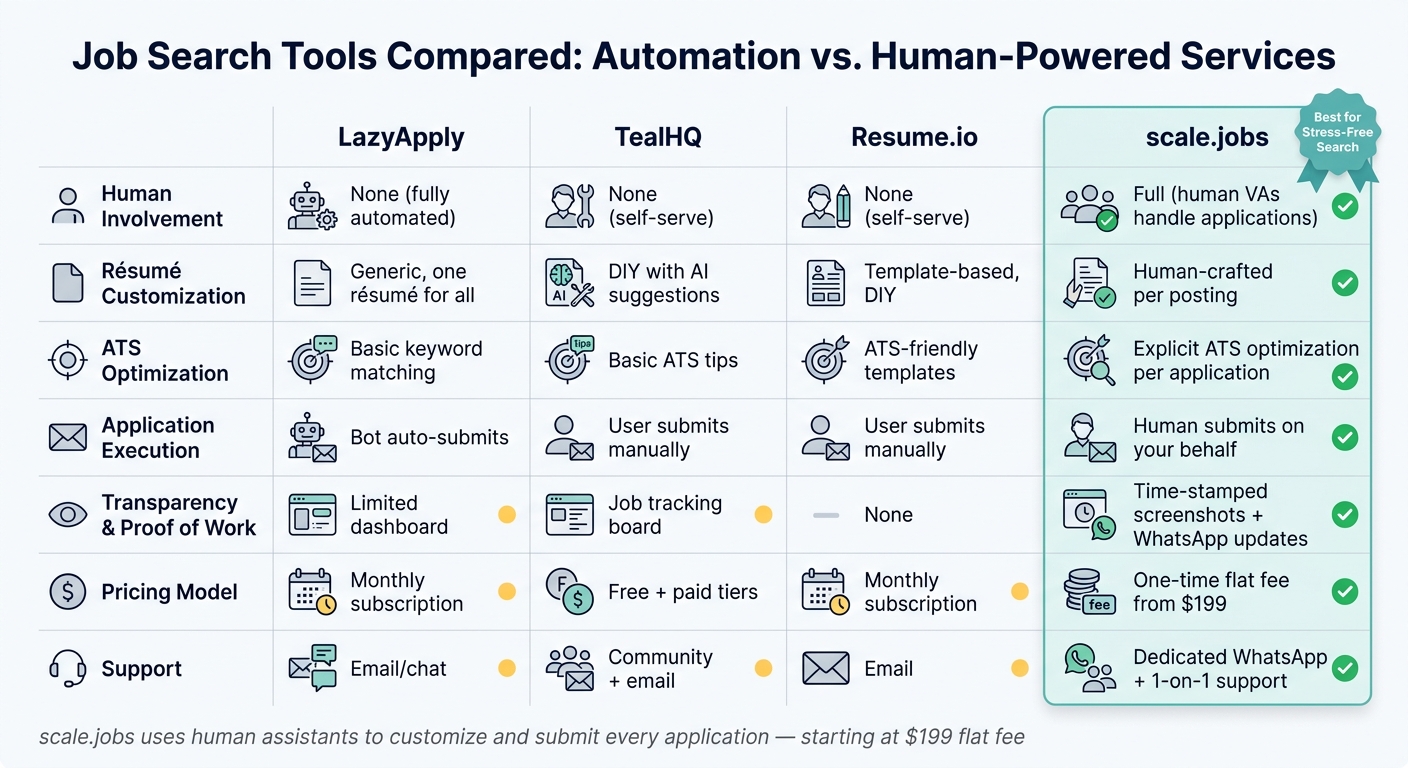
Job Search Tools Compared: Automation vs. Human-Powered Services
Automation vs. Human-Powered Job Search Services
Finding the right job search tool isn't just about saving time - it’s also about managing stress effectively. If automated platforms like LazyApply or Sonara have left you feeling overwhelmed, you might want to consider a human-powered service like scale.jobs.
Automated tools such as LazyApply and Sonara can connect to multiple job boards and submit hundreds of applications using a single résumé and basic filters. This approach is great for sheer volume, but it comes with downsides. You may lose track of where your applications were sent, which can create confusion and add to your anxiety.
On the other hand, human-powered services prioritize quality over quantity. Instead of blasting out generic applications, they focus on tailoring your résumé and cover letters to specific roles. For instance, scale.jobs employs human assistants to customize your materials for every job posting. They also provide clear records of each submission, including time-stamped proof-of-work screenshots. This level of detail ensures you always know what’s been done, reducing the uncertainty that often comes with automated tools.
The following table highlights the differences between popular job search tools to help you decide what suits your needs best.
Side-by-Side Comparison of Popular Job Search Tools
| Feature | LazyApply | TealHQ | Resume.io | scale.jobs |
|---|---|---|---|---|
| Human involvement | None (fully automated) | None (self-serve) | None (self-serve) | Full (human VAs handle applications) |
| Résumé customization | Generic, one résumé used across all apps | DIY with AI suggestions | Template-based, DIY | Human-crafted per posting |
| ATS handling | Basic keyword matching | Basic ATS tips | ATS-friendly templates | Explicit ATS optimization per application |
| Application execution | Bot auto-submits | User submits manually | User submits manually | Human submits on your behalf |
| Transparency & proof of work | Limited dashboard | Job tracking board | None | Time-stamped screenshots + WhatsApp updates |
| Pricing model | Subscription (monthly) | Free + paid tiers | Subscription (monthly) | Flat-fee, one-time bundles from $199 |
| Support | Email/chat | Community + email | Dedicated WhatsApp + 1-on-1 support |
For those who prefer a DIY approach, tools like TealHQ and Resume.io offer helpful features. TealHQ provides a job tracking board that simplifies managing multiple applications, while Resume.io offers ATS-friendly templates that streamline résumé formatting. These tools are ideal for job seekers who want to stay hands-on but need a bit of support.
However, if you’re looking for a managed service that reduces stress and uncertainty, scale.jobs takes a different approach.
Who Should Use LazyApply vs. Who Should Choose scale.jobs
LazyApply might be right for you if:
- You want to send a high volume of applications quickly with minimal effort.
- You’re in the early stages of your job search and exploring different roles or industries.
- You’re comfortable handling follow-ups and tracking applications on your own.
- You prefer a low-cost subscription model and don’t mind managing the process yourself.
scale.jobs might be better suited if:
- You need each application tailored to the job description by a real person.
- You want ATS-optimized résumés and cover letters without doing the work yourself.
- You value transparency and want proof of every submission to ease your mind.
- You’re working under a tight timeline, such as an H-1B grace period, and need a reliable service.
- You prefer a one-time payment over recurring subscription fees, especially when your job search isn’t active.
Where scale.jobs Differs From the Rest
Looking at the features above, it’s clear where scale.jobs stands out. Their human-driven process ensures that your applications are customized for the job description and submitted manually through the employer’s portal. This approach minimizes the risk of ATS systems flagging bot-submitted applications and helps your tailored materials stand out during the screening process.
Additionally, their flat-fee pricing structure - starting at $199 for up to 250 applications - removes the unpredictability of monthly subscription costs. With real-time updates via WhatsApp and a transparent application log, scale.jobs offers a level of accountability that can make the job search far less stressful.
Switch to scale.jobs if…
- You need ATS-optimized résumés and cover letters crafted by real people, not generated by software or templates.
- You want real-time updates and proof of submissions delivered through WhatsApp, so you’re never left wondering.
- You prefer a one-time payment model instead of ongoing subscription fees.
- Keeping track of applications across multiple platforms is becoming overwhelming.
- You’ve tried high-volume automated tools but aren’t getting responses, signaling a need for more targeted, personalized applications.
Decision Summary: Which Tool Fits Your Job Search
Choosing the right job search tool means understanding your specific challenges and priorities. The comparisons above highlight key features, but here's a breakdown to help you decide which option suits your needs best.
Who Should Use Competitor Tools
- LazyApply: This tool works well if you're at the beginning of your career search and need to apply to many roles quickly. For instance, recent graduates applying to over 200 similar entry-level positions might prioritize speed over customization. LazyApply can help you cast a wide net without spending too much time on individual applications.
- TealHQ: If you're already employed and casually exploring new opportunities, TealHQ could be a good match. It’s a great fit for those who prefer a self-managed approach, using tools like tracking boards to stay organized. Plus, if you're on a tight budget, their free tier or affordable subscription options make this a practical choice.
When to Choose scale.jobs
If your job search has stretched on for months without significant results, or if the process feels overwhelming, scale.jobs might be the solution you need. This service is especially helpful for senior professionals, career changers, and visa holders (like H-1B, F-1, or OPT) where every application has higher stakes.
Here’s what sets scale.jobs apart:
- Tailored Human Support: Professional assistants create customized, ATS-friendly résumés and cover letters for each job application.
- Clear Communication: You’ll receive real-time updates via WhatsApp and time-stamped proof-of-work screenshots, ensuring transparency.
- One-Time Flat Fee: Starting at $199, this pricing model eliminates the hassle of subscriptions, letting you focus on interviews and networking.
- Stress Reduction: By outsourcing the time-consuming parts of the application process, you can dedicate your energy to preparing for interviews and other critical steps.
These features make scale.jobs a strong option for those juggling high application volumes or facing complex job search requirements.
Switch to scale.jobs if…
- Your job search has gone on for more than two months without meaningful responses, and managing multiple applications feels overwhelming.
- You’re targeting a high-stakes role, such as a senior-level position, a career change, or a job tied to visa requirements.
- You want consistent updates and accountability throughout the application process.
- You prefer a one-time payment model over recurring subscription fees.
Think about it: Do you have the time and organization to handle every detail of your job search yourself? If the answer is no, delegating those tasks to scale.jobs could save you time and reduce stress, allowing you to focus on what matters most - landing the job.
FAQs
How do I know if I’m burned out from job hunting?
If you’re dedicating 20–25 hours each week to customizing resumes and completing applications but seeing minimal results, you could be facing job search burnout. Common indicators include feeling drained, growing frustration with ATS rejections, and a noticeable slowdown in your progress. Burnout can actually prolong your job search by up to 40% and reduce your chances of success by 27%. If this resonates with you, it might be time to consider a more streamlined and supportive strategy.
What’s the simplest daily routine to job search without spiraling?
To maintain balance during your job search, concentrate on consistent progress instead of expecting instant outcomes. Setting a goal of submitting around 10 applications each day can add up to 300 applications a month, significantly increasing your chances of landing interviews. Treat your initial applications as a testing ground to evaluate how well your resume performs and refine it if necessary. Delegating time-consuming tasks, such as resume submissions, to a service like Scale.jobs can save you 20–30 hours each week. This extra time can be better spent on networking or preparing for interviews.
When should I outsource applications instead of using automation?
When aiming for competitive mid-to-senior roles, outsourcing to human-powered services like Scale.jobs can make a big difference. While automation might handle high-volume, entry-level applications, it often struggles to pass Applicant Tracking System (ATS) filters and lacks the personal touch needed for more advanced positions. Human-led services excel in creating ATS-optimized, role-specific applications, verifying work samples, and navigating complex application platforms like Workday or Taleo - areas where bots often fall short.