
The LazyApply Risk That Could Get Your Profile Banned on LinkedIn

Leela Yanamaddi
March 31, 2026

Using automation tools like LazyApply on LinkedIn might save time, but it can also lead to serious consequences, including account bans. LinkedIn’s policies strictly prohibit automated actions, such as bulk connection requests or job applications, which tools like LazyApply perform. Violating these rules triggers LinkedIn’s detection systems, which monitor unnatural patterns like repetitive actions and high activity volumes. This can result in temporary restrictions or permanent bans, with less than 10% of appeals succeeding.
For safer alternatives, human-powered services like Scale.jobs are recommended. These services manually handle applications, ensuring compliance with LinkedIn’s rules while providing tailored, ATS-friendly resumes for each job. Unlike automation tools, Scale.jobs minimizes risks by mimicking natural user behavior and offering transparent, one-time payment options.
If protecting your LinkedIn profile and professional connections is a priority, avoid automation tools and consider safer, manual options like Scale.jobs for your job search needs.
Why LazyApply Breaks LinkedIn's Rules
What LinkedIn Actually Prohibits
LinkedIn’s User Agreement, specifically Section 8.2, lays out clear restrictions on automation. The platform explicitly bans the use of "any engine, software, tool, agent or other device or mechanism (including spiders, robots, crawlers, data mining tools or the like) to navigate or search our Services other than the search agents provided and authorized by LinkedIn." This policy targets tools that automate tasks like profile interactions, connection requests, or messaging without user involvement.
LinkedIn uses browser fingerprinting to detect unapproved automation tools. LazyApply, for instance, auto-fills and submits forms without requiring manual confirmation, which activates LinkedIn’s detection systems.
The platform’s rules are designed to protect its ecosystem by allowing only approved integrations, such as Sales Navigator or HubSpot CRM. These tools operate within LinkedIn's official API guidelines. On the other hand, automation tools like LazyApply, which mimic human actions at an unnatural scale, violate these rules. LinkedIn monitors several activity patterns to identify unauthorized automation:
| Signal Type | What LinkedIn Monitors | Risk Level |
|---|---|---|
| Volume Patterns | 500 connection requests in 2 hours, 100 messages in 1 hour | Critical |
| Timing Patterns | Connections made at odd hours, like 3 a.m., or at exact, repetitive intervals | High |
| Browser Fingerprints | Detectable extension signatures or unusual browser behaviors | High |
| Message Similarity | Identical messages sent to 100+ users | Critical |
For example, LazyApply’s Ultimate plan enables users to submit up to 1,500 applications daily, a figure far beyond what a human could realistically manage. Even the Premium plan’s 150 daily applications, if submitted too quickly, can raise red flags with LinkedIn’s monitoring systems.
These flagged behaviors have real consequences for users.
Documented Cases of LazyApply-Related Bans
The risks aren’t hypothetical - there are real cases of users facing bans due to automation violations. While LazyApply claims its "advanced AI job search algorithms" minimize risks, LinkedIn’s enforcement history tells a different story. In March 2025, for instance, LinkedIn permanently banned Apollo.io and Seamless.ai for unauthorized automation and data scraping, leaving thousands of users locked out of their accounts.
LinkedIn employs a tiered enforcement system to handle violations. Initial infractions usually result in temporary restrictions lasting 24–48 hours. However, repeated offenses can lead to permanent bans. These measures are designed to protect the platform’s users from spam and unauthorized data usage.
Unlike LazyApply, Scale.jobs provides human-assisted vs. automated job applications that align with LinkedIn’s strict policies. If you’re seeking help with applications while avoiding risks to your LinkedIn profile, services like professional resume writing or job application assistance are safer alternatives. These services rely on real people to tailor and submit applications, ensuring compliance with LinkedIn’s rules while still helping you expand your job search effectively.
LazyApply vs Scale.jobs: Why Human-Powered Applications Avoid Bans
Where LazyApply Works Well
LazyApply shines when speed and volume are the priority. Its automation tools allow users to submit far more applications than traditional methods. This makes it particularly useful for entry-level roles in retail, warehouse jobs, or gig economy positions - roles that typically don’t require highly customized resumes or cover letters. By spreading applications across multiple job boards, LazyApply can save users countless hours of filling out repetitive forms.
That said, while LazyApply focuses on quantity, Scale.jobs prioritizes precision and safety through its human-assisted approach.
4 Ways Scale.jobs Outperforms LazyApply
1. No risk of bot detection
Scale.jobs employs trained human assistants to manually submit each application. Since these submissions are made during regular business hours (9 a.m.–5 p.m.), they mimic natural human activity. Automated tools like LazyApply often trigger LinkedIn’s algorithms, leading to a 70–85% ban rate within 30 days. By avoiding automation entirely, Scale.jobs ensures users stay compliant with platform rules.
2. Tailored, ATS-friendly documents for every job
LazyApply typically sends the same resume to multiple job postings, which can hurt your chances of standing out. In contrast, Scale.jobs crafts a unique, ATS-optimized resume and cover letter for each role by aligning the documents with keywords from the job description. This personalized touch not only improves application success rates but also helps maintain a strong connection acceptance rate - critical for avoiding penalties when acceptance rates dip below 50%.
3. Real-time updates through WhatsApp
Scale.jobs provides proof-of-work by sharing time-stamped screenshots of submitted applications via a dedicated WhatsApp channel. Unlike dashboards that only show the number of applications sent, these real-time updates give users clear visibility into the process, ensuring every application is handled exactly as promised.
4. Transparent, one-time payment options
Rather than locking users into recurring monthly fees, Scale.jobs offers straightforward flat-fee bundles. Options include $199 for 250 applications, $299 for 500, and $399 for 1,000 applications. With refunds available for unused applications, this model avoids surprise charges and gives users complete control over their spending.
"The difference between staying safe and getting banned often comes down to understanding which specific behaviors LinkedIn's algorithms flag and how to operate within human-level activity patterns." – Alex Thompson, Certified LinkedIn Sales Professional
The right way to automate on LinkedIn Without Getting Banned
Feature Comparison: LazyApply vs scale.jobs
LazyApply vs Scale.jobs: Feature Comparison for LinkedIn Job Applications
Comparison Table
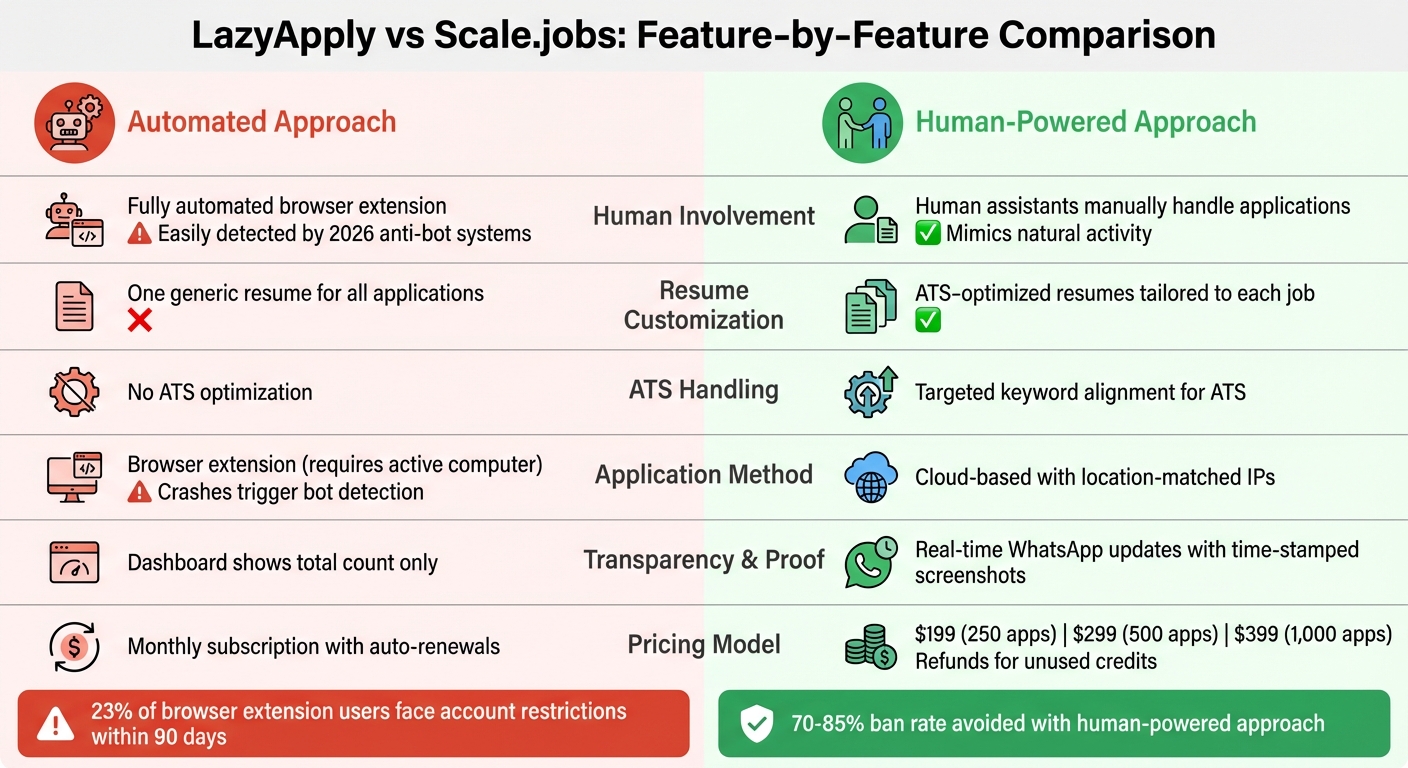
Here's a side-by-side comparison of LazyApply's fully automated approach and scale.jobs' human-assisted process to help you understand how they handle key aspects of job applications.
| Feature | LazyApply | scale.jobs |
|---|---|---|
| Human Involvement | Fully automated browser extension; injects code into LinkedIn pages but is easily detected by 2026 anti-bot systems | Human assistants manually handle applications, mimicking natural activity to avoid detection |
| Resume Customization | Uses a single generic resume for all applications; lacks job-specific tailoring | Creates ATS-optimized resumes and cover letters tailored to individual job descriptions |
| ATS Handling | Basic automation without optimization for Applicant Tracking Systems (ATS) | Documents are designed to match ATS requirements with targeted keyword alignment |
| Application Method | Relies on a browser extension that needs an active computer; crashes can trigger bot detection | Operates through cloud-based servers with location-matched IPs for seamless platform interaction |
| Transparency & Proof | Offers a dashboard showing only the total number of applications; lacks detailed submission proof | Provides real-time WhatsApp updates with time-stamped screenshots of submitted applications for complete transparency |
| Pricing Model | Monthly subscription with auto-renewals | Flat-fee bundles: $199 for 250 applications, $299 for 500, $399 for 1,000, with refunds for unused credits |
A report from 2026 revealed that 23% of users relying on browser-based extensions experienced account restrictions within 90 days. LinkedIn's behavioral AI flags tools that operate at fixed, predictable intervals, such as performing actions every 45 seconds. On the other hand, human-first protocols, like those used by scale.jobs, introduce variable delays (e.g., waiting 45 seconds for one action, then 4 minutes for another) to imitate natural behavior and avoid detection.
These differences highlight when each platform might be the right fit. If you're aiming for a secure, effective job search process, consider exploring professional resume writing services to stand out. For more insights, read our guide on how to beat ATS algorithms when transitioning to scale.jobs for your applications.
Who Should Use LazyApply and Who Should Choose scale.jobs
LazyApply: For High-Volume, Low-Customization Needs
LazyApply is designed for those who prioritize quantity over customization in their job applications. It works best for users who don’t rely heavily on their LinkedIn profiles for ongoing networking or professional visibility. However, automated tools like LazyApply come with a significant downside - users risk account restrictions or even bans, which could lead to the loss of valuable professional connections and years of networking history.
For those concerned about protecting their profiles and maintaining professional safety, switching to a human-powered approach can greatly reduce these risks.
scale.jobs: For Customized Applications Without Platform Risk
On the other hand, scale.jobs caters to job seekers who require a more tailored and secure application process. This is particularly important for mid-career professionals, as a LinkedIn Level 4 ban could disrupt years of networking and limit access to referral-driven opportunities. By using human assistance, scale.jobs avoids automation patterns that platforms can detect, ensuring a safer and more natural application process.
For individuals facing tight hiring timelines - like those navigating visa requirements (H-1B, OPT, TN) - scale.jobs offers customized resumes crafted for each job description. The service includes real-time updates via WhatsApp and time-stamped proof of every submission. Its flat-fee pricing model ($199 for 250 applications, $299 for 500, $399 for 1,000) removes the hassle of recurring subscriptions, and refunds are available for any unused credits.
For employed professionals who need to apply discreetly, scale.jobs ensures activity is spread naturally throughout the day. Human assistants maintain safe limits, such as fewer than 15 connection requests and fewer than 15 direct messages daily. To further enhance your chances, consider pairing this service with top resume writing services, ensuring your materials are polished and effective without raising any red flags on job platforms.
Switch to scale.jobs If...
You've Received LinkedIn Warnings or Restrictions
If LinkedIn has flagged your account, continuing to use tools like LazyApply could increase the risk of a permanent ban. LinkedIn keeps a close watch on flagged accounts, especially for signs of bot-like activity, and automation tools often trigger high ban rates. A ban can have serious, lasting consequences. Switching to a human-powered service like scale.jobs removes the automated activity that LinkedIn typically targets. With scale.jobs, your daily activity stays within safe, human-like limits - fewer than 15 connection requests and 15 messages, naturally spaced throughout business hours. This approach not only protects your account but also allows for a more tailored and genuine application process.
You Need Tailored Resumes for Each Application
Safety is important, but so is effectiveness. LazyApply often sends out the same generic resume for every job, which can hurt your chances when recruiters or ATS systems are looking for role-specific keywords. For example, a product manager role at a fintech startup will likely require a different focus compared to a B2B SaaS position. scale.jobs ensures that each application is paired with a customized, ATS-friendly resume delivered within 24 hours. Human assistants carefully analyze job descriptions, highlight relevant skills and projects, and format resumes to perform well in automated screenings. This level of precision is especially critical for roles with tight deadlines, such as those relevant to H-1B or OPT visa holders. If you want to refine your base materials further, scale.jobs also offers professional resume writing services to bolster your job search.
You Want to Avoid Recurring Subscription Fees
LazyApply's monthly subscription model can become expensive if your job search takes longer than expected. On the other hand, scale.jobs provides flat-fee bundles that offer more flexibility and value. Options range from $199 for 250 applications to $399 for 1,000 applications, with a one-time payment and refunds for any unused credits. Along with this, you get real-time WhatsApp updates, proof-of-work screenshots, and human-driven customization, making it a more cost-effective and transparent solution compared to ongoing automated services.
If LinkedIn warnings, the need for customized resumes, or recurring fees are concerns for you, scale.jobs offers a safer, more personalized, and budget-friendly alternative.
Decision Summary
Your decision between LazyApply and Scale.jobs depends on what matters more to you: speed or maintaining the safety of your professional profile.
Opt for LazyApply if Volume and Speed Are Your Priorities
LazyApply is designed for those who need to apply to a large number of jobs quickly. With plans that allow up to 1,500 applications per day, it prioritizes volume over precision. This tool is ideal for job seekers focused on high-output searches, where tailoring applications isn't a top concern. It's particularly suited for situations where your LinkedIn profile isn't a critical professional asset, and you're okay with the possibility of platform warnings due to automation. LazyApply users typically send out 50–100 applications daily, a massive leap compared to the usual 5–10 manual submissions. Pricing ranges from $99 to $999 annually, making it a time-saving option for high-volume job searches.
However, if safety and customization are essential to you, Scale.jobs may be a better fit.
Opt for Scale.jobs for Safe, Personalized Applications
Scale.jobs offers a safer, more personalized alternative, especially if your LinkedIn profile carries significant value or you’re targeting competitive roles. Instead of automation, human assistants manage each application to replicate natural behavior, reducing the risk of account warnings. Every application includes a tailored, ATS-friendly resume delivered within 24 hours. With flat-fee bundles starting at $199, Scale.jobs focuses on quality and safety, ensuring your materials pass recruiter screenings. This approach is particularly beneficial if you’ve already received LinkedIn warnings or are applying to roles where precision is key. For an even stronger start, their professional resume writing services can help refine your application materials before you begin your search.
FAQs
How can I tell if LinkedIn has flagged my account for automation?
If you're wondering whether LinkedIn has flagged your account, look out for specific signs. These include sudden restrictions on sending connection requests, messaging other users, or viewing profiles. LinkedIn uses algorithms to detect unusual activity, such as performing a large number of actions in a short period. If flagged, you might face temporary limitations or receive notifications about suspicious activity. To avoid this, aim to keep your actions within a natural and reasonable pace.
If I stop using automation now, how long until my LinkedIn risk drops?
If you stop relying on automation, your LinkedIn account's risk level could drop noticeably within a few weeks to a month. Restrictions are typically linked to unusual activity patterns or high volumes of actions. By scaling back or completely stopping automated tools, you give your account the chance to recover gradually and return to normal activity levels.
What application volume is "human-like" enough to avoid LinkedIn limits?
A realistic application rate on LinkedIn hovers around 30 applications per day. This number is designed to mimic natural human activity, as LinkedIn keeps a close eye on user patterns to ensure they reflect genuine behavior. Pushing beyond this limit could activate LinkedIn's automated monitoring systems, potentially leading to account restrictions or even bans. Keeping your daily applications within this range helps maintain your account's safety and avoids unnecessary complications.