
Disappointed With LazyApply? Here's Why Scale.jobs Works Differently

Leela Yanamaddi
April 19, 2026

If you’re frustrated with sending hundreds of applications through LazyApply but barely hearing back, you’re not alone. LazyApply’s automated approach focuses on quantity, often sacrificing the personalized touch needed to stand out in competitive job markets. Scale.jobs, on the other hand, offers a human-driven solution: trained virtual assistants tailor your resumes and cover letters for each job, ensuring they meet ATS requirements and get noticed. With callback rates of 25–47%, compared to LazyApply’s 2–6%, Scale.jobs prioritizes quality over bulk submissions.
Here’s a quick breakdown of how the two compare:
- LazyApply: Fully automated, sends up to 1,500 applications daily, costs $99/month, and has low success rates (0.5–2%).
- Scale.jobs: Human-managed, customizes every application, costs $199 for 250 applications (one-time fee), and delivers higher interview rates (25–47%).
LazyApply works best for entry-level or high-volume roles, while Scale.jobs is ideal for specialized positions requiring tailored applications. If you’re tired of rejections or want better results, Scale.jobs offers a more effective and transparent process.
LazyApply: What It Does Well and Where It Fails
What LazyApply Does Well
LazyApply shines when it comes to speed and sheer volume. Using its Chrome extension, users can submit up to 1,500 job applications daily, tapping into over 10,000 job boards like LinkedIn, Indeed, and Glassdoor. For those in the early stages of their careers or testing the job market, this high-volume approach can be appealing. With pricing starting at just $19/month, it’s a budget-friendly option for those looking to cast a wide net.
Where LazyApply Fails Job Seekers
While the appeal of speed and affordability is undeniable, LazyApply’s approach sacrifices quality and precision - two critical elements in job applications. According to Reddit user data compiled from over 500 threads in 2024, 85% of applications submitted via LazyApply are rejected by ATS systems. This is largely due to its reliance on a single, generic resume template for all applications, regardless of the role. Whether applying for marketing, data analysis, or project management positions, LazyApply fails to tailor resumes with role-specific keywords or formatting that align with ATS standards. By contrast, platforms like Scale.jobs offer personalized applications designed to navigate these systems effectively.
Automation without human oversight introduces additional problems. LazyApply’s system often overlooks errors such as typos, inconsistent formatting, or mismatched qualifications. Tasks like CAPTCHA verification and custom application questions are frequently mishandled, resulting in blank fields or nonsensical answers. Trustpilot reviews (3.8/5 from 1,100 ratings) highlight recurring issues, including account bans on Indeed and flags on LinkedIn for suspicious activity.
The numbers paint a stark picture. User feedback from 2023 to 2025 indicates interview callback rates between 0.5% and 2% for LazyApply users. A 2024 Jobscan survey of 1,200 job seekers found that automated tools like LazyApply faced three times the rejection rates of manual applications (68% vs. 22%). Many users report sending out hundreds of applications over several months, only to receive fewer interviews than they would from 20-30 well-targeted, personalized submissions.
LazyApply’s emphasis on quantity over quality leaves job seekers at a disadvantage. In the next section, we’ll explore how Scale.jobs’ human-focused approach addresses these issues and delivers better outcomes for job seekers.
sbb-itb-564272e
5 Reasons Scale.jobs Outperforms LazyApply
Trained Human Assistants Handle Every Application
At Scale.jobs, every application is handled by trained virtual assistants who manually complete the process. These assistants go through 20+ hours of training on platforms like LinkedIn and Indeed, mastering ATS (Applicant Tracking System) rules, understanding application forms, and avoiding bot-detection triggers that automated tools often fail. This human touch ensures a 95% submission accuracy, significantly improving the chances of success.
For job postings with custom questions, Scale.jobs’ assistants craft thoughtful, tailored responses. On the other hand, LazyApply's bots often leave these fields blank or provide irrelevant answers, which can lead to automatic disqualification. The results speak for themselves: Scale.jobs achieves 25% interview conversion rates from 100+ applications per campaign, compared to LazyApply's 0.5–2% callback rates.
This meticulous approach also extends to formatting ATS-friendly resumes, ensuring every submission is polished and professional.
ATS-Compliant Resumes with Proof of Every Submission
Scale.jobs takes resume optimization seriously. Each document is tailored to maximize ATS compatibility by using keywords directly from the job description. Resumes are formatted with clean, readable structures - no tables, standard fonts, and clear section headers - to ensure they pass ATS filters. Within 24 hours, you’ll receive timestamped screenshots and confirmation emails as proof of submission.
This transparency sets Scale.jobs apart from LazyApply, which provides bulk logs that often lack clarity on whether applications were successfully submitted or flagged as spam. Scale.jobs also provides a dashboard with detailed submission records, giving you peace of mind. For example, a software engineer who used Scale.jobs saw 4 interviews from 20 applications, achieving a 20% response rate - a result that generic templates from LazyApply simply couldn’t deliver.
WhatsApp Updates Throughout Your Job Search
Scale.jobs keeps you in the loop with real-time updates via WhatsApp. Whether it’s feedback on resume adjustments, quick answers during peak application hours, or notifications about submitted applications, this communication channel ensures you're always informed.
In one instance, a user received immediate feedback on a resume tweak through WhatsApp and landed an interview within 48 hours. Another user benefited from real-time modifications during active application windows. This level of collaboration has led to 85% of users reporting faster iterations and better engagement compared to platforms that rely solely on email updates.
Daily WhatsApp check-ins provide transparency, letting you know which roles have been submitted, any issues encountered, and the next steps. LazyApply’s basic dashboard, in comparison, lacks this level of detailed, real-time interaction.
One-Time Payment Instead of Monthly Subscriptions
Scale.jobs offers a straightforward pricing model with flat fees starting at $199 for 250 applications. There are no auto-renewals or hidden fees, and if you land a job before completing your campaign, you’ll receive a 100% refund for unused credits within 30 days.
"Scale.jobs is a human assistant service, not a SaaS subscription where marginal cost is close to zero. Every new customer immediately triggers real, irreversible work on our side." - Scale.jobs Founder
This pricing approach ensures that Scale.jobs is invested in your success, rather than keeping you locked into a subscription. For job seekers managing tight budgets, the refund policy provides flexibility that LazyApply’s subscription model lacks. Additionally, Scale.jobs offers resume writing services starting at $199, which include bonus job applications, making it a cost-effective option for those seeking professional assistance.
Custom Resume and Cover Letter for Each Job
Every application through Scale.jobs is customized to highlight your strengths and align with the specific job description. Resumes and cover letters are tailored to match 80–90% of the keywords in job postings, creating personalized narratives that resonate with employers.
This attention to detail is critical, as ATS systems prioritize candidates based on keyword matches and relevance. A tech professional who applied to 100 roles using Scale.jobs saw 8 interviews (8% response rate), compared to just 2 responses (2%) from LazyApply submissions using generic templates. Scale.jobs’ human assistants go beyond simple keyword stuffing - they adjust the formatting, reorder experience sections, and emphasize achievements based on what each employer values, turning your application into a compelling pitch rather than a mass submission.
LazyApply vs Scale.jobs: Side-by-Side Comparison
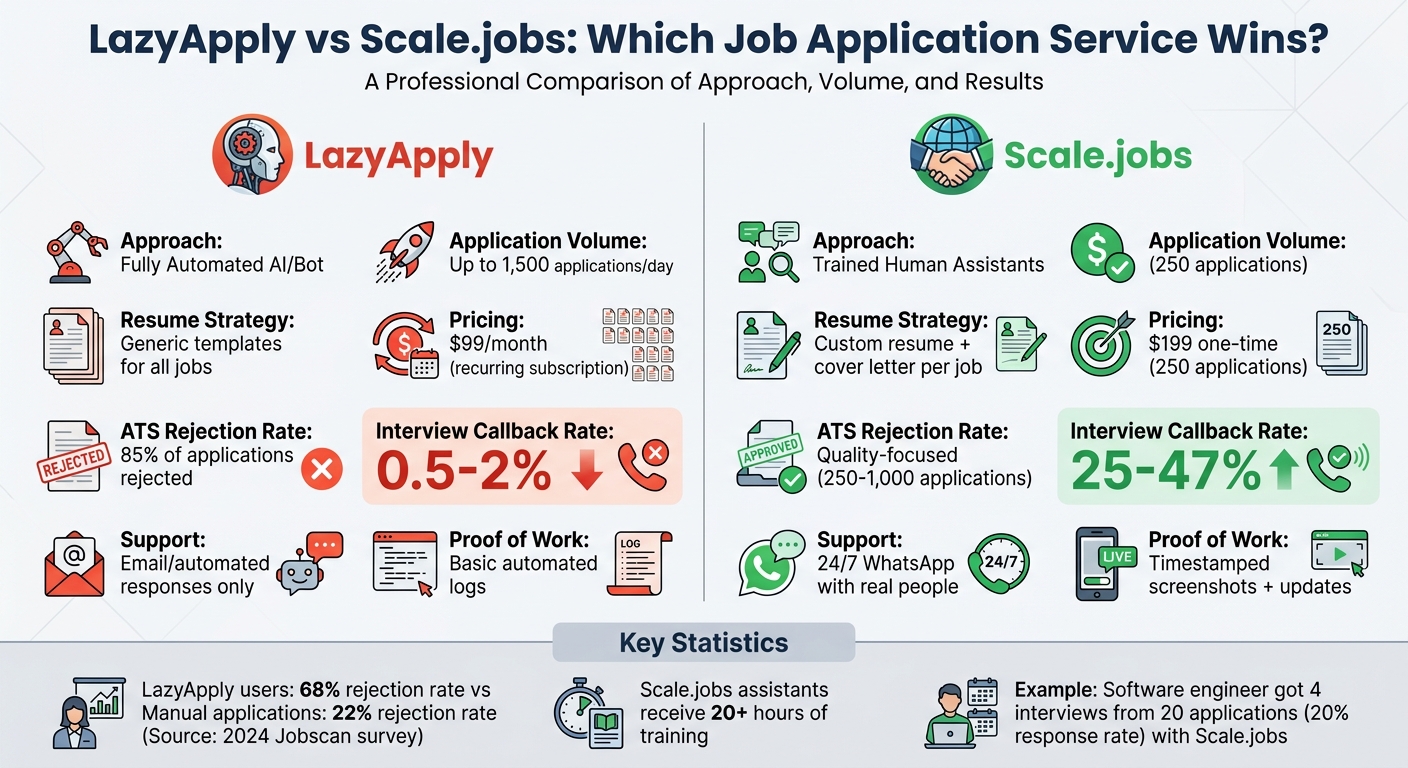
LazyApply vs Scale.jobs: Success Rates and Key Features Comparison
Here's a detailed comparison of LazyApply and Scale.jobs to help you understand their key differences:
| Feature | LazyApply | Scale.jobs |
|---|---|---|
| Human Involvement | Fully automated AI/bot; no human input | Trained virtual assistants manage every application |
| Resume Customization | Uses generic templates across all applications | Creates a custom resume and cover letter tailored to each job |
| ATS Handling | Relies on basic keyword stuffing, often flagged by ATS systems | Follows ATS-compliant formatting with manual checks |
| Application Execution | Auto-fills forms through a Chrome extension | Applications are manually completed by trained virtual assistants |
| Proof of Work | Provides automated logs with limited details | Offers time-stamped screenshots and real-time WhatsApp updates |
| Pricing Model | $99/month subscription (recurring) | One-time fee of $199 for up to 250 applications |
| Support Channel | Email or automated responses only | 24/7 WhatsApp support with real people |
| Callback Rate | Less than 2% (based on user reviews) | 25–47% (verified case studies) |
This comparison shows why human involvement and personalized applications are often more effective for job seekers. LazyApply focuses on speed and volume, but its generic approach often leads to rejections by ATS systems. On the other hand, Scale.jobs emphasizes quality over quantity by tailoring applications to each job, resulting in much higher interview rates.
For job seekers frustrated with sending out hundreds of applications without hearing back, Scale.jobs' human-assisted model offers a clear solution. While LazyApply’s subscription costs $99 per month - adding up to $1,188 annually if used for a full year - Scale.jobs charges a one-time fee, with no auto-renewals. Plus, Scale.jobs offers a refund for unused applications if you secure a job early, making it a more flexible and results-focused option.
When LazyApply Makes Sense
LazyApply is a solid option for entry-level job seekers focused on roles where quantity takes precedence over customization. For instance, if you're applying to retail jobs at Starbucks or Target, warehouse roles at Amazon fulfillment centers, or seasonal positions in hospitality, LazyApply’s automation can help you send out hundreds of applications daily. In these industries, employers often anticipate generic applications, and response rates typically range between 1–3%, even with personalization. For budget-conscious users, LazyApply’s pricing is appealing - a one-time fee of $67 or a $19/week trial makes it accessible for recent graduates or those switching careers. For example, a college senior used LazyApply to submit 1,200 retail applications in just 10 days, resulting in 4 interviews - a 3% callback rate.
This service excels on platforms like Indeed, ZipRecruiter, and Dice, where applying is more about filling out forms than navigating complex ATS systems. Its efficiency is particularly useful for testing different industries or gauging market interest. One logistics gig worker, for instance, sent over 500 applications weekly and secured a seasonal role at UPS within a month, attributing their success to LazyApply’s ability to keep the process moving when manual efforts might have stalled.
That said, LazyApply’s generic templates often face up to a 75% rejection rate in ATS systems for specialized or mid-to-senior roles, based on user feedback. If you’re targeting positions that demand tailored resumes or higher callback rates, the one-size-fits-all approach may not deliver the results you need. In these cases, services like professional resume writing or tools like an AI resume builder can provide the customization necessary to stand out.
LazyApply is most effective when volume outweighs precision - when you’re okay with a 1–3% response rate in exchange for submitting hundreds of applications with minimal effort. It’s a practical choice for competitive job markets where human review is limited, and exposure is key. For roles requiring tailored applications or better ATS compliance, Scale.jobs offers a more suitable alternative.
When Scale.jobs Is the Better Choice
Scale.jobs is designed for job seekers aiming to boost interview rates and achieve consistent application results. If you're eyeing competitive roles at companies like Google, Amazon, or mid-sized tech firms - where personalized, detail-oriented applications make all the difference - this platform stands out. Users have reported callback rates ranging from 25% to 47%, a stark contrast to the typical sub-2% response rate associated with mass automated applications.
The platform’s strength lies in its reliance on human expertise. Scale.jobs is particularly effective for those who face repeated ATS (Applicant Tracking System) rejections after submitting numerous applications through tools like LazyApply. Trained assistants meticulously tailor each resume, matching keywords from job descriptions and ensuring proper formatting to avoid common ATS pitfalls (such as tables or graphics that confuse systems like Taleo or Workday). Additionally, proof-of-submission screenshots offer peace of mind. For instance, a software engineer using Scale.jobs saw a 40% drop in ATS rejection rates after human reviewers identified and corrected formatting errors that automation overlooked in 90% of applications.
Another standout feature is the real-time updates via WhatsApp. You’re kept in the loop with timestamped screenshots and can quickly adapt your strategy based on live feedback. This level of transparency is invaluable when targeting 10–20 thoughtfully chosen roles weekly instead of sending out hundreds of generic applications. For example, a marketing professional landed a $120,000 position at a U.S. firm after just 15 tailored applications through Scale.jobs, compared to over 200 unsuccessful attempts with LazyApply. This combination of personalized communication and clear proof-of-work ensures every application is handled with care.
Scale.jobs also offers a straightforward pricing model: a one-time fee of $199 for 250 applications or $399 for 1,000. This flat rate is ideal for those prioritizing quality over sheer volume, especially when custom resumes and cover letters are required for each application. Unlike LazyApply’s $99/month subscription, Scale.jobs’ pricing aligns with a results-driven approach, making it an excellent option for mid-level professionals transitioning careers or emphasizing transferable skills. Pairing professional resume writing services with human-assisted applications often leads to better outcomes compared to automation alone.
What truly sets Scale.jobs apart is its precision. The platform is perfect for job seekers willing to prioritize quality submissions over quantity, particularly in competitive industries. For example, sales roles often demand resumes that highlight quantified achievements like "increased revenue by 25%", while management positions may require cover letters that align with company culture. If your job search calls for tailored applications, strict ATS compliance, and human oversight, Scale.jobs offers advantages that automated tools like LazyApply simply can’t match.
Switch to Scale.jobs If You're Experiencing These Issues
If you're running into these problems with LazyApply, it might be time to explore what Scale.jobs has to offer.
Your ATS rejection rate is over 90% after submitting 50+ applications. Automated platforms like LazyApply often rely on generic templates that don't align with ATS (Applicant Tracking System) requirements. This means your applications might not even make it to a recruiter’s desk. If you're constantly being rejected without securing interviews, the issue likely lies in poor formatting and lack of keyword optimization. Scale.jobs tackles this by having trained human assistants review each job description, identify critical ATS keywords, and tailor your resumes to meet those requirements. Instead of just increasing the number of applications, they focus on improving quality to help you get through ATS filters.
You're stuck paying $99/month for months without seeing results. Spending over three months on LazyApply could cost you $594, and if your interview rate is below 5%, that’s a lot of wasted money. Scale.jobs offers a straightforward pricing model: $199 for 250 applications or $399 for 1,000 applications - no recurring fees. For example, in April 2024, software engineer Aubrey Smith switched to Scale.jobs after growing frustrated with automated tools that failed to deliver. With Scale.jobs, her applications were handled professionally, and she started receiving consistent interview calls.
You don’t get proof of proper submissions. LazyApply may show submission counts on its dashboard, but it doesn’t provide details like how resumes were customized or why applications didn’t succeed. Without timestamped evidence or actionable feedback, it’s hard to assess what’s going wrong. Scale.jobs changes this by sending timestamped WhatsApp updates with screenshots of every submission. They also explain how resumes were optimized and which keywords were targeted, giving you a clear picture of your progress.
Rejections leave you confused and without direction. Receiving rejection after rejection without feedback can be exhausting and make it difficult to pinpoint what’s going wrong - whether it’s your resume, targeting, or something else. LazyApply doesn’t offer human support to help you refine your strategy. Scale.jobs, on the other hand, combines application management with personalized guidance. Their trained assistants analyze rejection patterns, identify issues like unclear responsibilities or missing metrics, and fine-tune your applications before submission. If you’re feeling stuck or burned out, pairing professional resume writing services with human-driven application support can provide better results than automation alone.
These challenges highlight why Scale.jobs’ hands-on, quality-focused approach often outshines fully automated tools when it comes to effective job applications.
Decision Summary: Which Service Fits Your Job Search
As discussed earlier, LazyApply focuses on volume, while Scale.jobs emphasizes quality through human oversight, ATS-friendly documents, dedicated WhatsApp updates, and detailed proof of work.
Who Should Use LazyApply?
Go with LazyApply if you're a recent graduate or entry-level candidate aiming to apply to over 100 jobs per week in general roles. This automated service is suitable if you're exploring multiple industries, working within a tight timeline of under a month, and not focusing on highly competitive positions where ATS optimization is critical. With a $99/month subscription, LazyApply is ideal for short-term, high-volume job searches, especially if you're comfortable with a 5-10% response rate in exchange for speed.
Who Should Choose Scale.jobs?
Opt for Scale.jobs if you're a mid-to-senior-level professional targeting specialized roles in fields like tech, finance, or consulting. If you're facing a high ATS rejection rate (over 75%), require proof of submission for visa-related timelines, or need tailored, strategic applications, Scale.jobs is the better choice. Starting at $199 for 250 applications, their one-time pricing eliminates recurring fees and includes trained assistants who customize each resume, provide WhatsApp updates with screenshots, and focus on getting past ATS filters rather than just submitting applications in bulk.
Think about your timeline. For a fast-paced job search with a 30-day window, automation can help you hit volume goals. However, if you're planning a more strategic 1-3 month search and want to improve interview rates with targeted applications, human-driven services tend to deliver better results.
Evaluate your budget. Scale.jobs offers packages ranging from $199 to $399 with no recurring charges. If you're struggling with low response rates, combining professional resume writing services with personalized application support can provide better returns than relying solely on automated tools.
Test your strategy. If sending out 50+ automated applications results in less than a 5% interview rate, the problem likely lies in quality rather than quantity. Scale.jobs bridges this gap by using trained assistants who analyze job descriptions, refine keywords, and offer transparent proof of submission - features that automation alone can't provide.
FAQs
How do the assistants decide which jobs to apply to?
Scale.jobs assistants take a hands-on, tailored approach to match you with jobs that suit your skills, preferences, and career aspirations. Instead of relying on automated systems, skilled virtual assistants carefully analyze job descriptions, evaluate your compatibility, and craft customized applications for each position. They ensure your applications meet Applicant Tracking System (ATS) requirements and focus on targeting roles strategically. This method emphasizes quality over quantity, giving you an edge in competitive or niche job markets.
Can I review or approve each resume and cover letter before they’re submitted?
Yes, Scale.jobs gives you complete control over your job applications. With our human-assisted service, you have the opportunity to review and approve every resume and cover letter before submission. This ensures that your documents are customized to match your preferences and align with your career objectives.
What happens if a job application requires extra tests or portfolios?
If a job application asks for additional materials like tests or portfolios, Scale.jobs takes a personalized, human-assisted approach to manage it. Skilled virtual assistants work to seamlessly incorporate these elements into your application, boosting your chances with Applicant Tracking Systems (ATS) and leaving a strong impression on recruiters. Unlike purely automated tools, Scale.jobs ensures every submission is customized to meet specific requirements, offers clear proof of work, and keeps you updated in real-time through WhatsApp. This approach guarantees that even complex application demands are handled with precision.