
Learn These #6 Skills Before Your Next Job Hunt

Sarah Mitchell
May 25, 2026

Struggling to land interviews despite sending out countless applications? The problem might not be your qualifications but how you're approaching the job market. With over 90% of Fortune 500 companies using Applicant Tracking Systems (ATS) and 85% of jobs filled through networking, job hunting today requires more than just effort - it demands strategy.
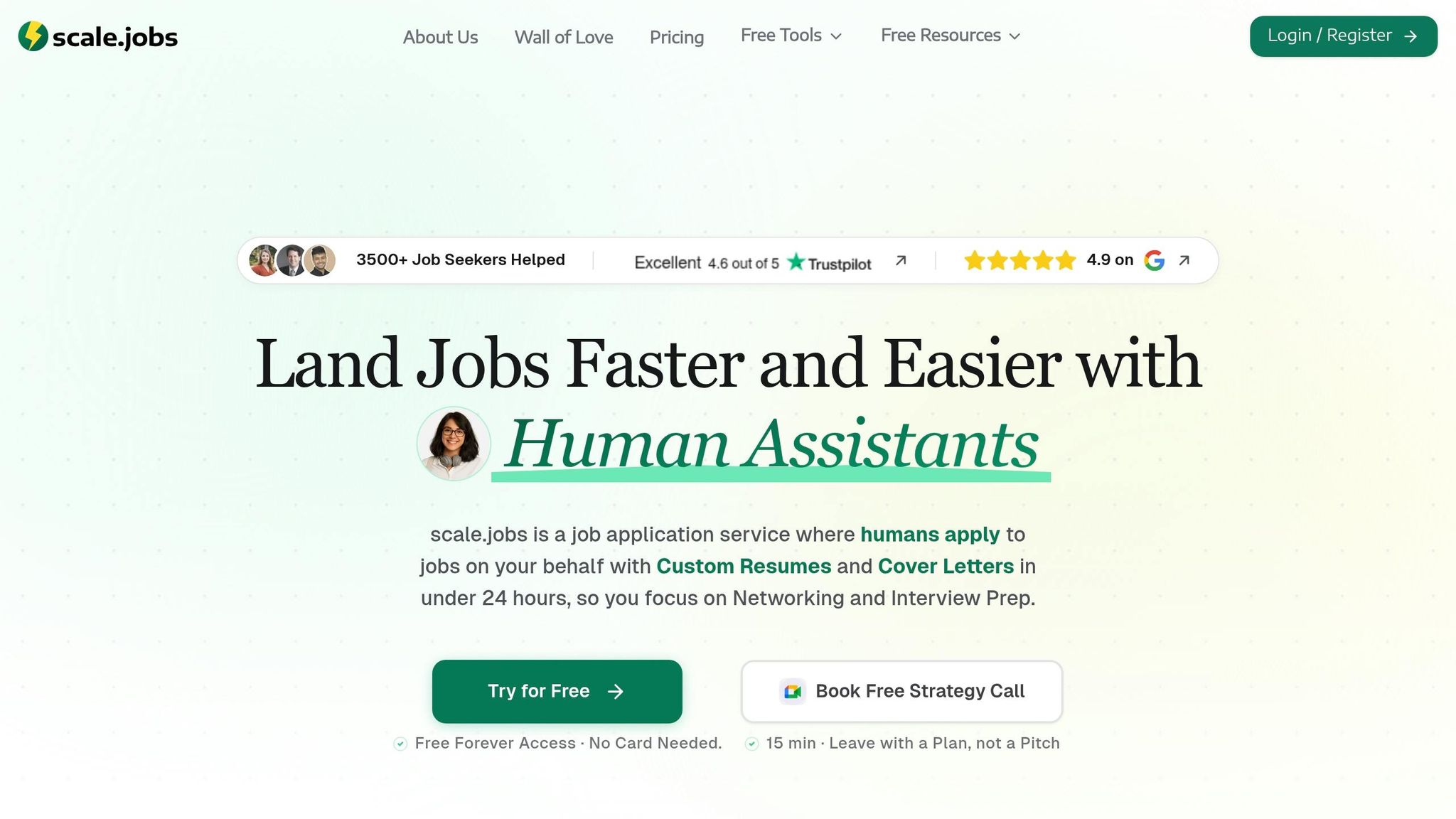
Here’s what you need to know: mastering six key skills - ATS-friendly resumes, efficient applications, networking, interview prep, tracking progress, and using the right tools - can dramatically improve your results. This guide breaks down actionable steps and tools like scale.jobs to streamline the process, save time, and boost your chances of success.
Key Takeaways:
- Optimize your resume for ATS: Use simple formatting and keywords from job descriptions.
- Leverage AI for applications, but review manually: Combine automation with human oversight for quality.
- Network effectively: Focus on building relationships; 70% of jobs aren’t publicly listed.
- Prepare for interviews: Use the STAR framework and create a "story bank" of examples.
- Track your progress: Use tools like Google Sheets or Teal to measure application-to-interview rates.
- Choose the right tools: Compare options like LazyApply, Jobscan, and scale.jobs to find what fits your needs.
By following these steps, you can turn your job hunt into a structured, results-driven process. Let’s dive deeper into each skill and the tools that can help you succeed.
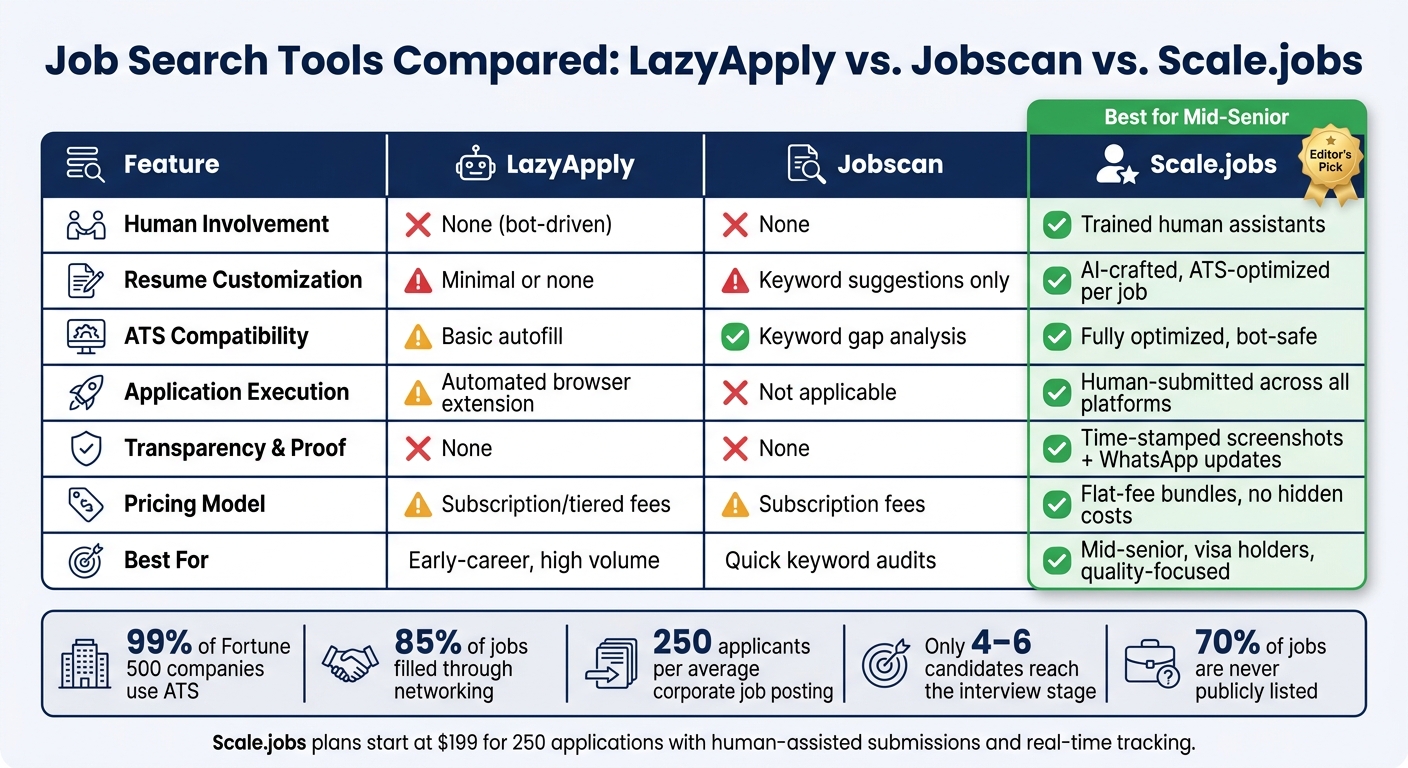
LazyApply vs Jobscan vs Scale.jobs: Job Search Tools Compared
20 Years of Job Search Advice in 26 Minutes (I've hired 1,000+ people)
1. Resume Optimization and ATS-Friendly Applications
Did you know that 99% of Fortune 500 companies rely on Applicant Tracking Systems (ATS) like Workday, Greenhouse, Taleo, and iCIMS to screen resumes before a recruiter even sees them? These systems scan resumes for specific keywords, rank applicants, and decide who moves forward. If your resume isn't formatted correctly or doesn't align with the job description, it might get filtered out - no matter how impressive your qualifications are.
Formatting Matters
To ensure your resume passes ATS screening, stick to a simple, clean design:
- Use a single-column layout with standard fonts like Arial or Calibri (10–12 pt).
- Stick to common section headers like Work Experience, Education, and Skills.
- Avoid using graphics, text boxes, or overly designed templates.
- Keep your contact information out of the document header.
- Save your resume as a .docx or a straightforward PDF.
Keyword Alignment
Once your format is ATS-friendly, focus on keywords. Carefully review the job description and identify 10–20 key terms or phrases. Incorporate these naturally into your resume. For example, instead of saying "handled CRM tasks", write something like, "Managed Salesforce CRM for a $5M pipeline, improving lead response time by 32%." This not only matches ATS criteria but also provides concrete achievements that appeal to recruiters.
Using AI Tools Wisely
AI tools, such as ChatGPT, can help you refine bullet points or identify keywords faster. However, they often generate generic language or incorrect metrics if your input lacks detail. Use AI as a starting point, but always verify the accuracy of numbers and tailor the language to reflect your unique accomplishments.
The Human Touch
While AI can assist, it can't replace the expertise of a professional. A recruiter or career expert can spot gaps, refine your language, and ensure your resume resonates with U.S. hiring managers. For a streamlined process, scale.jobs' professionally written resume service combines a personalized Zoom consultation with ATS-optimized writing. You'll get a polished resume that not only passes ATS filters but also grabs the attention of recruiters - without spending weeks on revisions.
2. Human and AI Application Execution
Once your resume is ready to pass through ATS filters, the next step is executing applications efficiently. Many job seekers either apply manually at a slow pace - around 5 to 10 applications weekly - or take a scattershot approach with mass-blast tools. Unlike LazyApply's bulk submission method, scale.jobs combines AI's speed with human oversight for more precise and tailored results. The ideal strategy lies in the middle: let AI handle repetitive tasks while humans focus on critical decisions.
What AI Excels At - and Its Limitations
AI tools are great at speeding up tasks like extracting keywords from job descriptions, drafting resume bullet points, and generating initial cover letter drafts. With AI, you can target 15 to 30 applications per week. However, relying solely on AI can lead to issues such as inaccurate data, overly generic phrasing, and mismatches between your resume, cover letter, and LinkedIn profile. The solution? Always use AI for drafting, not for final submissions. Review and refine every line to ensure accuracy and alignment.
A Tiered Approach to Applications
Not every job requires the same level of effort. Prioritize your top 5 to 10 weekly targets as Tier 1 opportunities. For these, use AI to create drafts but dedicate time to customize details for each company, verify metrics, and ensure consistency across your application materials. For the next 10 to 20 roles, AI can handle more of the workload, but a human review is still essential before hitting submit.
Automate repetitive tasks, but always rely on human judgment for the final touch.
Tier 1 applications often yield a conversion rate of 20–40%, while Tier 2 and Tier 3 applications have lower individual success rates of 5–15%. However, the increased volume compensates for this. This hybrid approach consistently delivers better results than either low-volume manual applications or high-volume automation alone. For those juggling many applications, this method may still require a significant time investment.
When to Consider Professional Assistance
If you're applying to over 30 roles per week while managing a full-time job, visa deadlines, or extensive application tracking, professional help can save you time and effort. Scale.jobs offers a flat-fee service with human-assisted application management, ensuring accuracy and efficiency. Here’s what sets scale.jobs apart:
- Human-submitted applications: Each application is handled manually, avoiding automation errors.
- ATS-optimized documents: Every submission is tailored and formatted to pass ATS filters.
- One-time payment model: No recurring fees, making it easy to calculate your return on investment.
- Real-time WhatsApp updates: Stay informed without needing to manage the process yourself.
- Proof of submission: Time-stamped screenshots provide transparency, confirming every application was completed on your behalf.
For those balancing high application volumes with other responsibilities, scale.jobs simplifies the process while maintaining a high standard of quality.
3. Networking and Direct Outreach
Many job seekers stick to job boards, but here's the thing: 70% of jobs are never publicly listed. These roles are often filled through referrals and internal networks before they even hit the market. Data from LinkedIn reveals that 85% of jobs are filled through networking, and candidates referred by someone within the company are up to 15 times more likely to land the job compared to those who apply cold. If you're only clicking "Apply", you're leaving a huge chunk of opportunities untapped. This is where proactive outreach becomes essential, and why scale.jobs’ blend of human expertise and AI precision outshines purely automated methods like LazyApply.
Build a Targeted Contact List
Once your resume is polished and your applications are sent out strategically, it’s time to shift your focus to networking. Effective networking creates a direct connection to decision-makers, bridging the gap between applicant tracking systems and human judgment - exactly what the hybrid approach at scale.jobs is designed to do.
Start by identifying 20–30 companies you’re interested in, then narrow down 3–5 key contacts at each organization. These contacts could include hiring managers, peers currently in your target role, and recruiters. Use LinkedIn to filter connections based on mutual contacts and shared experiences, as this significantly increases your chances of getting a response. Keep in mind that 87% of recruiters actively use LinkedIn, so make sure your profile is polished before reaching out.
Writing Messages That Get Responses
Generic outreach messages rarely work. To stand out, craft a concise and personalized note that includes a specific hook, demonstrates your value, and ends with a simple ask for a short 15-minute chat. For instance, if you’re pursuing a product management role at a fintech company, reference something specific like a recent product launch, a press release, or a blog post from their team. This shows you’ve done your homework and are genuinely interested.
Avoid leading with questions like "Are you hiring?" or "Can you refer me?" Instead, focus on building rapport. These asks can come later, once a connection is established.
If you don’t hear back, follow up once or twice, spacing your messages 5–7 business days apart.
Turning Conversations Into Referrals
While optimizing your resume and applying strategically can get your foot in the door, targeted networking helps you connect directly with the people who matter. When someone agrees to a call, treat it as an opportunity to learn. Ask about their role, what qualities they value in top performers, and what advice they’d give someone in your position. Wrap up the conversation by asking, “Is there anyone else you think I should connect with?” This simple question can exponentially grow your network in a short time.
If the conversation goes well, the referral ask will feel natural rather than forced. Aim to schedule 3–5 of these conversations each week while actively job hunting. And if juggling applications and networking feels overwhelming, consider using a service like scale.jobs to handle the heavy lifting, so you can focus on building meaningful relationships.
sbb-itb-564272e
4. Interview Preparation and Answer Crafting
Once you've nailed your application strategy and networking efforts, the next big hurdle is acing the interview. While many tools focus solely on automation, scale.jobs takes a more comprehensive approach, including tailored interview preparation, to help boost your chances of success.
Getting the interview is just the beginning. According to a TopResume survey, 70% of employers said lack of preparation - like vague answers or insufficient research - was a major deal-breaker. A structured and thoughtful approach to preparation can help you stand out and avoid these pitfalls.
Build Your Answer Framework First
When it comes to behavioral questions - those "Tell me about a time you…" prompts that dominate interviews in the U.S. - the STAR framework is your best friend. STAR stands for Situation, Task, Action, and Result, and it ensures your responses are clear, focused, and results-oriented.
Here’s how STAR might look in action. Imagine you’re applying for a customer support role and are asked how you handle difficult customers:
"In my previous role as a SaaS support specialist, a long-term customer called in upset about a $250 billing error. My goal was to quickly resolve the issue and rebuild their trust to prevent churn. I listened carefully, pulled up their billing history during the call, confirmed the overcharge, and immediately processed a refund. To make amends, I also offered them one month of free service and documented the issue for the billing team to address the underlying problem. The customer appreciated how quickly we resolved the issue and renewed their annual contract two months later."
This concise, 90-second response is specific, honest, and backed by measurable outcomes - exactly what employers are looking for.
Once you’re comfortable with frameworks, focus on delivering authentic, unscripted answers.
Prepare a "Story Bank", Not a Script
Instead of memorizing responses, create a "story bank" of 10–15 real-life work experiences. Organize them by themes like leadership, problem-solving, or conflict resolution. When asked a question, you can pull the most relevant example and adapt it on the spot. This keeps your answers natural and avoids sounding overly rehearsed.
For role-specific questions, carefully review the job description. Each responsibility listed could inspire a potential interview question. For example, if a job mentions "analyze campaign performance", prepare a story that highlights your ability to evaluate data and deliver actionable results. Glassdoor’s "Interviews" tab is also a great resource for finding examples of actual questions asked by companies.
Practice Out Loud, Not Just in Your Head
Silent preparation isn’t enough. Practice speaking your answers aloud. Record yourself using your phone or try platforms like Big Interview or Pramp, which are especially useful for technical roles. Reviewing these recordings can help you refine your pacing, eliminate filler words, and make your responses more impactful. Professional services, such as those offered by scale.jobs, can also help fine-tune your delivery to ensure it aligns with the strengths highlighted on your resume. Check out their resume and career support options to make sure your experience is framed effectively.
If your interview is virtual or on a one-way platform like HireVue, practice under similar conditions. These platforms often give you 30–60 seconds to prepare and 2 minutes to respond. Adjust your STAR responses to be more concise - summarizing the Situation in one sentence - and always focus on maintaining eye contact by looking directly into the camera.
5. Tracking Your Job Search with Data
Sending out countless applications without a clear sense of what's working can feel like throwing darts in the dark. By treating your job search as a data-driven process, you can pinpoint which strategies yield results - whether it's identifying the best job boards, fine-tuning your resume, or spotting roadblocks in your approach.
Build a Simple Pipeline First
Begin with a straightforward Google Sheet to record key details for each application, such as:
- Company Name
- Role Title
- Location
- Salary Range (USD)
- Source (e.g., referral, job board, company website)
- Date Applied
- Resume Version Used
- Current Stage (e.g., applied, interview, offer)
- Next Action
- Notes
Once you surpass 50 applications, consider upgrading to specialized tools like Teal or Huntr. These platforms simplify tracking with features such as browser extensions, Kanban-style boards, and automated follow-up reminders. Their premium plans typically cost between $10 and $20 per month, offering a more seamless way to manage high application volumes.
Measure Your Funnel Weekly
One of the most important metrics to monitor is your application-to-interview rate, calculated by dividing the number of interviews by the total applications submitted. If your rate dips below 10–15%, it could indicate issues with your targeting strategy or resume, rather than your interview performance. On the other hand, if interviews aren’t leading to offers, it's time to focus on interview preparation.
For example, a mid-level marketing professional significantly improved their interview rate by shifting from generic applications on large job boards to a more focused approach. They targeted 15–20 specific companies, customized their resumes for each role, and leveraged referrals. This shift, informed by tracking their job search data, allowed them to refine their applications and networking efforts.
Labeling each application by source is also crucial. After 3–4 weeks, review your data to identify which channels generate the best results. Referrals and direct applications via company career pages often outperform mass submissions on large job boards. If you're using services like Scale.jobs' resume and career support, tracking which resume versions lead to higher callback rates can help you continuously improve your strategy. This approach also signals when it might be time to switch to more personalized, human-assisted services for better results.
Next, we’ll explore how tools like Scale.jobs and its competitors can enhance your tracking efforts with integrated dashboards and advanced metrics, making your job search even more efficient and effective.
6. Picking and Switching the Right Job Search Tools
Once you've diligently tracked your job search data, it's time to streamline your efforts with the right tools. Using disconnected platforms can make job hunting more cumbersome, leading to missed opportunities and incomplete insights. Many job seekers rely on a mix of resources - email alerts, Google Docs for resumes, Jobscan for keyword checks, spreadsheets for tracking, and LinkedIn for networking. While each tool has its strengths, juggling them often creates gaps, like missed follow-ups or unclear results about what’s working.
Is LazyApply Worth It? Reviews & Alternatives
LazyApply is known for its ability to send out a large number of applications quickly, which appeals to early-career job seekers targeting generalist roles. However, mass applications often lack the personal touch recruiters look for, making it easier for them to overlook. For mid- or senior-level positions, this "spray and pray" method can harm your credibility, and the conversion rates tend to be low.
Why scale.jobs is a better fit:
- Human involvement: Applications are submitted manually by trained assistants, not bots.
- Tailored resumes: AI-enhanced and ATS-friendly resumes delivered within 24 hours.
- Transparency: Time-stamped screenshots and real-time updates via WhatsApp.
- Simple pricing: Flat-fee plans with no surprise renewals.
- Full visibility: Insights into the entire application process, not just the number of applications.
LazyApply vs. scale.jobs: Why Human-Powered Applications Make a Difference
| Feature | LazyApply | scale.jobs |
|---|---|---|
| Human involvement | None (bot-driven) | Trained human assistants for every task |
| Resume customization | Minimal or none | AI-crafted resumes tailored to each job |
| ATS compatibility | Basic autofill | Fully optimized, bot-safe documents |
| Application execution | Automated browser extension | Human-supported across all platforms |
| Transparency | None | Time-stamped proof and real-time updates |
| Pricing | Subscription or tiered fees | Flat-fee bundles, no hidden costs |
This side-by-side comparison highlights why scale.jobs offers a more thorough and reliable service compared to LazyApply's automated approach.
Who benefits from LazyApply: Early-career professionals managing high application volumes, where speed matters more than precision.
Who benefits from scale.jobs: Mid-to-senior-level professionals, those recently laid off, visa-dependent job seekers, or anyone struggling to see tangible results from their current tools.
Stop Using Jobscan Until You Read This
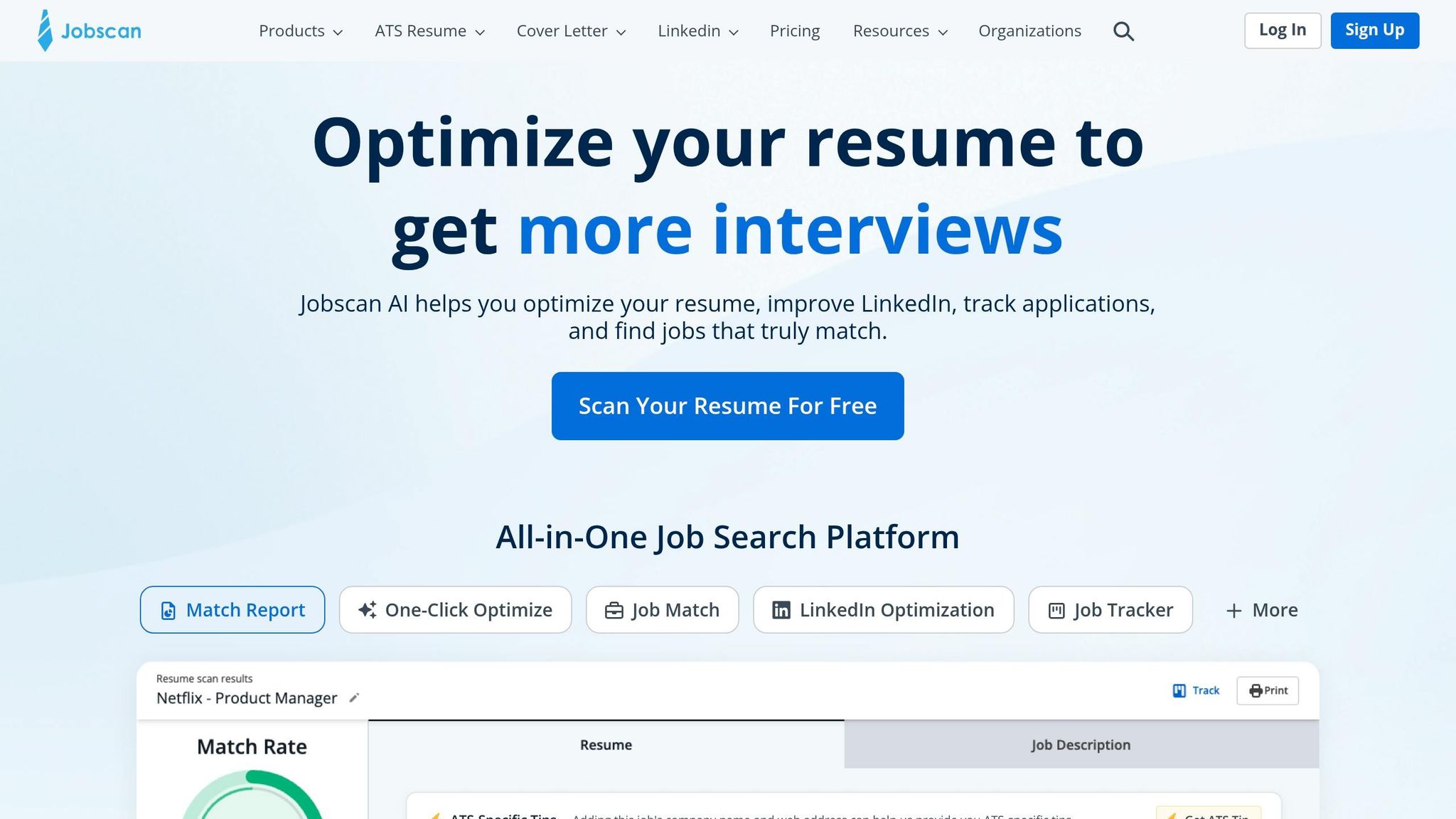
Jobscan can be helpful for a specific purpose: it compares your resume to a job description, identifying keyword gaps. This is particularly useful when applying to large companies where ATS systems can filter out resumes that don’t align with job requirements. However, its functionality is limited compared to scale.jobs, which offers:
- Complete application pipeline management
- Role prioritization with integrated tracking
- Human oversight and personalized submissions beyond just keyword matching
Overusing Jobscan might also encourage overloading your resume with keywords, which can make it less appealing to human recruiters.
Who should use Jobscan: Those looking for a quick keyword check before submitting a targeted application manually.
Who should choose scale.jobs: Job seekers needing comprehensive support, from application tracking to tailored submissions and proof of effort.
Switch to scale.jobs if…
If you're unsure about how many applications you’ve sent in the past month, which sources led to interviews, or where your process is breaking down, it’s time to reassess your tools. Consider switching to scale.jobs if you:
- Spend 20+ hours a week filling out repetitive forms
- Are a mid-career professional who values quality submissions
- Need error-free applications due to visa requirements (H-1B, F-1, OPT)
- Struggle to pinpoint which tools are driving interviews
- Want consistent, human-reviewed applications across platforms
With plans starting at $199 for 250 applications, scale.jobs simplifies your job search. Their human assistants handle applications, AI refines your resume, and you receive real-time updates with proof of work. Their resume writing services ensure consistency between your applications and your resume.
Decision Summary: Use LazyApply or Jobscan for quick, high-volume applications or keyword audits. For a complete, human-powered job search process with measurable outcomes, scale.jobs is the smarter choice.
Conclusion
The six skills discussed - ATS-friendly resume optimization, human and AI application execution, proactive networking, structured interview preparation, data-driven tracking, and intentional tool selection - work together as a cohesive system. Each element plays a critical role, transforming your job search from a scattered effort into a well-organized, strategic process. By linking these skills, you can shift from trial-and-error to a methodical approach that increases your chances of success.
Think about the competition: for an average corporate job posting in the U.S., around 250 applicants compete, but only 4–6 make it to the interview stage. To stand out, your applications must be precise, targeted, and consistently followed up. It's not always the most experienced candidates who advance - it's the ones who present themselves effectively and strategically.
The real challenge lies in execution. Without a streamlined process, juggling all six skills can feel overwhelming. That’s where consolidation becomes essential. For those looking for an integrated solution, scale.jobs offers a platform that combines resume building, AI-powered applications, and real-time tracking, all supported by personalized WhatsApp assistance. This approach ensures every application is ATS-compliant and maximizes your visibility, saving time while improving your odds.
However, you don’t need specialized tools to get started. Focus on one or two areas where you feel less confident, such as networking or tailoring your resume. Set clear goals - like submitting 10 focused applications or sending three outreach messages each week - and monitor your progress. Treat your job search as a project with measurable steps rather than a series of disconnected tasks.
Mastering these skills creates long-term benefits. Strong resume-writing skills will serve you in every future role. Networking habits will make your next job search faster. Interview preparation will help you negotiate better salaries and promotions down the line. The effort you invest today will pay dividends far beyond landing your next job.
Final Decision: Choose scale.jobs for an all-in-one solution with human guidance, ATS-ready documents, and tracking tools. If speed and volume are your main focus, consider simpler tools like LazyApply or Jobscan, but be aware they may lack personalized support.
FAQs
How do I know if my resume is failing ATS?
If your resume isn't making it past ATS (Applicant Tracking Systems), there are a few red flags to watch for. These include using unsupported fonts, graphics, or tables, as well as lacking the right keywords tailored to the job. Tools like Scale.jobs' ATS Score Checker can help you identify these issues. Once pinpointed, you may need to adjust the formatting or include more job-specific keywords. Additionally, a human review can be invaluable for catching nuanced errors that automated tools might overlook, giving your resume a better chance of passing ATS filters and improving your odds of landing interviews.
What should I automate vs do manually when applying?
Automate routine tasks such as filling out forms, uploading documents, and submitting applications across various platforms to streamline your efforts and save time. For tasks that require a personal touch - like customizing resumes, crafting tailored cover letters, ensuring compatibility with ATS systems, and double-checking application details - handle these manually for better precision. If necessary, enlist human assistance to improve accuracy and relevance. To maintain transparency and track your progress, always keep records of your submissions, such as timestamped screenshots.
What should I track weekly to improve results?
To make steady progress in your job search, it's important to track these key metrics each week:
- Total applications submitted: Keep an eye on how many positions you’re applying to and aim for consistency.
- Application status updates: Regularly check whether your applications are marked as "Queued", "Submitted", or "Under Review."
- Submission proof: Maintain timestamped records of your applications to ensure everything is properly documented.
- Response and callback rates: Monitor how often you receive responses or interview invitations to gauge your approach's effectiveness.
- Resume keywords and ATS scores: Regularly assess your resume's compatibility with Applicant Tracking Systems (ATS) to identify and address any gaps.
By keeping track of these metrics, you can adjust your strategy and improve your job search outcomes over time.