
What to Do If Your OPT Application Is Delayed: Step-by-Step Guide 2026

Sarah Mitchell
March 30, 2026

If your OPT application is delayed, you're not alone. USCIS's overall Form I-765 backlog (across every employment authorization category) topped 1.7 million cases in early 2026, but OPT-specific processing is a different story. Post-completion OPT (Form I-765 category C (3)(B)) typically takes 2 to 5 months in 2026, though individual cases can run longer, especially if you're affected by a country-specific security review, a fraud-scrutiny flag, or a Request for Evidence.
Without your Employment Authorization Document (EAD), you can't legally start work, even with a signed offer letter. That means real risk to your job, income, or health insurance while your 60-day grace period after graduation keeps running. If you're several months past the typical window, here's exactly what to do, in order:
- Check your case status and compare it against USCIS's live processing times for your specific service center.
- Consider premium processing ($1,780, 30-business-day decision) if your case is still within the standard filing window and your start date is tight.
- Contact USCIS directly to escalate your case or request a Tier 2 officer callback.
- File an expedite request if you qualify due to financial hardship or a USCIS error.
- Work with your Designated School Official (DSO) to confirm your SEVIS record is accurate.
- Seek help from your congressional representative if standard channels haven't moved your case.
- Plan for employment gaps — Cap-Gap, STEM OPT extension, or other bridge options — before you hit the 14-month usability cap on OPT.
With delays now stretching to 6–14 months, taking immediate action is critical. Start by checking your case status and contacting USCIS. If your case remains unresolved, escalate through your DSO or congressional representative. Avoid working without authorization, as it could jeopardize your immigration status. Consider tools like a job search virtual assistant or AI resume builder to stay ready for job opportunities once your EAD is approved.
Your USCIS Case Is Pending. Your Job Search Doesn't Have to Be.
You've checked your status. You've filed the e-Request. Now you wait, and that wait can be 6 to 14 months.
The smartest thing you can do right now: have ATS-optimized applications ready to go the moment your EAD arrives.
Scale.jobs human assistants build your custom resume, craft tailored cover letters, and apply to jobs on your behalf, so your first week of work authorization is already generating interviews.
✅ Free tier, start today, no card needed
✅ ATS-optimized for OPT/H-1B-sponsoring employers
✅ 30 applications/day once you're authorized
✅ 3,500+ OPT and visa candidates helped
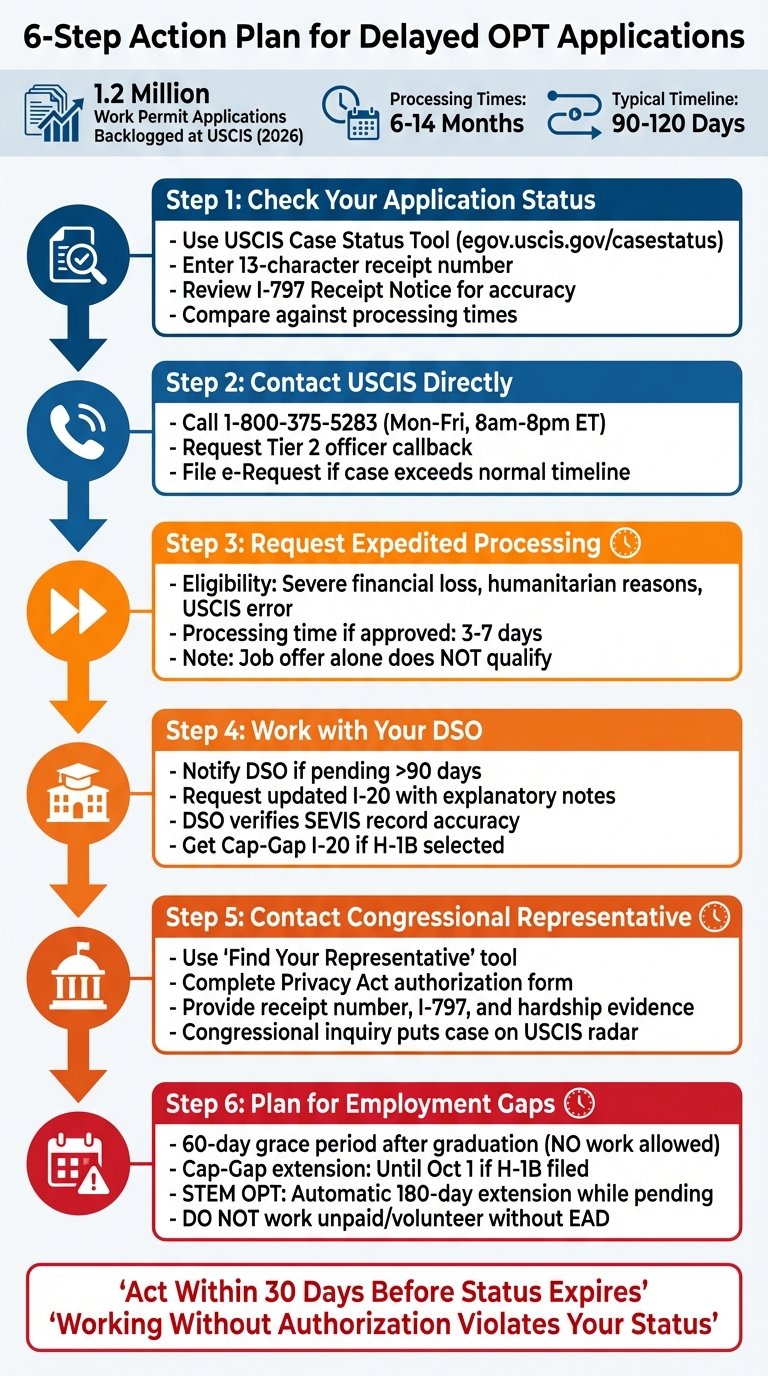
6-Step Action Plan for Delayed OPT Applications
Top 10 Reasons Why your OPT was Delayed, Denied or Rejected
sbb-itb-564272e
Step 1: Check Your Application Status
If your OPT application is delayed, the first step is to verify its current status within the USCIS system. This goes beyond simply confirming receipt - it’s about understanding whether your case is under review, delayed, or requires additional documentation.
Use the USCIS Online Case Status Tool
Head to the USCIS Case Status Online page at egov.uscis.gov/casestatus and input your 13-character receipt number. This number can be found on your Form I-797C, Notice of Action, which USCIS sends after receiving your I-765 application. The tool provides updates like "Case Was Received", "Request for Evidence (RFE) Sent", or "Case Approved." For a more detailed view, consider creating a USCIS online account, which can notify you when your EAD card is printed or mailed, offering more insight than the basic updates.
You can also use "Ask Emma", the virtual assistant on the USCIS website, located in the top right corner. While Emma provides the same status updates as the online tool, she can also guide you on next steps if your case status is unclear. Check your status regularly - early alerts for RFEs allow you to respond quickly and avoid further delays.
Additionally, compare your case's progress against the official processing times at egov.uscis.gov/processing-times. For OPT applications, typical processing takes 90–120 days, though delays of six months or more have been reported in early 2026. If your case exceeds the posted timeframe for your service center, you may file a formal "Case Inquiry" with USCIS. Keep in mind that Tier 1 customer service agents at the USCIS Contact Center (1-800-375-5283) only have access to the same online information, but you can request a "Tier 2" officer callback for a more thorough review of your case.
After checking your online status, take a closer look at the details on your I-797 Receipt Notice.
Review Your I-797 Receipt Notice
Once you've confirmed your online status, carefully examine your I-797 Receipt Notice for accuracy. Double-check that your name, birthdate, and EAD category (e.g., C03B for Post-Completion OPT) are correct. Even small errors can lead to your EAD card being mailed to the wrong address or, worse, being rejected. Pay special attention to the Receipt Date, which marks when USCIS officially received your application. This date helps determine if your case has exceeded normal processing times.
"You can also use your Receipt Number (found on your I-797C Receipt Notice) to track the status of your specific USCIS application on the USCIS Case Status website." - UC Merced International Students & Scholars
Keep your original I-797C in a secure location. If you plan to travel internationally while your application is pending, this notice is essential for re-entry into the U.S., especially if you’re on a STEM OPT extension. If your application has been pending for over 115 days from the Receipt Date, consult your Designated School Official (DSO) to explore filing a formal inquiry.
While navigating this process, it’s worth ensuring you’re prepared for job opportunities once your EAD is approved. Services like professional resume writing can help you craft ATS-friendly resumes tailored to your field, making you stand out in a competitive job market.
Step 2: Contact USCIS Directly
If your application has been pending beyond normal processing times, reaching out directly to USCIS can help clarify your case status and potentially expedite a resolution. While online tools provide basic updates, direct communication with USCIS offers a more effective way to address delays or concerns.
Call USCIS Customer Service
You can contact the USCIS Customer Service Center at 1-800-375-5283 Monday through Friday, from 8:00 a.m. to 8:00 p.m. Eastern Time. Before calling, ensure you have the following information ready:
- Your 13-character receipt number (found on your I-797C Notice)
- Full name, date of birth, and current mailing address (for identity verification)
The Contact Center is particularly helpful if your case has been pending longer than the typical processing window, which is usually 90–120 days for OPT applications.
When speaking with a representative, keep in mind the distinction between Tier 1 and Tier 2 agents:
- Tier 1 agents can provide basic case updates based on online data.
- Tier 2 officers can conduct a more detailed review of your case. To escalate, request a "service request" or ask for a "Tier 2 officer callback."
If your case exceeds normal timelines or qualifies for expedited processing (due to financial loss, USCIS error, or humanitarian reasons), explain your circumstances clearly. However, note that having an employment offer or start date alone does not meet the criteria for expedited processing. If approved, expedited processing is typically completed within three to seven days.
Should your phone inquiry not resolve the issue, proceed to file an e-Request for further assistance.
File an e-Request for Case Assistance
If calling USCIS doesn’t yield results, you can escalate your case by submitting an e-Request. This is especially useful if your application has been pending longer than the posted processing times for your service center. Check your eligibility for an e-Request by verifying the current processing times at egov.uscis.gov/processing-times.
To file an e-Request, you’ll need:
- Your receipt number
- The date your application was filed
- The type of application (e.g., I-765 for OPT)
If you have a USCIS online account, you can also use secure messaging to submit your inquiry. Select "expedite" or "case inquiry" as your reason and upload any supporting documents - especially important if requesting expedited processing. For example, you could include evidence of financial hardship or documentation of a USCIS error.
Filing an e-Request creates an official record of your inquiry and often leads to a more detailed review of your case. Once your Employment Authorization Document (EAD) is approved, you’ll be ready to apply for jobs. Following a job search system for OPT candidates can help you stay organized during this transition. Services like Scale.jobs can assist with creating an ATS-friendly resume to help you secure employment quickly.
Step 2.1: Consider Premium Processing Before You Escalate
Before you go through the expedite-request process (which requires proving financial hardship or a USCIS error), check whether premium processing is a faster, more reliable path.
How Premium Processing Works for OPT
Premium processing has been available for all F-1 OPT and STEM OPT categories — pre-completion, post-completion, and the 24-month STEM extension — since 2023. Unlike an expedite request, you don't need to prove hardship. You simply pay for guaranteed speed.
- Cost: $1,780 (Form I-907), effective March 1, 2026, up from $1,685. This is in addition to your standard I-765 filing fee ($470 online / $520 paper).
- Guarantee: USCIS will take action on your case approval, denial, or an RFE within 30 business days (roughly 6 weeks, accounting for federal holidays), or refund the $1,780.
- What it doesn't do: Premium processing speeds up the officer's decision, not the physical card production. Once approved, your EAD still takes an additional 2-3 weeks to print and mail — the same queue as standard applicants.
- Who can pay: You, your employer, or an attorney. If your employer wants your start date to happen on schedule, this is a fee many companies will cover.
- If you get an RFE: The 30-business-day clock stops the moment USCIS issues the RFE and restarts only once they receive your response.
Step 3: Request Expedited Processing
If your OPT application has been stuck in limbo for over 75 days and contacting USCIS hasn't resolved the delay, you might consider requesting expedited processing. However, keep in mind that USCIS doesn’t expedite cases solely based on a job offer or start date. To qualify, you’ll need to demonstrate specific circumstances, such as severe financial hardship, an urgent humanitarian need, a nonprofit or government request, or a processing error by USCIS.
Eligibility Requirements for Expedited Processing
Each expedite request is reviewed on a case-by-case basis, and it's essential to provide strong evidence to support your claim. For OPT applicants, severe financial loss is often the most applicable category. This requires proof that the delay is causing significant financial harm, either to you or your employer. Examples of evidence include bank statements, eviction notices, or a letter from your employer outlining how the delay is impacting their business. Simply being unable to start work isn’t sufficient; you must show tangible consequences, such as losing your housing, health insurance, or job.
For humanitarian reasons, you’ll need to show documentation of a medical emergency or safety concern requiring immediate work authorization. Examples include medical records or evidence of a family emergency. If your case involves a USCIS processing error, such as lost documents or incorrect information, provide receipts or correspondence that highlight the mistake.
Requests from nonprofit organizations supporting U.S. social or cultural interests or those tied to government priorities may also qualify. In such cases, include a letter from the relevant organization or agency explaining the importance of expedited processing.
| Expedite Category | Examples of Required Evidence |
|---|---|
| Severe Financial Loss | Bank statements, eviction notices, employer impact letters |
| Humanitarian Reasons | Medical records, family emergency proof, safety documents |
| Nonprofit Organization | Letter from nonprofit detailing cultural or social impact |
| USCIS Error | Receipts and correspondence showing the error |
| Government Interest | Letter from a U.S. government agency (e.g., Department of Defense) |
Submit Your Expedite Request
To start, call the USCIS Contact Center at 1-800-375-5283, available from 8:00 a.m. to 8:00 p.m. Eastern Time. To avoid long wait times, aim to call right at 8:00 a.m. when the center opens. Before calling, gather your 13-character receipt number, full name, date of birth, and all supporting documents.
When you reach an agent, clearly state that you want to request expedited processing and mention the specific category that applies to your case. If possible, ask for a "service request" or a callback from a Tier 2 officer, as Tier 1 agents typically have access only to basic information. If you submitted your application electronically, you can also make your expedite request through your USCIS account by selecting "expedite" and uploading your supporting documents.
Your request should include a detailed explanation of your situation along with evidence. For instance, if you’re facing financial hardship, your letter might say: "I am at risk of eviction on April 15, 2026, as shown in the attached notice," or "My employer has stated that my position will be terminated on April 30, 2026, as outlined in the attached letter."
If USCIS denies your expedite request or you don’t hear back within 7–10 business days, you can escalate your case. One option is to file a case assistance request with the DHS Citizenship and Immigration Services Ombudsman, particularly if your application has been pending for 150 days or more.
Step 4: Work with Your Designated School Official (DSO)
Your Designated School Official (DSO) plays a key role in helping you maintain your legal status, providing necessary documentation for your employer, and addressing any errors in your records. Their support can strengthen your case as you navigate delays with USCIS.
Notify Your DSO About the Delay
If your application has been pending for over 90 days or your start date is approaching, reach out to your DSO immediately. Be prepared with the following:
- Your 13-character USCIS receipt number from Form I-797
- The receipt date
- Copies of all USCIS correspondence
- Details of any contact you've had with the National Customer Service Center or an e-Request submission
Your DSO will check your OPT recommendation in the Student and Exchange Visitor Information System (SEVIS) to ensure everything is accurate. Sometimes, delays occur due to school-side errors, like failing to update your I-20 status correctly. If an issue is found, your DSO must fix the SEVIS record right away. David C. Elwell, Associate Dean and Director of MIT's International Students Office, highlights the importance of this:
"ISO staff has been continually reaching out to USCIS regarding concerns and can also advise about additional steps that may be taken."
If your employer is concerned about the delay, your DSO can communicate directly with them. According to MIT's International Students Office:
"If you have your employer contact your ISO Advisor, please let your advisor know in advance that they can speak with your employer about the specifics of your application."
This official communication reassures employers that the delay is due to government processing times, not your eligibility. After addressing these concerns, request an updated I-20 for further documentation.
Get an Updated I-20 with Explanatory Notes
Your DSO can provide an updated I-20 that confirms your pending OPT application. This document serves as official proof for your employer. In cases where errors require you to reapply, your DSO will issue a new OPT recommendation I-20. Since processing these requests can take 10 to 15 business days, it's important to act promptly.
If you’ve been selected for the H-1B lottery and your OPT is set to expire before October 1, 2026, ask for a Cap-Gap I-20. This extends your status and work authorization until your H-1B petition becomes active. Stanford's Bechtel International Center warns:
"Working without an endorsed I-20 for OPT and a valid EAD card for the authorized dates is a serious violation of your legal status."
If you change employers while your OPT application is still pending, notify your DSO immediately. They will update your SEVIS record and issue a revised I-20, which you can submit to USCIS as additional evidence. Some schools, like USC, may charge an administrative fee (around $200) for STEM OPT extension services, so check with your institution about any costs. If your application is denied and you’re running out of options, your DSO can guide you through alternative solutions, such as enrolling in a new degree program or transitioning to Day-1 CPT to maintain your work authorization.
Step 5: Contact Your Congressional Representative
If you're dealing with delays in your OPT application, reaching out to your congressional representative can be a powerful step. When your application has been stuck beyond the normal processing timelines and previous efforts to escalate haven’t worked, your U.S. Representative or Senator’s office can step in. While they can’t guarantee approval or force USCIS to act, they can request updates or explanations for delays that go beyond the standard processing windows.
What Congressional Offices Can Do
When other methods, like working with USCIS or your Designated School Official (DSO), don’t resolve the issue, your congressional office can help bring attention to your case. Congressional staff act as intermediaries between you and federal agencies like USCIS, ensuring your situation is acknowledged and addressed fairly. By submitting an inquiry on your behalf, they can put your case on USCIS’s radar, which may lead to action on stalled applications.
As the Modern Law Group explains:
"A congressional inquiry does not guarantee faster processing, but it puts your case on USCIS's radar and sometimes produces movement."
This approach is especially useful when your application has been delayed well beyond the typical processing times. For context, as of early 2026, USCIS is grappling with a backlog of over 1.2 million work permit applications, with I-765 processing times ranging from 6 to 14 months depending on the service center. While congressional offices cannot demand approval of your application, they can hold USCIS accountable for unreasonable delays. If your expedite request is supported by congressional intervention and approved, the Bechtel International Center at Stanford notes that processing often speeds up:
"If the expedite is approved, it is normally processed within three to seven days of the request, and your Employment Authorization Document (EAD) arrives within the normal mail delivery time."
How to Request Congressional Help
To start, use the "Find Your Representative" tool on the House of Representatives website to locate your representative based on your current U.S. residential address. Assistance is typically only available to residents of a representative’s district, so be sure to use your actual home address - not your school’s address.
Once you’ve identified your representative, visit their official website and look for sections like "Help with a Federal Agency", "Constituent Services", or "Casework." When you call their office, ask specifically for the immigration caseworker, as they specialize in USCIS-related issues and know how to escalate cases effectively.
Before congressional staff can assist, you’ll need to complete a Privacy Act authorization form. As explained by Rep. Bill Foster’s office:
"The Privacy Act of 1974 (5 U.S.C. § 552a) requires that Members of Congress or their staff have authorization before they can obtain information about an individual's case."
This form must be completed by you personally - forms filled out by others, like friends or family, are generally not accepted. When submitting your request, be prepared to provide:
- Your 13-character USCIS receipt number
- A copy of your I-797 Notice of Action
- Your contact details
- Any USCIS correspondence about the delay
- Employer documentation on company letterhead showing your start date urgency
- Proof of financial hardship or USCIS error (e.g., bank statements or evidence of incorrect card information)
If the delay stems from a USCIS error, include clear documentation of the mistake to support your request for urgent correction. USCIS has stated:
"The need to obtain employment authorization, standing alone, without evidence of other compelling factors, does not warrant expedited treatment."
This means your case will be stronger if you can show financial hardship or an employer’s pressing need for your start date, in addition to the delay itself. If congressional intervention doesn’t resolve the issue promptly, you can also reach out to the DHS Citizenship and Immigration Services Ombudsman for further assistance. Additionally, consider planning for potential employment gaps while your case is being processed.
Step 6: Plan for Employment Gaps
Dealing with delays in your OPT application can be stressful, especially when you're trying to avoid gaps in your legal status or career. It's crucial to plan ahead and have strategies in place to navigate these delays effectively. Remember, after your program ends, you have a 60-day grace period during which you can stay in the U.S., but working during this time - paid or unpaid - is not allowed. If your Employment Authorization Document (EAD) doesn’t arrive before this period ends, you’ll need to secure an extension or leave the country to avoid unlawful presence.
To address potential employment gaps, consider formal options like Cap-Gap or STEM OPT extensions.
Use Cap-Gap or STEM OPT Extensions
If you’ve been selected in the H-1B lottery and your employer filed the petition before your current OPT expired, you’re eligible for a cap-gap extension. This option extends both your F-1 status and work authorization until October 1, when your H-1B status begins. However, keep in mind that if your H-1B petition was filed during the 60-day grace period (after your OPT expired), you’ll only maintain legal status - not work authorization - during the gap.
To activate the cap-gap work extension, confirm with your employer that the H-1B petition was filed as a "Change of Status" rather than "Consular Processing." Afterward, request an updated I-20 from your Designated School Official (DSO). This document will serve as proof of your extended work authorization for I-9 verification. Note that the cap-gap extension is typically automatic and does not require a new EAD card.
For those with STEM degrees, the STEM OPT extension offers an additional safety net. By filing Form I-765 for the STEM OPT extension before your current EAD expires, you’ll receive an automatic 180-day work authorization extension while your application is being processed. This 24-month extension can even serve as a backup during a cap-gap period if your H-1B petition is denied or withdrawn. To ensure a smooth transition, submit your STEM OPT application up to 90 days before your current EAD expires. Keep in mind that your employer must be enrolled in E-Verify and have a valid Employer Identification Number (EIN) for you to qualify.
| Extension Type | Eligibility | Work Authorization |
|---|---|---|
| STEM OPT | Filed before current EAD expires | Automatic 180-day extension while pending |
| Cap-Gap (Standard) | H-1B filed before current EAD expires | Extension until Oct. 1 |
| Cap-Gap (Grace Period) | H-1B filed during 60-day grace period | Legal status only (no work authorization) |
If you don’t qualify for these extensions, it’s important to understand that unpaid or volunteer work in your field is still prohibited without valid authorization.
Avoid Unpaid or Volunteer Work
It’s a common misconception that unpaid or volunteer work is allowed while waiting for your EAD. However, this is not the case. Any activity in your field of study, whether paid or unpaid, is considered "work" by USCIS. Since OPT is categorized as practical training, engaging in unpaid internships or volunteer roles without your EAD card is a violation of your legal status. Such a violation can jeopardize your ability to remain in the U.S. and may result in a bar on future re-entry.
If your OPT delay extends beyond the grace period and you don’t qualify for cap-gap or STEM extensions, you might consider filing Form I-539 to change your status to B-1/B-2 (Visitor). The filing fee for this option is $420, and it allows you to legally remain in the U.S. for up to six months while you continue your job search or explore other visa options. However, you are not permitted to work while on B-1/B-2 status. During this time, you can use tools like a job search virtual assistant or AI resume builder to prepare for opportunities once your EAD arrives.
Another option, for those interested in further education, is enrolling in a "Day 1 CPT" program. These programs grant immediate work authorization while you pursue a new degree, although they typically come with a hefty price tag of $15,000 to $40,000 per year and require about 30 days for enrollment. For individuals with extraordinary ability, an O-1 visa is another potential avenue. With premium processing ($2,805), you could receive a decision within 15 days, though the standard O-1 filing fee is $1,015.
If you’re preparing for future opportunities during this waiting period, consider using professional tools like AI cover letter builders to optimize your application materials. These resources can help you stay ready for new roles as soon as your work authorization is approved.
Conclusion: Take Action on Your Delayed OPT Application
If your OPT application is delayed, it’s crucial to act immediately. The six steps outlined here - checking your case status, contacting USCIS, requesting expedited processing, working with your DSO, seeking congressional support, and preparing for potential employment gaps - are designed to help you address the situation in a structured way. Start with the basics and escalate your efforts as necessary.
"30 days is cutting it extremely close. Most solutions take longer, so you need to act within 72 hours." - OpenSphere Legal Operations
Timing is everything. Take action at least 30 days before your status expires. Check your USCIS case status daily and file an expedite request if you qualify due to severe financial loss or an error on their part. If your case goes beyond the typical 90–120 day processing window, contact USCIS and request a Tier 2 callback. Don’t overlook the option of engaging your congressional representative’s office - they can often help push USCIS to prioritize your case.
Given the current processing delays, waiting passively isn’t an option. Once your work authorization is approved, you’ll want to hit the ground running. Services like professional resume writing can help ensure your documents are ready for applicant tracking systems (ATS) and tailored to stand out to employers.
Keep thorough records of all communications, receipts, and supporting documents. If your delay exceeds 12 months, consult an attorney about filing a mandamus action. And remember, working without authorization - even if unpaid - violates your status and can have long-term consequences, including jeopardizing future visa applications or your ability to remain in the U.S.
FAQs
What can I do if my OPT case is outside normal processing times but USCIS won’t give details?
If your OPT case is delayed and you're not getting clear updates from USCIS, here are some steps you can take:
- Contact USCIS directly: Use their online tools or customer service line to check your case status and request updates.
- File a formal inquiry: Submit a service request through the USCIS website to escalate the issue, especially if your case is outside normal processing times.
- Seek help from a congressional representative: Reach out to your local congressperson's office. They can often assist in expediting your case by contacting USCIS on your behalf.
While waiting, it's wise to explore backup options. For example, you might look into alternative visa categories or other steps to avoid gaps in employment or legal status.
Can I stay in the U.S. if my EAD isn’t approved before my 60-day grace period ends?
If your Employment Authorization Document (EAD) isn’t approved by the end of your 60-day grace period, you won’t be allowed to legally work in the U.S. While you can remain in the country during the grace period, staying beyond it without valid status or a pending application could impact your eligibility for future immigration benefits. It’s possible to request an expedited review of your application through USCIS, but keep in mind that approval of such requests isn’t guaranteed.
What is the strongest evidence for an OPT expedite request due to financial hardship?
When submitting an OPT expedite request due to financial hardship, the strongest evidence includes clear documentation of substantial financial loss either to yourself or a company. It’s crucial to demonstrate that the urgency of your situation wasn’t caused by your own actions or delays. For instance, you could include proof of job offers that are in jeopardy or financial records that highlight the severity of the impact.