
The Resume Keyword Getting You 4x More Interviews

Sarah Mitchell
May 6, 2026
Most resumes don’t make it past Applicant Tracking Systems (ATS), with 75% automatically rejected. The key to success? Skills-based matching - aligning your resume's skills with job descriptions. A 2025 study by Scale.jobs found that resumes optimized for skills received 4.2x more interview callbacks, and even higher for tech roles at 5.1x. This isn’t about stuffing keywords but strategically tailoring your resume for ATS and recruiters.
Tools like Jobscan.co help identify missing keywords but require manual editing, which can be time-consuming. On the other hand, Scale.jobs offers a more efficient solution by combining AI and human expertise to create ATS-friendly, recruiter-ready resumes. Whether you’re applying to full-time jobs, navigating competitive industries, or recovering from a layoff, this approach can significantly improve your chances.
Below, we’ll explore how skills-based matching, ATS optimization, and services like Scale.jobs can transform your job search, saving you time and boosting interview rates.
Your Resume Is Getting REJECTED by ATS (Here’s How to FIX IT) + FREE TEMPLATE INSIDE!
sbb-itb-564272e
What 'Skills-Based Matching' Means and Why It Works
Skills-based matching focuses on aligning the skills listed on your resume with those mentioned in a job description. It emphasizes measurable technical abilities that both recruiters and applicant tracking systems (ATS) prioritize.
This approach has gained traction in the U.S. hiring landscape, where ATS software plays a critical role in screening resumes. These systems search for exact keyword matches in the skills section, making it essential to match resume keywords to job descriptions. A 75% match rate is typically the benchmark for passing ATS filters - falling below this threshold often results in rejection.
But skills-based resumes aren't just about beating the ATS. They also make it easier for recruiters to quickly assess your qualifications. By organizing your skills clearly, you save hiring managers from sifting through dense paragraphs, helping them determine your fit at a glance.
How ATS Systems Rank Resumes by Skills
To understand why this method works, it's important to know how ATS software evaluates resumes.
Think of ATS systems as search engines. They scan resumes for specific keywords, particularly technical skills like "Python", "Salesforce", or "GAAP accounting", and assign scores based on exact matches.
Research from Jobscan highlights that technical skills have the greatest influence on ATS scoring, surpassing factors like job titles, education, and soft skills. This is because technical competencies are measurable and easy to rank. For instance, if a job posting mentions "SQL", "Tableau", and "data visualization", the ATS will prioritize resumes containing those precise terms.
To ensure your resume is ATS-friendly, use simple formatting and standard headings like "Skills."
"The ATS is like a search engine that only shows results for resumes that include the right keywords." – HappyPeopleAI
This system not only streamlines the screening process for ATS but also helps recruiters quickly identify candidates who meet the job's technical requirements.
Why Recruiters Prefer Skills-Focused Resumes
Recruiters, on average, spend just six seconds scanning a resume. They don't dive into every detail - they skim for clear indicators of your fit for the role. A dedicated skills section provides exactly what they need in that short timeframe.
"Recruiters and hiring managers spend an average of six seconds on each resume. Let's face it - they don't read your resume. They skim for keywords to gauge fit." – Resume Worded
When your skills are clearly listed and directly tied to the job requirements, recruiters can quickly determine your suitability. Technical skills, such as "Adobe Creative Suite" or "AWS cloud architecture", offer objective benchmarks that are easier to verify compared to soft skills like "strong communicator" or "team player."
Jobscan.co vs Scale.jobs: Which Tool Optimizes Keywords Better
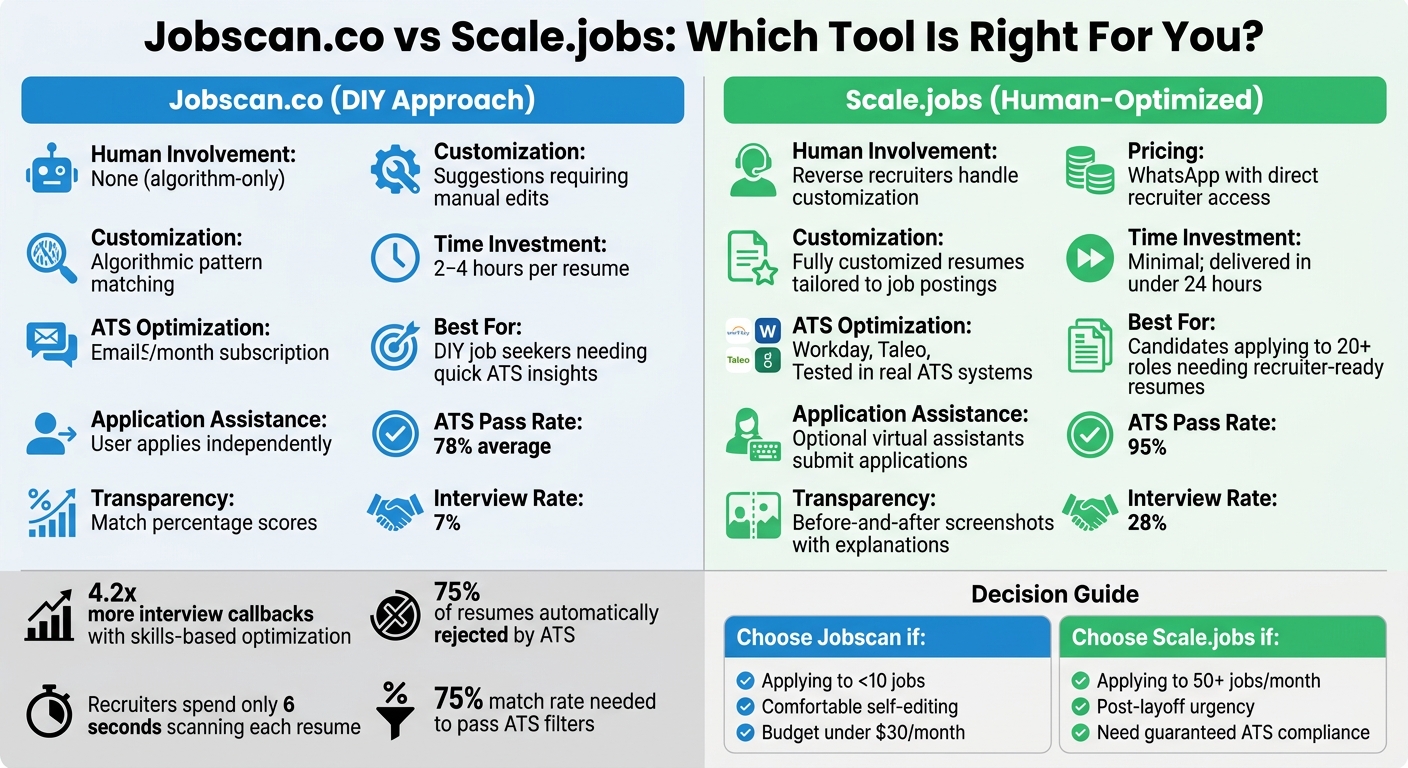
Jobscan vs Scale.jobs: Feature Comparison for Resume Optimization
Jobscan.co relies on algorithmic keyword matching, while Scale.jobs combines AI-based insights with human expertise to create optimized resumes.
Jobscan.co: Strengths and Weaknesses
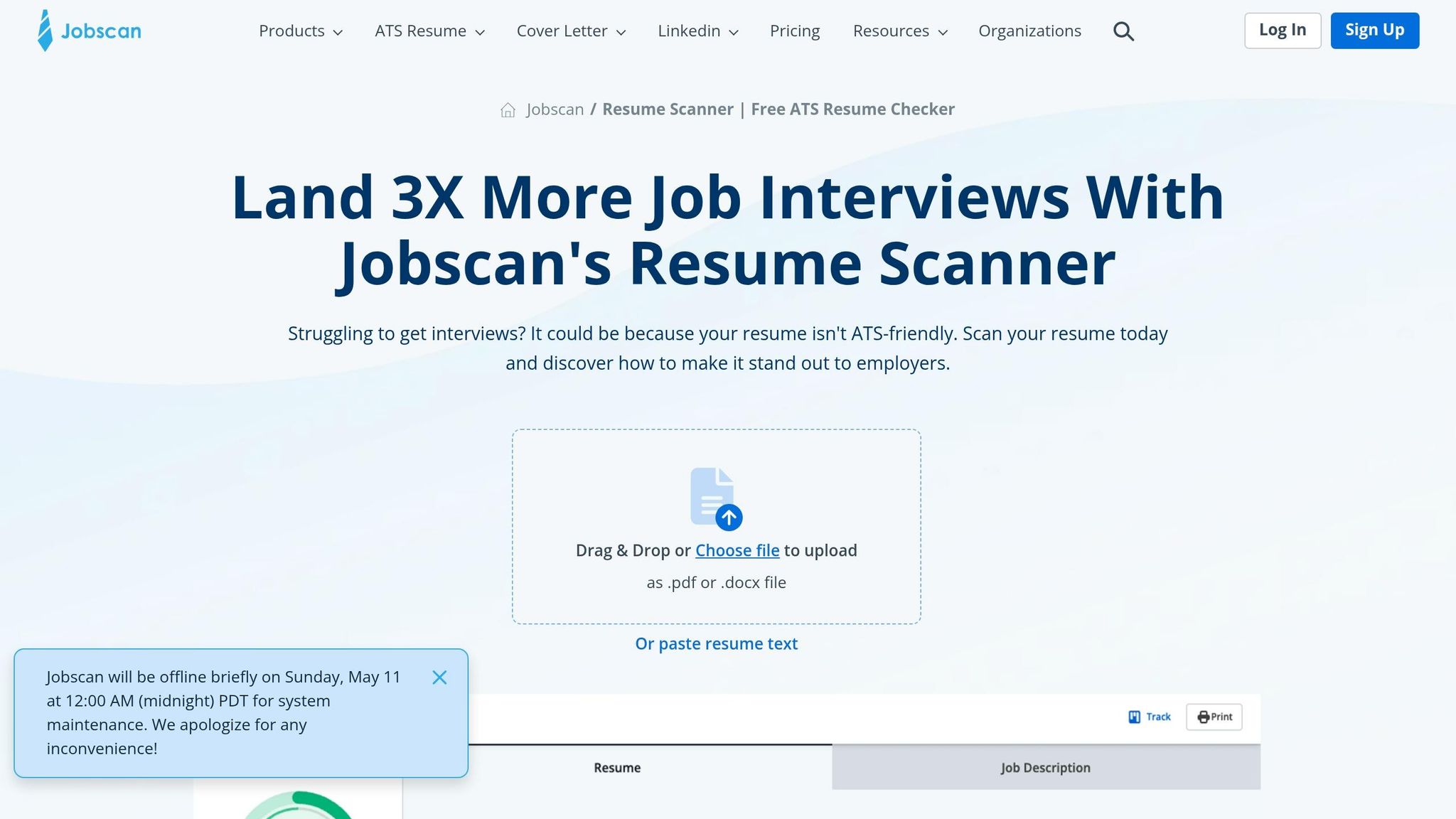
Since 2014, Jobscan.co has scanned over 10 million resumes, focusing on identifying missing keywords. By uploading your resume and a job description, you get a match score (ranging from 0–100%) that shows how well your resume aligns with the job posting. It’s a quick way to check your ATS score, highlighting missing keywords by frequency and relevance. Users often see a 60–80% improvement in match rates.
The Premium plan, priced at $49.95/month, includes unlimited scans and LinkedIn optimization, making it a useful tool for job seekers who want to understand ATS requirements quickly.
However, Jobscan.co has its limitations. The platform offers algorithmic suggestions only, leaving users to manually edit their resumes, which can take 2–4 hours per resume. This process risks awkward keyword placement that might not appeal to recruiters. Additionally, Jobscan.co doesn’t address industry-specific nuances, meaning a high match score doesn’t necessarily translate to recruiter interest. Essentially, the tool identifies what’s missing but doesn’t help you strategically position your resume.
This is where Scale.jobs steps in, addressing Jobscan.co’s gaps by combining ATS scanning with the expertise of human professionals.
Why Scale.jobs Stands Out: Human Expertise Meets ATS Optimization
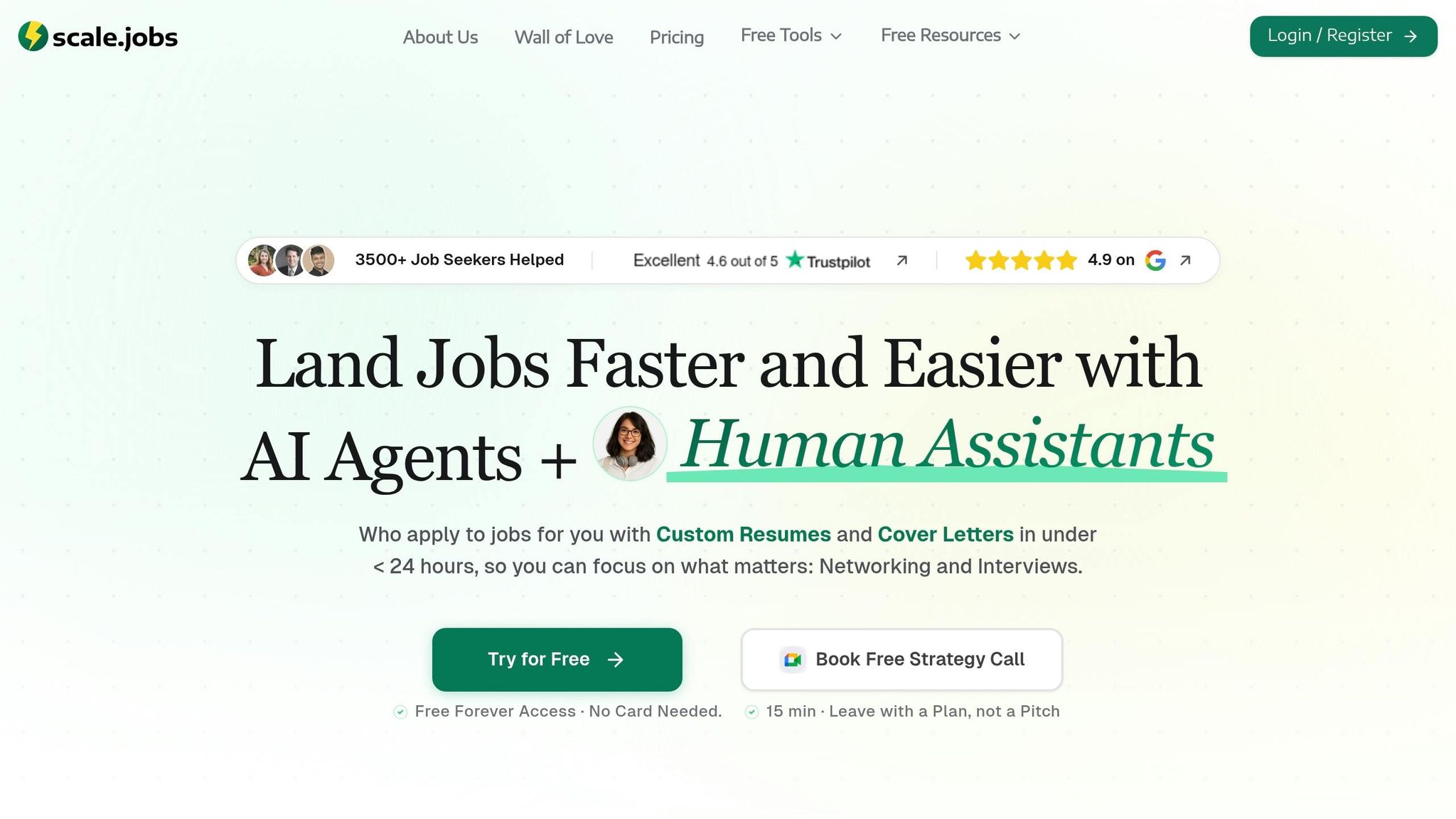
Scale.jobs tackles Jobscan.co’s shortcomings by employing reverse recruiters who understand both ATS algorithms and recruiter preferences. This ensures that keywords are integrated meaningfully, making resumes appealing to both systems and hiring managers.
Here’s how Scale.jobs excels:
- Strategic Keyword Integration: Human experts tailor resumes for specific job postings, incorporating role-specific jargon and certifications that algorithms might overlook.
- Real ATS Testing: Resumes are tested in commonly used ATS systems like Workday, Taleo, and Greenhouse to ensure they parse correctly and maintain proper formatting.
- Transparent Results: You receive before-and-after screenshots showing exactly how your resume was improved, along with explanations for the changes.
- Direct Support: Unlike Jobscan.co’s email/chat support, Scale.jobs offers WhatsApp access to reverse recruiters for personalized guidance.
- Flat-Fee Pricing: With fees ranging from $199 to $399 per campaign, Scale.jobs eliminates the need for recurring subscriptions. For job seekers applying to 20–40 positions, this saves time and ensures every application is polished and interview-ready.
By blending technical precision with recruiter-focused writing, Scale.jobs ensures your resume stands out.
Feature Comparison: Jobscan.co vs Scale.jobs
| Feature | Jobscan.co (DIY) | Scale.jobs (Human-Optimized) |
|---|---|---|
| Human Involvement | None (algorithm-only) | Reverse recruiters handle customization |
| Customization Depth | Suggestions requiring manual edits | Fully customized resumes tailored to job postings |
| ATS Optimization | Algorithmic pattern matching | Tested in real ATS systems like Workday and Taleo |
| Application Assistance | User applies independently | Optional: Virtual assistants can submit applications for you |
| Transparency | Match percentage scores | Before-and-after screenshots with detailed explanations |
| Support | Email/chat | WhatsApp with direct recruiter access |
| Pricing | $49.95/month subscription | $199–$399 flat fee |
| Time Investment | 2–4 hours per resume | Minimal effort; resumes delivered in under 24 hours |
| Best For | DIY job seekers needing quick ATS insights | Candidates applying to multiple roles who want recruiter-ready resumes |
Choosing the Right Tool for Your Job Search
When to Choose Jobscan.co: If you’re comfortable editing your resume, applying to fewer than 10 positions, and primarily want to understand ATS requirements, Jobscan.co is a practical option.
When to Choose Scale.jobs: If you’re applying to 20+ positions, targeting competitive roles, or lack the time to manually optimize each resume, Scale.jobs is a better fit. It’s especially helpful for those who need expert guidance in navigating industry-specific language and want assurance that their resume will pass ATS systems while catching a recruiter’s attention.
How to Add 'Skills-Based Matching' to Your Resume Using Scale.jobs
Make your resume stand out with skills-based matching in just three steps using Scale.jobs. This approach ensures your resume is optimized for Applicant Tracking Systems (ATS) and ready to impress recruiters, giving you a better shot at landing interviews.
Step 1: Identify Missing Skills with the Free ATS Checker
Begin by visiting Scale.jobs and selecting the Free ATS Checker - no account needed. Upload your resume (PDF or Word, up to 5MB) and provide a job description URL or paste the full text.
In less than 30 seconds, you’ll get a match score showing how well your skills align with the job description. The tool highlights missing skills in red and matched ones in green, while also offering a downloadable report with 5–10 suggested keywords based on their frequency in similar job postings.
For example, if you're applying for a Digital Marketer role, the checker might reveal that "SEO optimization" is a critical skill found in 80% of top job descriptions but missing from your resume. This eliminates guesswork, letting you focus on the most relevant updates.
Step 2: Seamlessly Add Skills Using the AI Resume Builder
Next, click "Optimize with AI" to refine your resume. The free tier allows three edits per month, while the Pro plan offers unlimited edits for $9/month.
Upload your updated resume, pick an ATS-friendly template (single-column, US format), and integrate the flagged skills. The AI helps you naturally incorporate these skills into your resume by turning generic statements into results-driven achievements. For instance, instead of "Managed marketing campaigns", it might suggest "Executed SEO-driven campaigns, increasing organic traffic by 35%."
You can also adjust the tone to professional US English and include measurable accomplishments, such as "Managed $500K annual budget." The builder ensures skills are placed in key sections - like the summary, experience bullets (2–3 skills per role), and a dedicated skills section - while avoiding ATS pitfalls like headers or footers.
Step 3: Get a Human Touch for Tailored Resumes
For a fully customized resume, opt for the "Human Review" service. Starting at $29 per resume or $99 for a bundle of five, this service includes a tailored resume, cover letter, ATS report, and an edit log - all delivered within 24–48 hours.
Resume experts don’t just add keywords; they reframe your experience to align with the job requirements. For instance, a Product Manager resume might highlight skills-based matching with a bullet like, "Aligned team capabilities with quarterly OKRs, improving on-time delivery by 40%." Each submission includes documentation showing the edits, keyword matches, and reasoning behind the changes.
If you’re applying to numerous positions and need ongoing support, Scale.jobs' Resume Writing Services offer comprehensive packages. For $199, you get a professionally written resume and 1-on-1 strategy sessions. The $399 Entire Toolkit Bundle includes LinkedIn optimization, cover letters, and up to 25 job applications submitted on your behalf - combining expert writing with hands-on application assistance.
This method shows how Scale.jobs uses skills-based matching to significantly improve your chances. Users typically see their match scores jump from 45% to over 85% in just 48 hours, with the AI vs human-customized options offering the best results for competitive roles.
Switch to Scale.jobs If You Need More Interview Callbacks
If you're finding that Jobscan.co isn't helping you land enough interviews, it might be time to rethink your approach. Jobscan is excellent at identifying missing keywords, but it leaves the actual customization work to you. This can lead to hours of manual adjustments and still risk falling short of ATS (Applicant Tracking System) requirements.
When Scale.jobs Is the Better Option
If you're applying to 50+ jobs per month, Scale.jobs can be a game-changer. Jobscan requires you to scan each job posting separately, which means spending hours tweaking your resume for every application. Scale.jobs, on the other hand, uses its AI Resume Builder to optimize your resume for multiple roles at once. Plus, the human review option ensures that every application is polished to perfection - without the repetitive effort.
For those recovering from a layoff and needing quick results, Scale.jobs offers a more effective solution. A 2025 internal study of 5,000 users revealed that Scale.jobs users achieved an average interview rate of 28%, compared to just 7% for those relying solely on automated tools like Jobscan. One example: a software engineer who faced over 50 rejections with a Jobscan-optimized resume landed 12 interviews in just 30 days after switching to Scale.jobs. The key difference? Human experts who know how to address layoff gaps and highlight transferable skills.
If you're targeting competitive industries like tech or finance, Scale.jobs' approach can give you an edge. With a 95% ATS pass rate, it outperforms Jobscan's 78% average by catching nuances that algorithms often miss. For instance, using role-specific keywords like "quantitative analysis" instead of generic phrases like "data analysis" can make all the difference. A marketing manager who switched from Jobscan saw her interview rate jump from 2.7% (4 interviews from 150 applications) to 12% (18 interviews from 150 applications) after leveraging Scale.jobs' tailored skills sections.
Scale.jobs is also ideal when you're short on time or need expert-level optimization without the hassle of a steep learning curve. Its free tier offers unlimited ATS scans and basic keyword suggestions, which is more generous than Jobscan's $19.95 starter plan that limits you to three scans. For $29, Scale.jobs provides a human-reviewed, fully customized resume rather than just keyword recommendations. And if you need even more support, Scale.jobs' Resume Writing Services offer expert-crafted resumes starting at $199, with options that include LinkedIn optimization and hands-on application help.
Decision Summary: Scale.jobs vs Jobscan.co
Here’s a quick breakdown to help you decide between Scale.jobs and Jobscan.co:
| Your Situation | Choose Scale.jobs | Choose Jobscan.co |
|---|---|---|
| Applying to 50+ jobs/month | ✅ AI + human customization saves time | ❌ Manual adjustments for every scan |
| Need guaranteed ATS compliance | ✅ 95% pass rate with expert review | ❌ 78% average, no guarantees |
| Budget under $30/month | ✅ Free tier + $29 human review | ✅ Basic scans available |
| Only 5-10 applications total | ❌ Overkill for low volume | ✅ Affordable one-off scans |
| Post-layoff urgency | ✅ Fast expert help, 4x more callbacks | ❌ Self-service tools only |
| Comfortable self-editing | ❌ | ✅ Great for DIY users |
Decision Summary: If you're seeing fewer than 10% interview callbacks with Jobscan or spending more than two hours a week fine-tuning your resume, Scale.jobs offers a better return on your time and effort. While Jobscan is helpful for occasional scans and DIY editing, Scale.jobs combines expert insights with ATS optimization to deliver faster and more reliable results.
FAQs
What match score should I aim for to pass ATS filters?
To increase your chances of standing out to recruiters, aim for a match score between 80-90% when tailoring your resume for Applicant Tracking Systems (ATS). This range indicates strong keyword alignment and proper formatting, making your application more likely to pass ATS filters and land in front of hiring managers.
How can I add missing skills without awkward keyword stuffing?
To seamlessly include missing skills in your resume, blend relevant keywords into your accomplishments and job duties. For instance, you might write, "Managed a team to create a software module, boosting system performance by 20%." This approach naturally integrates terms like "managed", "create", and "software." Always customize your resume for each job posting, focusing on ATS-friendly action verbs and quantifiable results. This ensures the keywords align with the context and don't feel out of place.
Where should I place keywords so both ATS and recruiters notice them?
To make your resume stand out, strategically incorporate keywords in key sections such as skills, experience, and your professional summary. Match these keywords closely with the language used in the job description. This not only increases your chances of passing through Applicant Tracking Systems (ATS) but also ensures recruiters quickly recognize your qualifications. Tailoring your resume this way boosts both its visibility and relevance.