
Startup vs. FAANG: Where is Your H1B Safer in 2026?

Sarah Mitchell
April 21, 2026

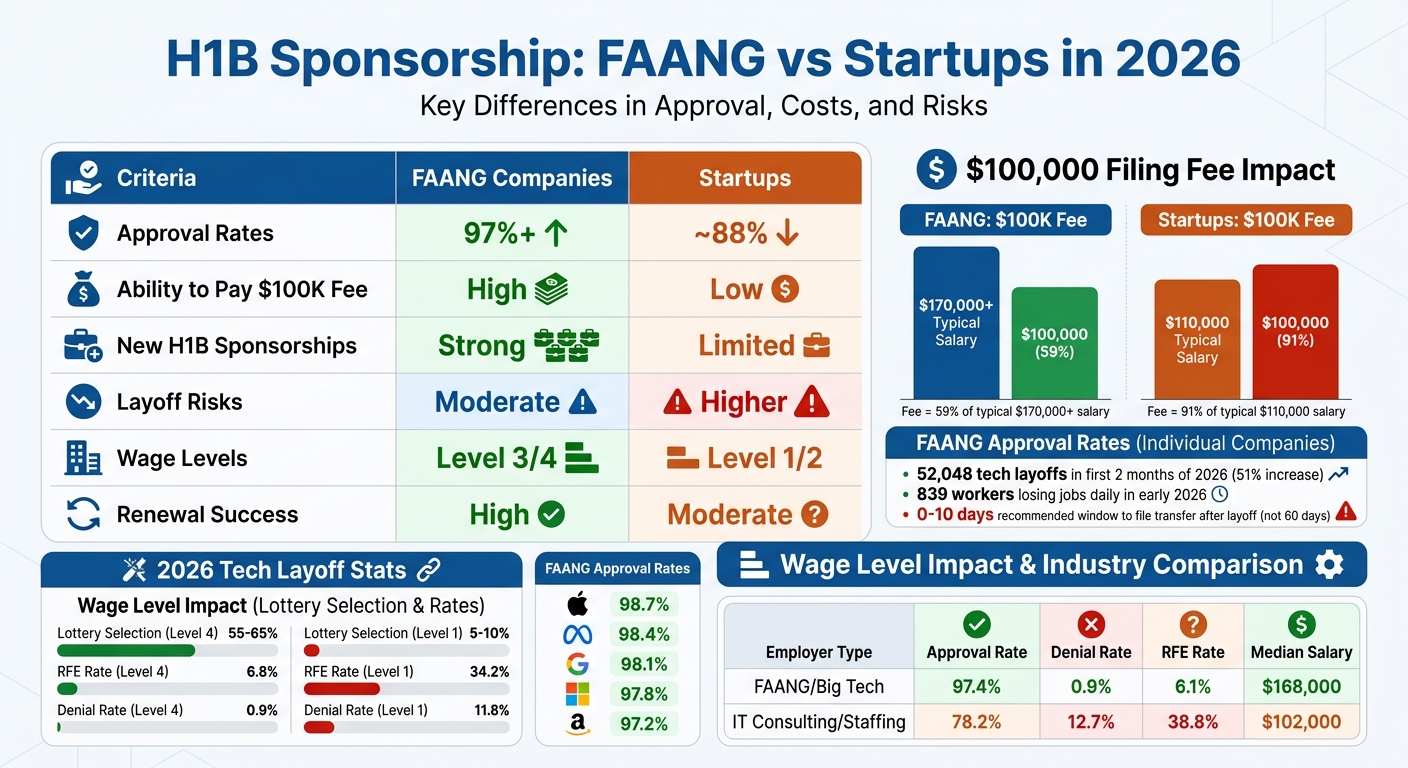
Navigating the H1B visa process in 2026 has become more complex due to stricter policies, a $100,000 filing fee for new petitions, and increased scrutiny from USCIS. FAANG companies (Facebook, Amazon, Apple, Netflix, Google) continue to offer higher approval rates, job security, and financial stability, making them the safer option for most applicants. Startups, on the other hand, face significant challenges, especially for new H1B sponsorships, as the high filing fee often consumes up to 91% of an average employee’s first-year salary.
Key Takeaways:
- FAANG companies: Boast approval rates above 97% and can easily absorb the $100,000 filing fee. They also offer higher wages (Level 3 or 4), which face less scrutiny.
- Startups: Struggle with the filing fee and often focus on H1B transfers or renewals, as these are exempt from the fee.
- Layoffs in 2026: With over 52,000 layoffs in early 2026, H1B holders must act quickly during the 60-day grace period, as USCIS has tightened transfer policies.
- Wage Levels Matter: Higher wages (Level 3 or 4) improve approval odds and minimize RFEs.
For new H1B sponsorships, FAANG companies remain the safer choice. Startups may still be viable for transfers or extensions, though financial stability and renewal history should be carefully evaluated. Acting quickly, optimizing your resume, and targeting H1B sponsoring companies are crucial steps in securing your visa status.
Quick Comparison:
| Criteria | FAANG Companies | Startups |
|---|---|---|
| Approval Rates | 97%+ | ~88% |
| Ability to Pay $100K Fee | High | Low |
| New H1B Sponsorships | Strong | Limited |
| Layoff Risks | Moderate | Higher |
| Wage Levels | Level 3/4 | Level 1/2 |
| Renewal Success | High | Moderate |
Bottom Line: For maximum H1B security, prioritize FAANG companies for new sponsorships. For transfers or renewals, ensure startups have the financial capacity and a strong track record.
Explore job search services or follow a daily job search system to connect with H1B-friendly employers and improve your chances of success.
H1B Sponsorship Comparison: FAANG vs Startups 2026
How He Built a $2M Startup on H-1B and Sponsored Himself | H1B To Green Card
sbb-itb-564272e
H1B Sponsorship in 2026: Current Data and Trends
FAANG companies continue to dominate with higher H1B approval rates and greater job security compared to startups. Their financial stability, established relationships with USCIS, and competitive wage levels play a significant role in this trend.
H1B Approval Rates: Startups vs. FAANG
In FY2025, FAANG companies displayed impressive approval rates, with Apple leading at 98.7%, followed by Meta (98.4%), Google (98.1%), Microsoft (97.8%), and Amazon (97.2%). Denial rates for these companies remained under 1.1%. In contrast, the overall H1B approval rate stood at 88.2%, with IT consulting and staffing firms facing a much higher denial rate of 12.7%. These smaller employers often encounter challenges, such as higher scrutiny and rejection rates, compared to the direct-hire roles offered by tech giants.
| Employer Type | Avg. Approval Rate | Avg. Denial Rate | Avg. RFE Rate | Median Salary |
|---|---|---|---|---|
| FAANG / Big Tech | 97.4% | 0.9% | 6.1% | $168,000 |
| IT Consulting / Staffing | 78.2% | 12.7% | 38.8% | $102,000 |
Startups face additional hurdles, with USCIS demanding extensive documentation to confirm their ability to pay the offered wage. For seed-stage companies, the $100,000 fee - equivalent to over 90% of a first-year salary - has made sponsoring new H1B candidates nearly impossible. This financial burden has been dubbed a "talent tariff" by startup founders.
Wage levels also play a critical role in approval rates. Roles with Level 1 wages see RFEs at a rate of 34.2%, compared to just 6.8% for Level 4 filings. Similarly, denial rates are higher for Level 1 filings (11.8%) than for Level 4 (0.9%). Since FAANG companies typically offer Level 3 or 4 wages, they face less scrutiny, while startups with lower wage levels often struggle to secure approvals.
These disparities highlight the need to consider job security, especially during layoffs, when comparing FAANG companies and startups.
Layoff Patterns and H1B Job Security
The tech sector has seen a surge in layoffs in 2026, with 52,048 positions cut in the first two months alone - a 51% increase from the previous year. This equates to about 839 workers losing their jobs daily in early 2026.
FAANG companies have not been immune to these layoffs. Amazon, for example, cut 16,000 positions in January 2026, following 14,000 layoffs in October 2025. Microsoft reduced its workforce by 15,000 between May and July 2025, and other companies like Atlassian and Epic Games have also made significant cuts. Despite these reductions, FAANG companies continue to sponsor H1B workers, albeit at lower volumes. For instance, Amazon's certified H1B applications dropped by 34% from Q1 2025 to Q1 2026, but the company still filed 14,850 petitions in FY2025. Nvidia, on the other hand, increased its filings slightly, reflecting its commitment to immigrant hiring despite the high costs.
The 60-day grace period following a layoff poses significant risks for H1B holders. USCIS has tightened its policies in 2026, often denying transfer petitions filed after the first 30 days of the grace period. Immigration lawyers now advise filing new petitions within 0–10 days of job termination to minimize risks.
"The 60-day grace period was supposed to provide a safety net. In 2026, that net has holes." - H1B Data Hub Research Team
Startups, already grappling with funding challenges, are increasingly turning to offshore hiring or stopping H1B sponsorship altogether. If you're considering joining a startup, it's crucial to evaluate the company's financial stability and H1B renewal history.
H1B Renewal Success Rates: Startups vs. FAANG
Renewals, which are exempt from the $100,000 fee, remain more viable for startups than new petitions. However, FAANG companies still hold a significant advantage in renewal approvals due to their financial strength and established USCIS records.
Direct-hire tech companies maintain a 97.4% renewal approval rate, while smaller employers face stricter scrutiny. USCIS often questions whether roles like Business Analyst or Quality Assurance Analyst qualify as "specialty occupations" requiring a specific degree, a challenge that startups frequently encounter because of less-defined job descriptions.
For H1B transfers, the situation is even more precarious. USCIS has been issuing Notices to Appear (NTAs) during grace periods, claiming workers are "not maintaining valid status" even if petitions are filed on time. Filing early and opting for premium processing ($2,805) can help reduce uncertainty and secure quicker decisions.
If you're navigating layoffs or planning a transfer, consider using professional resume services to connect with H1B-friendly employers. These services can help tailor your application to roles offering Level 2 or higher wages, increasing your chances of approval.
The data underscores a clear trend: FAANG companies provide better H1B security in 2026, both for new petitions and renewals. While startups may still be an option for current H1B holders seeking extensions, the financial barriers have largely closed the door for new applicants at early-stage companies.
What Determines H1B Stability at Startups and FAANG?
When deciding whether to pursue H1B sponsorship through startups or established giants like FAANG companies, it's important to weigh financial strength, industry trends, and changes in immigration policies. These factors can significantly influence the stability of your H1B status.
Company Size and Financial Health
The introduction of the $100,000 H1B filing fee in September 2025 has reshaped the sponsorship landscape. For FAANG companies, where salaries often exceed $170,000, this fee is a manageable expense. For instance, Google, with its impressive $1.5 million in revenue per employee, can absorb such costs without much strain. Startups, however, face a different challenge. For early-stage companies, this fee can be a considerable burden, often eating into funds meant for product development or matching a large portion of an employee's first-year salary.
Additionally, USCIS now closely examines smaller employers' "ability to pay", requiring them to submit tax returns and audited financial statements. While FAANG companies easily meet these requirements due to steady revenue streams, startups - particularly those in seed or Series A stages - may struggle to provide such documentation even when they have sufficient funding.
Industry Stability and Growth Outlook
The stability of your H1B sponsorship also depends on the industry you work in. Approval rates vary by sector, offering insights into where sponsorship is more secure. For example:
- Semiconductor and hardware companies boast a 97.8% approval rate with only 5.4% RFE rates.
- Internet and social media firms closely follow with a 97.6% approval rate.
- On the other hand, IT consulting firms face more challenges, with 12.3% denial rates and 37.4% RFE rates, largely due to scrutiny over third-party worksite models.
Layoffs add another layer of uncertainty, particularly for startups in volatile sectors like fintech or consumer apps. In downturns, these companies are more likely to pause or halt sponsorship efforts altogether.
If you're aiming for H1B-friendly employers in stable industries, using AI job search tools or professional resume services can help you stand out for positions offering Level 3 or 4 wages. These higher wage levels often face less scrutiny during the approval process.
Immigration Policy Changes in 2026
The traditional 60-day grace period following layoffs has become less reliable. USCIS now issues Notices to Appear if H1B transfers are delayed, effectively reducing the safe window for filing to 0–10 days after termination. Immigration attorneys strongly recommend acting quickly to avoid potential denials.
"Even the 60-day grace period is no longer guaranteed." – H1B Data Hub Research Team
Wage levels also play a key role in approval rates. FAANG companies, which typically offer Level 3 or 4 wages, face minimal scrutiny, while startups offering lower, entry-level compensation are more likely to encounter rejection.
It's worth noting that the $100,000 filing fee does not apply to H1B transfers or extensions. This makes current H1B visa holders more stable candidates than those seeking new sponsorship. Consequently, FAANG companies remain well-positioned to handle both new hires and H1B transfers, while startups often limit their sponsorships to workers already holding H1B status. These dynamics highlight why financially resilient employers, like FAANG companies, continue to offer more secure paths for H1B sponsorship.
Companies with Proven H1B Sponsorship Records
When it comes to reliable H1B sponsorship, data clearly separates direct-hire tech companies from consulting firms. The likes of Apple, Meta, Google, Microsoft, and Amazon - commonly grouped as FAANG companies - boast approval rates nearing 98%, highlighting their consistent track record in securing H1B visas. Beyond these industry leaders, newer tech sponsors are gaining recognition for their strong H1B approval rates.
Specialized AI labs have also emerged as major players in H1B sponsorship. For instance, OpenAI offers a median H1B salary of $310,000 for AI Research Scientists, placing these roles at Wage Level IV, with an estimated lottery selection rate of 61%. Similarly, Anthropic provides competitive salaries around $295,000, while Nvidia has significantly increased its H1B filings - from 369 in Q1 2025 to 434 in Q1 2026 - even with the new $100,000 sponsorship fee. This demonstrates Nvidia’s ongoing dedication to attracting global talent.
This trend isn’t limited to tech companies. Financial institutions like Goldman Sachs and JPMorgan Chase also maintain excellent H1B sponsorship records. Goldman Sachs achieves a 97.4% approval rate with a low 5.8% Request for Evidence (RFE) rate, while JPMorgan Chase follows closely with a 96.3% approval rate and 7.6% RFEs. These companies typically file H1B applications at Wage Levels III or IV, which helps minimize scrutiny during the approval process.
On the other hand, startups - particularly early-stage ones - are facing growing hurdles. While many continue to support existing H1B holders, the high $100,000 sponsorship fee has made new filings increasingly rare. Only later-stage startups (Series C or those generating $50M+ in revenue) are better positioned to handle these costs. As a result, startups are now more likely to prioritize transfers and renewals, making current H1B holders particularly appealing for these roles.
If you're aiming to work with H1B-friendly employers, leveraging professional resume services can give you a competitive edge. Highlighting specialized skills and targeting roles with Level III or IV wages can reduce the likelihood of application challenges. While automated tools like LazyApply and Simplify can assist with job applications, Scale.jobs offers human-powered, ATS-optimized resume services that align your skills with top H1B sponsors. These insights can help you strategically approach your job search and improve your chances of securing H1B sponsorship.
How to Secure a Safer H1B Sponsorship
How to Evaluate Employers for H1B Stability
When assessing potential employers for H1B sponsorship, it's important to focus on their hiring practices and track record. Companies that adopt a direct-hire model generally have higher approval rates - over 97% for tech firms - compared to IT consulting setups, which often face denials or Requests for Evidence (RFEs). RFEs are particularly common in third-party worksite arrangements due to concerns about employer control and compliance with specialty occupation standards.
Another key factor to consider is the company’s financial capacity, especially with the $100,000 filing fee introduced in September 2025. Speaking to current H1B employees can provide valuable insights into the company’s immigration support and how effectively they handle RFEs, demonstrating their commitment to visa compliance.
Pay attention to the wage levels at which the employer files H1B petitions. Higher wage levels, such as Level 4, have a better chance of being selected in the lottery - an estimated 55–65% - compared to Level 1 filings, which have a much lower selection rate of 5–10%. Employers filing at Level 3 or 4 not only show financial strength but also a preference for experienced professionals, which can minimize scrutiny from USCIS.
By evaluating these aspects thoroughly, you can lay the groundwork for a more secure H1B sponsorship process. Platforms like Scale.jobs can further simplify this process with targeted tools and services.
Using Scale.jobs to Target H1B-Friendly Employers
For H1B holders facing layoffs, acting swiftly is crucial. Immigration attorneys now recommend initiating a transfer within the first 0–10 days of termination, as late filings during the 60-day grace period are increasingly being denied by USCIS. This is where Scale.jobs stands out. Unlike automation-based platforms like Simplify.jobs, which rely on browser extensions that are vulnerable to bot-detection, Scale.jobs combines human oversight with precise application management.
Scale.jobs offers a more hands-on approach with trained virtual assistants who manually handle job applications. Here’s what sets their service apart:
- Human-powered, manual application submissions
- Customized, ATS-optimized resumes tailored for each job
- Real-time updates via WhatsApp, including timestamped proof of work
- Transparent pricing: $199 for 250 applications or $399 for 1,000, with unused credits refundable
For those targeting employers with strong H1B sponsorship records - such as Google, which boasts a 98.1% approval rate, or Meta at 98.4% - this approach reduces the risk of application rejections while speeding up the process.
If you need a polished resume that emphasizes specialized skills for Level 3 or 4 wage filings, Scale.jobs also offers resume writing services. These include a 45-minute Zoom consultation and formatting tailored for applicant tracking systems (ATS), which is critical for higher-wage roles.
Building Skills and Networks to Strengthen Your Position
Optimizing your job applications is just one piece of the puzzle; strengthening your skills and professional network is equally important in navigating today’s challenging H1B landscape.
Consider building qualifications for alternative visa options like the O-1 or EB-2. These pathways bypass the H1B lottery and the $100,000 filing fee. Developing a public portfolio - such as conference presentations, open-source projects, or published research - can demonstrate “extraordinary ability” in your field, making you a strong candidate for these alternatives.
If you’re already on an H1B and have been laid off, networking becomes critical. Use the first 10 days of your grace period to connect with former colleagues at companies known for their H1B sponsorship success. Focus on roles that offer transfer sponsorships, as these are exempt from the $100,000 fee for new petitions.
Additionally, target positions aligned with Level 3 or 4 wage classifications. Upskilling in high-demand areas like AI research, cloud architecture, or specialized engineering can make you a more competitive candidate for these roles. Higher wage classifications not only improve your chances in the lottery but also reduce the likelihood of USCIS challenges during the approval process.
Conclusion: Startup or FAANG for H1B Security?
The newly introduced $100,000 fee has reshaped the landscape for H1B sponsorships, making it increasingly difficult for startups to compete with FAANG-level companies. For initial sponsorships, FAANG and other large tech firms remain the most practical choice. They can absorb this fee as a routine expense - representing just 59% of a typical $170,000+ salary - and boast approval rates exceeding 97%. In contrast, for early-stage startups, the same fee could amount to 91% of a $110,000 salary, leading to a significant drop in new H1B sponsorships from smaller firms.
However, the equation shifts for those already on an H1B visa. Transfers and extensions are exempt from the $100,000 fee, making startups a viable option again, provided they have the financial resources and the ability to handle Requests for Evidence (RFEs). It's worth noting that startups now carry greater risks for new sponsorships due to increased scrutiny from USCIS. Maintaining your visa status is critical, as leaving the U.S. voluntarily could subject you to the new fee structure upon re-entry.
Your wage classification also plays a crucial role. FAANG positions often fall under Level 3 or 4 wage categories, which offer a 46–61% lottery selection rate, compared to just 15% for Level 1 roles, which are more common in smaller firms. Negotiating a higher base salary is essential, as it directly impacts your wage level classification.
If you're facing layoffs, quick action is paramount. Transfers should be initiated within 0–10 days to avoid complications during the grace period, as delays increase the risk of denial. To streamline this process and target H1B-friendly employers, professional resume services can help you secure roles that align with Level 3 or 4 classifications, improving your chances in the lottery and ensuring a smoother application process.
Bottom Line: For new H1B sponsorships, FAANG companies are the clear choice. Startups should only be considered for transfers if they demonstrate strong financial backing.
Decision Summary: Scale.jobs vs. Competitors for H1B Applications
When applying to H1B-friendly employers, the quality of your application strategy is just as important as the employer you target. Here’s how scale.jobs stands out compared to automated platforms:
- Simplify.jobs or LazyApply: Ideal for those who prefer browser-extension automation, minimal human oversight, and are willing to risk bot detection during high-volume applications.
- Scale.jobs: Best for applicants seeking hands-on support, ATS-optimized resumes, and transparent updates via WhatsApp. Scale.jobs also ensures tailored applications to FAANG and top-tier employers, reducing the likelihood of RFEs.
Why Switch to Scale.jobs?
Switch from automated platforms to scale.jobs if you find yourself in one of these situations:
- Urgent transfers: If you're in the critical 0–10 day transfer window after a layoff, scale.jobs ensures rapid and accurate submissions to H1B-friendly employers, avoiding delays caused by bot-detection issues.
- Targeting Level 3 or 4 roles: For FAANG positions, scale.jobs provides ATS-optimized resumes that emphasize specialized skills, increasing your lottery selection odds (46–61%).
- Proof of work: Scale.jobs offers timestamped WhatsApp updates, showing exactly when and where your applications were submitted - vital during time-sensitive periods.
- Avoiding errors: With human oversight, scale.jobs minimizes application mistakes that could result in RFEs or denials, especially when applying to employers with high approval rates like Google, Meta, or Amazon.
- Transparent pricing: Scale.jobs provides clear, one-time payment options ($199 for 250 applications, $399 for 1,000), with refundable credits for unused applications, avoiding the uncertainty of recurring subscription fees.
FAQs
Does the $100,000 H-1B fee apply to transfers or extensions?
The $100,000 H-1B fee will only apply to new petitions submitted on or after September 21, 2025. According to official sources, this fee does not extend to transfers or extensions of existing H-1B visas. For the most accurate and current information, always refer to the latest official guidelines.
How quickly should I file an H-1B transfer after a layoff in 2026?
Filing your H-1B transfer promptly after a layoff in 2026 is crucial, ideally within the 60-day grace period. It's worth noting that USCIS has been denying more transfer petitions submitted between days 30 and 60 of this window. To improve your chances, aim to act earlier within this timeframe.
How can I tell if a startup can safely sponsor my H-1B?
When assessing whether a startup can responsibly sponsor your H-1B in 2026, there are a few key aspects to examine. Start by looking into the company’s history with H-1B approvals and its track record with Requests for Evidence (RFEs). A low RFE rate often indicates that the company is familiar with the process and meets the necessary requirements.
Next, consider the startup's financial situation. Sponsoring an H-1B visa involves significant costs, including filing fees that can reach up to $100,000. A financially stable company is more likely to handle these expenses without issues. Also, check if the company has filed high-wage Labor Condition Applications (LCAs), as this can reflect its commitment to offering competitive salaries.
Startups that are larger, well-funded, or backed by reputable investors typically present lower risks for sponsorship. Finally, keep an eye on any updates or changes in USCIS policies that could affect the sponsorship process or associated risks. Staying informed can help you make a more confident decision.