
Switch Careers in 90 Days With These 3 Certificates

Sarah Mitchell
May 28, 2026

Looking to change careers quickly without spending years on a degree? In just 90 days, you can earn one of three industry-recognized certificates that open doors to high-demand jobs:
- Google Data Analytics Professional Certificate: Prepares you for roles like Junior Data Analyst or Business Intelligence Analyst.
- Google Cybersecurity Professional Certificate: Focuses on entry-level cybersecurity positions like SOC Analyst or Cybersecurity Analyst.
- CAPM or PMP-aligned Project Management Certificate: Ideal for project-focused roles such as Project Coordinator or Junior Project Manager.
These certificates are affordable, require no prior experience, and are designed for learners who can dedicate 8–10 hours per week. With job market demand growing - e.g., cybersecurity roles increasing by 32% through 2032 - this is a practical way to transition into a new field quickly. Pair your studies with tools like scale.jobs for ATS-optimized resumes for career switchers and job application support and job application automation tools to fast-track your career change.
Here’s how to pick the right certificate, complete it in 90 days, and start applying for jobs.
5 Free Certifications to Kickstart Your Career Immediately
sbb-itb-564272e
How to Pick the Right Certificate for Your Career Goals
Start by scanning leading U.S. job boards like LinkedIn, Indeed, and Glassdoor to identify entry-level job titles in your desired field. Look for recurring skills and certifications mentioned in job postings. If a specific certificate is consistently listed as "preferred" or "a plus", it’s a strong indicator that it holds value with hiring managers and boost your resume. Once you’ve identified potential certificates, validate your choice by examining the demand in the job market.
Check Job Market Demand First
Certain fields have high growth potential and competitive salaries, making them attractive for career advancement. For example, data scientist roles are expected to grow by 35% through 2032, which the Bureau of Labor Statistics (BLS) describes as "much faster than average." Similarly, project management roles are growing at 5%, offering opportunities across nearly every industry - ideal for those considering a career transition. According to 2023 BLS data, information security analysts earn a median salary of $120,360 per year, while data scientists earn a median of $108,020 per year. These positions not only provide stability but also offer attractive pay and entry-level openings.
Match Each Certificate to a Career Path
The best strategy is to choose a certificate that aligns directly with the job titles you're aiming for. Focus on practical relevance rather than prestige.
| Certificate | Targeted Job Titles | Key Skills Employers Want |
|---|---|---|
| Google Data Analytics | Junior data analyst, reporting analyst, BI analyst | SQL, Excel, Tableau, basic statistics |
| Google Cybersecurity | SOC analyst, security analyst, IT security support | SIEM tools, Linux, Python, network fundamentals |
| CAPM/PMP-aligned PM | Project coordinator, project assistant, PMO analyst | Agile/Scrum, Jira, risk management, scheduling |
For instance, if job descriptions emphasize dashboards and spreadsheets, the Google Data Analytics certificate is a clear match. If the focus is on threat detection or incident response, the Google Cybersecurity certificate is better suited. For roles requiring timeline management and stakeholder coordination, a CAPM/PMP-aligned project management certificate is the way to go. Once you’ve identified the right certificate, consider how quickly you can complete it to meet your career goals.
Factor in Completion Time and Schedule Flexibility
Balancing your study schedule with work or other commitments is crucial, especially if you’re aiming for a quick career transition. Most certificates are self-paced, making them convenient for full-time workers. Here’s a breakdown of the time commitment for popular options:
- Google Data Analytics and Google Cybersecurity certificates: Require about 160–200 hours of content. At a pace of 13–17 hours per week, you can complete these in 12 weeks.
- CAPM/PMP-aligned project management certificate: Lighter at 100–140 hours, requiring around 9–12 hours per week, making it the most manageable for those with busy schedules.
A practical study plan might involve 1–2 hours on weeknights and a 4–6 hour block on weekends. For those with more flexibility, dedicating 3–4 hours per day can significantly shorten the completion time to under 90 days. Regardless of the certificate you choose, begin your job search early - ideally from week one. Pair your studies with tools like a job application service to ensure your resume highlights the skills you’re acquiring.
Google Data Analytics Professional Certificate
The Google Data Analytics Professional Certificate on Coursera provides a hands-on pathway for those aiming to break into data-focused careers. With over 3.5 million learners enrolled, its popularity speaks volumes about its appeal and utility.
What It Covers and Who It's For
This program is tailored for beginners, requiring no prior experience or academic degree. It guides learners through every stage of the data life cycle: from formulating the right questions to cleaning and analyzing raw data, and finally presenting insights through compelling visualizations. A 2026 update introduces training in Generative AI (Gemini), which simplifies tasks like formula creation and data cleaning.
While the course primarily focuses on Google Sheets, it's worth noting that Excel remains a dominant tool in many job postings. To stay competitive, consider supplementing your Google Sheets knowledge with additional Excel practice.
| Course Component | Key Skills Taught | Tools Used |
|---|---|---|
| Data Cleaning | Integrity, validation, transformation | SQL, Spreadsheets |
| Data Analysis | Calculations, pivot tables, formulas | Python, SQL, Excel |
| Visualization | Storytelling, dashboards, design | Tableau, AI (Gemini) |
| Job Readiness | Portfolio creation, interview prep | LinkedIn, Gemini, NotebookLM |
Before enrolling, consider the time commitment and the types of roles this certificate prepares you for.
How Long It Takes and Which Jobs It Targets
The program consists of 9 courses totaling over 180 hours of instruction. With a weekly commitment of 15–20 hours, you can complete it in about 90 days. Coursera charges $49/month after a 7-day free trial, making the total cost approximately $147 if completed within three months. This is a relatively affordable investment for a credential that aligns with roles offering a median entry-level salary of $97,000 annually. Additionally, there are more than 270,000 open data analytics positions in the U.S., targeting roles like Data Analyst, Junior Data Scientist, Business Intelligence Analyst, and Operations Analyst.
Once you've earned the certificate, the next step is leveraging your new skills to secure a job.
What to Do After You Earn the Certificate
The capstone project is a key feature of this program, enabling you to create a case study that can be showcased on LinkedIn or added to your portfolio. This serves as concrete evidence of your analytical abilities. Additionally, graduates gain access to the Google Employer Consortium, connecting them with over 150 U.S.-based companies, including Deloitte, Target, and Verizon.
"Using the tools I learned in the certificate, I created a portfolio of work samples that showcased my ability as an analyst, and I successfully transitioned out of education and secured a full-time position in data analytics." - Scott H., Certificate Graduate
Earning the certificate is just the beginning. To stand out to hiring managers, especially if you're transitioning from another field, it's essential to tailor your resume. Highlight transferable skills and reframe your previous experience to align with data analytics roles. Consider using an AI resume builder to craft an ATS-friendly resume and fast-track your job search. With the right approach, you can move swiftly into your new career in data analytics.
Google Cybersecurity Professional Certificate
Cybersecurity remains one of the few industries where the demand for skilled professionals consistently surpasses the available talent. The Google Cybersecurity Professional Certificate, offered through Coursera, is tailored for individuals without prior experience in cybersecurity who want to quickly gain practical, job-focused skills. Unlike platforms like findmyprofession, which lean on automated processes, services like Scale.jobs provide human-driven support and ATS-optimized documentation to help you stand out in the job market. This certificate, when paired with modern job search tools like Scale.jobs, can serve as a fast track to a career in cybersecurity.
What It Covers and Why Employers Value It
The program dives into key areas essential for entry-level security roles, including network security, incident response, risk management, Linux, SQL, and Python. These topics align with the core skills employers seek in junior cybersecurity hires.
- Network Security: Learn how data flows through networks and identify potential vulnerabilities.
- Incident Response: Gain the ability to handle alerts, escalate issues, and document findings effectively.
- Risk Management: Understand the policies and decision-making processes that guide security teams.
Employers hiring for entry-level roles prioritize candidates who can monitor alerts, follow escalation protocols, and clearly communicate their findings. This certificate focuses on building the hands-on skills that hiring managers are actively looking for, making it highly applicable to real-world scenarios.
Time to Complete and Target Roles
The program is designed to be completed in approximately 90 days with a commitment of 8–10 hours per week. The structure includes foundational modules in the first four weeks, applied labs by week eight, and job application preparation by week twelve. If you already have an IT or technical support background, you may progress through the initial modules even faster.
This certificate prepares you for roles such as Security Analyst, SOC Analyst, IT Support Specialist, Cybersecurity Associate, or Junior Security Operations positions. Some companies may use broader job titles like "Information Security Analyst" or "Technology Support Analyst" for similar entry-level responsibilities. When searching for roles, focus on those mentioning tasks like monitoring alerts, managing tickets, access controls, or handling basic incidents - these are the positions where this certificate will have the most impact. Once your training is complete, tools like Scale.jobs can help you transition into building a competitive professional portfolio.
Building Your Cybersecurity Career After Certification
Earning the certificate is just the first step. To stand out, create a concise portfolio that highlights your skills. Include items like lab exercise summaries, a sample incident report, or a basic home network security checklist. A polished PDF or GitHub page showcasing sanitized lab work and screenshots can give hiring managers a clear picture of your capabilities beyond the certification.
Update your LinkedIn profile and resume with industry-relevant language. Use phrases from job postings such as "monitored security alerts", "documented incident response steps", or "analyzed suspicious activity" to align your training with the terminology employers expect. If you want to enhance your qualifications further, consider earning the CompTIA Security+ certification, which is widely recognized as a baseline credential in cybersecurity. For those needing to strengthen networking fundamentals, CompTIA Network+ is a good stepping stone before tackling Security+.
One common pitfall to avoid is applying for roles that are beyond entry-level because entry-level positions seem too basic. Start where the certificate positions you, gain experience, and work your way up. To improve your application success rate, consider working with a professional resume writing service. Unlike other platforms like LazyApply or ResumeGenius, Scale.jobs provides personalized WhatsApp support and transparent tracking of your progress, ensuring your resume is tailored to the specific skills hiring managers are seeking. With your certification and a solid job search strategy, you’re well on your way to launching a cybersecurity career.
CAPM or PMP-Aligned Project Management Certificate
Project management skills are highly versatile, making them valuable across industries like construction, healthcare, tech, and finance. The Certified Associate in Project Management (CAPM) and the Project Management Professional (PMP), both offered by the Project Management Institute (PMI), are two of the most recognized certifications in this field. These credentials provide a solid foundation for transitioning into project management roles, especially when paired with effective job search tools. Deciding which certification to pursue largely depends on your level of professional experience.
CAPM vs. PMP: Which Path Is Right for You
The decision comes down to your experience: if you’re new to project management or lack leadership experience, the CAPM is a great starting point. It requires only a high school diploma and 23 hours of project management education, with no prior work experience necessary. On the other hand, the PMP is designed for professionals with substantial project leadership experience, requiring 35 hours of education and either 36 months of leadership experience (with a four-year degree) or 60 months without one.
| Feature | CAPM | PMP |
|---|---|---|
| Experience Required | None | 3–5 years leading projects |
| Education Required | 23 contact hours | 35 contact hours |
| Exam Length | 3 hrs (150 questions) | 3 hrs 50 mins (180 questions) |
| Average Salary | ~$74,000–$77,000 | ~$118,000–$120,000 |
| Target Roles | Project Coordinator, Assistant PM | Project Manager, Program Manager |
One benefit of earning the CAPM first is that it waives the 35-hour education requirement for the PMP. PMP certification holders enjoy a significant salary boost, with a median income of about $120,000 - 33% higher than their non-certified peers. Furthermore, in October 2025, Indeed listed over 6,000 job openings seeking PMP certification, compared to 800+ for CAPM.
By understanding these distinctions, you can better align your certification choice with your career aspirations.
Which Roles This Certificate Supports
The CAPM prepares you for roles like Project Coordinator, Junior Project Manager, or Operations Coordinator. These positions are ideal for those starting out, as they focus on tasks like maintaining project timelines, tracking deliverables, managing documentation, and facilitating communication across teams. Employers in these roles prioritize candidates with a solid understanding of project management frameworks and terminology rather than extensive leadership experience.
For those transitioning careers, it’s essential to frame your past accomplishments in project management terms. Highlight experiences like leading a team, overseeing a product launch, or managing budgets using phrases such as "coordinated cross-functional deliverables" or "tracked milestones against project scope." Generic templates, such as those generated by AI resume builders, often miss these nuances, so consider comparing resume writing services vs. AI builders to ensure your application resonates with hiring managers.
How to Finish the Certification Within 90 Days
Once you’ve decided on the right certification, a structured 90-day plan can help you stay on track. Here’s a breakdown for completing the CAPM:
- Month 1: Fulfill the 23-hour education requirement. For example, Purdue’s 8-week Project Management Essentials course is a great option.
- Months 2–3: Dive into exam preparation. Use PMI’s PMBOK Guide and practice question banks to strengthen your understanding.
- Final 2 Weeks: Focus on timed mock exams to simulate the test environment and finalize your exam date.
Joining PMI before registering for the exam can save you money. Membership costs about $139–$159 annually and reduces the CAPM exam fee from $300 to $225. Students can take advantage of a bundle deal ($257) that includes both membership and the exam fee. After certification, maintaining your active status requires earning 15 Professional Development Units (PDUs) every three years, which can be achieved through webinars, courses, or volunteering within the PMI community.
This 90-day strategy ensures you’re ready to leverage your CAPM certification to secure project management roles and advance your career efficiently.
Side-by-Side Comparison of All 3 Certificates
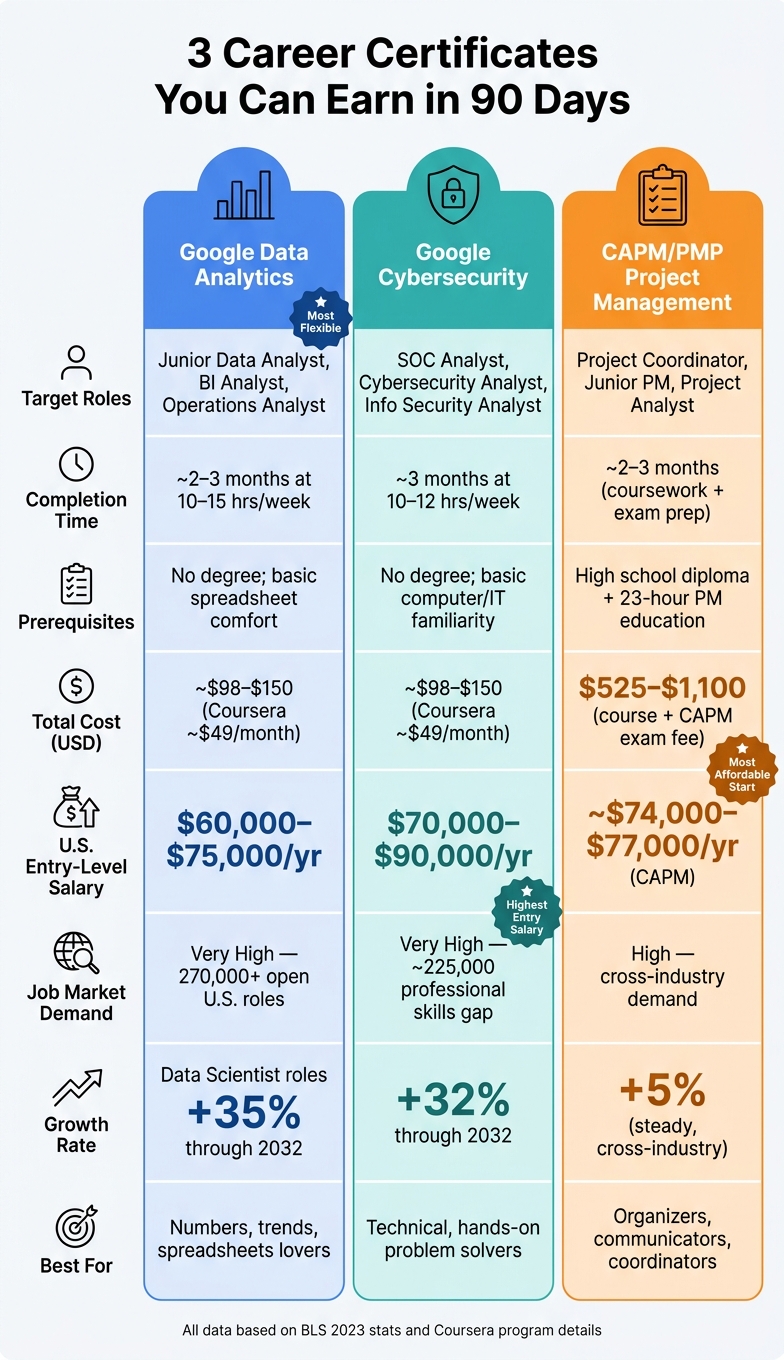
3 Career Certificates You Can Earn in 90 Days: Side-by-Side Comparison
To help you decide which certificate aligns best with your goals, here’s a breakdown of key factors to consider: your daily responsibilities, available study hours, and overall budget - exam fees included.
Comparison Table
| Factor | Google Data Analytics | Google Cybersecurity | CAPM-Aligned PM |
|---|---|---|---|
| Target Roles | Junior Data Analyst, BI Analyst, Operations Analyst | SOC Analyst, Cybersecurity Analyst, Information Security Analyst | Project Coordinator, Junior PM, Project Analyst |
| Completion Time | ~2–3 months at 10–15 hrs/week | ~3 months at 10–12 hrs/week | ~2–3 months (coursework + exam prep) |
| 90-Day Feasible? | Yes, if dedicated | Yes, with heavier weekly commitment | Yes, if you schedule the exam early |
| Prerequisites | No degree; basic spreadsheet comfort | No degree; basic computer/IT familiarity | High school diploma + 23-hour PM education |
| Total Cost (USD) | ~$98–$150 via Coursera (~$49/month) | ~$98–$150 via Coursera (~$49/month) | $300–$800 (course) + $225–$300 (CAPM exam) |
| Approach | Data-driven | Technical | Coordinative |
| U.S. Entry-Level Salary | $60,000–$75,000 | $70,000–$90,000 | Varies |
| Job Market Demand | Very high (cross-industry) | Very high (workforce gap ~225,000 professionals) | High (cross-industry) |
| Financial Aid Available? | Yes (Coursera aid, employer sponsorship) | Yes (Coursera aid, employer sponsorship) | Sometimes (employer reimbursement common) |
The Google Cybersecurity certificate stands out with the highest entry-level salary and a significant skills gap in the U.S. job market. However, it’s also the most technical option, requiring familiarity with tools like Linux, Python, and SIEM software. This path is ideal for those who thrive in hands-on, technical learning environments and can handle a faster-paced study schedule.
The Google Data Analytics certificate offers flexibility and broad applicability across industries such as finance, healthcare, and marketing. If you enjoy working with numbers, spotting trends, and are comfortable with spreadsheets, this is a great entry point with minimal barriers.
The CAPM-aligned PM certification has a higher upfront cost because of the exam fee, but it’s perfect for individuals who excel in organization, communication, and team collaboration. It’s particularly suited for those looking to enter project management roles where technical expertise isn’t the focus.
This comparison highlights how each certification aligns with different career paths, helping you shape your 90-day career plan. Pairing the right certificate with support from scale.jobs, such as their professional resume writing service, ensures your skills are presented in a way that resonates with hiring managers.
Ready to take the next step? Learn how scale.jobs can turn these certifications into career opportunities through tailored job search assistance and expert guidance.
Your 90-Day Career Transition Plan, Step by Step
How to Plan Your Study Schedule
One common pitfall for career changers is waiting to finish a certificate program before taking any other steps. A more effective strategy is to tackle studying, building a portfolio, and applying for jobs simultaneously over three distinct phases.
Break your 90-day plan into three equal parts. During the first 30 days, focus on defining your target role, scheduling weekly study blocks, and starting your certificate program. If you’re working full-time, aim for 10–15 hours of study each week. This could look like four 90-minute sessions on weeknights and a longer 3-hour block on Saturday mornings. During the middle 30 days, dive into the core technical modules of your course while beginning to turn your coursework into portfolio projects. In the final 30 days, shift about half your time toward job searching activities - updating your resume, submitting applications, and conducting informational interviews.
Here’s a helpful tip: reserve a "catch-up buffer" of a few hours every Sunday. Life can throw curveballs - whether it’s extra work hours, family commitments, or an off week. Having this built-in recovery time ensures that one rough patch won’t derail your entire plan.
Building a Portfolio and Applying for Jobs
Start working on your first portfolio project by Week 2 or 3, even if you’re still learning the ropes. Your skills will improve as you go, and you can refine the project along the way. For example, if you’re studying data analytics, analyze a publicly available U.S. dataset and present your findings with clear visualizations. If you’re in cybersecurity, create a detailed write-up of a simulated incident response scenario using tools from your course. For project management, develop a comprehensive project package that includes a charter, timeline, and risk register - this can be for a hypothetical or volunteer project.
By Days 15–30, add your certificate (even if it’s in progress) to your resume and LinkedIn profile with a note like "Expected completion: [Month, Year]." Once you’ve completed one or two portfolio pieces and feel confident discussing them, start applying for jobs. Aim for 10–20 well-tailored applications per week, customizing the top section of your resume - headline, summary, and key achievements - to align with each job description. Many employers in fields like data analytics, cybersecurity, and project management are open to hiring based on skills, and a strong portfolio can carry as much weight as your certificate for entry-level roles.
To juggle these tasks without burning out, streamlining your application process becomes crucial.
How scale.jobs Can Speed Up Your Job Search
As you balance studying, building a portfolio, and job applications, the final 30 days of your plan can feel overwhelming. Trying to wrap up your certificate, polish your portfolio, and send out 10–20 applications per week is a lot to handle.
This is where scale.jobs can make a difference. Unlike automated tools like LazyApply or findmyprofession, scale.jobs offers a more personalized approach:
- Human assistants handle applications manually, avoiding bot-related errors or generic submissions that could get flagged.
- ATS-optimized resumes ensure your application aligns with the keywords and formatting that applicant tracking systems prioritize.
- One-time payment options eliminate ongoing subscription costs.
- Dedicated WhatsApp support keeps you updated throughout the process.
- Proof-of-work screenshots show exactly when and where your applications are submitted, offering full transparency.
When to use LazyApply or findmyprofession: These tools are ideal for job seekers who want an affordable, automated solution to quickly apply to a large volume of jobs and are comfortable handling follow-ups and quality control on their own.
When to choose scale.jobs: This service is perfect for career changers who need a precise, efficient process. It’s especially useful for those balancing certificate studies with a busy job search, as it provides human-verified applications, ATS-ready documents, and consistent support.
"Applying jobs everyday has been super daunting. But now with scale jobs, one can apply 100s of jobs per day as well as focus on prep for interviews." - Sona Tambe
To stay on track for a 90-day career transition, consider starting with an ATS-optimized resume from scale.jobs around Week 3 or 4. Their professional resume services and Human Assistant packages start at $199 with a one-time payment, making it easier to manage your workload and focus on learning and interview preparation. This approach ensures your career change remains steady and on schedule.
Conclusion: Start Your Career Change Today
With your 90-day career transition plan in place, it’s time to take action. Three months is all you need to gain a certificate, build a portfolio, and start establishing yourself in a new field - provided you follow a clear and structured approach. Whether you’re drawn to Google Data Analytics for its focus on numbers and reports, Google Cybersecurity for its emphasis on problem-solving and system protection, or the CAPM/PMP-aligned certificate for its project management focus, the key is to begin with intention and commitment. Unlike other platforms such as findmyprofession, scale.jobs offers a personalized touch by combining human expertise with ATS-optimized tools to ensure your applications are seen by the right people - not lost in automated filters.
These certificates are specifically designed for career changers looking for a fast-track way into a new industry. Google highlights that 75% of U.S. graduates from its Career Certificate programs report a positive career impact within six months - many of whom transitioned from fields like retail, education, or hospitality. Plus, no advanced degree or prior tech experience is required, making this an accessible option for almost anyone.
Start by committing to your plan in writing: pick your certificate, set a 90-day goal for completion, and schedule dedicated weekly study hours. Update your LinkedIn headline to reflect your career shift, such as "Aspiring Data Analyst | Completing Google Data Analytics Certificate", so you begin reshaping your professional identity right away.
As you progress through your certificate program, the challenge of managing job applications while studying can become overwhelming. This is where scale.jobs stands out. Unlike automated tools like LazyApply, their human-powered service ensures each application is handled with care, giving you the freedom to focus on learning and building connections.
Why Choose scale.jobs?
- Human-driven application process: No bots - real people handle each application.
- ATS-optimized resumes: Tailored formatting and keyword alignment to get past applicant tracking systems.
- Proof of submission: Receive screenshots showing exactly where and when your applications were sent.
- One-time payment: Avoid recurring subscription fees with a straightforward pricing model.
- Dedicated support: Get help via WhatsApp to stay on track throughout your job search.
Before diving in, document your chosen certification and set a firm start date. Turning your career change goal into a specific project with a deadline makes it real - and sets you on a path toward success.
FAQs
Which certificate fits my background best?
To choose the right certification for your career change, prioritize those that match the demands of your desired industry. Services like Scale.jobs bring in human expertise to assess your experience and suggest certifications that align with your career objectives. Unlike one-size-fits-all tools, their recruiters focus on ensuring your certifications are strategically presented in ATS-friendly application materials, making it easier for you to catch the attention of hiring managers.
How can I build a portfolio while still studying?
Building a portfolio while you're still studying is an excellent way to highlight your abilities to potential employers early on. Platforms such as Scale.jobs offer helpful tools like portfolio generators, ATS checkers, and job trackers to simplify the process of building and managing your professional profile. When crafting your portfolio, emphasize measurable accomplishments and showcase projects that are relevant to your field. This approach helps you align with industry expectations and creates a clear, compelling story that can make your entry into the workforce much easier and more seamless.
When should I start applying for jobs during the 90 days?
Start applying for jobs as soon as possible. Shifting to a new career often means adjusting your experience to align with the expectations of hiring managers in a different field. This process can be complex, and working with experts early on can make a significant difference. Platforms like Scale.jobs streamline the application process, saving you time by automating submissions while ensuring your documents are optimized for Applicant Tracking Systems (ATS). This approach helps you make the most of the critical 90-day period, increasing your chances of landing a role quickly.