
What Is a Good ATS Score, and Should You Worry About Yours?

Sarah Mitchell
October 13, 2026
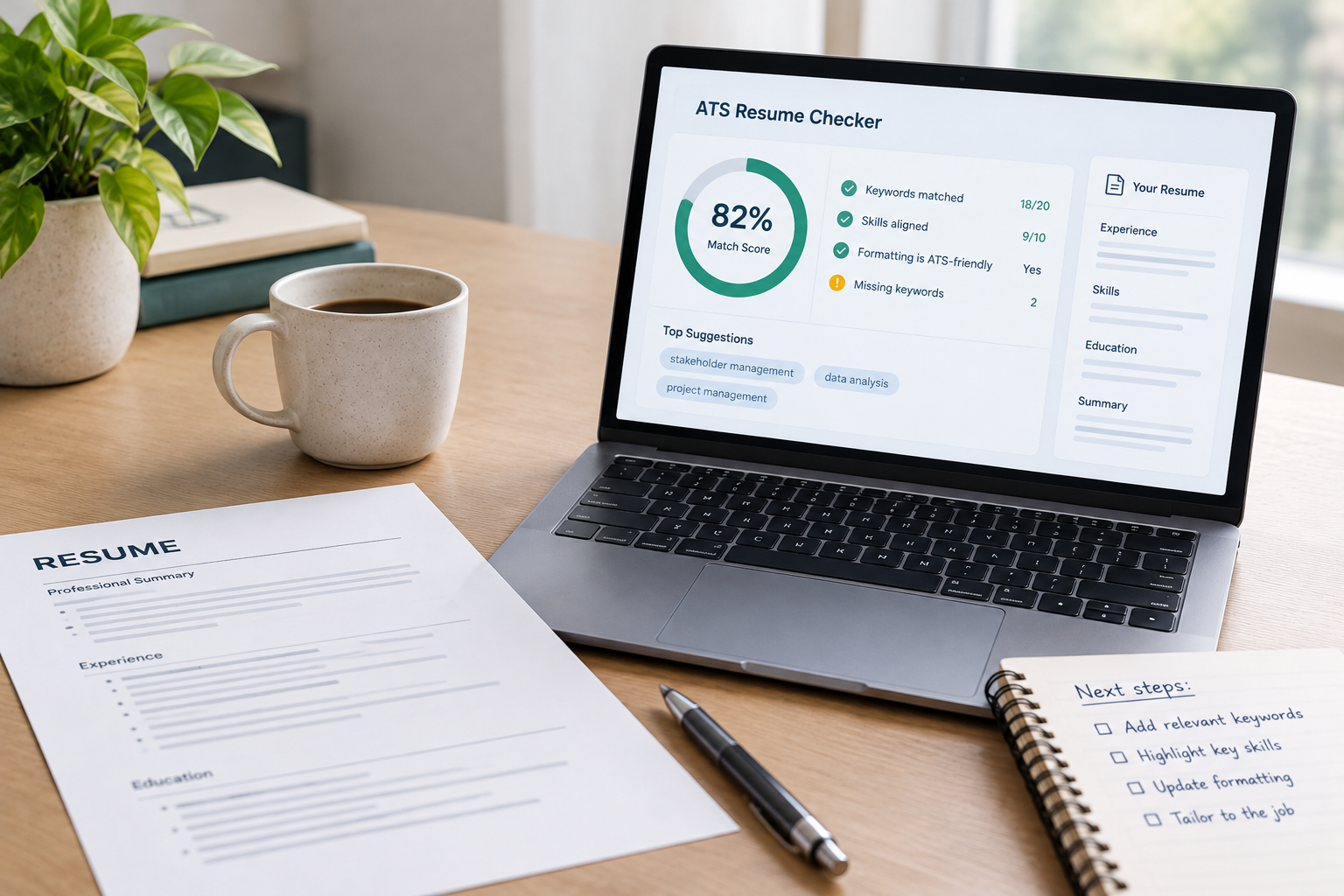
You got an 82% on an ATS resume checker. Nice. But what is a good ATS score, really? Will a recruiter see your resume, or are you still getting rejected before anyone reads it?
Here's the thing: there is no universal ATS score that guarantees your resume will pass screening or get you an interview. The 70%, 80%, and 90% benchmarks you see online often come from individual resume-checking tools, not from a hiring standard followed by every employer.
That doesn't mean these tools are useless. It means you need to understand what they're measuring before you start rewriting your resume to chase a number.
Let's break it down.
What Is Considered a Good ATS Score? Is There Really a Benchmark?
A quick search for "good ATS score" will give you plenty of answers. Some websites recommend 70%. Others say 80% is the sweet spot. A few suggest aiming for 90% or higher.
But where are these numbers coming from?
Resume-checking tools use their own methods to evaluate how closely your resume matches a job description. They might look at relevant keywords, skills, formatting, and other criteria. The resulting percentage represents that tool's assessment, not a universal score assigned by employers.
For example, Jobscan recommends a match rate of 75 or higher for its own resume-matching tool. That's a recommendation for using Jobscan, not proof that every employer requires a 75% ATS score.
This distinction matters because employer-side systems work differently.
Workday documents a Candidate Skills Match feature that compares skills from a candidate's resume and application with skills listed in a job requisition.
Greenhouse offers its own Talent Matching feature, which evaluates candidates against criteria defined by recruiters.
Neither establishes a universal ATS score out of 100 that guarantees an interview.
So, if your resume scores 65% on one checker and 84% on another, that doesn't automatically mean one tool is right and the other is wrong. They may be evaluating different things.
Stop treating a particular percentage as a pass or fail grade. First, understand what the tool is telling you.
How Is an ATS Score Calculated?
It depends on which tool you're using.
A third-party resume checker typically compares your resume with a specific job description. Depending on the product, its report may evaluate keyword alignment, skills, qualifications, formatting, or other aspects of the match.
Let's say you're applying for a product manager role that asks for experience with product roadmaps, stakeholder management, SQL, and experimentation.
Your resume mentions stakeholder management and product roadmaps, but it doesn't clearly describe your SQL experience or experimentation work.
A resume checker might flag those gaps.
That's useful information. But it doesn't automatically mean you lack the required qualifications. Maybe you have the experience but haven't explained it clearly. Or maybe you genuinely don't have one of the requested skills.
Those are two very different problems, and a percentage alone won't tell you which one you're dealing with.
Also, don't assume every checker uses the same formula. One might place more emphasis on keyword matches, while another may assess additional resume elements. Unless the tool publishes a transparent methodology, you shouldn't assume you know exactly how its score is calculated.
So, what is a good ATS score for a resume?
It depends on the checker you're using and what it measures. A good ATS score for a resume can indicate that your experience and skills align with a job description, but it isn't a universal hiring benchmark.
Do All ATS Systems Score Resumes the Same Way?
No. And official documentation from ATS providers makes this difference easier to understand.
How does Workday match resumes to job requirements?
Workday documents a feature called Candidate Skills Match. It compares skills derived from a candidate's resume and application with skills identified in the job requisition.
The feature uses categories such as Strong, Good, Fair, and Low. Workday also explains that required skills receive greater weight in the match calculation.
This is an actual employer-side matching feature. But notice something important: its documented output uses qualitative categories, not a universal 0 to 100 score that applies across all ATS platforms.
You can read the details in Workday's official Candidate Skills Match documentation.
How does Greenhouse evaluate candidates?
Greenhouse offers Talent Matching, which compares candidate information against criteria defined by recruiters. Its documentation describes match categories and explains how recruiters can use the results to assess candidates.
Greenhouse also states that its Talent Matching feature does not automatically reject or advance candidates. Recruiters and hiring managers remain responsible for those decisions.
You can read more in Greenhouse's official Talent Matching FAQ.
These examples show that employer-side matching can involve structured criteria and automated assistance. They don't establish that every employer uses these features, that every ATS works the same way, or that a particular third-party score predicts the outcome.
And that's exactly why a universal ATS score benchmark doesn't make sense.
How Do Recruiters Actually Screen Resumes?
Let's look beyond the software for a second.
In a Reddit discussion about how ATS works, the discussion explores how recruiters narrow down large applicant pools.
Commenters describe several parts of the process:
- Application questions can filter candidates who don't meet specific requirements.
- Recruiters may search for relevant skills, qualifications, and experience.
- Some recruitment systems offer candidate matching and scoring features.
- Recruiters and hiring managers may review applications manually.
- Qualified candidates can still miss out when many applicants meet the requirements.
*This is an anecdotal discussion, not a representative study of every employer's hiring process.
Still, it illustrates an important point: screening can involve multiple stages, and an ATS score is only one possible input.
A recruiter may need someone with a particular certification, a specific type of experience, or a skill that's essential for the role. Another employer may prioritize different criteria.
A high score on a third-party checker can't tell you how that employer has configured its system, how your resume compares with the actual applicant pool, or whether a recruiter will select you.
Getting your resume noticed is not the same thing as getting shortlisted.
Does a Higher ATS Score Increase Your Chances of Getting an Interview?
Not necessarily.
A higher score can indicate that your resume aligns more closely with the criteria a particular checker evaluates. But that doesn't establish that your interview chances have increased.
Think about two candidates applying for the same data analyst role.
Candidate A has a 92% match score. Their resume includes the requested keywords, but their experience section doesn't clearly demonstrate how they've used those skills.
Candidate B has a 76% match score. Their resume shows relevant projects, explains their analytical work, and demonstrates how their findings influenced business decisions.
We can't conclude that Candidate B will get the interview. We also can't conclude that Candidate A will.
The point is that the percentages alone don't tell us enough to make that prediction.
A candidate's fit depends on the role's requirements and the evidence supporting their qualifications. The employer's screening process, the strength of the applicant pool, and the recruiter's assessment can all matter.
What Can Checking Your ATS Score Before Applying Actually Help You With?
Now for the practical part. If the score isn't a hiring guarantee, why bother checking it?
Because a resume checker can help you spot problems you might otherwise miss.
1. Find relevant skills you haven't clearly demonstrated
A checker may flag terminology from the job description that doesn't appear in your resume.
Review those suggestions carefully. If you have the relevant experience, consider whether you've described it clearly enough. If you don't have the skill, don't pretend otherwise.
2. Check whether your resume matches the specific role
A generic resume might describe your experience well but fail to highlight the parts most relevant to a particular job.
Comparing your resume with the job description can help you identify which genuine qualifications deserve more attention.
3. Catch potential formatting or parsing problems
Depending on the tool, you may be able to check whether your resume's text, dates, headings, and other information are being extracted correctly.
If information disappears or gets scrambled, fix the underlying issue. A higher match score won't help if essential details aren't being represented properly.
4. Identify gaps before submitting the application
A checker can give you another opportunity to review your resume before you apply.
Maybe you've forgotten to mention a relevant project. Maybe your experience is described too vaguely. Maybe you've focused on responsibilities without explaining the results.
These are worthwhile things to catch.
But remember that a checker can also produce suggestions that aren't relevant to your situation. Review its feedback rather than accepting every recommendation automatically.
Use the report to identify problems you can fix. Don't treat the score itself as the problem.
How Can You Improve Your Resume Without Chasing an ATS Score?
Here's a better approach to preparing your resume for a specific job.
Read the job description for actual requirements
Identify the skills, qualifications, responsibilities, and experience the employer is asking for. Separate the essential requirements from the preferred ones.
Then compare those requirements with your actual background.
Use relevant keywords naturally
If the job description asks for stakeholder management and you've done that work, use the term where it accurately describes your experience.
But don't force the same keyword into every section just because a checker keeps flagging it.
A resume should communicate your qualifications, not read like someone copied the job description into a document.
Don't list skills you don't have
This one matters.
If a role requires Python and you've never used Python, adding it to your skills section to improve your score is not optimization. It's misrepresenting your qualifications.
If you've used a related tool or have transferable experience, explain that accurately. Don't claim proficiency you can't demonstrate.
Show evidence of your skills
Instead of listing "data analysis" as a skill and leaving it at that, explain how you used it in a relevant project or role.
For example:
"Analyzed customer behavior data to identify drop-off points and recommended changes to improve onboarding."
Use an example like this only if it accurately reflects work you've done. Add a measurable result when you have a real, verifiable number.
Keep the resume easy to read
Use clear section headings, consistent dates, and readable formatting. Follow the employer's file-format instructions and check that the resume's content can be extracted correctly.
A clean, accurate resume is a better starting point than a document filled with keywords that don't reflect your experience.
Frequently Asked Questions About ATS Scores
Is 70 a Good ATS Score?
A 70% score may indicate that your resume matches some of the criteria evaluated by a particular checker. Whether that's a good result depends on the tool's methodology. It doesn't guarantee that an employer's ATS will shortlist you or that a recruiter will contact you.
Is 80% a Good ATS Score?
An 80% score may indicate strong alignment with a particular tool's criteria. However, it doesn't guarantee that an employer's ATS will shortlist you or that you'll receive an interview.
Can an ATS automatically reject a resume?
Some employer systems can filter candidates using configured screening rules or application-question responses. However, automated rejection behavior varies by system and configuration. A low score from a third-party resume checker does not automatically mean an employer has rejected you.
Do all ATS systems score resumes?
No. ATS platforms offer different features, and employers configure them differently. Some offer candidate matching or scoring, while other parts of the recruitment process may rely on search, filters, application questions, and human review.
Should I keep editing my resume until I get a 90% score?
No. Make changes when they improve relevance, accuracy, or clarity. Don't add irrelevant keywords or claim skills you don't possess simply to reach a particular percentage.
What Should You Focus on Instead of Your ATS Score?
A good resume isn't one that hits an arbitrary number on a checker. It's one that clearly and honestly demonstrates why you're qualified for the specific role.
Use an ATS score checker if it helps you identify missing details, unclear experience, or potential formatting issues. Review its recommendations, fix what genuinely needs fixing, and leave the rest.
You don't need a 90% score to prove you're a strong candidate. You need a resume that makes your actual qualifications clear.
Check the score and analyze it. Then focus on the resume, not the number.
You can use the Scale.jobs ATS Checker to review your resume against a specific job description and identify areas that may need improvement before applying.