
Scale.jobs vs LinkedIn vs Google Jobs: Best platform for job search

Leela Yanamaddi
May 17, 2026

When searching for a job, choosing the right platform can save you time and increase your chances of success. Here's a quick breakdown of Scale.jobs, LinkedIn, and Google Jobs:
- Scale.jobs: Focused on high-volume, tailored applications with human and AI support. Best for professionals who need help managing their job search efficiently.
- LinkedIn: A networking-first platform ideal for building connections and visibility, particularly in industries like tech, finance, and consulting.
- Google Jobs: A job discovery tool that aggregates listings from multiple sources, perfect for exploring opportunities but limited in application management.
Quick Comparison
| Feature | Scale.jobs | Google Jobs | |
|---|---|---|---|
| Core Function | Application execution (human + AI services) | Networking and visibility | Job discovery and aggregation |
| Human Involvement | High (dedicated assistants) | Low (user-driven) | None |
| ATS Optimization | Yes, role-specific optimization | Limited to user input | None |
| Application Tracking | Real-time updates via WhatsApp | Basic dashboard | None |
| Pricing | One-time fee ($199–$399) | Free basic, $39.99/month premium | Free |
If you're overwhelmed by manual applications or need expert assistance, Scale.jobs is a smart choice. Use LinkedIn for networking and recruiter outreach using cold outreach strategies, and Google Jobs for initial job discovery. For a seamless experience, consider combining these platforms based on your job search goals.
8 Job Search Engines to Land Your Next Role
sbb-itb-564272e
How We Evaluated These Platforms
When it comes to job search tools, each platform plays a unique role: LinkedIn focuses on networking, Google Jobs excels in job discovery, and Scale.jobs shines in application execution. To help you understand how these platforms stack up, we’ve assessed them based on six key factors that directly influence job search outcomes. This evaluation underscores why Scale.jobs offers a standout approach, particularly for candidates looking for a structured blend of human expertise and AI efficiency.
Comparison Criteria Explained
Here’s a closer look at the six dimensions we used to evaluate these platforms:
- Job Discovery: How well does the platform identify relevant and up-to-date openings? Google Jobs outpaces LinkedIn with nearly three times the response rate, thanks to its ability to pull listings from a wider range of sources.
- Application Execution: Does the platform streamline the application process or leave it entirely up to you? This is where the platforms show the most variation.
- ATS Handling: Can the platform optimize your resume to pass Applicant Tracking Systems (ATS) filters? This is a critical factor for getting noticed by recruiters.
- Human Involvement: Does the platform provide personal guidance, or are you navigating the process solo with automated tools?
- Tracking and Transparency: How effectively can you monitor your applications - what’s been submitted, when, and to which employers? This is especially crucial for high-volume job searches.
- Pricing Structure: We compared costs, including free options, subscriptions, and one-time fees, to evaluate the value each platform delivers. This is particularly important if you're considering additional services like professional resume support services.
Platform Overview Table
| Dimension | Scale.jobs | Google Jobs | |
|---|---|---|---|
| Primary Model | Human-assisted AI (hybrid) | Networking-first job board | Search aggregator |
| Application Execution | Done-for-you by human VAs (30+/day) | Manual or "Easy Apply" | Manual (redirects to source) |
| ATS Handling | Human-verified, expert-optimized | Manual | Manual |
| Human Involvement | High - dedicated virtual assistants | Moderate - user-driven networking | Low - fully self-service |
| Tracking & Transparency | Real-time WhatsApp updates + screenshots | Basic in-platform dashboard | None (self-tracked externally) |
| Pricing | One-time fee ($199–$1,099) | Free basic; ~$39.99/month for Premium | Free |
"The data tells a massive story: the sites where everyone looks might not be the sites that get you hired." - Sam Wright, Head of Career Strategy, Huntr.co
This table provides a snapshot of how these platforms compare, but the details matter. In the sections that follow, we’ll dive deeper into each platform’s strengths and how they align with different job search needs. If you're considering a virtual assistant for job seekers or looking for a job application service, this breakdown will help you make an informed choice.
Scale.jobs: Human-Assisted Job Search with AI Support
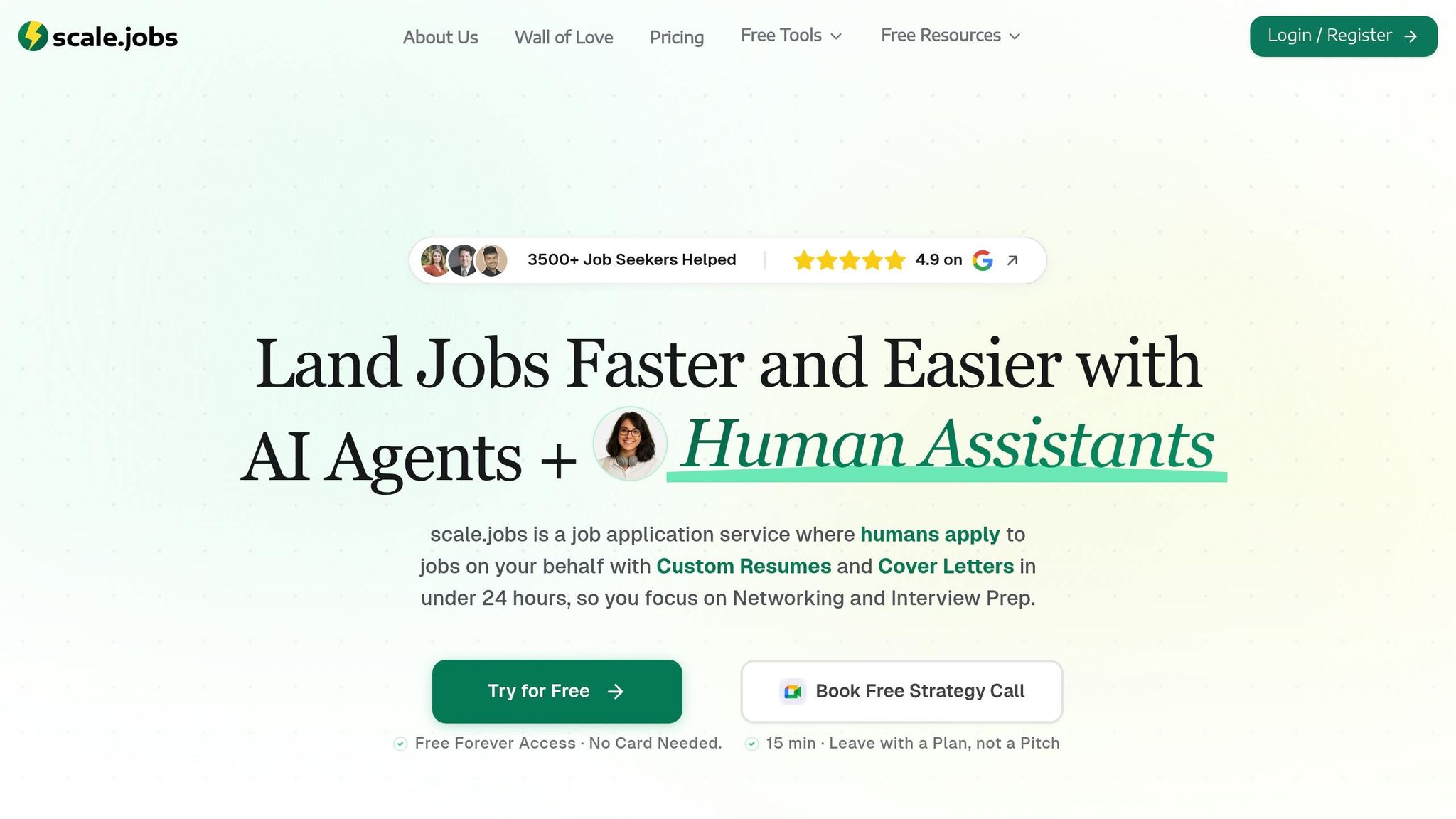
Scale.jobs offers a unique approach to job searching, standing apart from platforms like LinkedIn or Google Jobs. Rather than being a traditional job board or networking site, it operates as a done-for-you application service. By combining trained human virtual assistants with AI tools, Scale.jobs takes charge of your job search campaign from start to finish.
How Scale.jobs Works
The service is structured around three tiers:
- Free Tier: Ideal for those managing their own job search, this plan includes access to a job board, an ATS-compliant resume builder, an application tracker, and limited daily AI tools. It’s a solid starting point for a self-directed approach.
- AI Assistant Pro: Priced at $9/month during launch ($19/month regular), this plan provides unlimited AI-generated resumes, cover letters, and interview prep responses tailored to specific job postings. It’s perfect for job seekers who want to enhance their applications with AI support.
- Human Assistant: This is where Scale.jobs sets itself apart. Starting at $199 for 250 applications (up to $399 for 1,000), this plan employs trained virtual assistants to manually submit applications. These assistants handle submissions across corporate ATS portals, niche job boards, and company career pages, avoiding the risks associated with automated scripts that could trigger red flags.
The pricing is a flat, one-time fee, and unused credits are refundable. For those needing additional support, Scale.jobs also offers resume writing and career services, which include one-on-one Zoom consultations, LinkedIn profile overhauls, and direct application assistance.
This tiered system ensures a comprehensive and customizable experience, catering to a variety of job search needs.
Where Scale.jobs Stands Out
- Human Virtual Assistants: Applications are handled by real people, ensuring a personalized touch.
- ATS-Compliant Resumes: Resumes are optimized for applicant tracking systems using NLP technology.
- Transparency: Real-time WhatsApp updates and time-stamped screenshots provide proof of each submission.
- Flat, One-Time Fee: No recurring monthly costs, with refunds available for unused credits.
One of the standout benefits is the ability to manage high-volume applications without sacrificing quality. For most job seekers, submitting 30 or more tailored applications daily is unmanageable. Scale.jobs takes on this workload while ensuring resumes are customized to improve ATS performance.
Additionally, the platform’s transparency is unmatched. Every application is accompanied by a time-stamped screenshot and real-time updates via WhatsApp, letting you see exactly what’s been submitted and when - a level of detail neither LinkedIn nor Google Jobs provides.
Limitations and Who It’s Best For
The upfront cost of $199–$399 may give some pause, especially compared to a $39.99/month LinkedIn Premium subscription. However, the flat-fee model eliminates ongoing charges, offering peace of mind with no surprise bills.
Scale.jobs is best suited for white-collar professionals and tech job seekers who need a structured, high-volume application process. This includes recent graduates, those navigating layoffs, or visa holders (H-1B, F-1, OPT) requiring precise communication of sponsorship needs in every application.
It’s less ideal for casual job seekers or those relying heavily on networking and recruiter outreach. Unlike LinkedIn’s networking-driven approach or Google Jobs’ broad search capabilities, Scale.jobs focuses on disciplined, high-volume application management. For those who value efficiency and personalized attention, it’s a standout choice for streamlining the job search process.
LinkedIn: Networking-First Job Search
LinkedIn stands out as a professional networking platform with over 1 billion members across 200+ countries and more than 20 million open job listings at any time. It’s a dominant force for white-collar job seekers in the U.S., but its vast reach doesn’t guarantee success for everyone.
How LinkedIn Works for Job Seekers
Unlike services like Scale.jobs, which handle applications for you, LinkedIn requires users to manage their own networking and job applications. You can search for roles by title, location, and filters like remote or hybrid options and company size. The Easy Apply feature allows quick submissions of your profile and resume, while other roles might redirect you to a company's ATS (Applicant Tracking System).
LinkedIn's real strength is in its networking capabilities. You can identify 2nd-degree connections at companies, send InMails to recruiters, and set up saved searches with email alerts. For those willing to invest, LinkedIn Premium Career (around $39.99/month) offers applicant insights, InMail credits, and an expanded profile view history to help you stand out.
What LinkedIn Does Well
LinkedIn thrives as a networking tool, especially for professionals skilled at building connections. Recruiters heavily rely on it, with 87–90% of recruiters citing it as their primary sourcing platform. This means that a strong, well-optimized profile can attract attention without requiring you to apply directly.
The platform is especially effective for mid-level and senior positions in industries like tech, finance, consulting, and marketing, where referrals and visibility play a huge role. For example, if you’re a senior data analyst who updates their LinkedIn headline and skills, you might receive unsolicited InMails from recruiters at startups or established companies. Active engagement - posting updates, commenting, and building your network - can significantly boost your chances.
Where LinkedIn Falls Short
Despite its advantages, LinkedIn is a tool, not a service. That means every aspect of the job search - researching roles, tailoring resumes, applying, and following up - is your responsibility. For those balancing a job search with full-time work, this can quickly become overwhelming.
The Easy Apply feature, while convenient, often backfires. It lowers the effort needed to apply, leading to hundreds of generic submissions for popular roles. This can make it harder for your application to stand out. Additionally, LinkedIn lacks a pipeline tracking system, meaning you’ll likely need to rely on spreadsheets to monitor your progress. While LinkedIn suggests profile keywords, it doesn’t provide ATS-specific optimization for resumes uploaded to external platforms like Workday or Greenhouse. Services like Scale.jobs fill this gap by offering tailored resume writing and career support.
| Feature | Scale.jobs | |
|---|---|---|
| Application handling | User-managed | Submitted by human assistants |
| ATS optimization | Profile-level suggestions only | Role-specific, human-verified |
| Application tracking | No pipeline view | Real-time WhatsApp updates + screenshots |
| Networking support | Full networking tools | Focused on application execution |
| Pricing model | ~$39.99/month (Premium) | One-time flat fee from $199 |
| Proof of work | None | Time-stamped submission records |
LinkedIn also tends to favor users who are already active and visible. If you’re introverted, early in your career, or unable to dedicate hours weekly to building a network and posting content, the platform’s benefits can be limited. This is where Scale.jobs’ hands-on approach, focusing on personalized application support, stands out as a more thorough alternative for job seekers.
Google Jobs: Broad Job Discovery Through Search
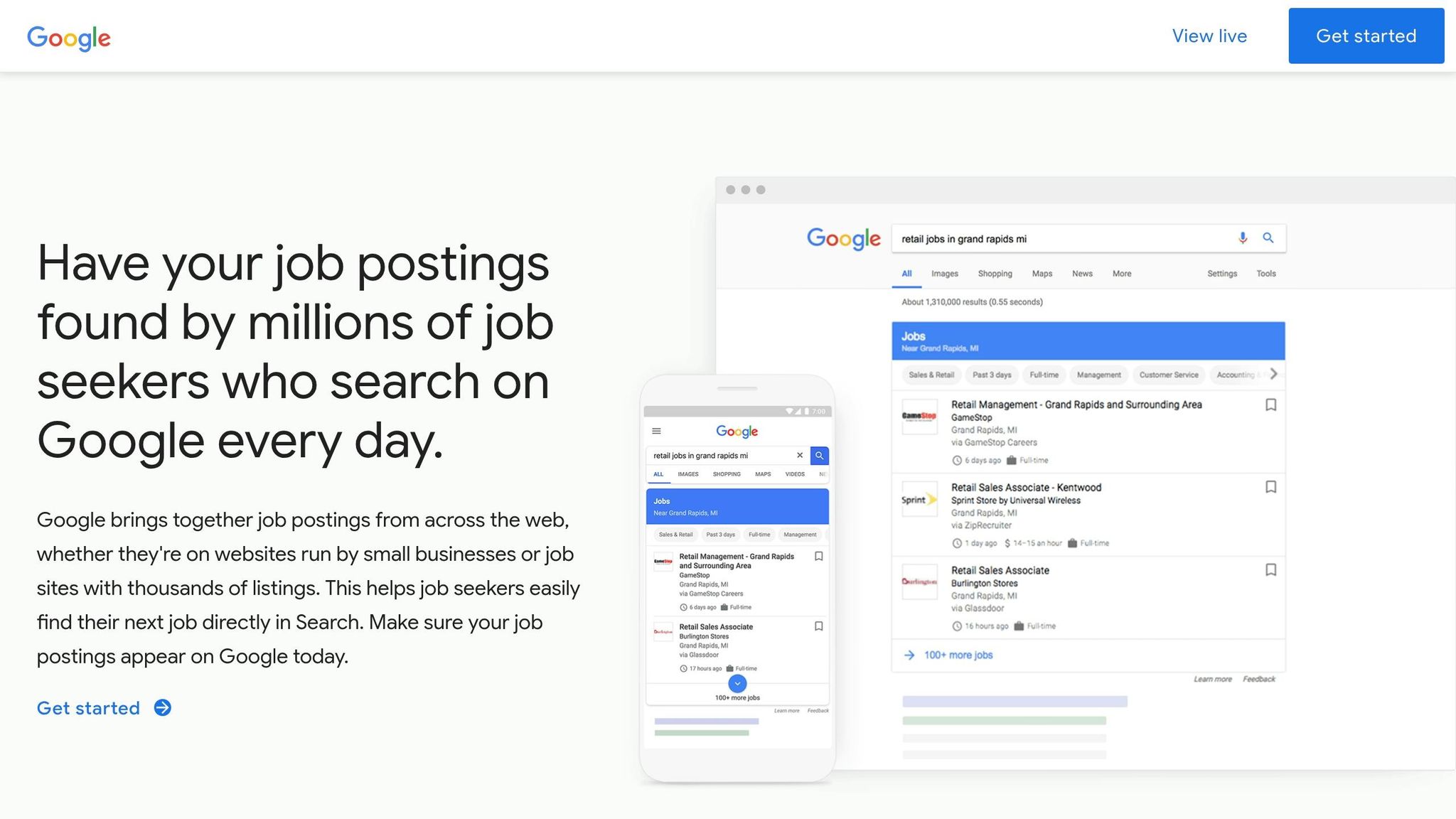
Google Jobs isn’t your typical job board. Instead, it acts as a search aggregator integrated directly into Google Search. It pulls job listings from platforms like LinkedIn, Indeed, Glassdoor, ZipRecruiter, Monster, CareerBuilder, and many smaller job boards. With approximately 78% of all job searches starting on Google, it’s one of the most accessible tools for job seekers today.
How Google Jobs Works
When you type something like "product manager jobs in Austin" into Google, a job box appears at the top of the search results, often above ads and organic links. These listings are sourced from third-party platforms or employer career pages using Schema.org's JobPosting structured data. This data helps Google identify details like the job title, location, and posting date. Through this system, Google processes around 200,000 U.S. job listings daily.
However, Google Jobs doesn’t host job applications itself. Instead, it provides a summary of the listing and redirects you to the original source - whether that’s Indeed, a company’s career page, or another platform - where you’ll need to manually complete the application. While this approach is excellent for initial job market research, it offers limited assistance for the application process itself.
What Google Jobs Does Well
The platform excels at quick and easy job discovery. Within minutes, you can see which companies are hiring for specific roles in your area, making it an excellent tool for early-stage job searches. It’s particularly helpful for identifying smaller companies or niche roles that might not appear on larger platforms like LinkedIn or Indeed, as long as the employer uses the correct structured data on their website.
For someone just starting out - exploring demand for their skills or identifying potential employers - Google Jobs offers a frictionless way to scan the market. However, when it comes to managing the next steps, its limitations become apparent. By contrast, platforms like Scale.jobs not only help identify opportunities but also streamline the application process for you.
Where Google Jobs Falls Short
While Google Jobs simplifies job discovery, it offers little support for managing applications. Key features like saved profiles, resume tools, and application tracking are missing. Every application requires navigating a different platform with its own unique process, which can quickly become overwhelming, especially if you’re applying to dozens of roles. Additionally, Google Jobs doesn’t optimize resumes for applicant tracking systems (ATS), leaving job seekers to handle this crucial step on their own.
Another drawback is its reliance on structured data. If a company’s career page doesn’t include the correct JobPosting schema, those jobs won’t appear in search results. This means Google Jobs can miss open positions. Unlike LinkedIn, it also lacks passive visibility - recruiters can’t discover your profile through the platform.
Here’s how Google Jobs compares to Scale.jobs in terms of features and support:
| Feature | Google Jobs | Scale.jobs |
|---|---|---|
| Primary function | Job discovery and aggregation | Human-assisted application execution |
| Application process | Fully manual; redirects to third-party sites | Submitted by human assistants on your behalf |
| ATS handling | None | Role-specific, human-verified optimization |
| User profile | No native profile | Centralized candidate profile |
| Proof of work | None | Time-stamped submission records + screenshots |
| Networking tools | None | Focused on application execution |
| Pricing | Free | One-time flat fee from $199 |
For job seekers ready to move beyond research and focus on applying to roles, Google Jobs doesn’t address the challenges of scaling your applications. At this point, a virtual assistant for job seekers can step in to handle repetitive tasks like submission tracking and ATS optimization, saving you time and effort while improving your chances of landing interviews.
Side-by-Side Comparison and How to Choose
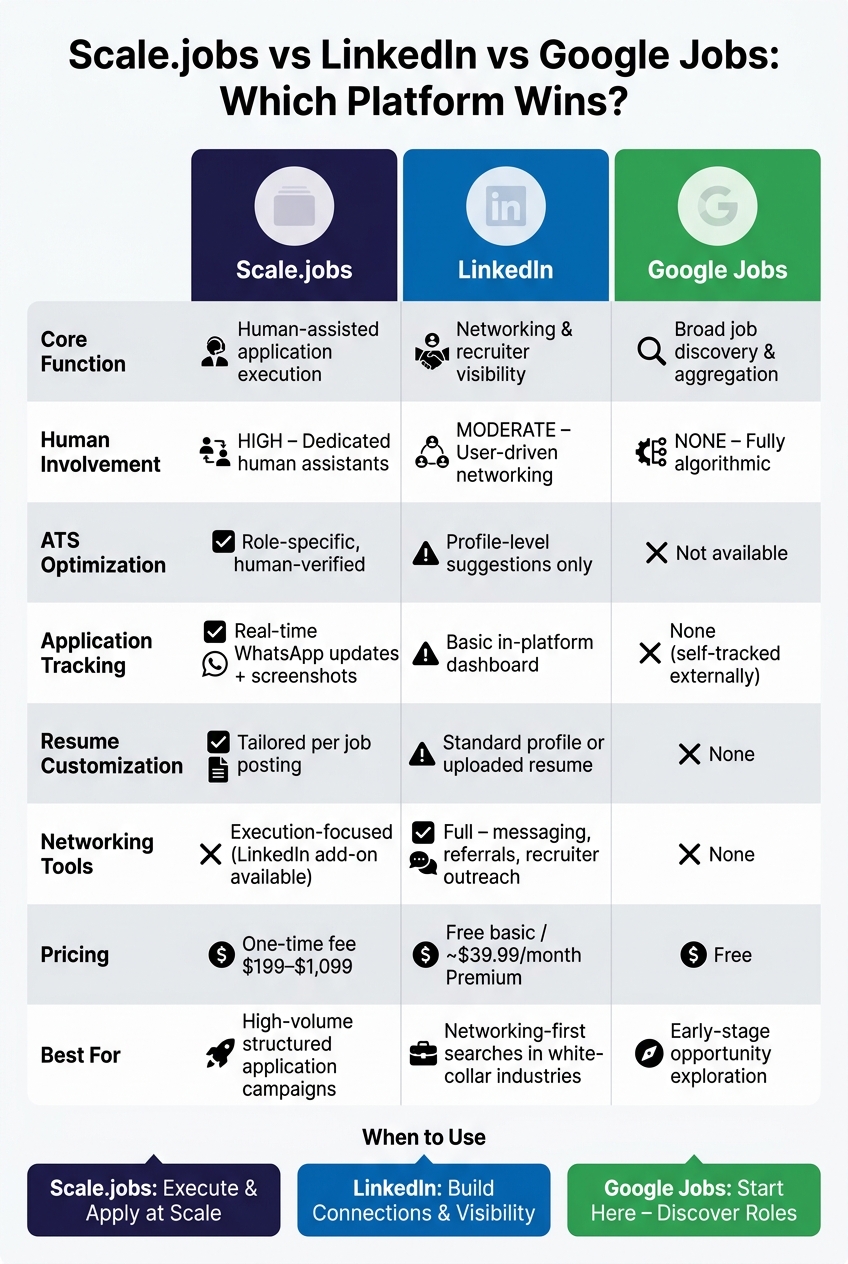
Scale.jobs vs LinkedIn vs Google Jobs: Full Feature Comparison
Full Feature Comparison Table
Here’s a breakdown of how Scale.jobs, LinkedIn, and Google Jobs stack up against each other:
| Feature | Scale.jobs | Google Jobs | |
|---|---|---|---|
| Core Function | Human-assisted application execution | Networking and recruiter visibility | Broad job discovery and aggregation |
| Human Involvement | High – dedicated human assistants handle submissions | Low – user-driven networking | None – algorithmic |
| ATS Optimization | Role-specific, human-verified per application | Depends on user-uploaded content | Not applicable |
| Submission Method | Hand-submitted within 24 hours | Manual or LinkedIn Easy Apply | Redirects to external sites |
| Resume Customization | Tailored to each job posting | Standard profile or uploaded resume | None – user handles externally |
| Transparency and Proof of Work | Screenshots + real-time WhatsApp updates | Limited – "Application Viewed" notifications | None |
| Networking Tools | Execution-focused; LinkedIn Makeover available as an add-on | Strong – messaging, referrals, recruiter outreach | None |
| Pricing Model | Flat fee starting at $199 | Free basic; ~$40–$50/month for Premium Career | Free |
| Best Fit | Mid-career professionals managing structured, high-volume campaigns | Networking-first searches in white-collar industries | Early-stage exploration of opportunities |
This table highlights where each platform excels, making it easier to decide which tool aligns with your job search needs.
When to Use Each Platform
Each platform serves a distinct purpose, depending on where you are in your job search journey. Here’s a closer look:
- LinkedIn: Ideal for relationship-building and recruiter visibility. If your search is in industries like tech, consulting, marketing, or finance, LinkedIn’s networking tools - like direct messaging and referrals - are invaluable. With over 50 million job seekers active weekly, it offers broad exposure for passive opportunities.
- Google Jobs: Best suited for the initial stages of your search. It aggregates listings from multiple sources, helping you map out available roles. However, it doesn’t support application tracking or submission, so its utility diminishes after identifying target positions.
- Scale.jobs: Perfect for transitioning from exploration to execution. If you’ve pinpointed your target roles and need to submit numerous high-quality applications efficiently, Scale.jobs takes care of the heavy lifting. It handles submissions across platforms like corporate ATS, niche boards, and company career pages, freeing you up to focus on networking and interview prep.
Switch to Scale.jobs if…
For many job seekers, the challenge isn’t finding job postings - it’s ensuring applications are submitted accurately and consistently. Here’s when Scale.jobs might be your best option:
- You face recurring ATS rejections: Scale.jobs optimizes applications with role-specific keywords and human oversight, addressing issues that LinkedIn Easy Apply and Google Jobs cannot.
- Managing 20+ applications per week feels overwhelming: With Scale.jobs, you get a centralized dashboard, real-time WhatsApp updates, and transparent tracking, making high-volume submissions manageable.
- You want professional-grade results without hefty costs: Starting at $199 for 250 applications, Scale.jobs offers a cost-effective option. Their resume writing services can further enhance your application materials.
- You’re not gaining traction on other platforms: If weeks of effort on LinkedIn or Google Jobs haven’t led to interviews, the issue might lie in application quality or volume - areas where Scale.jobs excels with its human-supported approach.
If any of these scenarios resonate with your current job search challenges, the next section will guide you in finalizing your choice of platform.
Conclusion: Choosing the Right Job Search Platform
Google Jobs is ideal for quickly surveying available roles during the early stages of your search. Meanwhile, LinkedIn shines in networking-driven fields like tech, finance, and consulting, where referrals can significantly boost your chances - 30% hiring success through referrals versus just 2–3% for cold "Easy Apply" submissions. However, when your priority shifts to managing a high volume of customized applications, Scale.jobs offers a more focused and efficient approach.
Scale.jobs specializes in a structured, high-volume application process with human assistance. Whether you're a recent graduate, a mid-career professional, or navigating visa constraints like H-1B or F-1, their method ensures quality over quantity. With 20 carefully tailored applications outperforming 20 rushed ones, Scale.jobs takes care of everything - from crafting ATS-friendly resumes to manually submitting applications - allowing you to focus on interviews and networking. This attention to detail and execution makes it a go-to option for professionals whose job searches have hit a plateau.
The recommended strategy is clear: use Google Jobs to identify opportunities, LinkedIn to build connections, and Scale.jobs to ensure your applications stand out. If you also require polished application materials, Scale.jobs' reverse recruiting services integrate seamlessly with their application management.
LinkedIn excels for networking-focused candidates, Google Jobs works well for initial exploration, and Scale.jobs is the solution for those who need professional-grade, high-volume application management. Its human-AI hybrid approach outpaces both DIY methods and basic automation tools.
Switch to Scale.jobs if…
- You're repeatedly rejected by ATS systems despite consistent applications.
- You need to handle 20+ customized applications weekly without compromising quality.
- Your efforts on LinkedIn or Google Jobs haven't led to interviews.
- You want real-time tracking and transparency for every submission.
- You seek professional-level results without breaking the bank.
Decision Summary
For quick role discovery, opt for Google Jobs. For networking and referrals, turn to LinkedIn. For a disciplined, high-volume, and personalized application process backed by human oversight, choose Scale.jobs.
FAQs
How many applications should I submit per week for my role?
The number of job applications you should aim for each week can vary based on your strategy and the tools you use. For example, Scale.jobs applies to around 30 jobs per day, which adds up to about 150 applications weekly. This approach strikes a balance between quantity and quality, increasing the likelihood of finding the right job opportunity.
Do human-submitted applications reduce ATS rejection risk?
Yes, applications submitted by humans can greatly reduce the risk of rejection by Applicant Tracking Systems (ATS) when handled properly. Services like Scale.jobs blend human expertise with ATS-friendly resume optimization, leading to better results. By customizing applications to align with specific job requirements, this method captures details that automated tools often overlook. Automated systems frequently generate generic applications, which are more likely to be rejected. Human involvement plays a key role in minimizing these rejections and boosting the chances of landing an interview.
What proof do I get that my applications were actually submitted?
Scale.jobs keeps you informed every step of the way by offering time-stamped screenshots for each job application submission. Additionally, you’ll receive real-time WhatsApp notifications, ensuring you have immediate confirmation that your applications have been successfully submitted.