
Cap-Exempt H1B by State: Where to Target First

Sarah Mitchell
July 4, 2026

If I wanted a cap-exempt H-1B in 2026, I would not search all 50 states. I would start with 3 states, focus on universities, teaching hospitals, and research employers, and use a tool based on my deadline: discovery first if I still need leads, execution first if I already know where to apply.
Here’s the short answer:
- Start with: Massachusetts, New York, Pennsylvania, Michigan, Minnesota, and Maryland
- Best for tight deadlines: large university and hospital systems that file often
- Best search method:
- use a job search platform for lead finding
- use a job application service or Virtual Assistant for Job Applications for portal-heavy submissions
- Main rule: cap-exempt depends on employer type, not job title
- Best document format: academic CV, not a private-sector resume
H-1B Cap-Exempt Jobs: Indian Beneficiaries' Path Beyond Lottery
sbb-itb-564272e
Quick comparison
| Option | Best use | Main issue | Best fit |
|---|---|---|---|
| scale.jobs | Manual applications in university and hospital portals | Less useful if you only want alerts | Tight deadline, fixed state list |
| LazyApply | High-volume public board applications | Weak fit for many academic portals | Broad private-sector search |
| Simplify.jobs | Finding sponsorship-friendly openings | Does not confirm cap-exempt employer type | Early-career discovery |
| Jobright.ai | AI-based lead finding | Good for leads, not employer verification | Early shortlist building |
| DIY search | Direct outreach to labs and departments | Slow and admin-heavy | Niche research search |
What I’d do first
If you want a simple plan, use this:
- Pick 3 states, not 10.
- Build a list of universities, teaching hospitals, and research nonprofits.
- Check whether each employer is cap-exempt.
- Convert your resume into an academic CV with an ai resume builder if needed.
- Start to Apply for jobs through official portals first.
- Use direct outreach only for niche lab or PI-led roles.
My take
The article’s main point is right: state choice changes your odds. A broad search wastes time. A short state list, a clean employer check, and the right workflow usually work better than mass applying across random openings.
Quick Comparison
| State cluster | Best states to start with | Best for |
|---|---|---|
| Northeast academic-medical | MA, NY, PA, CT, NJ, MD | Fast cap-exempt targeting |
| Public university/hospital volume | MI, MN, WI, OH, FL, CA, TX | More openings across role types |
| Research-focused hubs | MD, TN, CO, AZ, WA | Specialized research profiles |
If I were choosing today, I’d start in the Northeast for speed, Michigan or Minnesota for volume, and Maryland for research-heavy roles.
1. scale.jobs
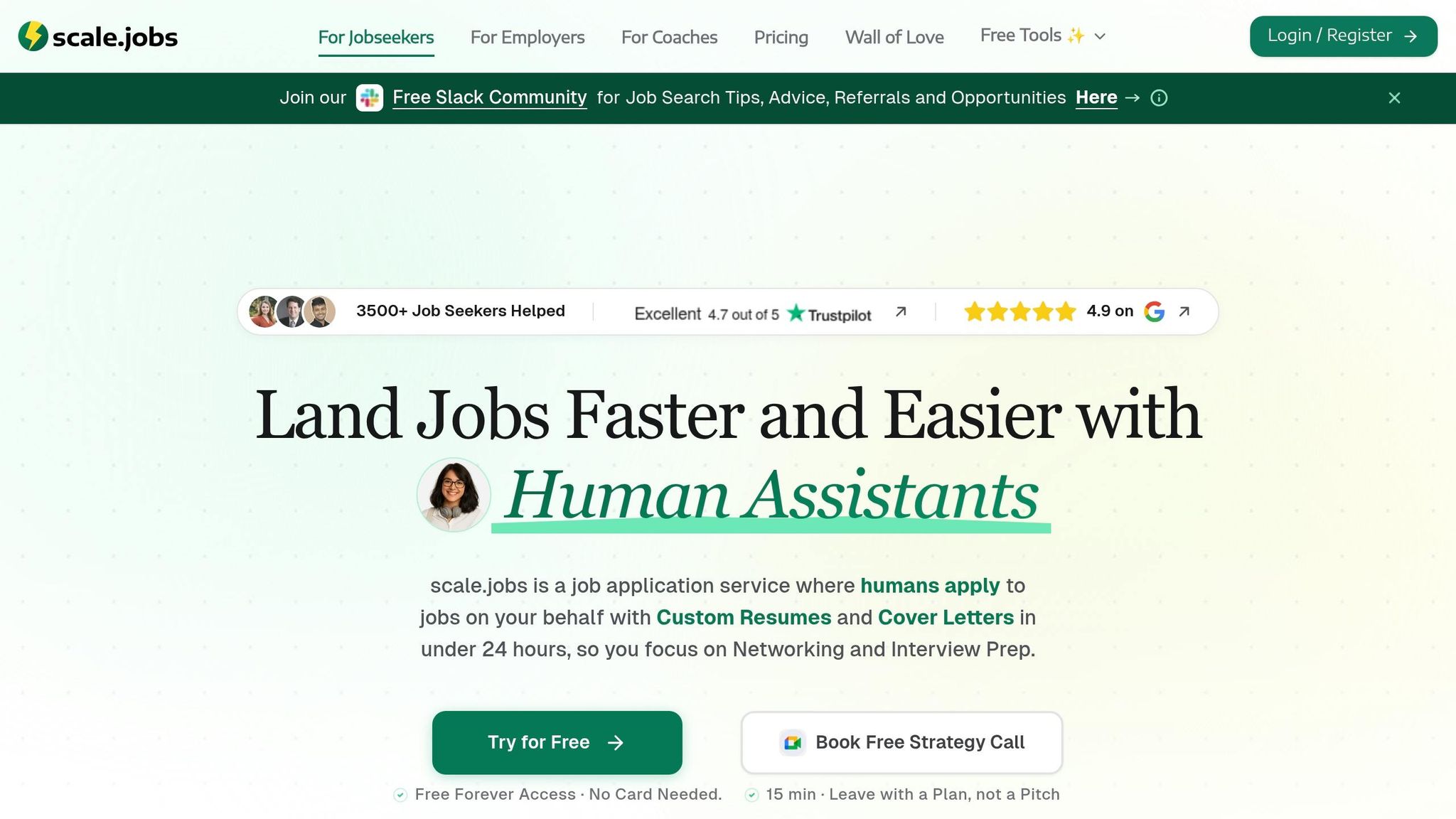
scale.jobs is a strong fit for cap-exempt searches when portal work keeps slowing you down. If tools like LazyApply or Simplify.jobs still leave you fixing broken fields, rechecking uploads, or dealing with odd employer portals, scale.jobs moves that work to human assistants.
Instead of relying on browser automation, trained human virtual assistants submit applications by hand across university and hospital portals. You also get screenshots and WhatsApp updates, so you can check what was submitted and when. That kind of visibility helps a lot when your search is already narrowed and you’re focused on a short list of states.
You choose the states to target, and the assistants work only from that list. The pricing is simple: a flat $199 for 250 applications or $299 for 500. That makes budgeting easier, even if you decide to swap out one state for another. This is best used when you need careful handling across many portals in a small group of target states.
The goal here isn’t just sending more applications. It’s cleaner execution in the places most likely to lead to cap-exempt roles. If your materials need work before you apply for jobs, scale.jobs also offers resume and LinkedIn support, including 1-on-1 Zoom calls and ATS-ready output. For people who want extra help with documents, tools like an ai resume builder or ai cover letter builder can also help before submission starts.
Who should use scale.jobs: Candidates who have already narrowed their search to high-density cap-exempt states - those with universities, teaching hospitals, or research nonprofits - and need a virtual assistant for job seekers to handle portal submissions without constant oversight.
Who should choose a faster automation tool: Candidates running broad searches across many states and employer types, where volume matters more than manual accuracy on each submission.
Next, compare that manual workflow with LazyApply's automation-first approach.
2. LazyApply
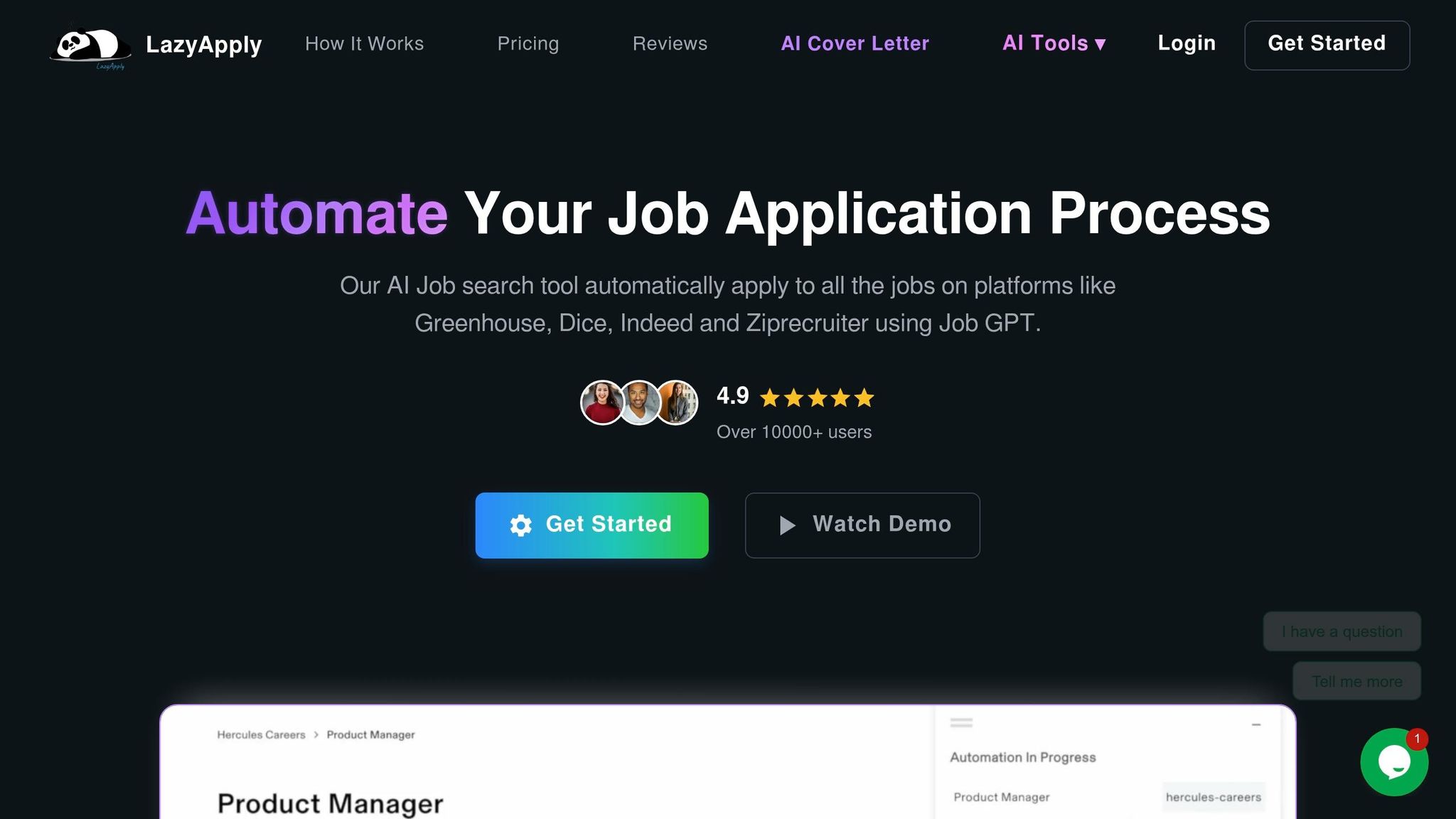
LazyApply is fast. That part is true. But cap-exempt job searches are a different beast.
A lot of these roles live inside university HR systems, teaching-hospital portals, and academic job boards that don’t play nicely with automation. In plain English: the tool may get you part of the way, then hit a wall. At that point, someone usually has to step in and finish the application by hand if you want it done right.
There’s another snag. A nonprofit is not automatically cap-exempt. It still needs the right affiliation or qualifying research status. If a platform doesn’t filter at the employer level, you can burn time applying to places that don’t fit your visa plan. That slows down your state-by-state shortlist instead of moving it forward.
Documents matter too. Academic hiring teams often expect a CV, not a standard resume. They usually want to see publications, talks, and research infrastructure experience. LazyApply sends the file you upload as-is. So if you’re using a resume built for private-sector roles, it may not fit what an academic employer wants to see. If you need better materials first, tools like an ai resume builder or ai cover letter builder can help, but you still need the right academic format.
Then there’s the hidden-market issue. Many cap-exempt jobs are filled through PI networks before they ever show up in public listings. Broad automation won’t catch those leads. That lowers its value when you’re chasing high-priority cap-exempt states and trying to keep your search tight.
LazyApply vs Scale.jobs
Here’s the short version: LazyApply works better for broad, high-volume applications on standard boards. Scale.jobs fits better when the search needs manual review, employer checks, and state-by-state targeting.
Why scale.jobs wins for cap-exempt targeting:
- Human assistants handle university HR portals and teaching-hospital systems that automation tools often can’t get through cleanly
- Employer cap-exempt status is checked before submission, which helps keep your shortlist focused
- CVs and support documents are shaped to fit academic hiring needs
- Screenshots and WhatsApp updates give you proof of submission
- State-level hiring limits are factored in, so the list stays aimed at places you can actually pursue
| Factor | LazyApply | scale.jobs |
|---|---|---|
| Academic portal handling | Struggles with complex university and hospital systems | Human assistants handle manual submission |
| Cap-exempt employer filtering | Not verified | Verified before submission |
| Document format | Uploads your file as-is | ATS-optimized CVs and supporting docs |
| State-level policy awareness | May miss localized restrictions | Accounts for local hiring constraints |
| Proof of submission | Limited visibility | Screenshots, proof of work, and WhatsApp support |
Is LazyApply Worth It?
Yes - if your plan is volume.
It makes sense for candidates who want to Apply for jobs across mainstream platforms and target private-sector openings where simple automation is enough. If you’re running a broad search through the best job boards, LazyApply can save time.
It makes less sense when your search depends on cap-exempt status, manual portals, and academic document fit. In that case, a more hands-on setup - like a job application service, a job search virtual assistant, or a virtual assistant for job seekers - usually gives you a cleaner process.
Who should use LazyApply: Candidates running high-volume searches across mainstream job boards for private-sector roles where simple automation is enough.
Who should choose scale.jobs: Candidates targeting a focused list of cap-exempt states where university HR portals, teaching hospitals, and research nonprofit applications need manual review, better document tailoring, and clearer submission proof.
If you want a middle ground between automation and human review, compare Simplify.jobs next.
3. Simplify.jobs
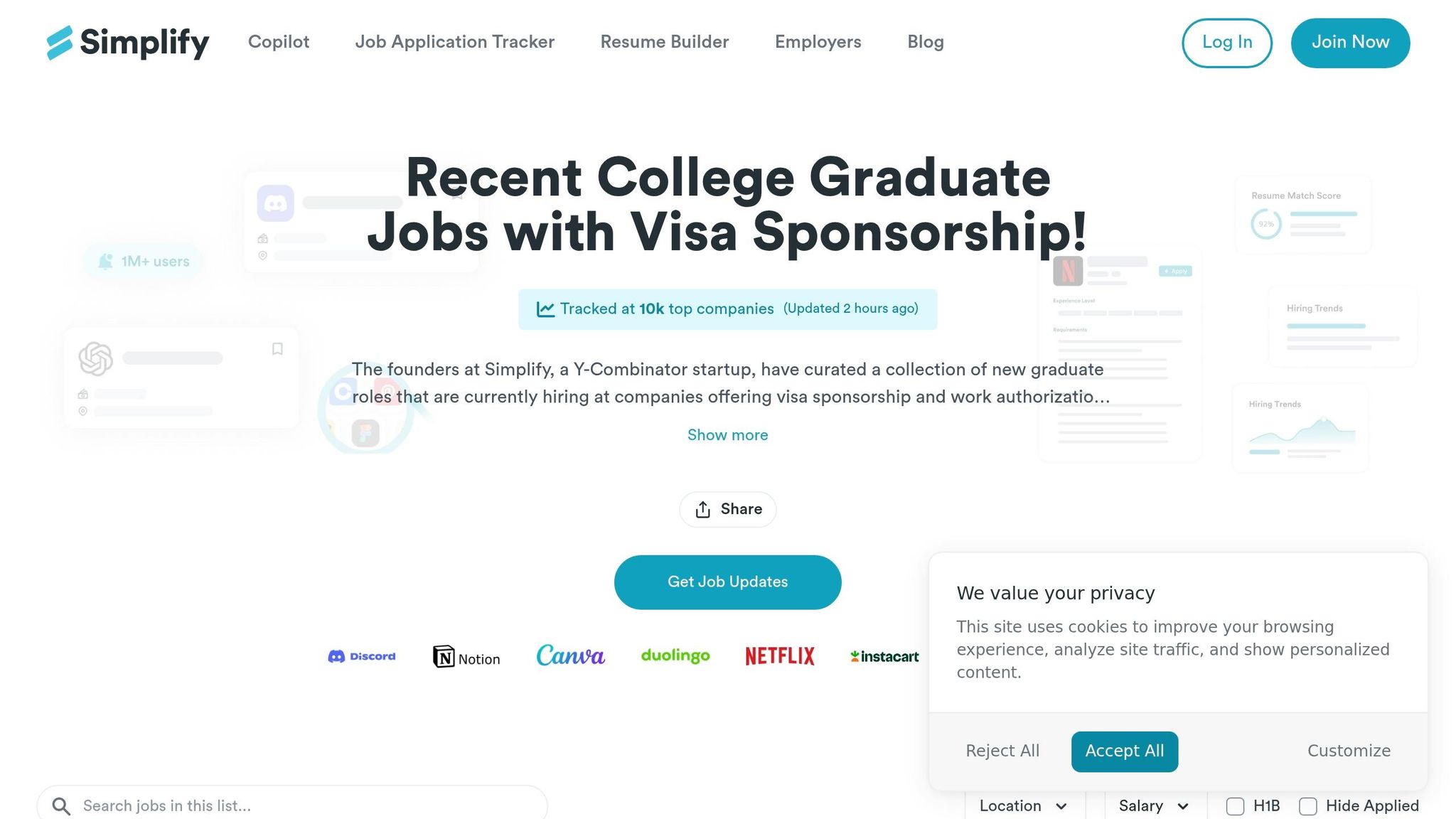
Simplify.jobs has two clear strengths: a visa sponsorship filter and a strong lean toward early-career roles. If you're new to the U.S. job market, that gives you a decent place to start. For international candidates, that filter can help surface openings faster. But for a cap-exempt search, that only solves part of the problem.
The bigger issue is what the platform filters for. Simplify.jobs filters visa sponsorship, not employer type. That sounds close enough at first glance, but it isn't. Cap-exempt strategy depends on whether the employer is a qualifying institution, not just whether the job mentions sponsorship. That gap can send you toward roles that look right on the surface but don't match what you need.
There's another catch. Cap-exempt hiring often runs on slower academic and research timelines. So a fast-apply tool helps with speed, but speed alone doesn't carry the full process. You still need employer checks, portal-specific submission work, and documents shaped for university or research hiring. Cap-exempt roles often call for CV-style materials, and Simplify.jobs doesn't tailor documents for that kind of use case.
If you're trying to Apply for jobs in this lane, that difference matters a lot more than it does in a standard private-sector search.
Simplify.jobs vs. scale.jobs
Why scale.jobs wins for cap-exempt targeting:
- Human assistants verify cap-exempt employer status before submission, not just visa sponsorship filters.
- Applications to university portals and teaching hospital systems are handled manually.
- Documents are tailored for academic and research roles, including CV-style formatting and ATS-optimized formatting.
- State-level prioritization: limited, because Simplify.jobs does not rank states by cap-exempt employer concentration.
| Factor | Simplify.jobs | scale.jobs |
|---|---|---|
| Cap-exempt employer verification | Visa sponsorship filter only | Verified before submission |
| Academic portal handling | Standard automation | Manual submission by human assistants |
| Document format for academic roles | Standard resume uploads | CV-formatted, ATS-optimized docs |
| Fit for slower academic hiring cycles | Built for quick application volume | Aligned with academic hiring timelines |
| Proof of work | Not a core focus | Screenshots and WhatsApp updates |
The difference comes down to this: do you need search help, or do you need submission help?
Simplify.jobs makes more sense for early-career candidates who want broad application volume and basic sponsorship filtering. It's closer to a job search platform for speed and reach.
scale.jobs fits better when the search is narrower and the details matter more. If you need confirmed cap-exempt targeting by state, manual submissions into university systems, or help from a Virtual Assistant for Job Applications, the gap gets pretty obvious. The same goes for candidates who need a job application service built around institution-specific portals instead of one-click volume.
If your materials also need to shift from a standard resume to academic-style documents, support from an ai resume builder or an ai cover letter builder may help - but only if the final submission still matches the employer's format and process.
Is Simplify.jobs Worth It?
Yes, for the right kind of user.
If you're early in your career, want to move fast, and mostly need a way to find sponsorship-friendly openings, Simplify.jobs can do the job. If you're targeting cap-exempt employers, though, it leaves a lot of work on your plate. You'll still need to check whether each employer qualifies, decide which states deserve your time first, and adjust your documents for academic or research hiring.
That's why this tool works better for broad search volume than for a focused cap-exempt plan.
Next, compare this search-first model with Jobright.ai.
4. Jobright.ai
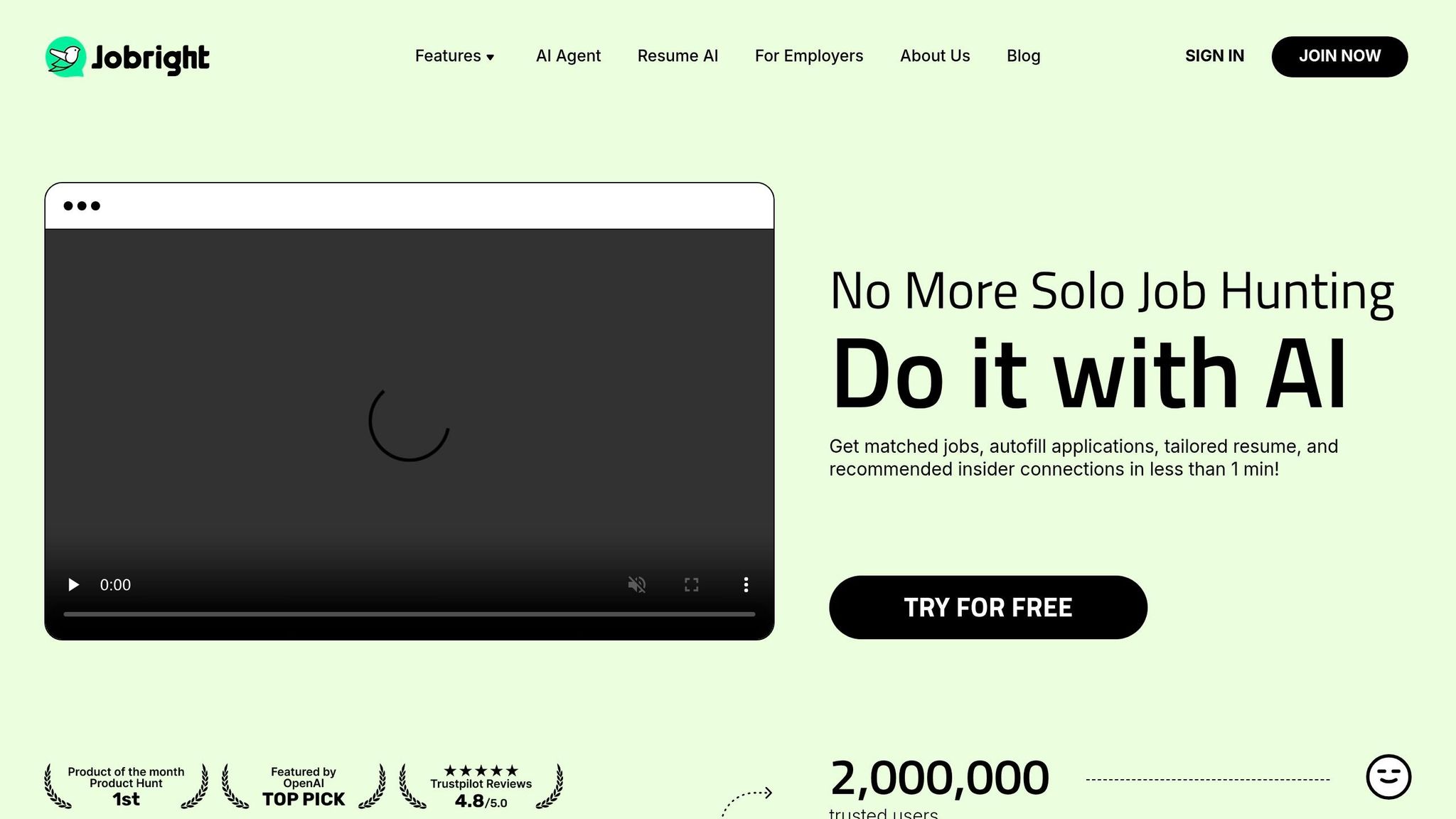
Jobright.ai gets a few things right. Its AI matching can surface relevant roles faster than a manual search, and its sponsorship signals can help international candidates rule out employers that are unlikely to file. If you need a starting point, that helps. Jobright can also show openings in your target states.
But for cap-exempt hiring, that still isn't enough.
The main issue is simple: cap-exempt targeting depends on employer type, not just sponsorship hints. You need to know whether the employer is a qualifying institution type, such as:
- institutions of higher education
- affiliated nonprofits
- nonprofit research organizations
- governmental research organizations
That’s the line that matters. Jobright helps with discovery. scale.jobs focuses on checking employer type before an application goes out. When you're aiming for large academic medical systems like Mayo Clinic or the University of Michigan, that difference can change your whole search.
There’s another wrinkle here. Many academic and research roles get filled through Principal Investigator networks before they ever show up on public best job boards. And academic hiring often moves slower than an industry search. So if timing depends on PI outreach, internal review, and back-and-forth with hiring teams, alert-based tools lose some of their edge.
Document format matters too. Cap-exempt roles usually expect a CV, not a standard resume. That can be a problem if your tool is built more for broad full time jobs searches than academic-style applications.
Jobright.ai vs. scale.jobs
| Factor | Jobright.ai | scale.jobs |
|---|---|---|
| Human review | AI-driven matching and alerts | Human assistants handle applications and updates |
| Resume customization depth | Broad matching; less CV-specific | CV-formatted, ATS-tailored documents |
| ATS handling | Limited portal and ATS control | Manual form handling with human oversight |
| Application execution method | Search and alerts | Manual submission by human assistants |
| Transparency and proof of work | Not a core feature | Screenshots and WhatsApp updates per application |
| Pricing model | Subscription | One-time payment |
That makes Jobright useful for finding leads, but not for deciding which employers or states should come first.
If you’re comparing platforms, this is the plain-English version: Jobright works more like a job search platform. scale.jobs leans more toward a hands-on job application service with human follow-through.
Is Jobright.ai Worth It?
Yes, if your main goal is fast discovery.
If you’re still trying to build a list of possible employers, Jobright can save time. It can also help if you want broad AI-driven matching before you narrow things down.
If your search is already more focused, the value drops. Once you know your target states and the employer types that count for cap-exempt roles, you usually need more than alerts. At that point, execution matters more than discovery. That’s where a Virtual Assistant for Job Applications or a job search coach can be more useful than another dashboard.
Who should use Jobright.ai: Candidates who want broad AI-driven discovery, are still building a list of possible cap-exempt employers, and mainly need a faster way to surface openings.
Who should choose scale.jobs: Candidates who already know which states to prioritize and their target employer types, need human help with applications and outreach, and want proof of work and one-time pricing.
If you already know your target states and want to build the shortlist yourself, the next section covers a DIY search workflow.
5. DIY State-by-State University and Teaching Hospital Search
The manual route gives you the most control over who you contact and what you say. It makes the most sense when you want to do direct outreach to schools, labs, and hospitals in a few target states.
DIY works best if you start with states that have dense clusters of universities and teaching hospitals. The Northeast corridor from Boston to Philadelphia is the strongest place to begin. It has the highest density of cap-exempt sponsors, with 50+ institutions within a 4-hour drive. That makes it a smart first pass if you're trying to build a focused target list. Still, don't assume anything stays fixed for long. State rules and public-university policies can shift fast, so check each employer before you apply.
One step people often skip: confirm the employer's legal category before sending anything in. A .edu domain is a strong sign that you're dealing with a university. For teaching hospitals and research nonprofits, look for a formal tie to a medical school or university. A campus address by itself does not mean the employer is cap-exempt. If there's any doubt, ask HR or the hiring manager directly whether the role qualifies for cap-exempt H-1B sponsorship.
DIY search also means you need an academic CV, not just a resume. That's a big difference. If you're applying through a job search platform, you might be able to move faster on volume. But with direct academic outreach, your CV often does much of the talking. If yours still needs work, tools like an ai resume builder can help with structure, though you'll still want to tailor it for academic use.
Compared with automation, DIY gives you maximum control. The tradeoff is simple: more control, more tracking. You'll need to keep up with contacts, follow-ups, department pages, and status notes on your own. Some people like that level of hands-on work. Others would rather use a job application service or a Virtual Assistant for Job Applications to cut down the admin.
If you don't want to build the shortlist by hand, the next section ranks the best states first.
Who should use the DIY approach: Candidates with 2+ weeks available for upfront research, a specific geographic target, and the ability to do direct PI outreach. It works best when you have a clear research focus and can write a strong academic CV independently.
Who should choose a platform-assisted search: Candidates who want broader application volume and faster execution, and who prefer less manual coordination than a PI-by-PI process.
State Targeting: Which States to Prioritize and Why
Cap-exempt H-1B openings tend to bunch up in a small set of states. Your best first move depends on the kind of role you want, how fast an employer can file, and whether green card sponsorship matters later.
A simple way to handle this: start with the highest-density states, then narrow by employer type and hiring speed. If you're using a job search platform, this is where filters and saved searches can save a lot of time.
Cluster 1: Northeast Academic-Medical Hubs
Start here if you need the fastest path.
Massachusetts, New York, Pennsylvania, Connecticut, New Jersey, and Maryland are the strongest first pass for most candidates. These states work well up front because they pack in large numbers of universities, teaching hospitals, and research nonprofits. Harvard and Johns Hopkins are among the top cap-exempt filers, especially in computational biology, public health, and clinical research.
The big day-to-day edge is proximity. In this corridor, universities, teaching hospitals, and research labs sit close together, so you can compare several cap-exempt employers without spreading your search all over the map. That matters if you're trying to apply for jobs fast and want more than one option in play at the same time.
Cluster 2: Public Universities and Hospital Systems
Prioritize here if you want volume.
Michigan, Minnesota, Wisconsin, Ohio, Indiana, Florida, California, and Texas anchor this group. The University of Michigan and Mayo Clinic are among the top cap-exempt filers in the country across engineering, clinical, and research roles.
These places often post more admin and clinical support jobs alongside faculty openings. So this cluster is less about name value and more about volume. If your plan is to cast a wider net for full time jobs or related support roles, this group usually gives you more shots on goal.
Public flagships also often show a stronger PERM record than private universities. If green card sponsorship matters, check filing history before you spend too much time on one employer. In Texas, look closely at institution-specific H-1B rules before you apply, especially with public universities and state agencies.
Cluster 3: Secondary Research Hubs
Use these states for niche research roles.
Maryland, Tennessee, Colorado, Indiana, Arizona, and Washington make up a third tier tied to federal labs and research institutes such as the National Institutes of Health, one of the largest federal research sponsors in the country.
These states tend to fit narrower technical profiles. If your background is specialized, this cluster can be a smart place to search instead of fighting through broad applicant pools on the best job boards. In cases like this, a job search virtual assistant or Virtual Assistant for Job Applications can help surface openings that don't jump out on the first pass.
Use the clusters below as a shortlist, not a full map. The best state still depends on whether you care more about faster filing, more openings, or a stronger PERM track record.
| Cluster | Key States | Density | Best-Fit Candidate Types | Best Search Method |
|---|---|---|---|---|
| Northeast Academic-Medical | MA, NY, PA, CT, NJ, MD | Extreme | Data Scientists, Software Engineers, Clinical Researchers, Postdocs | Direct PI outreach + multi-employer comparison |
| Public Universities and Hospitals | MI, MN, WI, OH, IN, FL, CA, TX | High | Engineers, Medical Staff, Agricultural Scientists, Physicians | Official university career portals |
| Secondary Research Hubs | MD, TN, CO, IN, AZ, WA | Moderate | Specialized technical profiles | Specialized job boards + AI-assisted matching |
If two states seem close, let PERM history break the tie. A school that sponsors H-1B visas but rarely files green cards is often a shorter-term option. If you need visa stability and a cleaner path to residency, lean harder toward public flagships with a stronger PERM record.
If you're juggling multiple targets, it helps to track them like a small pipeline: state, employer type, cap-exempt status, PERM history, and hiring speed. That's the kind of work a virtual assistant for job seekers or a job application service can make much easier when the search starts to sprawl.
Pros and Cons by Search Approach
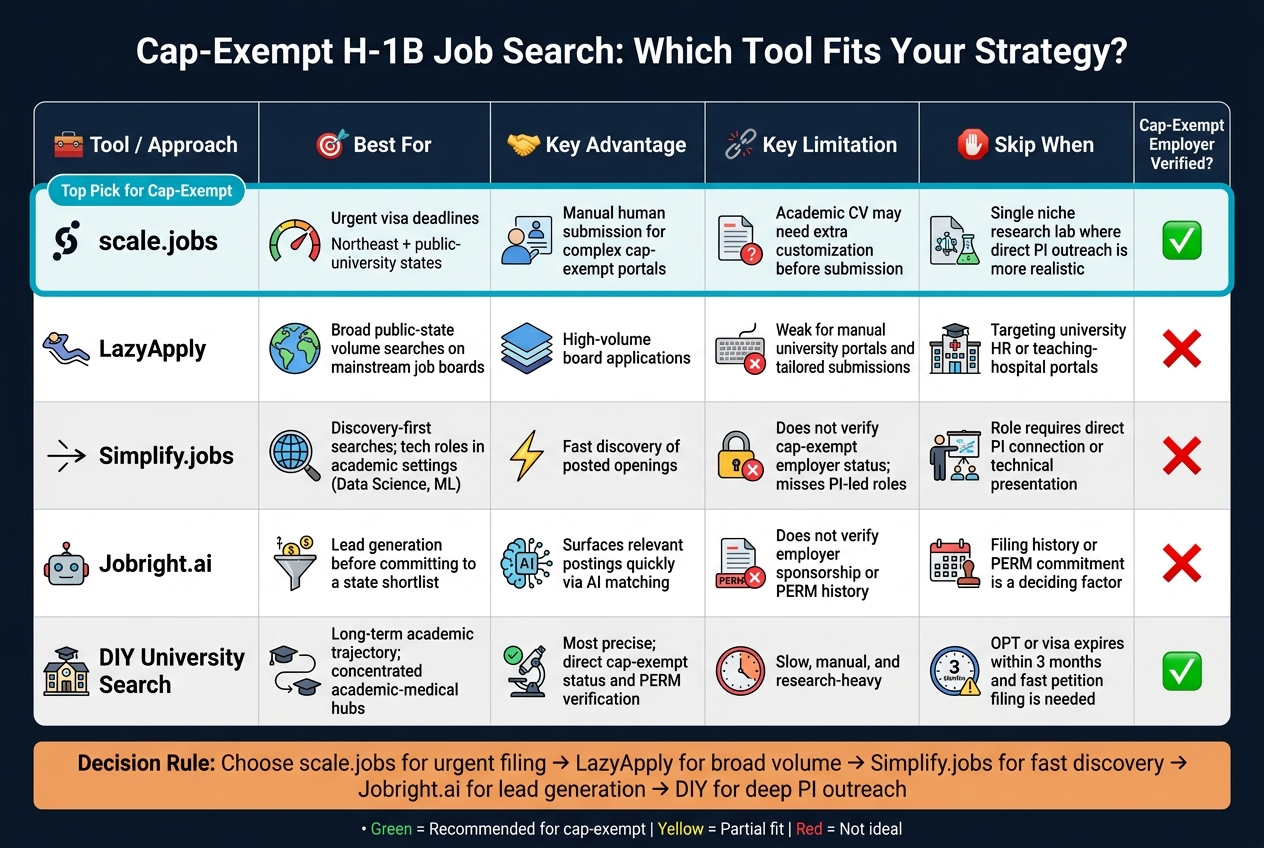
Cap-Exempt H1B Job Search Tools: Which One Is Right for You?
After you shortlist states, use this table to line up your timing, employer type, and search method.
| Approach | Best For | Key Advantage | Key Limitation | When to Skip |
|---|---|---|---|---|
| scale.jobs | Candidates with urgent visa deadlines targeting high-density Northeast and public-university states | Manual execution for complex cap-exempt portals | Academic CV formatting for publication-heavy roles may need extra customization before submission | When your only target is a single niche research lab and direct PI outreach is the more realistic path |
| LazyApply | Broad public-state volume searches across mainstream job boards | Best for high-volume board applications, not manual university portals | Weak for roles that need manual screening and tailored submissions | When targeting university HR systems or teaching-hospital portals |
| Simplify.jobs | Discovery-first searches before state narrowing; tech roles in academic settings, especially Data Science and ML | Fast discovery of posted openings | Does not verify cap-exempt employer status; misses PI-led roles never posted publicly | When the role requires a direct PI connection or technical presentation |
| Jobright.ai | Lead generation before committing to a state shortlist | Surfaces relevant postings quickly | AI matching does not verify employer sponsorship history | When filing history or PERM commitment is a deciding factor |
| DIY University & Teaching-Hospital Search | Candidates prioritizing long-term academic trajectory in concentrated academic-medical hubs where PI outreach is realistic | Most precise; allows direct verification of cap-exempt status and PERM history | Slow, manual, and research-heavy | When your OPT or current visa status expires within 3 months and you need a filed petition quickly |
Decision summary: Choose scale.jobs for urgent, high-confidence filing; LazyApply for broad volume; Simplify.jobs for fast discovery; Jobright.ai for lead generation; DIY for deep PI-led outreach.
The main tradeoff is speed vs. precision. If your OPT ends in under 90 days, a DIY PI-outreach plan is usually too slow. In that case, it makes more sense to focus on top-volume filers like Johns Hopkins, Harvard, and the University of Michigan, then use a job application service that can submit fast and cleanly.
If you have 6+ months and a specialized PhD, the math changes. Going straight to PIs can take more effort, but it often gives you a better shot at roles that never hit the public best job boards or a standard job search platform. That matters a lot in research-heavy hiring, where a direct intro can beat a stack of online applications.
There’s also a practical middle ground. You can use tools like Simplify.jobs or Jobright.ai to spot openings, then switch to a more hands-on process for university portals. That kind of split approach works well if you want to Apply for jobs at scale without losing control over cap-exempt targeting.
No matter which route you take, convert your materials to an academic CV before you submit. If your current resume is built for private-sector roles, fix that first with an ai resume builder and tighten role-specific outreach with an ai cover letter builder. For cap-exempt H-1B, your state shortlist matters most when it tells you whether you need speed, precision, or direct outreach.
Conclusion
Once you’ve narrowed your target states, the next call is simple: speed or fit.
Start with one question: how fast do you need a filed petition? If your deadline is under 3 months, go after large, high-volume cap-exempt employers first. That includes the University of Michigan, Mass General Brigham, Mayo Clinic, and Johns Hopkins. These employers already process many cap-exempt cases, so they’re better first targets when time is tight.
If time isn’t the main issue, shift from urgency to role fit. For clinical and medical research roles, Minnesota and Maryland are the clearest bets. For university-based tech, data, and engineering work, Massachusetts and Michigan are strong places to start. Pennsylvania stands out for stronger green card commitment among major cap-exempt sponsors.
The simplest rule is still the best one: pick three states, not ten. For high urgency, start in the Northeast, especially Massachusetts, New York, and Pennsylvania, where cap-exempt employers are packed more tightly. For moderate urgency, match your role to the state with the strongest employer concentration in that area. For long-term planning, filter by green card commitment rate, not just filing volume.
Use an academic CV, not a private-sector resume. If you need help with that, an ai resume builder can help shape your materials for research and university roles. And before you Apply for jobs, double-check Texas state-university and public-agency filing rules.
If your three-state shortlist is already set, Scale.jobs fits execution. If you’re still finding employers, use discovery tools first, like best job boards or a broader job search platform. That’s the key split: discovery tools help you find leads, while a job application service like Scale.jobs handles manual cap-exempt submission.
FAQs
How do I confirm an employer is truly cap-exempt?
First, confirm the employer fits one of four cap-exempt categories: a higher education institution, a nonprofit tied to a university, a nonprofit research organization, or a government research entity.
A few clues can help you check this fast. A .edu domain is the most obvious one. You can also look for 501(c)(3) status connected to a research mission, job posts on academic career sites, and past H-1B filings in public databases. If a company has sponsored before, that’s often a good sign.
Still not sure? Ask HR directly: "Is this position eligible for cap-exempt H-1B sponsorship?"
Which 3 states should I pick for my background?
Prioritize Massachusetts, New York, and California.
Massachusetts - especially Boston-Cambridge - should be near the top of your list. The area has a tight concentration of cap-exempt employers, including Harvard and MIT, plus a long list of affiliated labs, hospitals, and research centers. That matters if you want to Apply for jobs in places that hire year-round instead of waiting for the H-1B lottery cycle.
New York is another strong bet. Columbia, NYU, and their affiliated research hospitals post steady openings across research, data, IT, and admin roles. If you're sorting through the best job boards, it helps to filter for university systems and hospital networks, not just private companies.
California also stands out. Major hubs like Stanford, UC Berkeley, and UCLA hire throughout the year for technical and research roles. For many job seekers, this is where a job search platform or Virtual Assistant for Job Applications can save time, since openings move fast and often sit across separate university and medical-system portals.
Should I use a CV or resume for these roles?
For cap-exempt roles at universities, research institutions, and academic medical centers, use a CV instead of a standard corporate resume.
These employers usually expect a more detailed record of your academic background, publications, research work, conference presentations, and technical skills, especially for faculty, postdoctoral, or research-focused roles.