
F-1 to Cap-Exempt H1B: Faster Than the Lottery?

Sarah Mitchell
July 3, 2026

Yes - cap-exempt H-1B is often faster than the lottery path. If I’m on F-1 OPT or STEM OPT, a cap-exempt employer can file any time of year, while the cap-subject route usually follows an H1B cap checklist involving March registration and an October 1 start. The tradeoff is simple: cap-exempt is faster but the employer pool is much smaller.
If I had to boil this down, I’d focus on four facts:
- Cap-exempt H-1B skips the lottery
- Cap-exempt cases can usually move in about 3 to 6 months
- Cap-subject H-1B had about a 25% selection rate for FY 2026
- The hard part is finding the right employer, not filing the form
If my OPT clock were tight, I would not treat this as a visa question only. I’d treat it as a search problem:
- target universities, research nonprofits, affiliated hospitals, and government research groups
- keep a second pipeline for private employers
- screen sponsorship type early
- use tools that help me Apply for jobs without wasting time on employers that cannot file
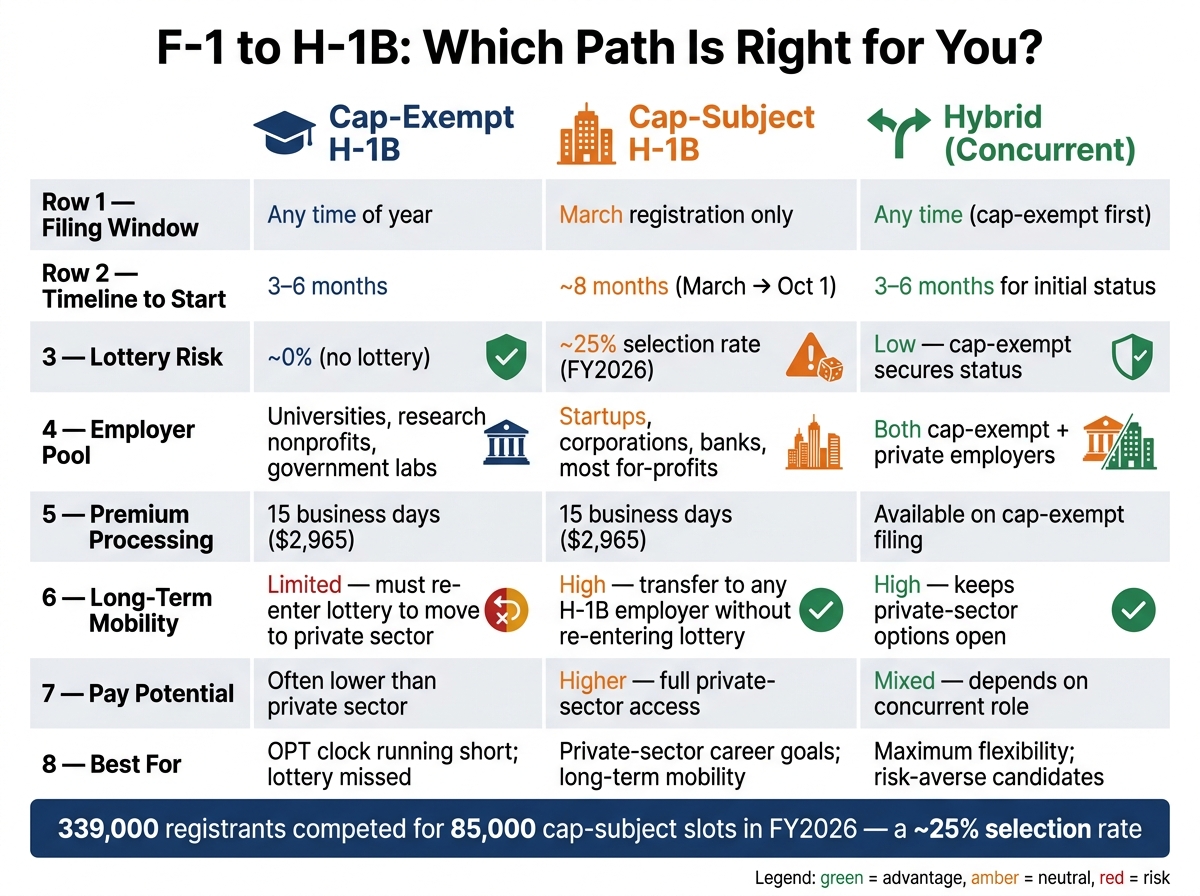
F-1 to H-1B: Cap-Exempt vs Cap-Subject vs Hybrid Path Comparison
H1B Cap-Exempt Strategy So You Don't Have to Rely on the Lottery And Day 1 CPT
sbb-itb-564272e
Quick comparison
| Path | Filing time | Lottery risk | Employer pool | Job mobility |
|---|---|---|---|---|
| Cap-exempt H-1B | Any time of year | None | Smaller | More limited |
Finding these employers requires a systematic job search strategy to identify qualifying non-profits and research institutions. | Cap-subject H-1B | March to October cycle | High | Much larger | Better later moves | | Hybrid path | Run both at once | Lower overall risk | Both | More moving parts |
My take
If I need work status fast, cap-exempt is often the better path. If I care more about private-sector pay and later job changes, the lottery path may still be worth keeping open. And if I do not want to bet everything on one route, I’d run both searches at the same time with a clear system.
What I’d do first
- Track cap-exempt employers
- Make a second list of cap-subject employers
- Check sponsor fit before applying
- Use a job search platform or a job application service only if it helps me move faster on the right roles
The short answer
Cap-exempt H-1B is faster than the lottery, but only if I can land a role with a qualifying employer. That is the whole game.
1. Cap-Exempt H-1B Path from F-1
Timeline
Once you're on OPT, a cap-exempt H-1B can be filed in any month of the year. There's no lottery season and no need to wait until October 1. That can save a lot of time, but only if the employer fits the cap-exempt rules.
In most cases, the full process takes about 3 to 6 months from application to start date. That usually includes about 7 business days for Labor Condition Application (LCA) certification. If the employer uses premium processing ($2,965 as of March 1, 2026), USCIS has a 15-business-day window to take action. Even then, hiring steps on the employer side can still take a few weeks, and an RFE can slow things down.
If you're trying to plan your next move after OPT, this is one reason many students look beyond general best job boards and focus on schools, research groups, and affiliated nonprofits that can sponsor year-round.
Selection Risk
Once the lottery is removed, the main issue shifts from luck to case strength.
For FY 2026, about 339,000 unique beneficiaries competed for 85,000 cap-subject slots. That's roughly a 25% selection rate. By contrast, a cap-exempt filing has close to zero lottery risk because there is no cap draw. Approval depends on how well the petition is put together and whether the role and employer meet the rules.
That difference matters. If your goal is to apply for jobs with a clearer visa path, cap-exempt roles can offer more predictability than the cap-subject route.
Employer Eligibility
The main bottleneck is usually employer type, not filing date.
Cap-exempt employers include:
- Accredited institutions of higher education
- University-affiliated nonprofits with a formal written affiliation agreement
- Nonprofit research organizations
- Government research organizations
A for-profit employer may also qualify, but only in a narrower setup. The worker must spend at least 50% of their time at, or serving, a qualifying exempt institution.
This is where people get tripped up. Nonprofit status by itself does not mean cap-exempt status. You need to confirm it with HR or an immigration attorney before you bank on this path. If you're using a job search platform or working with a job search coach, it's smart to screen employers for sponsorship type early instead of finding out after interviews.
Mobility
The trade-off is mobility.
A cap-exempt H-1B ties you to that class of employer. If you later want to move to a private-sector company, you'll usually need to enter and win the cap-subject lottery. The main exception is a concurrent setup where you keep an active cap-exempt role while also working in a cap-subject setting. That only works for as long as the cap-exempt job stays active.
There's also a pay trade-off in many cases. These roles often pay less than similar jobs in the private sector. That's the core downside compared with the lottery path: more filing flexibility now, but fewer easy moves later.
For students trying to map this out, a virtual assistant for job seekers or job application service can help sort roles by visa fit, not just title or salary.
2. Cap-Subject H-1B Lottery Path from F-1
Timeline
Unlike cap-exempt filings, the cap-subject route runs on the annual H-1B lottery and an October 1 start date. That timing drives almost everything.
The cycle usually works like this:
- Employers register in March
- If selected, they file the full petition during the usual 90-day window starting April 1
- The earliest possible H-1B start date is October 1
Even when everything goes smoothly, the wait from registration to H-1B start is about 8 months.
If your OPT expires before October 1, the cap-gap extension may cover that period, but only if the H-1B petition is filed on time after selection. If you aren’t selected and your OPT or STEM OPT ends, you’ll need another status or you may have to leave the U.S. This is why timing matters so much when you apply for jobs and plan your next move.
Selection Risk
If your OPT clock is short, lottery odds can matter more than the employer itself. In 2024, more than 500,000 registrations competed for 85,000 spots, which put the selection rate at less than 1 in 5.
Starting with the FY 2027 lottery, USCIS moved to weighted selection, which gives better odds to higher-paid roles. So yes, compensation can now shape your chances.
STEM OPT can give you as many as three lottery attempts, but each try still comes with the same basic uncertainty. That’s one reason many students use a job search platform or work with a job search coach to target employers and roles with a better shot at sponsorship.
Employer Eligibility
Most for-profit employers can sponsor cap-subject H-1Bs. That includes startups, banks, and large corporations. In plain terms, you get access to a much bigger pool of employers than you would in the cap-exempt path.
The tradeoff is timing. More employers qualify, but the process is less predictable. The role still must meet H-1B specialty-occupation rules, and an RFE can slow things down. If you’re targeting full time jobs, it helps to check sponsorship history early instead of finding out late in the process.
Mobility
Once your H-1B is selected and approved, you can usually move to another for-profit employer without going back into the lottery. That’s a big upside. It gives you more room to change jobs later, especially if a better offer comes along.
Still, this path tends to make sense only when the private-sector role is strong enough to justify the wait. For many students, the hard part isn’t just getting an offer. It’s lining up the right employer, the right timeline, and a role worth betting several months on. Tools like a Virtual Assistant for Job Applications or a job application service can help keep that search organized when the clock is ticking.
3. Hybrid Strategy: Pursue Both Cap-Exempt and Cap-Subject Roles
If you can’t afford to bet on one path too early, run both tracks at the same time.
A cap-exempt offer gives you a more predictable path to work status and often an earlier start date. A cap-subject filing keeps private-sector mobility on the table. Instead of forcing one big choice, this approach turns the problem into managing two hiring pipelines at once.
That matters because the lottery can miss. If it does, a cap-exempt route can help protect your ability to keep working while you still try for a cap-subject role. In plain English: you’re not putting all your chips on one number.
A cap-exempt petition can start in any month. A cap-subject case can move in parallel and, if selected, still leads to an October 1 start. That overlap is exactly why employer screening and application volume matter more here than in a standard search. If you’re trying to apply for jobs across both paths, you need a tighter system for tracking deadlines, sponsorship type, and start-date timing.
The hybrid route lets you stay eligible for cap-exempt work now while keeping later private-sector options open. That’s the main upside. You can focus on cap-exempt roles in the short term without closing the door on an industry move later. For example, a student might take a cap-exempt research role first, then add a cap-subject offer later if selected in the lottery.
This is where a strong process helps. A good job search platform or a Virtual Assistant for Job Applications can help you sort employers by sponsorship path, location, and filing timeline so you’re not juggling everything by hand.
There is a trade-off, though. The upside is flexibility. The downside is less freedom to leave the cap-exempt track later. If that future move matters to you, target cap-exempt employers near private-sector hubs. That gives you a better shot at making a later switch without starting from scratch.
A simple way to work this plan:
- Build one list of cap-exempt employers that can hire year-round
- Build a second list of cap-subject employers open to H-1B filing
- Track both lists in one workflow, with notes on start dates, sponsorship type, and interview stage
- Prioritize roles where location and field make a later move easier
If managing two pipelines sounds like a lot, that’s because it is. But for many students and early-career workers, it’s the safest middle ground between waiting on the lottery and locking into one path too soon.
4. Job-Search Support Options for Tight Visa Timelines
Running cap-exempt and cap-subject searches at the same time takes more than sending out résumés. The tools you use have to fit your deadline, your sponsor target, and the kind of employers you're trying to reach. When time is short, the main issue is simple: which option can verify sponsors, tailor your documents, and get applications out fast enough.
If you're trying to Apply for jobs under OPT, STEM OPT, or H-1B pressure, posting volume matters less than execution. A big list of openings doesn't help much if you're still checking sponsor type by hand.
Timeline
Once both searches are live, the bottleneck usually shifts to application execution.
General job boards like LinkedIn and Indeed give you fast access to lots of openings, but most listings lean cap-subject. That means you still have to check sponsorship type yourself. Niche academic boards like HigherEdJobs.com and AcademicPositions.com focus more on cap-exempt institutions, but hiring often moves slower there. Ellis and Wisa help narrow the list by cap-exempt status, location, and filing history, which makes it easier to build a sponsor list you can trust.
At that point, raw job volume stops being the best filter. Sponsor access and turnaround speed matter more.
Employer Eligibility Filtering
DIY databases can help you review sponsor history, but borderline nonprofits still need human review. Affiliation questions and research-organization status aren't always clear from a listing or database entry.
That's where a job search virtual assistant can save time. Instead of guessing, you get another layer of review before spending hours on the wrong employer.
Tool Comparison: LazyApply, Simplify.jobs, Teal, Jobscan, and scale.jobs
The biggest difference between these tools is whether they simply help you stay organized or actually handle the application work for you.
- Fast for high-volume submissions across major job boards
- Low setup time for broad outreach
- Uses the same résumé across roles and does not separate cap-exempt from cap-subject employers or filter by sponsorship type
- Clean interface for tracking applications and autofilling forms
- Helpful browser extension for one-click applies on many portals
- Does not tailor documents by role or verify cap-exempt status, and niche academic portals are often out of reach
- Strong application tracker and résumé keyword tools
- Helps spot gaps between your résumé and a job description
- Does not submit applications or filter by sponsorship path; it helps organize the search but doesn't run it
- Detailed ATS match scoring against job descriptions
- Helpful for adjusting résumé language before applying
- Focuses on résumé analysis only; no submission help, no sponsor filtering, and no OPT deadline tracking
Why scale.jobs wins for cap-exempt timing:
- Human assistants submit each application by hand, not bots, including niche academic and research portals that many automation tools can't reach
- ATS-optimized résumés and tailored documents are prepared before applications go out, instead of reusing one template
- Human review for borderline employers helps flag cases where cap-exempt status is unclear from the posting
- Time-stamped screenshots and WhatsApp updates show each submission as it happens
- Flat-fee pricing starts at $199 for 250 applications, with no recurring subscription
If you need more than tracking, this starts to look less like a simple job search platform decision and more like an execution choice. Do you want software that helps you manage tasks, or do you want a job application service that gets the work done?
Readers should compare tools by sponsor verification speed, not just posting count. That's the part that tends to slow people down when OPT or STEM OPT deadlines are getting close.
| Feature | General Boards (LinkedIn/Indeed) | Niche Academic Boards (HigherEdJobs) | Visa Databases (Ellis/Wisa) | LazyApply / Simplify.jobs | Teal / Jobscan | scale.jobs Human Assistant |
|---|---|---|---|---|---|---|
| Human involvement | None | None | None | None | None | Trained human assistant on every application |
| Resume tailoring | Not built in | Not built in | Not built in | Single résumé reused | Keyword analysis only | ATS-optimized, role-specific docs |
| ATS handling | Not built in | Not built in | Not built in | Basic autofill | Match scoring only | ATS-optimized résumés and tailored docs |
| Submission method | Self-service | Self-service | Self-service research | Automated bot | Self-service | Human assistant submits by hand |
| Proof of work | None | None | None | None | None | Time-stamped screenshots and WhatsApp updates |
| Pricing model | Free | Free | Subscription-based | Subscription-based | Subscription-based | Flat-fee, one-time |
Who Should Use LazyApply or Simplify.jobs
These tools make sense for candidates with flexible visa timelines who want broad outreach fast and are not filtering hard by cap-exempt status. If your main goal is raw application count, they can help.
They fit best when employer type matters less than speed. For someone looking across full time jobs in a broad market, that can be enough.
Who Should Use Teal or Jobscan
These are a better fit for people who want to run their own search and need help aligning résumé language with job descriptions before applying.
Think of them as prep tools. They can improve your materials, especially if you're using an ai resume builder or ai cover letter builder as part of your workflow, but they won't submit applications or screen for sponsorship type.
Who Should Choose scale.jobs
scale.jobs fits F-1 candidates on OPT or STEM OPT who need applications moving across both cap-exempt and cap-subject employers fast, with tailored documents, verified portal access, and live tracking.
It's especially helpful when cap-exempt status is fuzzy. A posting may look fine at first glance, but the employer structure may tell a different story. In those cases, human review can stop you from wasting effort. For job seekers who want a Virtual Assistant for Job Applications, that's the main draw: less guesswork, more movement.
Switch to scale.jobs If…
- Your OPT deadline is within 6 months and you need verified cap-exempt sponsors, not just more postings
- You are applying through niche academic or research portals that automation tools do not reach well
- You need ATS-optimized documents tailored by role, not one résumé reused across applications
- You want time-stamped proof of submission for every application, not just a dashboard total
- You'd rather pay a flat one-time fee than keep paying a subscription while waiting on offers
How the Paths Compare Side by Side
With timing and eligibility already covered, this section shows which path fits a short OPT clock. If your OPT ends soon, the main question is simple: which option gets work authorization the fastest?
| Criterion | Cap-Exempt H-1B | Cap-Subject H-1B | Hybrid (Concurrent) |
|---|---|---|---|
| Timeline | 3–6 months; year-round filing | March registration; October 1 start date | 3–6 months for initial status |
| Selection Risk | ~0% (no lottery) | Approx. 25% selection rate in FY2026 | Low; initial status secured through the cap-exempt role |
| Employer Type | Universities, research nonprofits, government labs | Most non-exempt employers, including startups, corporations, and public companies | Both cap-exempt + private |
| Long-Term Mobility | Limited to other exempt orgs unless lottery is won later | Can transfer to another H-1B employer without re-entering the lottery | High; keeps you in status while working a private role |
| Role Examples | University software engineer, lab research associate | Private-sector data scientist, fintech developer | Nonprofit research coordinator + private consultant |
The hybrid route combines cap-exempt work with concurrent private-sector work. For example, a nonprofit research coordinator can keep cap-exempt status and also add approved private work on the side. It works like a safety net: the cap-exempt job holds your status in place while a cap-subject filing stays active.
That trade-off shapes the kind of help you need in your search. Cap-exempt searches depend on sponsor checks and access to school, nonprofit, and research portals. Cap-subject searches lean more on speed and high application output. A fast visa route can still fall apart if your job search platform keeps sending you toward employers that don't sponsor.
For people weighing job-search tools, the issue isn't just how many jobs a tool can touch. It’s whether it can reach exempt employers and confirm sponsorship fast. Niche academic portals and sponsor checks line up well with scale.jobs human assistants, who apply by hand across many portals and tailor documents for the role. Broad private-sector volume is where automation tools like LazyApply and Simplify.jobs tend to fit better. Teal and Jobscan stay on the prep side.
If you want both document help and done-for-you applications, scale.jobs combines both through its flat-fee job application service and ai resume builder. That setup can matter when you're trying to Apply for jobs across exempt and private employers at the same time without losing days to admin work.
From here, the practical question is which kind of Virtual Assistant for Job Applications can move fast enough for your deadline.
Pros and Cons
Now that the mechanics are clear, the next step is simpler: which route gives you the best mix of speed, pay, and career mobility?
Each path solves a different problem.
Cap-exempt H-1B is the fastest route if you can land a role with a qualifying employer. There’s no lottery, no fixed filing season, and premium processing can move things along in 15 days. The tradeoff is job choice and pay. These roles often pay less than similar private-sector jobs, and the employer list is tight: universities, research nonprofits, government labs, and formally affiliated institutions.
Cap-subject lottery opens the door to a much bigger set of employers. That can mean better pay and more room to grow. But the timing is less forgiving. You’re dealing with March registration, uncertain selection, and possible OPT pressure if the clock is running down. If you plan to apply for jobs in the private sector, this is often the route people want most, even though it comes with more risk.
Hybrid (concurrent) sits in the middle. It can give you status protection through a cap-exempt role while letting you work toward private-sector pay at the same time. On paper, that sounds like the best of both worlds. In practice, it takes a lot of coordination. You need two employers who are both willing, organized, and aligned on timing. For many job seekers, this is where a job application service or a Virtual Assistant for Job Applications can save a lot of time.
The table below strips away the legal mechanics and shows the tradeoff at a glance.
| Path | Biggest Advantage | Biggest Risk |
|---|---|---|
| Cap-Exempt H-1B | No lottery; year-round filing; 15-day premium processing | Lower pay; limited employer types |
| Cap-Subject Lottery | Broader private-sector access; higher pay potential | Uncertain selection; strict March window; OPT timing risk |
| Hybrid (Concurrent) | Status secured plus private-sector pay | Administratively complex; requires two aligned employers |
Use this breakdown to match your OPT timeline, salary goal, and target employer pool.
If your OPT clock is short, speed matters more than theory. In that case, the best move is often the one that helps you find sponsors fast, narrow the list, and act without delay. That’s where a job search platform, a job search coach, or even a virtual assistant for job seekers can help turn a messy search into a focused one.
If your timeline is tighter than your options, don’t treat every employer the same. Filter hard, move fast, and spend your energy on the path that can actually file in time.
Conclusion
Cap-exempt H-1B is faster than the lottery, but that speed only applies if the employer qualifies. If your OPT is running short, you missed the March filing window, or you want a path that skips lottery risk, cap-exempt filing gives you a year-round option with no selection step.
That said, speed alone doesn’t make it the right move. The job still has to fit your pay goals and your long-term plans. Many cap-exempt roles pay less than similar private-sector roles. And if you later want to move to a private-sector company, you’ll usually need to go through the lottery unless you keep a concurrent cap-exempt setup in place.
If that tradeoff makes sense for you, act fast and screen employers carefully. Start by checking sponsor history in a visa database to confirm eligibility. Then apply only to roles from qualified employers. If private-sector access may matter later, keep the lottery in play by registering in March and continuing to apply for jobs that fit both paths.
When the clock is ticking, execution matters just as much as employer fit. The biggest time drain is sending applications to companies that don’t sponsor at all. That’s where a focused job application service can help. If you need to move fast, Scale.jobs offers human-submitted applications, ATS-tuned resumes through its ai resume builder, support for cover letters with its ai cover letter builder, WhatsApp updates, and proof of work. It’s built for F-1 candidates dealing with visa deadlines and trying to stay on track in a crowded job search platform.
Filter hard. Move fast. Keep both paths open until one works.
FAQs
How do I verify whether an employer is truly cap-exempt?
Confirm that the employer fits one of these groups: a higher education institution, a nonprofit tied to a university, a nonprofit research organization, or a government research organization.
Start with the basics. Check whether the employer uses an .edu domain. If it’s a nonprofit, verify its 501(c)(3) status. Then look at past H-1B filing history in public databases to see whether the employer has sponsored similar roles before.
If the answer still isn’t clear, ask HR or the hiring manager directly whether the role qualifies for cap-exempt H-1B sponsorship.
Can I move from a cap-exempt H-1B to a private company later?
Yes. In most cases, moving from a cap-exempt employer to a private company still means you’ll need to go through the annual H-1B lottery.
Here’s the simple version: even if you already have a cap-exempt H-1B, a private employer that is not cap-exempt usually must register you for the lottery unless you qualify under a different exemption.
One path some people use is concurrent employment. That means you keep your cap-exempt job and, at the same time, take a cap-subject H-1B role with a private employer. To make this work, you generally need to keep the cap-exempt role at at least 50% of your total work hours.
It’s a practical setup for people who want to test the move without letting go of the cap-exempt position too soon.
What should I do if my OPT ends before the next H-1B lottery?
If your OPT ends before the next H-1B lottery, moving to a cap-exempt employer is often the steadiest way to keep your work authorization. Universities, nonprofit research institutions, and government-affiliated research centers can file an H-1B petition at any point in the year. There’s no lottery bottleneck.
The timing matters. Start early, focus on roles that line up with the kind of private-sector work you may want later, then lock in the offer and ask the employer to file the petition as soon as possible. If they can use premium processing, even better. It can cut down the waiting time and make the handoff much less stressful.
If you're in active search mode, this is where a focused plan helps. Don’t just apply for jobs at random. Build a short list of cap-exempt employers, tailor your materials, and track deadlines closely. If you need help managing the process, a Virtual Assistant for Job Applications or job search coach can help you stay organized and move faster.