
Cap-Exempt H1B for PhDs: Best Research Institutions

Sarah Mitchell
July 25, 2026

If your OPT time is running out, the safest first move is to target cap-exempt employers before you send more applications. I’d focus on universities, university-linked nonprofits, nonprofit research groups, and some government research employers because they can file H-1B petitions year-round and do not rely on the annual cap lottery.
Here’s the short version:
- F-1 OPT allows only 90 days of unemployment
- STEM OPT allows 150 total days
- Cap-exempt H-1B usually fits PhD candidates best when the employer is a university or a linked nonprofit
- The job title does not decide cap exemption; the employer’s legal status does
- I’d verify each employer before applying, then rank targets by hiring speed, portal complexity, and fit
If I were building a search plan today, I would:
- Verify employer type first
- Focus on cap-exempt institutions with clear hiring paths
- Use role-specific documents with an ai resume builder
- Apply through a workflow that can handle hard academic portals, whether that’s DIY or a job application service
That’s the main idea: don’t apply blind when your visa timeline is tight.
How to get the cap free H1b visa? (As a university postdoc, doctorate degree, PhD, non-profit)
What I’d do first if OPT time is short
I would start with a short filter, not a long job list.
- Best first targets: universities and university-linked nonprofits
- Next targets: nonprofit research organizations with a clear research mission
- Also check: some government research employers
- Skip for now: any employer with unclear legal status or vague sponsorship language
My simple playbook for cap-exempt PhD job searches
I’d keep the process tight:
- Build a verified employer list
- Sort roles by fit and hiring speed
- Use tailored documents
- Track every submission
- Avoid spending hours on employers that may not qualify
That’s also where a good job search platform or job search virtual assistant can help if you’re dealing with a high-volume search.
Quick comparison
| Institution type | Usually cap-exempt? | Best for PhD roles? | What I’d check first |
|---|---|---|---|
| Universities | Often yes | Yes | Legal employer name and H-1B history |
| University-linked nonprofits | Often yes | Yes | Formal university link |
| Nonprofit research organizations | Sometimes | Yes, if field match is strong | Research mission and filing history |
| Government research organizations | Sometimes | Case by case | USCIS fit and employer records |
How I’d think about tools
For simple portals, browser autofill tools can work.
For older university systems, department pages, and custom portals, I’d be more careful. That’s where a Virtual Assistant for Job Applications or virtual assistant for job seekers may fit better than pure automation.
sbb-itb-564272e
FAQ-style answers
Which research employers are best for cap-exempt H-1B?
Usually universities and university-linked nonprofits.
Does a research job title make an employer cap-exempt?
No. The employer’s legal structure matters.
Should I verify before I apply?
Yes. I would check the USCIS employer data and the employer’s immigration or ISSS page first.
What if I need volume?
Then I’d use a clear workflow, strong targeting, and only then decide whether to Apply for jobs by hand or with support.
If you want results before your OPT clock runs out, I’d keep the search narrow, verified, and fast.
Cap-exempt H-1B for PhDs: which research institutions actually qualify
Not every employer with “research” in its name qualifies for cap exemption. That’s the first filter, and it matters more than many PhD candidates expect.
USCIS looks at the employer’s legal structure, not the job title on the posting. So when you build your target list, judge the employer by what it is on paper, not by whether the role sounds academic or research-heavy. This is a smart first pass before you Apply for jobs, especially if you're trying to avoid wasting time on roles that won’t support a cap-exempt path.
The 4 institution categories to target: universities, affiliated nonprofits, nonprofit research organizations, and government research organizations
Institutions of higher education are the clearest place to start for PhD candidates. Universities and university-affiliated nonprofits are usually the most dependable route for cap-exempt sponsorship.
Nonprofit entities affiliated with or related to a university come next. The key point here is simple: the affiliation needs to be active and documented. A loose partnership or a friendly working relationship usually isn’t enough.
Nonprofit research organizations are standalone groups whose main mission is research. These employers can qualify, but they need more careful checking before you spend hours on an application or route them through a job application service.
Government research organizations are the fourth category. They can also fall under cap exemption when they meet the rules for that category.
Which institution types fit PhD candidates best, by role and hiring pattern
For most PhD job seekers, universities and university-affiliated nonprofits are the most practical targets. They tend to post the most predictable openings for postdocs, research staff, and lab roles. That makes them easier to monitor when you're on OPT and working against the clock.
Nonprofit research organizations can also be a strong match, especially if your background lines up with a narrow research mission. A cancer institute, policy lab, or disease-focused research center may fit your profile well. But there’s a catch: you need to verify the employer before you treat the role as cap-exempt. If you skip that step, your job search platform list can get messy fast.
A simple way to think about it:
- Best first targets: universities and university-affiliated nonprofits
- Good second-tier targets: nonprofit research organizations with a clear research mission
- Also worth checking: government research organizations that meet USCIS rules
If you're using a Job search virtual assistant or working with a virtual assistant for job seekers, this is the sort of screening rule that should be built into your workflow from day one.
How to verify cap exemption before you spend time applying
Once an employer looks eligible, verify cap exemption before you tailor your resume or write a custom letter. This step can save a lot of time.
Start with the USCIS H-1B Employer Data Hub. Search using the employer’s legal name, not a shortened brand name. Then check whether past filings show cap-exempt status.
After that, confirm the employer’s ISSS page. Cap-exempt institutions, especially universities, often have a dedicated ISSS page that spells out their H-1B process. If the school or affiliated entity regularly sponsors cap-exempt H-1Bs, that page usually makes it plain.
A simple verification workflow looks like this:
- Search the employer’s legal name in the USCIS H-1B Employer Data Hub
- Check for cap-exempt history in prior filings
- Review the employer’s ISSS or immigration support page
- Confirm the entity you’re applying to matches the legal employer name
This is also a good point to tighten your materials with an ai resume builder or ai cover letter builder, but only after you know the employer belongs on your shortlist.
Once you have a verified cap-exempt list, the next move is deciding which postings deserve a fast application.
How to pick the right research institution instead of applying blindly
After you’ve built a verified list of cap-exempt employers, the next step is simple: rank them well.
Not every verified institution deserves the same amount of effort. Some hiring teams move slowly. Others spread openings across department pages, lab sites, and old career portals. At that point, tracking jobs can feel like a second full-time job.
The goal here is not to send more applications. It’s to focus on the employers most likely to act before your OPT window closes. If you need help managing that volume, a job search virtual assistant can save a lot of time.
A decision checklist for PhD applicants evaluating cap-exempt employers
Before you tailor a resume or write a cover letter, run each institution through four simple filters:
- Role-to-research alignment? The role should line up with your dissertation focus or postdoc work.
- Worksite clarity? Make sure the job location is clear.
- Can the employer start an H-1B case now? You want to know whether the institution can move right away.
- One portal or many portals? Check if roles live in one ATS or are scattered across lab pages and department websites.
This is the fastest way to sort strong targets from time sinks. If an employer looks messy at this stage, the application path usually gets messier later too. For job seekers trying to apply for jobs at scale, this step matters more than people think.
Common blockers: unclear sponsorship language, slow academic portals, and scattered job postings
The biggest time drain is vague sponsorship language.
Phrases like “must be eligible to work in the U.S.” or “authorization required” don’t tell you much about cap-exempt sponsorship. They’re not a green light. They’re a cue to pause and check before spending hours on an application.
Academic hiring systems also tend to be fragmented. New roles may show up on:
- lab pages
- department sites
- institutional career boards
And often, there’s no central index tying all of it together. That’s where many applicants lose track of openings or miss deadlines.
scale.jobs is built for exactly these roadblocks. Human assistants monitor and apply across 50,000+ career pages, including fragmented institutional portals that standard automation tools often miss. Applications are handled across 15+ ATS types, and every submission includes time-stamped proof-of-work screenshots. That matters when you’re up against the 90-day OPT unemployment window.
You also get WhatsApp updates as applications go out, which makes the process easier to track than a scattered DIY workflow or many best job boards searches stitched together by hand.
If you’re comparing support options, this is where a job application service or Virtual Assistant for Job Applications can make more sense than relying on automation alone. And if you’re still polishing materials before applying, tools like an ai resume builder can help you move faster without starting from scratch.
Once these blockers are visible, the next step is figuring out which tool can handle them without missed fields or lost applications.
scale.jobs vs Simplify, LazyApply, and LoopCV for cap-exempt H-1B searches
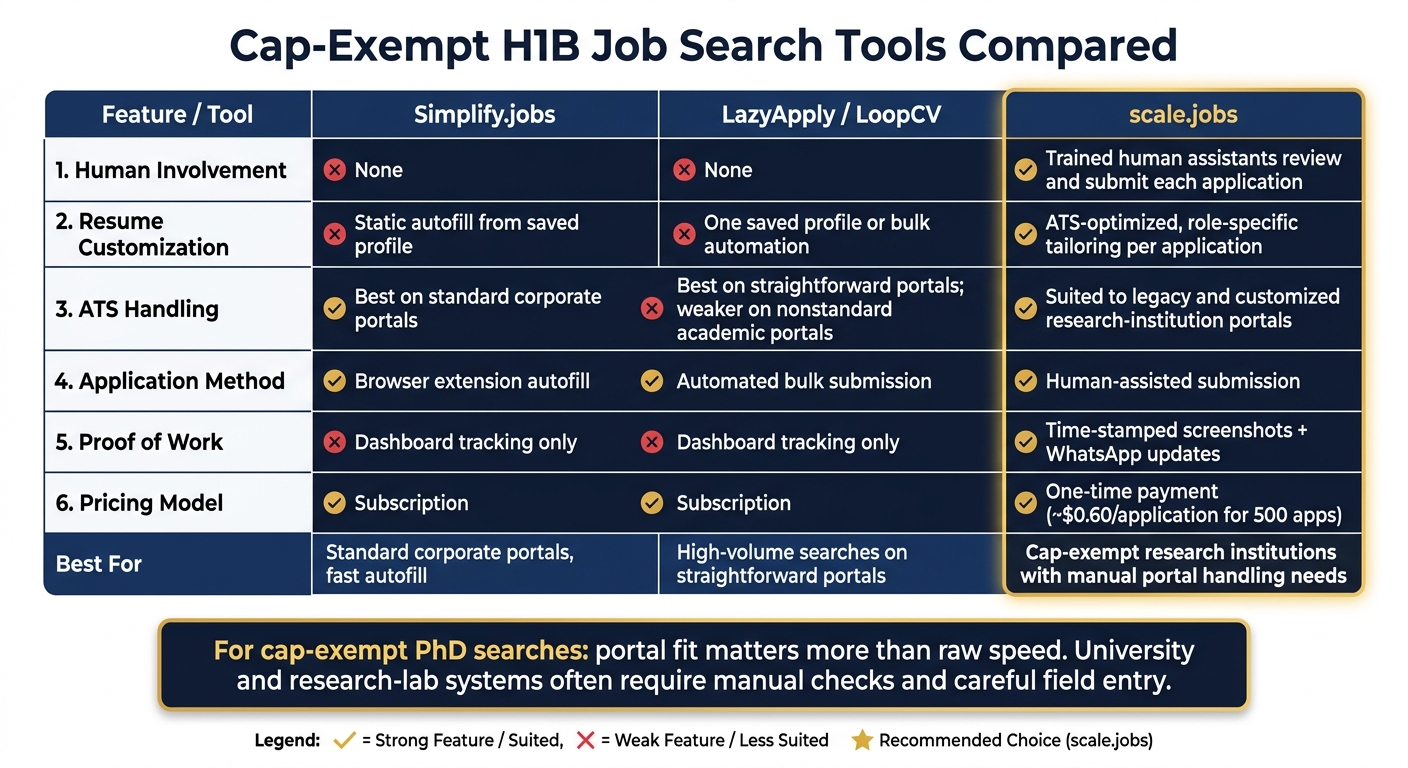
Cap-Exempt H1B Job Search Tools: scale.jobs vs Simplify vs LazyApply vs LoopCV
For cap-exempt PhD searches, portal fit matters more than raw speed. Tools like Simplify.jobs, LazyApply, and LoopCV can save time on clean, structured portals. But university and research-lab systems are often a different beast. They tend to need manual checks, careful field entry, and the right document in the right place.
Simplify.jobs vs scale.jobs: when autofill works and when human-powered apply is safer
Simplify.jobs works best on standard corporate ATS platforms. If you're trying to apply for jobs across structured company portals, its autofill can cut a lot of repeated typing.
Where it starts to struggle is in academic and research-institution portals. That gap gets bigger on older university systems, where autofill alone often doesn't get the job done.
Why scale.jobs fits better here
- Human assistants submit each application by hand, which tends to work better on messy academic and research portals.
- Documents are ATS-optimized and tailored to the role, instead of being pulled from one saved profile.
- Time-stamped proof-of-work screenshots show what was submitted, and WhatsApp updates make follow-up easier.
LazyApply and LoopCV vs scale.jobs: automation speed versus accuracy on research institution portals
LazyApply and LoopCV are built for volume on straightforward portals. If your focus is bulk outreach through standard systems, they can fit that workflow well.
For cap-exempt PhD searches, the tradeoff shifts. Research-institution portals often run on older systems or heavily customized ATS setups. Those are exactly the places where automation can miss small but costly details that a human reviewer would catch. In plain English: the issue isn't just speed. It's who checks the portal before submission, and what proof you get after it's done.
Why scale.jobs fits better here
- Human assistants review the portal before submission instead of relying on automation to guess the fields.
- ATS-optimized resumes and tailored documents are prepared for each role.
- Proof-of-work screenshots and WhatsApp support make status checks much easier to verify.
Those differences stand out most in human review, ATS handling, and submission visibility.
| Feature | Simplify.jobs | LazyApply / LoopCV | scale.jobs |
|---|---|---|---|
| Human involvement | None | None | Trained human assistants review and submit each application |
| Resume customization depth | Static autofill from your profile | One saved profile or bulk automation | ATS-optimized, role-specific tailoring |
| ATS handling | Best on standard corporate portals | Best on straightforward portals; weaker on nonstandard academic portals | Often better suited to legacy and customized research-institution portals |
| Application execution method | Browser extension autofill | Automated bulk submission | Human-assisted submission |
| Transparency and proof of work | Dashboard tracking | Dashboard tracking | Time-stamped screenshots + WhatsApp updates |
| Pricing model | Subscription | Subscription | One-time payment |
If you're comparing a job search platform for cap-exempt roles, this is the part that matters most: does the tool match the portal you're using?
Decision Summary
- Choose Simplify.jobs for standard corporate portals and fast browser autofill.
- Choose LazyApply or LoopCV for high-volume searches across straightforward portals.
- Choose scale.jobs for cap-exempt research institutions where manual portal handling and submission proof matter.
Who should use these tools, and who should choose scale.jobs
Who should use Simplify.jobs: Job seekers applying mainly to standard corporate portals where autofill saves time.
Who should use LazyApply or LoopCV: Applicants aiming for volume across straightforward portals.
Who should choose scale.jobs: F-1/OPT PhD candidates targeting cap-exempt research institutions where manual field entry, tailored documents, and proof-of-work visibility matter.
This is also where a Virtual Assistant for Job Applications can make more sense than browser-led automation. On older portals, a human pair of eyes often saves you from avoidable mistakes.
Switch to scale.jobs if:
- You are applying to universities, affiliated nonprofits, or government labs with nonstandard portals
- Your applications require manual field entry and careful document placement
- Your 90-day OPT unemployment window leaves little room for rework or resubmission
If that sounds like your situation, a job application service or job search virtual assistant is usually the safer route than pure automation.
A practical application workflow for cap-exempt PhD jobs
Once your cap-exempt shortlist is verified, shift from research to execution.
Find and Prep: build your cap-exempt institution list and tailor documents fast
Start by sorting your target list into four institution categories: universities, affiliated nonprofits, nonprofit research organizations, and government research organizations. Inside each group, move university research centers and government labs in your field to the top.
Build the list by institution type first. Then search the matching career portals. That keeps your process clean and cuts down on random searching.
If you're using a job search platform, this is the stage where structure matters most. You don't want a messy spreadsheet and five browser tabs fighting for your attention. You want a short, checked list of places that can actually hire you under cap-exempt rules.
On the document side, prepare separate ATS-friendly resumes for postdoc, research scientist, and lab roles. Each version should mirror the wording in that role's job description. A postdoc resume usually leans more on publications, methods, and advisor-led work. A research scientist resume may need more focus on independent projects, cross-team work, and grants. Lab roles often need clearer skills sections and tool-specific language.
If you're short on time, tools like an ai resume builder and ai cover letter builder can help you turn one base draft into role-specific versions much faster.
After the documents are ready, the main risk becomes speed without errors.
Apply and Track: keep application volume high without losing accuracy or missing deadlines
With the list and documents in place, the next step is submission volume and tracking.
The timing is unforgiving. A 90-day OPT clock and 300 to 800 applications leave little room for a slow workflow. On OPT, speed matters because delays burn through your unemployment allowance.
Use one workflow: Find = verified cap-exempt employers, Prep = role-specific documents, Apply = human-handled submissions, Track = proof and confirmation.
That’s where a job application service can help. Instead of bouncing between portals and losing track of what went where, you keep one system for submissions, confirmations, and follow-up status.
scale.jobs maps directly onto that pipeline. Human-submitted applications, timestamped confirmation, and WhatsApp updates keep every stage visible. The Standard plan costs $299 for 500 applications, or about $0.60 per application. The Free Trial Plan gives you the first 5 applications at no cost - a fast way to test whether the workflow fits before committing.
For PhD applicants trying to Apply for jobs at volume, that kind of setup solves a plain problem: how do you move fast without making avoidable mistakes?
If you’ve looked at a virtual assistant for job seekers or a Virtual Assistant for Job Applications, the same question applies here. Can the workflow help you send more applications without losing control of quality? In this case, the pitch is simple: verified targets, role-matched documents, human submission, and proof after each apply.
Once your shortlist is verified, the next bottleneck is submitting accurately at scale.