
Day 1 CPT vs OPT: Which Should International Students Choose

Sarah Mitchell
July 29, 2026

If I had to answer this in one line: pick Day 1 CPT if you need to work at the start of a new program; pick OPT if you want the usual post-graduation work path.
Here’s the short version:
- Day 1 CPT fits students who need off-campus work right away
- OPT fits students who want to work after graduation
- Day 1 CPT often has more school rules and more status risk
- OPT often gives more room to change employers after approval
- Your choice affects when you can Apply for jobs, how you explain your status to recruiters, and how fast you can accept offers
A timing mistake can cost you weeks. In some hiring cycles, that can mean missing fixed start dates for full-time roles.
⚠️ STEM OPT STUDENTS MUST AVOID DAY 1 CPT
sbb-itb-564272e
Quick comparison
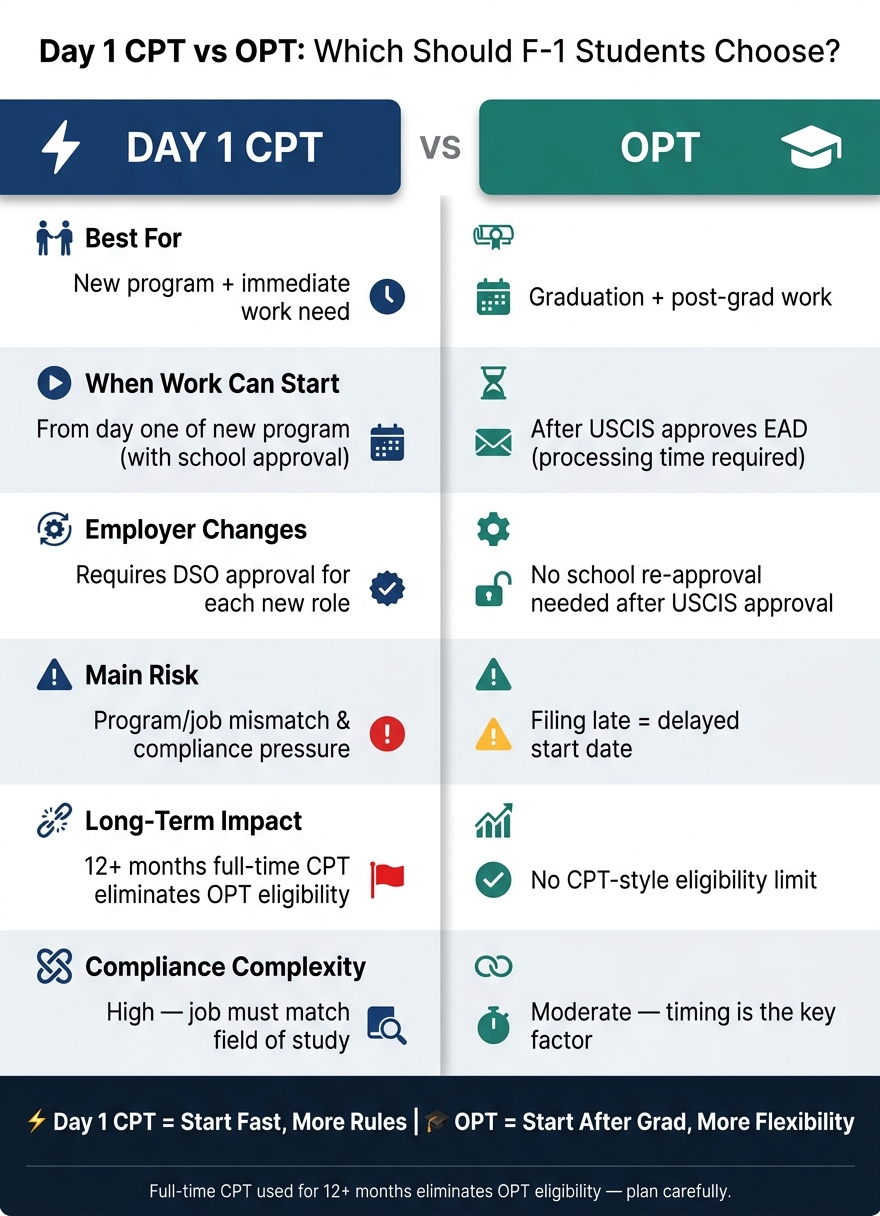
Day 1 CPT vs OPT: Side-by-Side Comparison for F-1 Students
| Factor | Day 1 CPT | OPT |
|---|---|---|
| Best for | New program + immediate work need | Graduation + post-grad work |
| When work can start | With school approval tied to program timing | After OPT approval and EAD receipt |
| Employer changes | More school involvement | Less school involvement after approval |
| Main risk | Program/job mismatch and CPT compliance | Filing late and EAD delays |
| Long-term impact | 12+ months full-time CPT can end OPT eligibility | No matching CPT-style limit |
If I were planning my search, I’d decide my visa path first, then pick the right workflow: DIY tools, a job search platform, or a job application service with human review.
Day 1 CPT: best when you need work authorization from the start of a new program
Choose Day 1 CPT when you need off-campus work authorization during a new academic program, not after graduation.
How Day 1 CPT affects your job-search timing
A student starting a master's program in September might begin interviewing in July, get an offer in August, and need CPT authorization tied to the term start before their first day of work. That creates a tight window. Employer talks, offer letters, and school approval often have to move at the same time.
If you're trying to Apply for jobs on that kind of schedule, timing matters a lot. A delay from the school, a late offer letter, or missing paperwork can push back your start date.
That faster path can help with immediate hiring. But it can also shrink your choices later.
Day 1 CPT tradeoffs that limit future flexibility
Here are the main tradeoffs:
- Program restrictions: Not every program qualifies. The degree structure must support CPT as an academic requirement.
- Administrative friction: Authorization needs school approval before work begins, which adds a processing step for each new role or employer change.
- Academic relevance: The job must match the program's field of study as documented by the school.
- OPT eligibility impact: Using 12 or more months of full-time CPT removes OPT eligibility entirely, which cuts off a major post-graduation path.
That means approval depends on school policy, program structure, and documented academic relevance. In plain English: even if an employer wants to hire you, the school still has to sign off first.
This is one reason some students use a job search coach or a Virtual Assistant for Job Applications when timelines are tight. It helps to keep interviews, documents, and school steps from slipping through the cracks.
For students whose search starts after graduation, OPT usually gives more employer flexibility. If you do not need work authorization until after graduation, OPT is usually the simpler route.
OPT: the standard post-graduation work route for most F-1 students
If Day 1 CPT works best for students who need to work while starting a new program, OPT is usually the cleaner route for students who are about to finish school. Put simply: Day 1 CPT helps with the start now issue, while OPT fits the start after graduation timeline.
This matters a lot during hiring season. A student graduating in May and interviewing in March usually needs a work path that lines up with post-grad recruiting. With OPT, they can apply during their final semester, accept an offer, and begin work after graduation once their Employment Authorization Document, or EAD, arrives. Timing is a big deal here, so file as early as you can in that last semester. A delay in processing can push back your start date.
If you're getting ready to apply for jobs, OPT often gives you a cleaner story to share with recruiters and HR teams. It also tends to work well for students targeting full time jobs right after graduation.
OPT advantages for long-term employer flexibility
OPT is often easier to use after graduation because it gives you more room to move during your job search and early career steps.
- Broader employer acceptance: Most employers already know OPT and standard EAD documents. That usually means less back-and-forth during onboarding.
- Less school-level approval than Day 1 CPT: Once USCIS approves your OPT application, you can change employers without going back to your DSO for each new role.
- Better fit for post-grad job searches: OPT gives you more freedom to switch employers after graduation than Day 1 CPT. That can help if you're comparing offers, handling a counteroffer, or changing roles a few months after finishing your degree.
This is one reason many students use OPT alongside tools like a job search platform, a job application service, or a job search coach when they want a smoother post-grad search.
That difference in timing and employer flexibility matters most in the side-by-side comparison below.
Day 1 CPT vs OPT: direct comparison across timing, flexibility, and risk
At this point, the choice usually comes down to timing, employer flexibility, and how much paperwork risk you're willing to carry.
If you're trying to Apply for jobs with a tight start-date window, this comparison matters a lot. A path that looks fine on paper can fall apart fast if the employer wants you to start in two weeks and your work authorization isn't lined up.
Here’s the direct side-by-side view:
- Start-date speed: Day 1 CPT can allow work from the first day of a new program. OPT requires USCIS to issue an EAD before you can start, which means extra processing time after filing.
- School approval steps: Day 1 CPT needs DSO approval before each new role or employer change. OPT does not require school re-approval every time you move to a new employer after USCIS approves the application.
- Employer movement: OPT gives you more room to switch employers, compare offers, or change roles without going back to your school for each move. Day 1 CPT ties each role to academic relevance and school approval.
- Compliance risk: Day 1 CPT carries more compliance pressure. The job must match your field of study, and the program must support CPT as an academic requirement. With OPT, the main risk is timing. File late, and your start date may slide.
- Impact on future options: Using full-time CPT for 12 months or more wipes out OPT eligibility. OPT does not have a matching limit tied to CPT use.
If you need immediate off-campus work during a new program, Day 1 CPT can fit. But that only works if the program qualifies and the job lines up with your field of study.
For post-completion hiring, OPT is usually the cleaner route. It asks for less back-and-forth with your school and is more familiar to employers and HR teams. That matters when you're using a job search platform or talking to recruiters who want a simple answer to, “When can you start?”
A short caution here: Day 1 CPT can create a serious status problem if the role does not clearly connect to your program. That gap doesn't just affect one job. It can affect your full visa record. On the OPT side, the most common avoidable mistake is waiting too long to file during your final semester. Processing delays are common, and they can push your start date back by weeks.
In plain English: Day 1 CPT is faster up front but needs tighter school and job alignment. OPT is slower at the start but easier to manage once approved.
This is also where job-search planning starts to shift. If you're on OPT, timing your applications around EAD approval is key. If you're on Day 1 CPT, you need to screen roles more carefully before you apply. A job search coach or job application service can help here, especially when every application needs to match your visa timeline.
For students trying to manage deadlines, employer follow-ups, and paperwork at once, a Virtual Assistant for Job Applications can save time by keeping the search organized without losing track of status-sensitive details.
That same timing gap also affects which job-search tools make the most sense.
Job-search tools for F-1 students: scale.jobs vs LazyApply, Jobscan, and Teal
Once your work authorization path is set, the next choice is simple: do you need automation, tracking, or someone to handle the work for you?
For F-1 students, this isn’t just a software pick. It’s a workflow choice. The big issue is whether a tool can protect visa details and keep proof of what was submitted. If a platform can’t do that, it can create extra risk at the worst time.
If you're trying to Apply for jobs while managing school, deadlines, and status rules, the right setup can save hours and cut down avoidable mistakes.
LazyApply vs scale.jobs: switching from bot-driven volume to human-powered applications
LazyApply is built for speed and volume. That sounds good on paper. But for students on Day 1 CPT or OPT, speed can turn into a problem.
A tool can be fast and still be the wrong fit. If it can’t account for work authorization dates, visa status details, or timing, small mistakes can spread across dozens of applications before you even spot them. Automated submissions don’t stop and ask, “Is this date right?” or “Does this role line up with your current status?” They just keep going.
scale.jobs takes the opposite path. Instead of pushing out mass applications through bots, it uses human assistants to review and submit each one. That matters when a single form field can affect how an employer reads your eligibility.
Why scale.jobs wins here
- Human assistants check work authorization details and tailor each submission to the role
- WhatsApp support makes it easier to coordinate during an active search
- Proof-of-work screenshots show what was submitted and when
- A flat one-time fee replaces a recurring subscription
If you want less automation and more control, a job application service like scale.jobs fits that need better than a volume bot.
Jobscan and Teal vs scale.jobs: switching from DIY optimization to managed application execution
Jobscan is useful for ATS keyword scoring. It helps you spot resume gaps before you apply. Teal helps you track openings and manage your pipeline. Both can help you get organized.
But here’s the catch: they mostly stop at guidance.
They can show you what to fix, but you still have to make the edits, log in to each employer portal, fill out every form, and submit each application yourself. That’s a lot of manual work. And if you’re juggling classes, visa deadlines, and interviews, that work stacks up fast.
scale.jobs handles the submission layer. Human assistants submit across many portals, ATS-optimized documents are tailored for each posting, and proof-of-work screenshots plus WhatsApp updates show what was actually sent. That’s the difference between “here’s what you should do” and “it’s done.”
If you’ve been using a job search platform or tracker and still feel buried in application tasks, this is usually the point where managed help starts to make sense.
Why scale.jobs wins here
- It goes past ATS scoring and handles the applications
- It submits across many portals instead of leaving the manual work to you
- Proof-of-work screenshots and WhatsApp updates make the process easier to verify
- A one-time flat-fee model avoids monthly subscription costs
The contrast is easier to see when you look at people, submission, and proof of work side by side.
| Feature | scale.jobs | LazyApply | Jobscan / Teal |
|---|---|---|---|
| Human Involvement | High - trained human assistants | Low - automated submissions | Low - DIY software |
| Resume Customization | Deep - tailored per role | Low - volume-focused | High - DIY optimization |
| ATS Handling | Managed execution with ATS-optimized docs | Automated submission | Scoring and keyword guidance |
| Application Method | Submitted by hand | Automated submissions | Manual - user-executed |
| Transparency & Proof of Work | Screenshots + WhatsApp updates | Limited | User dashboard |
| Pricing Model | One-time / flat-fee bundles | Subscription | Subscription |
Who should use each tool
Use the table above to match the tool to the way you search.
Use LazyApply if you want high-volume submissions for non-specialized roles.
Use Jobscan or Teal if you like a DIY setup and want to improve resume keywords before applying.
Choose scale.jobs if you want human-reviewed submissions that line up with your visa timeline.
For Day 1 CPT, tools with human oversight are usually the safer pick. For OPT, tools that cut manual submission time can make a big difference during the hunt for full time jobs.
This also comes down to the kind of help you want. Some people need software. Some need execution. If you're looking for a virtual assistant for job seekers or a Virtual Assistant for Job Applications, scale.jobs sits in that second camp.
Switch to scale.jobs if…
- You want human oversight on every application instead of automated submissions that can miss details
- You need ATS-optimized documents plus someone to submit them
- You prefer a one-time flat fee over monthly subscriptions during a longer search
- You want proof-of-work screenshots so you can verify what was submitted
- You want to test the service first - the first 5 applications are free
If you've already tried tools that score resumes or track applications, but you're still doing all the labor yourself, moving to a job search virtual assistant can be the next logical step.
Decision summary: when to choose Day 1 CPT, when to choose OPT, and which tools support each path
Day 1 CPT makes sense for students who are starting a new qualifying program and need off-campus work authorization right away. If you have an offer that requires an immediate start, this is often the path that fits. The catch is simple: you’ll face tighter compliance checks and more paperwork, so the process needs close attention.
OPT is the standard post-graduation route. U.S. employers know it well, and it’s usually the better choice if you don’t need to work before graduation. If your plan is to finish school first and then start working, OPT is often the cleaner option.
At this point, the choice usually comes down to your date and your workflow. Check your eligibility, line up your Apply for jobs plan with either your program start date or your graduation date, and then use a process that matches that timeline.
Day 1 CPT usually needs more human review because the job must line up with program rules. OPT is often easier to move on once the EAD is approved, especially if speed matters. If you’ve already improved your resume with an ai resume builder and you’re still sending applications on your own, it may be time to use scale.jobs for managed document prep and application execution.
Use the table below to match your status to the right path and support option.
| Situation | Best fit |
|---|---|
| Need to work from day one of a new program | Day 1 CPT |
| Graduating and want post-completion authorization | OPT |
| Want human oversight on applications | scale.jobs |
| Need faster submission execution after EAD approval | scale.jobs |
Once your visa path is clear, the next step is just workflow. Pick the visa route first, then match it with the right job application service or job search platform for your timeline.
FAQs
How do I know if Day 1 CPT is worth the risk for my situation?
Check that you’re enrolled in a bona fide, accredited degree program where CPT is built into the curriculum. It should support the academic program, not act as the school’s main pitch. You should also confirm that your school has a steady SEVP certification record and no enforcement problems.
There’s another limit that matters a lot: keep full-time CPT under 12 months if you want to preserve OPT eligibility. It’s also smart to have an independent immigration attorney review your I-20 and the school’s CPT policy in writing. If you skip that step, scrutiny can be higher later on, especially when H-1B questions come up.
Can I switch from Day 1 CPT to OPT later?
Yes - if you have not used 12 months or more of full-time CPT at the same degree level. Once you hit that mark, you become permanently ineligible for post-completion OPT and the 24-month STEM extension.
Part-time CPT (20 hours per week or less) does not count toward that limit. That’s why many students treat Day 1 CPT as a short-term stopgap when they want to protect OPT later.
What should I ask my school before choosing Day 1 CPT or OPT?
Before you pick a work authorization path, talk to your school’s international student office and get clear answers on a few points.
Ask which CPT programs they offer and whether those programs sit inside an accredited degree program with coursework that goes beyond the internship itself. That matters because CPT isn’t supposed to stand alone.
You should also ask about the school’s SEVP track record. Has the school kept a solid certification history? Any recent enforcement actions? This is the kind of detail people often skip, but it can come back to bite later.
Next, ask whether the school can show that CPT is a required, built-in part of the curriculum. In plain English, the training should be tied to your program, not treated like a side add-on.
Last, get a clear explanation of how full-time CPT is tracked. You don’t want to misread the rules and accidentally lose your post-completion OPT eligibility. A small paperwork mistake here can turn into a big problem later.