
What Immigration Attorneys Want Every OPT Student to Know

Sarah Mitchell
April 28, 2026

Navigating the OPT process is challenging but manageable with the right strategies. Here’s what every F-1 visa holder on OPT needs to know:
- Unemployment Limits: Post-completion OPT allows a maximum of 90 unemployment days, while STEM OPT extends this to 150 cumulative days over 36 months.
- STEM OPT Requirements: Ensure your employer participates in E-Verify and file the required Form I-983 for compliance.
- Resume Clarity: Clearly state your work authorization (e.g., "F-1 OPT valid through April 2027") to avoid rejection by Applicant Tracking Systems (ATS) or recruiters.
- Application Timing: File your OPT application within 90 days before your program ends or up to 60 days after. For STEM OPT, apply before your current OPT expires.
- Compliance Reporting: Report any changes in your address, job, or employer details within 10 days to maintain your F-1 status.
To succeed, focus on compliance, start your job search early, and consider professional support like Scale.jobs for ATS-friendly resumes and tailored guidance.
Quick Comparison: Jobscan vs Scale.jobs
| Feature | Jobscan | Scale.jobs |
|---|---|---|
| Human Assistance | Automated analysis only | Dedicated human support |
| Resume Customization | Limited suggestions | Fully customized, ATS-optimized |
| Pricing | Subscription-based | One-time payment |
| Application Management | Self-service tools | Managed application process |
For students juggling compliance and job applications, Scale.jobs offers a streamlined solution tailored to F-1 visa holders.
Next Steps for OPT Students
- Track Unemployment Days: Avoid exceeding the limits by securing employment or internships related to your field.
- File Early: Submit OPT or STEM OPT applications as soon as the filing window opens.
- Verify Employer Eligibility: Ensure your STEM OPT employer is enrolled in E-Verify.
- Plan Beyond OPT: Explore H-1B, O-1, or EB-2 visa options early to extend your stay.
For more help, consider using a job search virtual assistant to streamline your applications and ensure compliance.
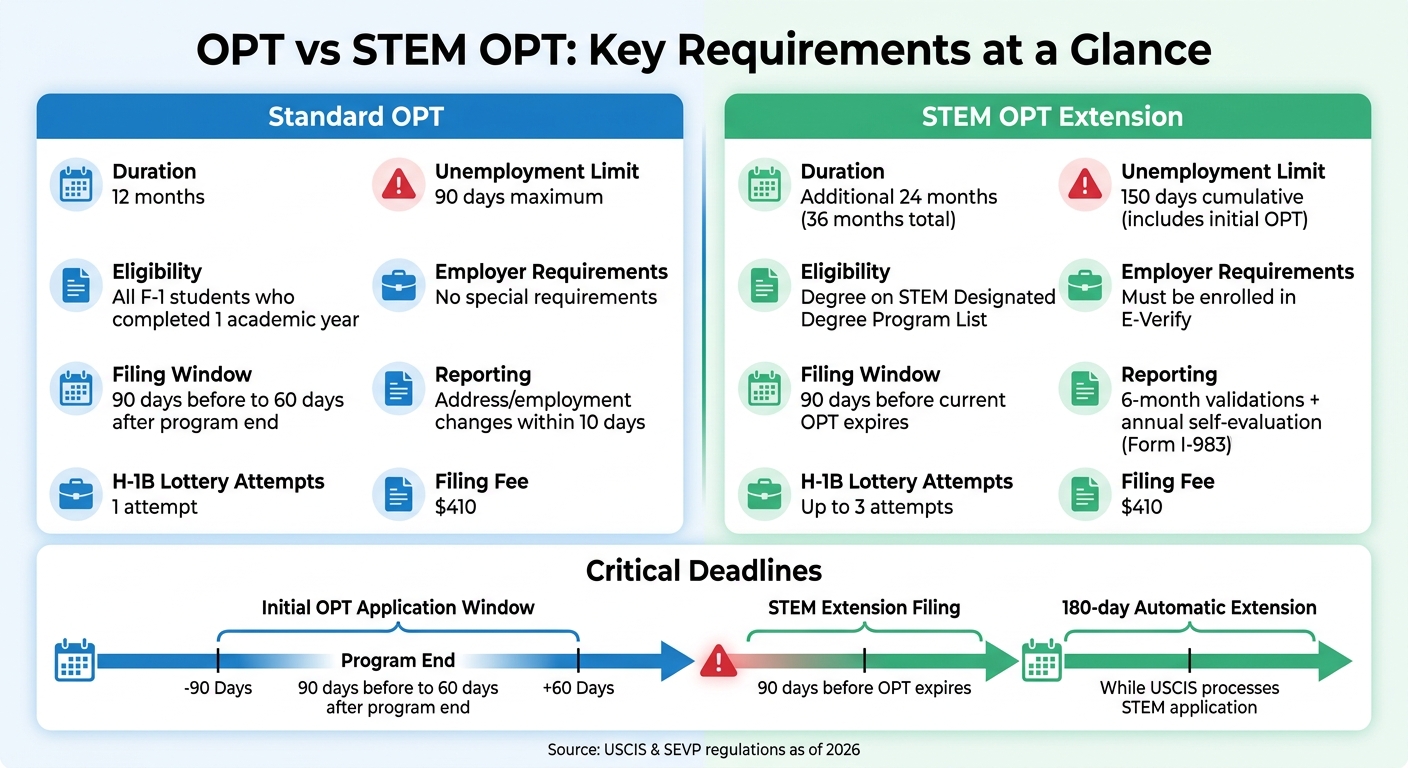
OPT vs STEM OPT Requirements Comparison for F-1 Students
OPT Basics: Rules and Who Qualifies
Who Qualifies for OPT
To be eligible for Optional Practical Training (OPT), you must maintain valid F-1 student status, remain physically present in the United States while filing your application, and complete at least one academic year at an SEVP-certified institution. Importantly, any work you engage in must directly relate to your major field of study and meet all documentation standards.
If you’ve used 12 months of full-time Curricular Practical Training (CPT), you won’t qualify for OPT at the same degree level. Additionally, students enrolled in English as a Second Language (ESL) programs are typically ineligible for OPT.
You are granted 12 months of OPT for each level of higher education you complete. For instance, you can utilize OPT after earning a Bachelor’s degree and again after completing a Master’s. During the 2023–2024 fiscal year, 163,452 international students participated in post-completion OPT, with 79,330 taking advantage of STEM OPT extensions. Keep in mind, standard OPT has a strict 90-day unemployment limit.
Curious about extending your work authorization? Let’s explore the STEM OPT extension next.
STEM OPT Extension: How It Works
If your degree is listed on the STEM Designated Degree Program List, you may qualify for a 24-month extension beyond your initial 12-month OPT period. This extension allows for up to 36 months of work authorization in total. However, your employer must be enrolled in and actively using the E-Verify system, so it’s crucial to confirm their status before applying.
STEM OPT comes with additional reporting responsibilities. You’ll need to submit Form I-983 (Training Plan) and provide updates to your Designated School Official every six months, along with an annual self-evaluation. The unemployment cap also increases to a cumulative 150 days over the entire 36 months, which includes any unemployment from your initial OPT period. If you file your STEM extension application on time, your work authorization automatically extends for 180 days while USCIS processes your request. The current filing fee for USCIS Form I-765 is $410 as of 2026.
A significant advantage of the STEM OPT extension is the opportunity to participate in the H-1B lottery up to three times, compared to just once with standard OPT. Need help ensuring your resume highlights your STEM qualifications? Consider using Scale.jobs' AI resume builder to make your credentials stand out to recruiters.
sbb-itb-564272e
How to Apply for OPT: Step-by-Step Process
Filing Your OPT Application with USCIS
The process begins with your school's Designated School Official (DSO). Your DSO must authorize your OPT request in the SEVIS system and issue an updated Form I-20 that includes their recommendation. Without this updated I-20, your application cannot proceed.
Once you receive the DSO-endorsed I-20, you’ll need to file Form I-765 (Application for Employment Authorization) with USCIS. Along with the form, include the $410 filing fee, a copy of your valid passport, any previous EAD cards (if applicable), and proof of payment. Keep in mind, USCIS only accepts paper filings for this process - online filing is not an option.
Processing times generally range from 3 to 5 months. During this period, you are not allowed to begin working until you receive your Employment Authorization Document (EAD) card in the mail, even if you already have a job offer. Filing early is key. If you’re planning to apply for jobs while waiting for your EAD, consider using a job search virtual assistant to help you find opportunities suited for F-1 students with pending work authorization.
Following these steps ensures you maintain your F-1 status while adhering to the guidelines set by immigration experts. Once your application is ready, timing becomes the next critical element.
Application Deadlines and When to File
Timing is everything when it comes to filing your OPT application. You must submit your application within the 90 days before your program ends or no later than 60 days after the end date. Filing outside of this window will result in a denial.
Immigration experts strongly advise filing as early as possible - ideally, as soon as the 90-day window opens. This minimizes potential delays after graduation. Additionally, ensure your DSO’s SEVIS recommendation is still valid when you file.
| Application Phase | Earliest Filing Date | Latest Filing Date | Critical Requirement |
|---|---|---|---|
| Post-Completion OPT | 90 days before program end date | 60 days after program end date | DSO-updated I-20 must be valid |
| STEM OPT Extension | 90 days before initial OPT expires | Before current OPT expires | Employer must be enrolled in E-Verify |
For those applying for the STEM OPT extension, confirming your employer’s E-Verify enrollment is essential - it’s a strict requirement for the 24-month extension. Additionally, keep in mind that your unemployment period begins the day your EAD becomes active, so plan your job search accordingly to avoid exceeding the unemployment limit.
Staying Legal on OPT: Compliance and Reporting Rules
Unemployment Limits You Cannot Exceed
If you're on post-completion OPT, you have a maximum of 90 days of unemployment. Exceeding this limit will result in automatic termination of your SEVIS record and loss of F‑1 status. For students on the 24-month STEM OPT extension, an additional 60 unemployment days are allowed, giving you a total of 150 cumulative days across your entire OPT period.
Keep in mind that these days are cumulative - they don't reset when you change employers or move from initial OPT to the STEM extension. To stay on top of this, maintain a detailed log of your unemployment days. If you don't have a job and are nearing 60 days of unemployment, consider taking on a volunteer position or an unpaid internship related to your field of study. However, STEM OPT students generally cannot use this option, as their employment must meet specific criteria, including being with an E‑Verify-enrolled employer in a legitimate working relationship.
It's also important to note that USCIS and SEVP track unemployment days via the SEVIS database. Traveling outside the U.S. while unemployed or close to your unemployment limit can be risky, as re-entry often requires proof of employment or a pending job offer.
What Employers and Students Must Report
Compliance with reporting requirements is just as important as monitoring unemployment days. Both students and employers have responsibilities to ensure accurate reporting.
You must report any changes to your legal name, address, or employment details (such as employer name, location, job title, and work dates) within 10 days. Include a brief explanation of how your job duties relate to your field of study.
For STEM OPT students, the reporting requirements are even stricter. You are required to:
- Verify your SEVIS information with your DSO every six months.
- Submit an annual self-evaluation using Form I‑983 at the 12-month mark.
- File a final evaluation either at the 24-month mark or within 10 days of ending employment.
- Notify your DSO immediately of any material changes to your STEM OPT training plan, such as changes to your employer’s EIN, compensation, or work hours.
Employers of STEM OPT students must also report any termination or departure within five business days.
"Unauthorized work/employment is a serious violation of F-1 status, which can result in the loss of U.S. immigration status and jeopardize future U.S. immigration benefits." – MIT International Students Office
Be sure to schedule all required reports, including six-month validations and annual evaluations, to avoid status issues. Additionally, keep an eye on your email for the SEVP Portal activation link, which should arrive within seven days of your OPT start date (check your spam folder for an email from [email protected]).
Staying compliant not only protects your immigration status but also strengthens your professional profile. Accurate reporting reflects positively on your resume and enhances your job application strategy. For personalized support with compliance and job applications, scale.jobs offers tailored assistance, ATS-friendly documents, and transparent, one-time services.
Common OPT Mistakes and How to Avoid Them
Frequent Errors and What Happens When You Make Them
Navigating the OPT process can be tricky, and small mistakes can lead to big consequences - both for your compliance and your appeal to employers who prioritize clear work authorization.
One major pitfall is missing the STEM OPT filing window. You’re required to file within 90 days before your current OPT expires and no later than the expiration date itself. If your DSO’s recommendation in SEVIS lapses before you submit your application to USCIS, your application could be rejected, leaving you without valid work authorization.
Another frequent misstep involves how students present their work authorization on their resumes. Some mistakenly answer "no" to sponsorship questions or omit their OPT dates entirely, hoping to bypass early screenings. However, this strategy often backfires. As Resume Optimizer Pro emphasizes:
"Do not answer 'no' to the sponsorship question if you will need sponsorship later. An incorrect answer can be treated as misrepresentation."
To avoid being filtered out by recruiters or applicant tracking systems (ATS), make sure your resume explicitly lists your work authorization, such as: “F-1 OPT valid through April 2027.”
Mismanagement of the cap-gap period is another area where students stumble. Traveling internationally or switching employers during this period without proper authorization can compromise your status. Keep in mind that cap-gap protection doesn’t transfer automatically between employers. Each change requires updated documentation.
Lastly, some students mistakenly believe that an approved I-140 or pending PERM application automatically extends their F-1 status or work authorization. Unfortunately, it doesn’t. You must maintain valid OPT or another authorized status independently. Given that PERM processing times now exceed 500 calendar days, careful planning is essential.
Recognizing these errors is the first step toward protecting your status and ensuring a smooth employment journey.
Steps to Take Now to Stay Compliant
- File early within the 90-day window for STEM OPT: Submitting your application as soon as the window opens allows time to fix errors or respond to USCIS requests without risking your work authorization.
- Confirm your employer’s E-Verify enrollment: Before accepting a STEM OPT position, verify that your employer is enrolled in E-Verify. If they’re not, your employment may not meet OPT requirements, and the days worked could be counted as unemployment.
- Regularly check your SEVIS record: Use the SEVP Portal to audit your record frequently, rather than waiting for the six-month validation reminder. Ensure your address, employer details, and I-983 training plan are accurate. Outdated information can lead to status termination and re-entry issues.
- Reach out to your DSO for corrections: If you’ve missed a compliance step - like failing to complete a self-evaluation, failing to report an address change, or altering your job duties - contact your DSO immediately. As USCIS advises:
"If you feel that your EAD has been wrongfully terminated, would like to request reconsideration of the EAD termination, or if you have other questions, see your DSO."
Your DSO can assist in updating SEVIS and resolving errors before they escalate.
Balancing compliance with your job search can be challenging. Services like professional resume assistance can help you clearly present your work authorization and create an ATS-friendly resume, ensuring you avoid misrepresentation while standing out to employers.
How to Apply for the STEM OPT Extension | Complete 24-Month F-1 Guide
After OPT: H-1B and Other Visa Paths
Once you've ensured compliance with your OPT requirements, it's time to think about the next steps for extending your stay and career opportunities in the U.S.
Cap-Gap Extension for H-1B Applicants
If your employer files an H-1B petition while you're on OPT, you may qualify for a cap-gap extension. This extension allows you to legally remain in the U.S. until your H-1B status begins on October 1. Here’s how it works:
- Filed Before OPT EAD Expiration: Both your work authorization and legal status are extended through September 30.
- Filed During the 60-Day Grace Period: Only your legal status is extended, meaning you must stop working until October 1.
For cap-gap protection, your employer must request a Change of Status. However, some employers now prefer consular processing due to the new $100,000 Fraud Prevention and Detection Fee tied to Change of Status filings. If consular processing is chosen, you won’t qualify for cap-gap protection and must leave the U.S. before your OPT expires.
To confirm your cap-gap eligibility, request an updated I-20 from your Designated School Official (DSO) using the H-1B receipt notice (Form I-797). Keep in mind that if your H-1B petition is denied, rejected, revoked, or withdrawn, cap-gap protection ends immediately.
If the cap-gap extension doesn’t apply to you, don’t worry - there are other visa options to explore.
Other Visa Options Beyond H-1B
If the H-1B visa isn’t the right fit or doesn’t work out, there are other visa paths that might align with your career goals. Immigration experts often recommend starting the green card process - such as the EB-2 or EB-3 categories - early during your OPT period. This is especially important as PERM processing times now exceed 500 calendar days. As Arvian Immigration emphasizes:
"H-1B should be viewed as one possible bridge, not as the entire plan." – Arvian Immigration
Here are some alternative visa options to consider:
- O-1 Visa: Designed for individuals with extraordinary ability, this visa doesn’t involve a lottery. To qualify, you must meet at least three out of eight criteria, such as publishing research, earning a high salary, or gaining peer review experience. While on OPT, you can strengthen your O-1 profile by publishing papers, judging hackathons, or taking on roles like peer reviewer.
- EB-2 NIW (National Interest Waiver): If you hold an advanced degree, this path allows you to bypass the PERM process and self-petition, making it an attractive option for highly skilled professionals.
- L-1 Visa: If you work for a multinational company, you can transfer to an overseas branch for one year and then return to the U.S. on an L-1 visa, avoiding the H-1B lottery altogether.
- Cap-Exempt H-1B: By working for a university or nonprofit research institution, you can bypass the 85,000 annual H-1B cap.
The table below outlines some of the key visa pathways to help you determine the best option for your situation:
| Visa/Path | Key Requirement | Lottery/Cap? | Main Benefit |
|---|---|---|---|
| O-1 | Extraordinary ability (3 of 8 criteria) | No | Available year-round |
| EB-2 NIW | Advanced degree + National Interest | No | Avoids PERM recruitment |
| Cap-Exempt H-1B | Employment at University/Nonprofit | No | No annual cap |
| L-1 | 1 year at overseas branch | No | Avoids H-1B lottery |
| EB-2/EB-3 | Employer sponsorship + PERM | Subject to Visa Bulletin | Path to permanent residency |
If you’re interviewing with smaller companies that may not be familiar with OPT hiring protocols, take the time to explain that hiring an OPT student doesn’t require immediate sponsorship or legal filings. Just as Scale.jobs simplifies your job search with personalized support, navigating visa pathways requires careful planning and the right resources. Using professional resume services can also help you effectively present your work authorization and qualifications across job applications while ensuring compatibility with applicant tracking systems (ATS).
Conclusion: What OPT Students Should Do Next
Your OPT period is a crucial time to not only build your career but also to lay the groundwork for your long-term immigration plans. As immigration attorneys often emphasize, the H-1B visa should be seen as a stepping stone rather than the ultimate goal. With PERM processing times now stretching beyond 500 calendar days, waiting until the final months of your STEM OPT to start green card discussions with your employer could prove costly.
Drawing from the compliance and application strategies discussed earlier, here's how you can set yourself up for success during this critical phase.
scale.jobs vs Jobscan: Why OPT Students Should Consider Human-Powered Apply
Jobscan provides basic ATS analysis, but scale.jobs offers a more tailored solution designed to address the unique challenges OPT students face, especially when dealing with tight compliance timelines and competitive job markets:
- Human assistance ensures each application clearly communicates your work authorization and avoids raising sponsorship concerns.
- ATS-optimized documents explicitly highlight your OPT details (e.g., "F-1 OPT valid through April 2027") to prevent automatic rejections.
- Real-time WhatsApp support provides guidance for adjusting applications as you approach critical unemployment deadlines.
- Transparent pricing with a one-time payment model - no recurring subscription fees to strain your OPT budget.
- Managed application process that balances accuracy and volume without risking misrepresentation.
| Feature | Jobscan | scale.jobs |
|---|---|---|
| Human Involvement | Automated analysis only | Dedicated human assistants |
| Resume Customization Depth | Template suggestions | Fully customized, ATS-optimized documents |
| ATS Handling | Score-based feedback | Human-verified optimization |
| Application Execution Method | Self-service tools | Managed application process |
| Transparency and Proof of Work | Limited tracking | Full proof-of-work documentation |
| Pricing Model | Monthly subscription | One-time payment |
Why scale.jobs Stands Out for OPT Students
Switching to scale.jobs could make a difference if:
- You're nearing your 60-day unemployment limit and need to apply efficiently without sacrificing quality.
- Employers are rejecting your application due to unclear work authorization details on your resume.
- You need expert assistance explaining OPT to smaller companies unfamiliar with F-1 hiring protocols.
- You're juggling STEM OPT reporting requirements and can't afford time-consuming trial-and-error with automated tools.
- You want assurance that your applications meet both ATS standards and immigration compliance.
Your Next Steps
Stay vigilant about tracking unemployment days - 90 days for standard OPT and up to 150 cumulative days for STEM OPT. Even a single day over the limit can jeopardize your status. Make sure every job you accept meets the 20-hour weekly minimum and aligns with your field of study. If you're nearing the unemployment threshold, consider field-related volunteer roles to pause the clock.
Begin your STEM extension application as early as 90 days before your initial OPT expires, and verify that your employer is enrolled in E-Verify before accepting a job offer. If you're interviewing with smaller companies, reassure them that hiring you involves no immediate sponsorship costs for up to 36 months, providing a low-risk opportunity for them.
Prepare a backup plan before H-1B lottery results are announced in late March. Look into cap-exempt employers, such as universities and nonprofits, research O-1 visa eligibility, or consult an immigration attorney about EB-2 NIW pathways. If you need help refining your application materials during this process, using a job application service can ensure your work authorization and qualifications are presented clearly and effectively.
Lastly, seek legal advice before making any significant changes, such as promotions, relocations, or switching employers. As Quijano Law aptly puts it:
"The cost of getting it wrong - delays, denials, or having to start over - can be far higher than the cost of legal services."
Even minor missteps, like missed deadlines or unreported changes, can derail months of effort. By combining these compliance strategies with a reliable job search tool like scale.jobs, you can confidently navigate your OPT period and set yourself up for future success.
FAQs
What jobs count as OPT employment for my major?
For a job to qualify as OPT (Optional Practical Training) employment, it must be directly connected to your major field of study. This can include internships, volunteer work, part-time roles, or full-time jobs, provided they align with your academic background and require at least 20 hours of work per week. Students are responsible for clearly explaining how the job relates to their major, as this connection will be evaluated by their Designated School Official (DSO).
How do I track unemployment days if I change jobs?
To monitor unemployment days after switching jobs while on OPT, make sure to report any employment changes within 10 days using your SEVIS portal or by notifying your Designated School Official (DSO). Unemployment days generally stop counting once your previous job ends, as long as you report the change promptly. Maintain accurate records of employment start and end dates to stay within the 90-day unemployment limit. If you face any challenges or have concerns about compliance, consider seeking advice from an immigration attorney.
What should I do if I miss a SEVIS or I-983 reporting deadline?
If you miss a SEVIS or I-983 reporting deadline, reach out to your Designated School Official (DSO) right away. They can help update your records and ensure your SEVIS information is accurate. Collaborate with your DSO to resolve the issue promptly and protect your immigration status. Make it a priority to report any employment changes within 10 days to stay compliant and avoid risking your status. Never work without proper reporting, as it could lead to severe immigration consequences.